
Shrink Jeggings the Right Way: Legit Methods and Tips

What Are Jeggings? — The Stretch Denim Textile Explained
Yes — you can shrink jeggings. Wash them in a hot cycle at 60–90°C (140–194°F) in your washing machine, then dry on high heat at 80–90°C (176–194°F). This combination triggers the cotton fibers to relax and contract, producing 3–6% shrinkage in a single treatment. For targeted shrinkage on specific areas like the waistband or thighs, apply direct heat using an iron at 150–180°C (302–356°F) or a hair dryer at 80–100°C (176–212°F). Avoid exceeding 150°C sustained exposure, as this degrades the spandex component and permanently damages the fabric’s stretch recovery.
Critical Temperature Thresholds for Jeggings Shrinkage
40°C (104°F) — Start of accelerated elastane degradation; avoid for routine washing.
60–90°C (140–194°F) — Safe hot wash range for cotton shrinkage without damaging spandex.
100°C (212°F) — Boiling water; maximum shrinkage for cotton-dominant blends only.
150°C (302°F) — Spandex degradation threshold; sustained exposure causes permanent elastic failure.
200°C (392°F) — Complete spandex breakdown; fabric will lose all stretch recovery.
What Are Jeggings? — A Definition of the Stretch Denim Textile

Jeggings are a type of pants manufactured from a blend of cotton, spandex (elastane), and polyester fibers. This three-fiber construction gives jeggings their characteristic elasticity. Stretch denim—the base textile—typically contains up to 3% spandex by fiber weight, which provides up to 15% stretch recovery. The remaining composition is predominantly cotton (approximately 70–85%) with polyester (approximately 15–25%) accounting for durability and shape retention.
Fabric weight for jeggings typically falls in the 10–14 oz per square yard range (approximately 340–475 gsm), placing them in the medium-weight denim category. This GSM range strikes a balance between the lightweight feel of leggings and the structure of traditional jeans, making jeggings a popular fashion choice for women who want the comfort of leggings with the appearance of polished denim.
Why Jeggings Stretch Out — Understanding Elastic Fiber Fatigue
Jeggings lose their shape through three primary mechanisms. First, the spandex or elastane fibers—which provide the stretch recovery—degrade over time under repeated stress. Elastane fibers lose their resilience after 200–500 wearing cycles, causing the fabric to fail to return to its original dimensions. Second, washing in water above 40°C (104°F) accelerates elastane degradation and causes cotton fibers to swell and release tension, leading to permanent dimensional change. Third, prolonged sitting or standing in jeggings places sustained stress on the knee and seat areas, causing the fabric to permanently stretch in those zones.
Lower-quality jeggings with inadequate spandex content (below 2% by weight) are particularly susceptible to premature stretching. Fabrics with a GSM below 300 tend to lose structure faster than heavier alternatives.
Are Jeggings Shrinkable? — Yes, But the Extent Depends on Fiber Content
Yes—jeggings are shrinkable. The cotton component shrinks when exposed to heat and moisture through a process called fiber relaxation shrinkage. However, the spandex component is heat-sensitive: it degrades at temperatures above 200°C (392°F) and can lose elasticity permanently when subjected to temperatures above 150°C (302°F) for extended periods. This means controlled heat application is essential to avoid damaging the stretch performance of the fabric while still achieving measurable shrinkage in the cotton fibers.
The typical shrinkage achievable for a cotton-dominant jeggings fabric (70% cotton / 25% polyester / 5% spandex) is 3–8% in the width and 2–5% in the length after one hot wash and dry cycle. Multiple cycles can increase total shrinkage to 8–12%, though this risks damaging the elastane fibers.
How to Shrink Jeggings — Four Methods Ranked by Effectiveness
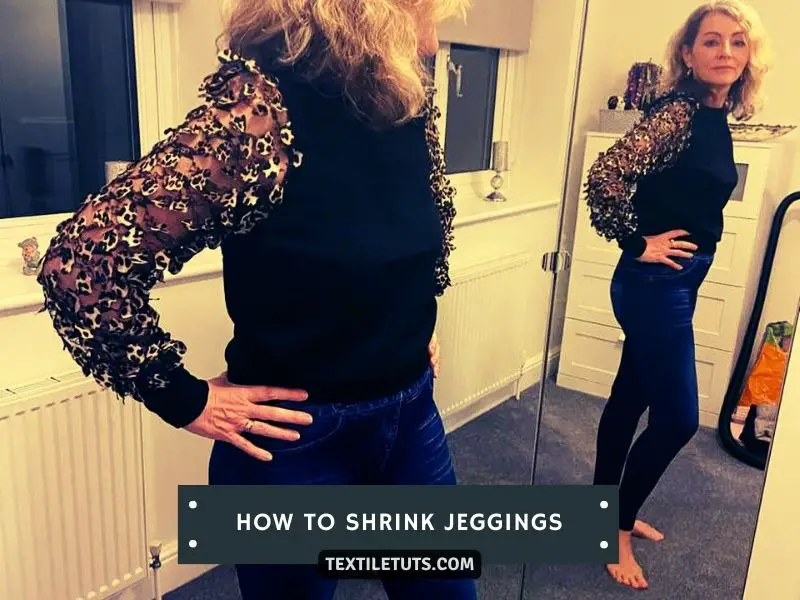
Four methods can shrink jeggings, ranging from full-machine treatment to targeted spot application. The table below compares these methods by shrinkage amount, risk level, and time required.
| Method | Temperature | Time | Shrinkage | Risk Level |
|---|---|---|---|---|
| Washing machine — hot cycle | 60–90°C (140–194°F) | 45–60 min | 3–6% | Low |
| Tumble dryer — high heat | 80–90°C (176–194°F) | 30–45 min | 2–4% | Low |
| Steam iron | 150–180°C (302–356°F) | 10–15 min | 1–3% | Medium |
| Hair dryer (targeted) | 80–100°C (176–212°F) | 15–20 min | 1–2% | Low |
Method 1: Using a Washing Machine
Steps
Place your jeggings in the washing machine alone. Adding other garments reduces heat transfer and dilutes the shrinkage effect.
Set the machine to a hot water cycle at 60–90°C (140–194°F). This temperature range triggers cotton fiber shrinkage while remaining below the 150°C threshold where spandex begins to degrade.
Transfer to the dryer and set to high heat (80–90°C / 176–194°F). Run a full 30–45 minute cycle. The combination of heat and tumbling amplifies the shrinkage effect.
Check your jeggings after 15 minutes. If they have not reached the desired size, run an additional 10–15 minute cycle. Do not exceed 60 minutes total dryer time to avoid over-shrinking.
Remove from the dryer and allow the fabric to cool to room temperature. Fabric dimensions stabilize fully once cooled, so measure before folding.
Method 2: Using an Iron
The iron method works best for jeggings that have only slightly stretched out. It allows for targeted heat application on specific areas such as the waistband or thighs without exposing the entire garment to high heat.
Steps
Dampen the jeggings evenly using a spray bottle set to a fine mist. The moisture activates the cotton shrinkage response when heated.
Set the iron to 150–180°C (302–356°F) — the setting labeled for synthetic blends or medium-high heat. Do not use the maximum temperature, which exceeds the spandex degradation threshold of 150°C sustained exposure.
Iron in smooth, overlapping strokes. Keep the iron moving — holding it in one spot for more than 5 seconds risks scorching the spandex-polyester blend surface.
Check the fit after 5 minutes of total ironing time. Target areas include the waistband and thighs. The shrinkage is gradual and controllable with this method.
Allow the fabric to cool completely on a flat surface before wearing or storing. The cotton fibers set their new dimensions once fully cooled.
Method 3: Using a Hair Dryer
This method is suitable for jeggings that are only slightly stretched. The hair dryer provides controlled, targeted heat without the aggressive shrinkage of a full wash-and-dry cycle.
Steps
Put on the jeggings to identify which areas have stretched the most. Common problem zones are the knees, seat, and waistband.
Set the hair dryer to its highest heat setting (typically 80–100°C / 176–212°F at the nozzle). Hold the dryer 10–15 cm (4–6 inches) from the stretched fabric area.
Move the dryer continuously across the target area in circular motions. Consistent movement prevents heat concentration that can scorch the polyester surface fibers.
Check the fit after 10 minutes of total heating time. The fabric should feel noticeably tighter. If further shrinkage is needed, continue for up to 20 minutes total.
Allow the fabric to cool while still wearing the jeggings for 5 minutes. The fabric will set its new dimensions as it cools, allowing you to assess the fit before removing them.
How to Shrink Jeggings in the Dryer — Standalone High-Heat Cycle
When skipping the wash, the dryer alone can still produce measurable shrinkage. This method is useful when the jeggings are clean but stretched. It relies entirely on sustained dry heat exposure to trigger cotton fiber relaxation.
Steps
Place the jeggings in the dryer alone. Overloading reduces heat circulation and produces uneven shrinkage.
Set the dryer to the highest heat setting (80–90°C / 176–194°F) and run a full 30-minute cycle. The sustained heat without moisture produces moderate shrinkage of approximately 2–4%.
Check the jeggings after 20 minutes. If additional shrinkage is needed, run a second 10–15 minute cycle. The dryer’s sustained tumbling motion helps distribute heat evenly across all fabric areas.
Remove from the dryer and allow to cool fully before trying them on. Fabric cooled in the dryer retains residual heat that continues the dimensional setting process.
How to Shrink Cotton Jeggings — Boiling Water Method
Cotton jeggings respond most aggressively to the boiling water method because the combination of maximum heat and full moisture saturation triggers the greatest cotton fiber shrinkage. This method achieves 4–8% shrinkage in a single treatment but carries the highest risk of damaging the spandex component.
The boiling water method is the most effective technique for achieving maximum shrinkage in cotton jeggings. However, it should only be used as a last resort when other methods have failed, and it is not suitable for jeggings with more than 5% spandex content.
Steps
Bring a pot of water to a rolling boil at 100°C (212°F) on a stovetop. Use a pot large enough to fully submerge the jeggings without crowding.
Carefully lower the jeggings into the boiling water using tongs. Maintain a rolling boil for 5–7 minutes. Extended boiling beyond 10 minutes increases the risk of damaging elastane fibers beyond recovery.
Remove the jeggings with tongs and transfer directly to the dryer on a high heat setting. Run a full 30–45 minute cycle. The rapid transition from boiling water to dry heat maximizes the shrinkage effect.
Check after 15 minutes in the dryer. If additional shrinkage is required, run a further 10–15 minute cycle. Total shrinkage from the boiling method typically plateaus at 6–8% after two dryer cycles.
Remove from the dryer once fully dry and allow to cool at room temperature. The cotton fibers reach their final stabilized dimensions only after cooling completely.
How to Shrink American Eagle Jeggings — Brand-Specific Considerations

American Eagle jeggings typically contain 71–77% cotton, 20–23% polyester, and 3–5% spandex. This composition is slightly higher in spandex than generic brands, which means the boiling water method carries a greater risk of elastane damage. The wash-and-dry method (Method 1) is the recommended starting approach for American Eagle jeggings.
Steps
Fill a pot with water and bring to a boil at 100°C (212°F). Ensure the pot can hold the jeggings without folding or creasing the fabric, which can cause uneven shrinkage.
Submerge the jeggings fully in the boiling water for 5–7 minutes. The higher spandex content in American Eagle jeggings means the shorter 5-minute soak is preferable to a full 7 minutes.
Transfer to the dryer on high heat for 30–45 minutes. The combination of the boiling soak and high-heat drying typically produces 5–8% shrinkage in American Eagle jeggings.
Check the fit after 15 minutes. American Eagle jeggings tend to shrink slightly more than generic blends due to their slightly higher cotton content, so monitor them carefully to avoid over-shrinking.
Allow the fabric to cool completely before wearing. American Eagle’s denim tends to have a slightly looser weave than premium denim, which means dimensions stabilize faster — typically within 10 minutes of cooling.
Jeggings Care and Maintenance — 5 Expert Recommendations
Proper care extends the life of jeggings and reduces the frequency of shrinkage treatments. Follow these five evidence-based practices to maintain the fit and fabric integrity of your stretch denim garments.
Frequently Asked Questions About Jeggings Shrinkage
Do jeggings shrink in the wash?
Yes — jeggings can shrink in the wash, particularly when washed in hot water (above 40°C / 104°F). To prevent unwanted shrinkage during routine care, wash in cold water at 30°C (86°F) or below on a gentle cycle and air-dry. The cotton component responds to heat and moisture, while the spandex degrades under sustained high temperatures.
How do you shrink the legs of jeggings?
To shrink the legs specifically, apply the hair dryer method (80–100°C / 176–212°F) directly to the thigh and knee areas while wearing the jeggings, or run the jeggings through a full hot wash and high-heat dry cycle for overall leg shrinkage. The tumble dryer method targets the entire garment rather than specific zones.
How tight should jeggings fit?
Jeggings should fit snugly enough to stay up without a belt but loosely enough to allow full movement. The ideal waistband tension allows two fingers to fit comfortably between the waistband and your waist. If you are between sizes, choose the larger size — jeggings that are too small accelerate elastane fatigue and can cause the fabric to bulge at seams.
Can you permanently shrink jeans?
No — cotton shrinkage is not permanently fixed. Repeated hot washing or drying will cause additional incremental shrinkage over time. However, the initial shrinkage from a single hot wash/dry cycle is the most significant (3–6%). Subsequent cycles produce diminishing returns of 0.5–1% per additional cycle. Heat-set shrinkage can be partially reversed by stretching the fabric while damp and allowing it to dry in the stretched state.
How do you keep jeggings from falling down?
Three solutions prevent jeggings from slipping: choose the correct size with a waistband that fits two fingers snugly; wear a thin belt for waistbands that stretch over the course of the day; and select jeggings with a higher elastane content (3–5%), which provides better recovery force to hold the waistband in place against gravity and body movement.
How do I make my jeans shorter?
To shorten jeggings without altering the inseam, use the boiling water method for maximum length shrinkage (2–5% reduction), or the hair dryer method for targeted adjustments of 1–2%. For a permanent hem, a tailor can cut and rehem jeggings — but note that cutting through the elastane content can cause the cut edge to curl, requiring a serger or zigzag stitch to finish the raw edge.
Do jeans shrink in the waist?
Yes — jeans shrink in the waist, particularly the waistband area, which absorbs the most heat during washing and drying cycles. A single hot wash and dry cycle typically produces 2–4% waist shrinkage for a cotton-dominant blend. The waistband tends to shrink more than the hip area due to its construction (often with interfacing or a different weave structure).
Is it better to buy jeans bigger or smaller?
For jeggings specifically, buying your true size is preferable. Unlike rigid denim, jeggings are designed to fit snugly — choosing a size up undermines the garment’s intended fit and support. Spandex-blend fabrics accommodate minor fluctuations through their elasticity, so there is no benefit to sizing up for future stretching, as it occurs in length and width, not stretch recovery.
Do all clothes shrink over time?
Not all fabrics shrink equally. Cotton, linen, and other cellulosic natural fibers shrink the most (3–8% on first hot wash). Polyester and nylon are heat-set during manufacturing and resist shrinkage. Blends like cotton-polyester-spandex (jeggings) shrink less than pure cotton because the polyester component does not absorb water or respond to heat the way cotton does. do clothes shrink over time depends on the fiber type, fabric construction, and care regimen — investing in high-quality garments with tighter weave construction (higher GSM) reduces long-term dimensional change.
Can I shrink a stretched t-shirt collar using jeggings methods?
Yes — the same principles apply to cotton t-shirt collars. Use a boiling water soak for 5–10 minutes followed by high-heat tumble drying. how to unstretch a t-shirt collar effectively relies on the cotton fiber relaxation response, which is identical to the mechanism used in jeggings shrinkage. T-shirt collars made with ribbed cotton knit may require multiple cycles to achieve visible results.
Will washing Lululemon leggings cause shrinkage?
Lululemon leggings are typically pre-shrunk during manufacturing using a heat-setting process. Most Lululemon styles (including Align, Wunder Under, and Fast and Free) are made from Lycra Nylon rather than cotton, so they do not respond to the cotton shrinkage mechanism. lululemon shrinkage in the wash is minimal to non-existent when care instructions are followed — cold wash and air-dry are sufficient to maintain their original fit.
Why GSM Matters When Shrinking Jeggings — Fabric Weight and Density
The GSM (grams per square meter) of a jeggings fabric is a primary indicator of how it will respond to shrinkage treatment. Higher GSM fabrics — those above 400 gsm — have a denser fiber matrix and tend to shrink less aggressively than lighter fabrics below 300 gsm. finding fabric GSM without cutter can be done by weighing a known area of fabric on a precision scale and calculating the weight per square meter. Understanding the GSM of your jeggings helps predict shrinkage outcomes and select the appropriate method: lighter fabrics respond faster to heat treatment but also over-shrink more easily, while heavier fabrics require more aggressive treatment to achieve the same result.
For jeggings with a GSM of 300–400 (the typical range for stretch denim), the wash-and-dry method produces 3–6% shrinkage in a single cycle. Fabrics below 300 gsm may shrink 6–10% and risk over-shrinking, while those above 400 gsm may show only 1–3% shrinkage per cycle and require multiple treatments.
Final Words — Restore the Fit of Your Stretch Denim
Shrinking stretched jeggings is straightforward when you apply the right combination of heat and moisture to the cotton fiber component. The washing machine method (hot wash + high heat dry) is the safest starting point, producing 3–6% shrinkage without risking spandex degradation. For more aggressive results, the boiling water method delivers 5–8% shrinkage in a single treatment but should be reserved for cotton-dominant blends with less than 5% spandex content.
The most important factor in long-term jeggings maintenance is consistent cold washing and air-drying. This care regimen preserves elastane elasticity for 200–500+ wearing cycles, compared to 50–100 cycles for jeggings regularly washed in hot water and tumble dried. If your jeggings have stretched beyond recovery, purchasing a new pair with a higher spandex content (3–5%) will provide better fit retention over the long term.
References
- Wikipedia. (2025). Denim. https://en.wikipedia.org/wiki/Denim
- Wikipedia. (2025). Spandex. https://en.wikipedia.org/wiki/Spandex


