
Parts of A Basic Shirt, Trouser, and Baseball Cap

Parts of a Shirt: Complete Guide to Shirt Components, Accessories, and Trimmings
A standard dress shirt is assembled from three categories of parts: primary structural components (body panels, collar, sleeves, cuffs, plackets), accessories used during manufacturing and retail (hangers, hangtags, polybags, collar stays), and trimmings incorporated into the garment itself (sewing thread, interlining, buttons, labels). A typical dress shirt contains between 18 and 22 individual pieces of fabric, plus the full trim package required to finish it to production standard. This guide provides a complete breakdown of every shirt component—from collar to hem—along with the accessories and trimmings used in modern shirt production.
Understanding shirt anatomy is essential for garment manufacturers, fashion students, pattern makers, and anyone involved in textile craftsmanship. Each of the four major garment types covered in this guide—shirts, trousers, baseball caps, and hoodies—follows distinct construction logic and requires a specific combination of components and trimmings.
Garment Construction Complexity: A Comparison
The following table compares the four garment types covered in this guide by their construction complexity, giving garment manufacturers and students a useful reference for production planning and quality benchmarking.
| Garment Type | Fabric Pieces (approx.) | Primary Structural Components | Key Trimmings |
|---|---|---|---|
| Dress Shirt | 18–22 | Collar, yoke, sleeves, cuffs, front/back body, placket, pocket, hem | Interlining, buttons (11–13 mm pearl), labels, collar stays |
| Dress Trouser | 8–15 | Waistband, fly, front/back panels, pockets, leg panels, hem | Zipper (#3 or #5 coil), waist button (19 mm), belt loops, rivets |
| Baseball Cap | 6–8 | 6 panels, bill/visor, sweatband, back strap, button, eyelets | Buckram interlining, rivets, embroidery motif, Velcro or snap adjuster |
| Hoodie | 10–15 | Hood panels (×2), sleeves, front/back body, waistband, pocket, zipper | Drawstring, aglets, 4–6 mm cord, zipper (#5 coil or plastic), label |
Components of a Shirt
A standard dress shirt consists of precisely engineered textile pieces sewn together according to standardized garment construction patterns. Each component serves a specific functional or aesthetic purpose. The following sections detail the primary structural elements found in conventional shirt manufacturing.
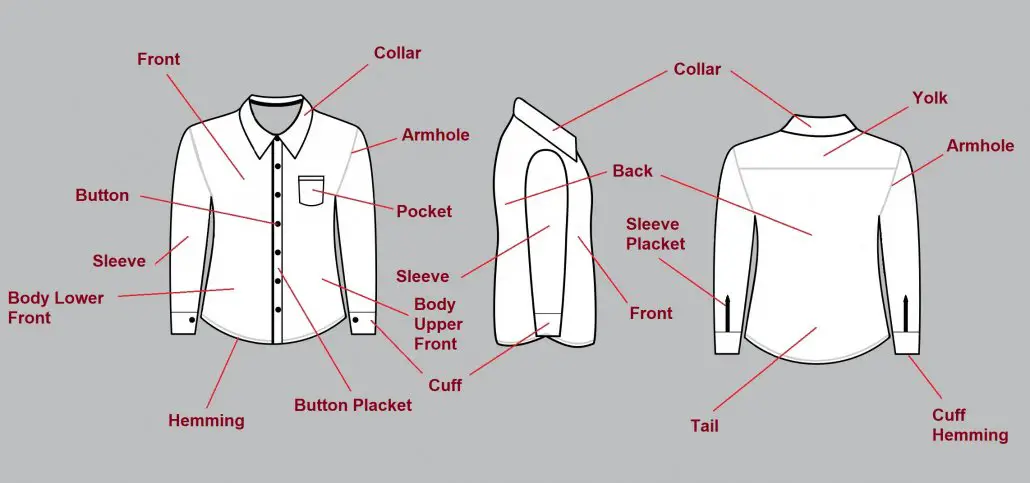
Primary Structural Parts
- Front Body (Lower Front) — The lower portion of the shirt face, typically extending from waist to hem. Cut on a bias grain to allow fabric drape over the body.
- Front Body (Upper Front) — The chest section above the waist, usually darted or princess-seamed for a tailored fit.
- Back — The rear panel of the shirt, often cut with center back pleats or darts to allow ease of movement.
- Yoke — The reinforced section across the shoulders that provides structural stability. Typically constructed from two pieces meeting at the center back.
- Collar — The folded fabric band around the neckline. Standard collar types include point collar (60–70° angle), spread collar (spanning 90–140°), button-down collar, and band collar. Collar height typically ranges from 1.5 inches (38 mm) for casual styles to 2 inches (51 mm) for formal expressions.
- Armhole (Scye) — The curved opening through which the sleeve attaches. Cut depth typically ranges from 7 to 10 inches (178–254 mm) measured from the shoulder seam.
- Sleeve — The arm-covering portion, segmented into upper sleeve, under sleeve, and sleeve cap. Standard sleeve length for a dress shirt is 24–25 inches (610–635 mm) from center back neck to wrist.
- Cuff — The finished band at the wrist. French cuff length is 2.5–3 inches (64–76 mm); barrel cuff is 1.25–1.5 inches (32–38 mm). Standard button count is 2 buttons for barrel cuffs and 4 buttons for French cuffs.
- Sleeve Placket — The vertical strip of fabric reinforcing the sleeve slit, typically 1 inch (25 mm) wide and running the full cuff length.
- Button Placket (Front Placket) — The reinforced strip on the shirt front where buttons are sewn. Standard placket width is 1.25–1.5 inches (32–38 mm).
- Pocket — The single chest pocket on dress shirts is positioned 1–1.5 inches (25–38 mm) below the sleeve seam and 4–5 inches (102–127 mm) from the center placket edge. Standard pocket dimensions are 4.5–5 inches (114–127 mm) wide by 5–5.5 inches (127–140 mm) deep.
- Hemming (Body Hem) — The finished lower edge of the shirt, typically turned up 1–1.5 inches (25–38 mm) and sewn with a clean finish or blind hem stitch.
- Cuff Hemming — The finished edge of the sleeve cuff, ensuring the lining does not fray.
- Tail — The extended back panel that ensures the shirt stays tucked in. Typically 1–2 inches (25–51 mm) longer at back than front.
Accessories Needed for Shirt Making
Shirt manufacturing requires a range of accessories beyond the main fabric pieces. These items are essential for finishing, packaging, and quality control in mass production environments.
- Hanger — Supports the finished garment during storage and retail display. Standard shirt hanger width is 15 inches (381 mm).
- Hangtag — Displays brand name, logo, and product information. Typically 2 × 3 inches (51 × 76 mm) in standard dimensions.
- Price tag — Shows retail price and SKU; attached at the hangtag or rear collar.
- Barcode tag — Carries UPC/EAN barcode for inventory and point-of-sale systems.
- Packaging poly (polybag) — Transparent polyethylene bag measuring 10 × 14 inches (254 × 356 mm) for standard shirt packaging.
- Neck board — Corrugated cardboard insert placed inside the collar neck opening to maintain shape during storage and transit.
- Backboard — Flat board inserted behind the shirt in retail packaging to prevent creasing; standard size is 14 × 18 inches (356 × 457 mm).
- Collar stan (collar stay butterfly) — Thin plastic or metal wire inserted into the collar point to maintain rigidity. Standard length is 2.5–3 inches (64–76 mm).
- Ballhead pin — Steel pin with a ball-shaped head used during the sewing process to hold fabric layers together before permanent seaming.
- Plastic clip — Spring-loaded clip used to attach the shirt to a hanging rack or during finishing processes.
- Plastic collar insert — Rigid or semi-rigid insert placed inside the collar stand to prevent collapse and maintain the rolled collar shape.
- Carton — Shipping container; standard garment carton dimensions are 20 × 24 × 2 inches (508 × 610 × 51 mm) for flat-packed shirts.
Trimmings Required for Shirt Construction
Trimmings are the consumable materials incorporated into the shirt during the manufacturing process. Each trimming serves a specific functional role in garment construction.
| Trimmming | Purpose | Specification |
|---|---|---|
| Sewing thread | Bears all seam stress; must match or exceed fabric strength | Standard ticket count is 40s–80s for dress shirts; polyester core spun or 100% polyester thread with 10–15 stitches per inch (SPI) |
| Lining | Provides opacity and comfort against skin, especially in the front placket and collar facing | typically 65% polyester / 35% cotton blend, 80–100 g/m² weight |
| Interlining | Reinforces collar, cuff, and placket areas; prevents wrinkling and maintains shape | Non-woven fusible is standard; weight ranges from 30–50 g/m²; thermal-bond or resin-bond type |
| Fusing material | Adhesive interlining activated by heat press (typically 120–150°C for 10–15 seconds) to bond collar and cuff facings | Release paper backing; coat weight 15–25 g/m² |
| Buttons | Functional closure; 4-hole or 2-hole pearl (mother-of-pearl) buttons are standard for dress shirts | Diameter: 11–13 mm (0.43–0.51 in) for standard dress shirts; 9–10 mm for junior sizes; thickness 1.5–2 mm |
| Labels (main, size, composition, care) | Legal compliance with fiber content, care instructions, and brand identification | Main label: 50 × 25 mm; size label: 25 × 15 mm; positioned at inner left side seam |
| Motif (embroidery/patch) | Decorative brand element typically placed at left chest or cuff | Standard chest motif: 2.5–4 inches (64–102 mm) width |
Additional decorative trimmings are used based on garment design requirements. Sewing thread ticket count directly affects seam strength and appearance; higher thread counts (80s, 100s) produce smoother, more durable seams in fine dress shirts. For Ladies’ wear and kidswear, decorative trimmings such as artificial flowers, piping, and printed tapes are commonly applied to collar and hem edges. Rivets are used at stress points for reinforcement and aesthetic enhancement. Extra pockets with placket finishes, and sometimes garment trimmings such as drawstrings for adjustable styling, are incorporated based on the garment model.
Hemming and collar areas are often finished with printed tapes for brand identification and decorative effect. The use of these trimmings varies by garment model and end-use; mass-market production typically standardizes trim packages, while premium and fashion garments incorporate customized trim selections.
Quick-Reference: Standard Shirt Measurement Specifications
| Measurement Point | Standard Value |
|---|---|
| Collar sizes | 14, 14.5, 15, 15.5, 16, 16.5, 17, 17.5 inches (356–445 mm) |
| Sleeve length (dress shirt) | 24–25 inches (610–635 mm) from center back |
| Body hem width | 20–24 inches (508–610 mm) at bottom edge |
| Placket width | 1.25–1.5 inches (32–38 mm) |
| Button spacing on placket | 3–3.5 inches (76–89 mm) between button centers |
| Armhole depth | 7–10 inches (178–254 mm) from shoulder seam |
| Pocket dimensions | 4.5–5 in wide × 5–5.5 in deep (114–127 × 127–140 mm) |
| Shirt body length (front) | 27–30 inches (686–762 mm) from shoulder to hem |
| Back length extension | 1–2 inches (25–51 mm) longer than front at hem |
Parts of a Trouser
Trousers are a fundamental garment category covering the lower body from waist to ankle. Modern trouser construction involves between 8 and 15 pattern pieces depending on the style. The following breakdown covers the primary structural components of standard dress trousers and casual trousers.
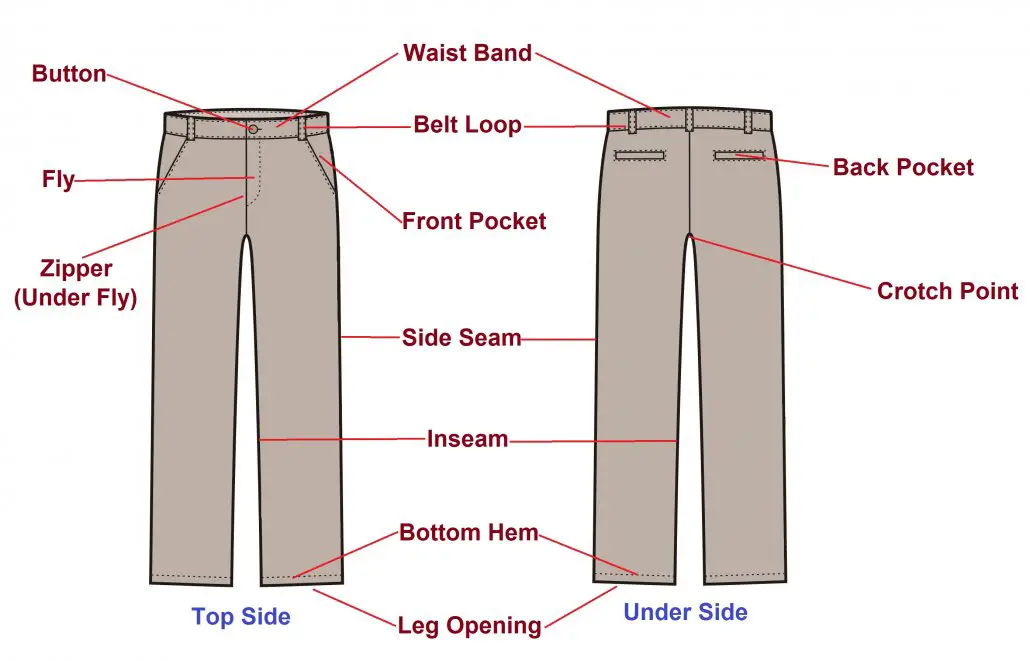
Trouser Structural Components
- Waistband — The reinforced top band that sits at the natural waist; typically 1–1.5 inches (25–38 mm) wide, constructed with interlining for shape retention.
- Belt Loop — Reinforced loops spaced 2.5–3 inches (64–76 mm) apart around the waistband to accept a belt; standard loop width is 1 inch (25 mm).
- Button — The primary waist closure; trouser buttons are typically 0.75 inches (19 mm) in diameter for standard dress trousers.
- Fly — The front opening panel. Standard fly construction uses a J-stitch configuration with a concealed button fly or zipper installation. Zipper fly lengths range from 4–6 inches (102–152 mm).
- Zipper — The closure mechanism in trouser flies. Standard trouser zipper chain gauge is #3 or #5 coil, with metal zippers used in premium dress trousers. Closed-front zippers with automatic locks are standard; zipper pull force should not exceed 3.5 N.
- Front Pocket — The curved seam pocket on each side of the front panel; opening width is typically 7–8 inches (178–203 mm) on men’s dress trousers.
- Back Pocket — Set-in pockets on the rear panel; welt pocket width is typically 5.5–6.5 inches (140–165 mm) on men’s dress trousers. Closed-back pockets are standard on dress trousers; patch pockets are used in casual chino styles.
- Side Seam — The outer leg seam running from waist to hem along the outseam.
- Inseam — The inner leg seam; standard inseam lengths range from 27 to 34 inches (686–864 mm) depending on trouser style and rise.
- Bottom Hem — The finished lower edge of the trouser leg; standard hem allowance is 1.5–2 inches (38–51 mm). Turn-of-cloth hem construction is standard for dress trousers.
- Leg Opening — The circumference at the bottom hem; slim-fit trousers typically have a leg opening of 14–16 inches (356–406 mm), while relaxed-fit trousers range from 17–20 inches (432–508 mm).
- Crotch Point — The lowest point where front and back panels meet; the crotch depth (distance from waist to crotch point) is a critical measurement that determines trouser fit and comfort.
Trouser Accessories
- Hanger — Trouser hanger with a crossbar prevents creasing; standard width matches trouser waist size.
- Hangtag — Displays brand and product details.
- Price tag and barcode tag — Retail and inventory identification.
- Belt — Woven or leather, 1–1.25 inches (25–32 mm) wide for standard trouser belt loops.
- Packaging poly — Polybag for individual garment packaging.
- Buckle — Prong, clip, or roller buckle depending on belt type; standard buckle width matches belt width.
- Silica gel sachet — Moisture-absorbing packet placed inside garment packaging to prevent mold and mildew during storage and transit; standard size is 25 × 40 mm.
- Carton — Garment shipping carton sized to accommodate flat-packed trousers.
Trouser Trimmings
- Sewing thread — 40s–60s cotton-polyester blend for standard trouser construction; seam strength must exceed 60 N (13.5 lbf) for primary seams.
- Zipper — #3 or #5 coil zipper or metal zipper; YKK or SBS brand zippers are industry standard.
- Lining — Bemberg (cuprammonium rayon) or polyester lining for premium trousers; 80–100 g/m² weight.
- Button — 0.75 inch (19 mm) diameter for waist button; shank button construction with 4 holes.
- Labels — Main label (brand, size, fiber content), composition label, and care label positioned at inner left side seam or waistband interior.
- Crochet — Elastic loop at waistband back for shirt-tail grip; standard width 0.5 inches (13 mm).
- Rivets — Reinforcement rivets at pocket corners and stress points; standard cap rivet diameter is 8–10 mm.
- Motif — Embroidered logo or decorative patch; chest-positioned at left side.
- Tape/Lace — Decorative and functional taping; satin ribbon or woven tape for waistband facing. In technical textiles, high-visibility reflective taping (EN ISO 20471 compliant) with 65–70% luminous transmittance is used for high-visibility workwear trousers.
Rivets, embroidered logos, and decorative motifs are commonly attached to the garment for brand enhancement and aesthetic appeal. Extra taping is used for fly and belt loop reinforcement in dress trousers. In workwear and technical textile trousers, high-visibility reflective tape meeting EN ISO 20471:2013 standards is incorporated into leg seams. Multi-colored contrast stitching thread is used for design detailing on pocket hems and leg openings. Some casual trousers use elastic cuffs at the leg opening for a cuffed hem finish.
Parts of a Baseball Cap
A baseball cap is a headwear essential worn across all age groups for sports, sun protection, and casual fashion. Modern baseball cap construction involves 6–8 panels of fabric sewn together, with each panel serving a distinct structural function. The following guide details every component found in a standard 6-panel baseball cap.
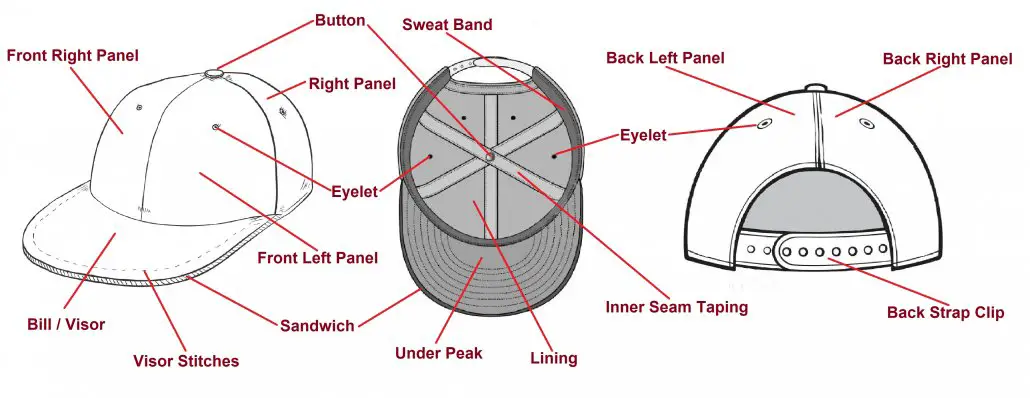
Baseball Cap Components
- Bill/Visor — The stiff forward-protruding projection that shades the eyes. Pre-curved bill length is 2.75–3.5 inches (70–89 mm) for standard baseball caps. Internal plastic stiffener (buckram) is standard for structured caps; unconstructed caps use a soft, flexible visor without reinforcement.
- Front Panels (Right and Left) — The two front panels form the crown front and accommodate the crown’s curvature. Standard panel count is 6 panels for classic baseball cap silhouette.
- Side Panels (Right and Left) — The side sections of the crown providing lateral coverage; each panel is typically 4.5–5 inches (114–127 mm) tall at center.
- Back Panels (Right and Left) — The rear crown sections; one or both back panels may incorporate a fastener (velcro, metal clip, or snap) for adjustability.
- Button (Crown Button) — A fabric-covered dome button 0.5–0.75 inches (13–19 mm) in diameter positioned at the crown top intersection of all panels. Secures the panel seams and provides a finished crown peak.
- Eyelets — Perforated ventilation holes typically 0.125–0.25 inches (3–6 mm) in diameter, placed in pairs on the side and back panels. Synthetic mesh or metal grommet eyelets are standard.
- Sandwich (Sandwich Visor) — A layered bill construction with contrast fabric visible at the edge, commonly used in sports team caps. Standard sandwich width is 0.25–0.375 inches (6–10 mm).
- Sweat Band (Perspiration Band) — The interior strip of absorbent material positioned at the forehead contact zone; typically 1.25–1.5 inches (32–38 mm) wide, made from cotton twill, microfiber, or bamboo fiber for moisture-wicking performance.
- Inner Seam Taping (Crown Tape) — Heat-sealed or sewn seam tape覆盖 panel seam allowances internally; prevents skin irritation and provides a clean interior finish.
- Under Peak (Under Visor) — The underside of the bill, often made from a different material such as satin or contrast fabric. Standard under peak width matches bill width.
- Back Strap (Size Adjuster) — The adjustable closure at the back of the cap. Standard options include: Velcro (hook-and-loop) strap 0.75–1 inch (19–25 mm) wide; metal clip (snap) with 5 adjustment positions; plastic tri-glide slide buckle; or fabric strap with riveted buckle. Strap length is 18–24 inches (457–610 mm) depending on cap size range.
Baseball Cap Accessories
- Hangtag — Displays brand logo, size, and洗涤 care instructions; standard size 2 × 3 inches (51 × 76 mm).
- Price tag and barcode tag — Retail pricing and inventory system identification.
- Brand tag — Woven or printed label with manufacturer information; positioned at the back strap or inside crown.
- Sticker — Decorative or promotional price sticker placed on the under peak or hat body.
- Packaging poly — Clear polybag sized to fit the compressed cap; standard polybag dimensions 10 × 14 inches (254 × 356 mm).
- Silica gel sachet — Moisture control packet placed inside polybag packaging.
- Carton — Shipping carton for cap dozen-packs; standard cap carton accommodates 12–48 units per carton depending on cap size distribution.
Baseball Cap Trimmings
- Sewing thread — 40s–60s cotton or polyester thread for panel seaming; decorative contrast stitching on top seam typically at 8–10 stitches per inch (SPI).
- Lining — Partial or full crown lining in polyester or cotton; 60–80 g/m² weight for standard structured caps; unlined construction is common for premium or夏季 caps.
- Interlining (Buckram)
- Button — Fabric-covered plastic dome button 0.5–0.75 inches (13–19 mm); attached with shank or sew-through construction.
- Labels — Main label (brand), size label, and care label positioned at the inside crown or sweatband seam. Care label content complies with ASTM D3136 standard for textile care labeling.
- Rivets — Cap rivets at stress points including the button base and bill attachment; standard rivet cap diameter is 8–10 mm with metal or plastic finishes.
- Motif — Embroidered logo or printed patch on the front panels; standard embroidery is 3-dimensional (3D puff) or flat twill appliqué; patch size typically 2.5–4 inches (64–102 mm) wide.
- Tape/Lace — Seam sealing tape, sweatband edge binding tape, or decorative ribbon lace woven through eyelets in performance caps.
- Logo — Printed, embroidered, or woven brand identification on any cap panel.
- Velcro — Hook-and-loop fastener used for the adjustable back strap; adhesive-backed Velcro is also used for attaching interchangeable patches.
- Buckle — Plastic tri-glide or metal D-ring buckle on adjustable strap configurations.
Extra decorative elements such as printed or embroidered tape, woven labels, and metal or embroidered logos are attached to the cap body depending on the design. The visor or bill may be modified with contrast fabric sandwich, embroidered patches, or 3D puff logo applications. Back straps are manufactured from tape, plastic, or metal depending on the cap’s target market and price point. Performance athletic caps incorporate moisture-wicking sweatbands, mesh side/back panels, and anti-microbial treated linings.
Parts of a Hoodie
A hoodie is a versatile garment combining the comfort of a sweatshirt with an integrated head covering hood. Modern hoodie construction involves multiple fabric panels and specialized trimmings designed to withstand the stress of daily wear. The hoodie has become a staple in athletic wear, streetwear, and casual fashion, with global hoodie sales exceeding 300 million units annually in the United States alone. The following sections detail every structural component of a standard hooded sweatshirt.
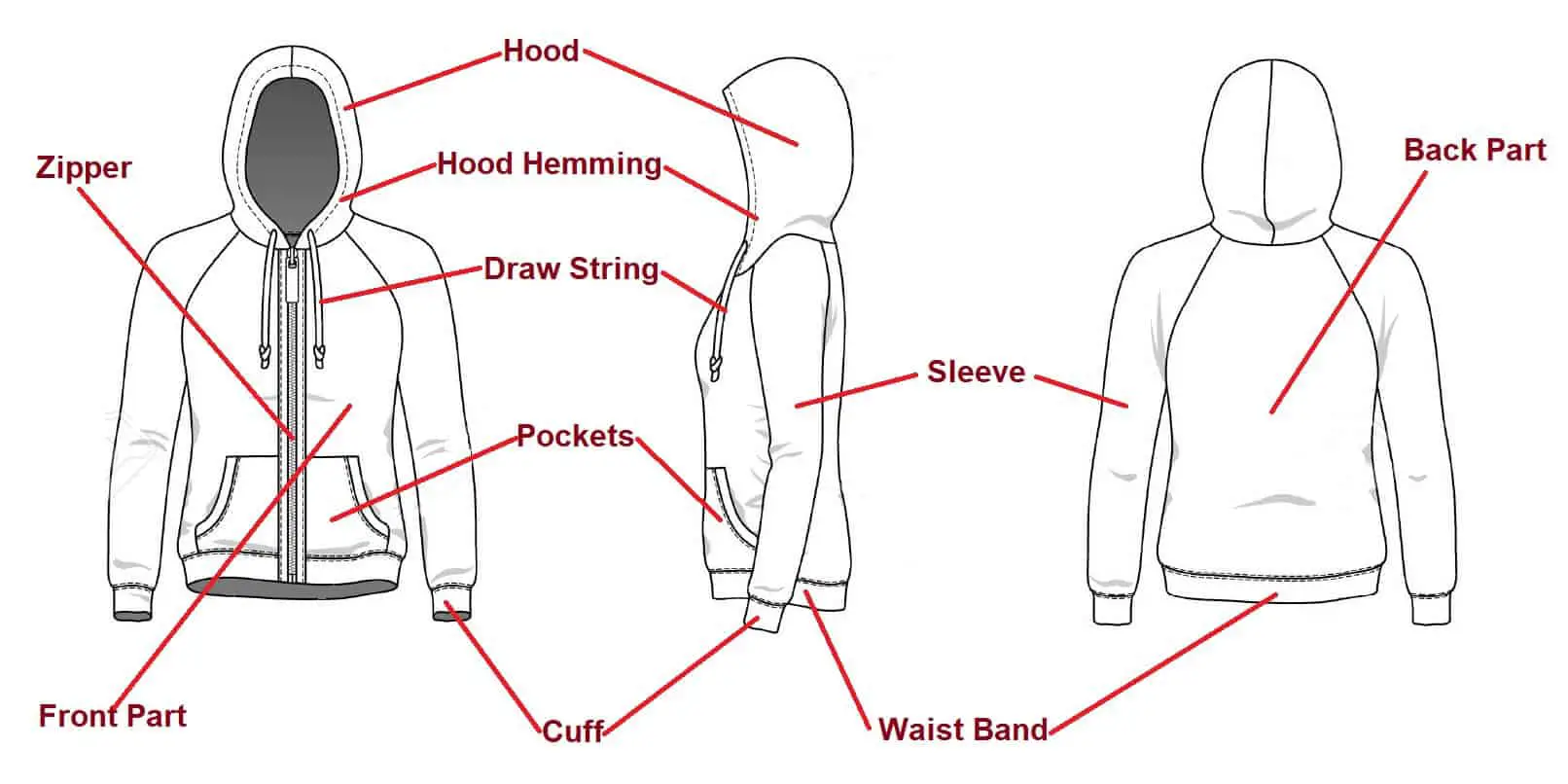
Hoodie Structural Components
- Hood (Crown) — The integrated head covering constructed from two hood panels meeting at the center back. Standard hood depth is 10–12 inches (254–305 mm) from neck seam to hood edge; hood opening circumference is 24–28 inches (610–711 mm) to accommodate head sizing. Hood lining is typically 100% cotton fleece or polyester fleece for warmth retention.
- Sleeve (Left and Right) — Full-length arms extending from shoulder seam to wrist; standard sleeve length is 26–28 inches (660–711 mm) for a medium-sized hoodie. Raglan sleeve construction (diagonal seam from underarm to collar) is common in athletic hoodies for improved mobility.
- Front Panels (Right and Left) — The two front body panels that zip together at the center front; panel width at chest is typically 9–10 inches (229–254 mm) each for a medium garment.
- Back Panel — The single rear body panel spanning from collar seam to bottom hem; cut slightly wider than front panels to accommodate the hood attachment overlap.
- Zipper (Front Closure) — The full-front zipper runs from bottom hem to hood neck opening. Standard hoodie zipper is a #5 coil or molded plastic zipper 22–26 inches (559–660 mm) long. Metal zippers are standard for fashion hoodies; plastic zippers are standard for athletic and performance hoodies.
- Drawstring — The hood adjustment cord threaded through the hood edge channel; standard drawstring length is 18–24 inches (457–610 mm) per side, with aglets (plastic or metal tips) at each end. Drawstring thickness is typically 4–6 mm flat cord or 3 mm round cord.
- Hood Hemming (Hood Edge Binding) — The finished edge of the hood opening, typically constructed with 2×2 rib knit (95% cotton / 5% spandex) for elastic recovery; width is 1–1.5 inches (25–38 mm).
- Pockets — Kangaroo pocket (single large front pocket spanning 12–16 inches / 305–406 mm across) is standard for pullover hoodies. Zippered side seam pockets are standard for zip-front hoodies; pocket opening width is typically 6–8 inches (152–203 mm).
- Waistband (Bottom Hem) — The elastic bottom band; standard construction uses 2×2 rib knit with 95% cotton / 5% spandex blend; waistband width is 1.5–2 inches (38–51 mm). Elastic recovery must exceed 90% to prevent permanent stretching.
Hoodie Accessories
- Hangtag — Brand logo and product information tag; standard size 2 × 3 inches (51 × 76 mm).
- Hanger — Heavy-duty hanger with clips or a horizontal bar to support the hoodie’s weight; standard hoodie hanger width is 17 inches (432 mm).
- Price tag and barcode tag — Retail and inventory identification.
- Brand tag — Woven label at inner neck or side seam with brand name and size.
- Sticker — Promotional sticker placed at the polybag or garment interior.
- Packaging poly — Polybag sized for folded hoodie; standard dimensions 12 × 16 inches (305 × 406 mm).
- Silica gel sachet — Moisture control packet placed inside polybag.
- Carton — Shipping carton sized for dozen-pack hoodie cartons; standard dimensions accommodate 12 units per carton.
Hoodie Trimmings
- Sewing thread — 40s–60s cotton-polyester core spun thread for fleece and French terry constructions; coverstitch thread (textured polyester) for rib knit and hem applications; standard stitch count is 10–14 stitches per inch (SPI) for seam durability.
- Lining — Hoodie hood lining uses 100% cotton fleece (300–400 g/m²) or polyester fleece (200–300 g/m²) for warmth; body lining is optional and ranges from lightweight mesh to midweight fleece.
- Interlining — Fusible or sew-in interlining used in collar and hood seam areas for dimensional stability; weight 40–80 g/m².
- Button — 4-hole plastic buttons 0.5–0.75 inches (13–19 mm) for pullover hoodie neck closures; metal snap buttons for some athletic hoodie designs.
- Labels — Main label (brand, size, fiber content), composition label, and care label positioned at inner neck or side seam. Care instructions comply with ASTM D5489 standard for care symbols.
- Rivets — Metal or plastic rivets at stress points including pocket corners and drawstring entry points; standard rivet diameter 8–10 mm.
- Motif — Embroidered or printed logo on left chest or hood; standard chest motif size is 3.5–5 inches (89–127 mm) wide. 3D puff embroidery is standard for sportswear hoodies.
- Tape/Lace — Seam binding tape at hood seam and shoulder seam; decorative satin ribbon tape woven through hood edge in fashion hoodies.
- Logo — Woven tag, embroidered patch, or printed design on any garment panel.
- Velcro — Hook-and-loop fastener patches used in athletic hoodie designs for team customization; standard patch size 2–3 inches (51–76 mm) square.
- Buckle — Plastic or metal buckle on drawstring chin guard or front pocket edge details.
Extra decorative trimmings are applied to fashion and sportswear hoodies. Embroidered logos, 3D puff motifs, woven labels, and contrast-color drawstring cords are common aesthetic enhancements. Multi-colored and contrast sewing thread is used for decorative coverstitching along hood edge, sleeve seams, and pocket edges. Some performance hoodies incorporate artificial flowers, colored tape, and heat-transfer patches for seasonal fashion collections.
References
- Wikipedia contributors. (2025). Shirt. Wikipedia, The Free Encyclopedia.
- Wikipedia contributors. (2025). Zipper. Wikipedia, The Free Encyclopedia.
- Nayak, R., & Padhye, R. (2018). Garment Manufacturing Technology. Elsevier. https://www.elsevier.com/books/garment-manufacturing-technology/nayak/978-1-78242-232-7
- Textile Exchange. (2024). Preferred Fiber & Materials Market Report. https://textileexchange.org/knowledge-center/reports/
- International Organization for Standardization. (2017). ISO 20471:2013 — High-visibility warning clothing for professional use. ISO. https://www.iso.org/standard/65473.html
- Cotton Incorporated. (2024). Industry Statistics — U.S. Cotton Consumption and Market Data. https://www.cottoninc.com
- ASTM International. (2024). ASTM D3136 — Standard Practice for Care Label Language for Textile Fiber Products. ASTM International. https://www.astm.org/standards/d3136
- U.S. Department of Commerce, National Textile Center. (2023). Annual Report on the U.S. Textile and Apparel Industry. https://ntcresearch.org


