
Types of Buttons for Clothes: What You Need to Know

What Are Buttons? A Complete Guide to Types of Buttons for Clothing
Buttons are fastening components sewn onto garments to secure clothing pieces together — the global textile industry produces over 60 billion buttons annually. They range from 10 mm to 60 mm in diameter and are classified into two primary mounting systems: sew-through (flat) buttons with thread holes, and shank buttons with a protruding neck that passes through a single fabric hole. Buttons are manufactured from natural materials (horn, shell, wood, bone), synthetic polymers (polyester, nylon, acrylic), and metals (zinc alloy, stainless steel, brass), each offering distinct properties for different garment applications.
Button Size Standards
The global button industry uses the ligne (abbreviated L) as its standard unit of measurement, where 40 lignes equal 1 inch (25.4 mm). Common sizes include:
| Ligne Size | Millimetres (mm) | Inches | Typical Garment Use |
|---|---|---|---|
| 16L | 10.16 mm | ~0.40″ | Men’s dress shirt buttons |
| 20L | 12.70 mm | ~0.50″ | Children’s garments, blouses |
| 24L | 15.24 mm | ~0.60″ | Blouses, light jackets |
| 28L | 17.78 mm | ~0.70″ | Women’s jackets, dresses |
| 32L | 20.32 mm | ~0.80″ | Suit jacket buttons |
| 36L | 22.86 mm | ~0.90″ | Coats, overcoats |
| 40L+ | 25.40 mm+ | 1.00″+ | Heavy coats, marine garments |
Button Selection Quick Guide
Choosing the right button depends on three key factors: garment type, fabric weight, and care requirements. Use this guide to match button characteristics to your project.
| Garment Type | Recommended Button Type | Recommended Size | Why |
|---|---|---|---|
| Dress shirts | Flat / sew-through | 16L–20L | Light fabric; flat profile sits smoothly |
| Blouses / lightweight tops | Flat, covered, or pearl | 20L–24L | Balanced aesthetics with manageable weight |
| Jackets and blazers | Flat, horn, or metal | 28L–32L | Heavier construction needs larger, sturdier buttons |
| Coats and overcoats | Shank, horn, or metal | 36L–40L+ | Heavy fabric requires shank or large flat buttons |
| Denim / workwear | Jeans rivet buttons or metal | 20L–24L | High pull-out resistance; durable fastening |
| Leather garments | Leather or metal shank | 28L–36L | Thick fabric; premium aesthetic matches leather |
| Knitwear / cardigans | Flat or toggle | 24L–32L | Flexible fabric accommodates various button weights |
| Children’s clothing | Nylon, plastic, or wooden | 20L–24L | Machine washable; lightweight and safe |
Types of Buttons by Mounting System
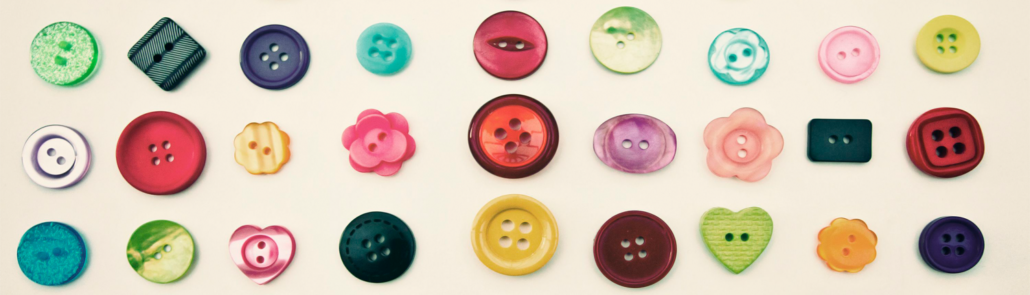
Buttons for clothing are grouped into two mounting systems. Sew-through (flat) buttons have thread holes and are stitched directly onto the fabric face. Shank buttons have a protruding neck (shank) on the reverse side that passes through a single fabric hole, positioning the button above the garment surface. The mounting system determines which garments can use a given button type and affects how securely the button fastens.
Flat Buttons
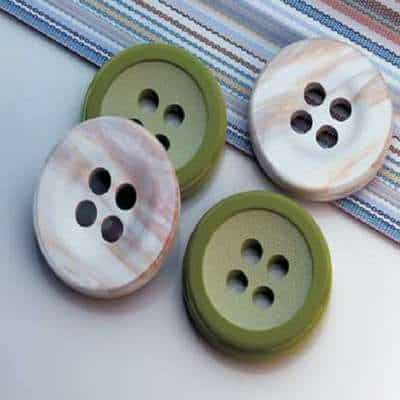
Flat buttons are the most widely produced button type globally, accounting for an estimated 60–70% of all garment buttons sold. They have a smooth or slightly domed face with two to four thread holes (or rivet studs) on the reverse. They are produced in sizes ranging from 10 mm to 40 mm and are used across all garment categories.
Typical Uses
- Jackets and blazers
- Coats and overcoats
- Outerwear garments
- Dresses and skirts
Shank Buttons
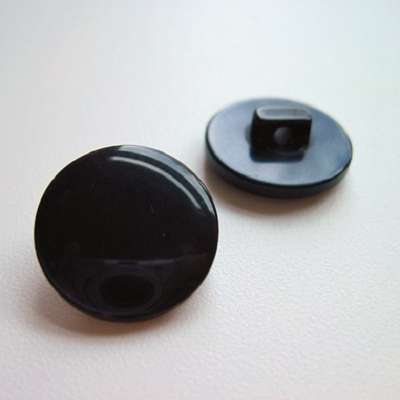
Shank buttons feature a metal or plastic shank — a hollow protrusion on the back — that passes through a single fabric hole. The shank interior contains a spring-loaded mechanism (in metal shanks) or a monofilament thread loop (in injection-moulded shanks) that secures the button to the garment. This mounting system keeps the button face visible and clean, making shank buttons the standard choice for high-end suits, sport coats, and tailored shirts.
Typical Uses
- Jackets and tailored coats
- Suit blazers and sport coats
- Dress shirts (higher-end)
Types of Buttons by Material
Button materials determine durability, appearance, wash-fastness, and suitability for different garment types. The textile industry classifies button materials into three broad groups: natural materials (horn, shell, wood, bone), synthetic polymers (polyester, nylon, acrylic, urea-formaldehyde), and metals (zinc alloy, stainless steel, brass).
Covered Buttons
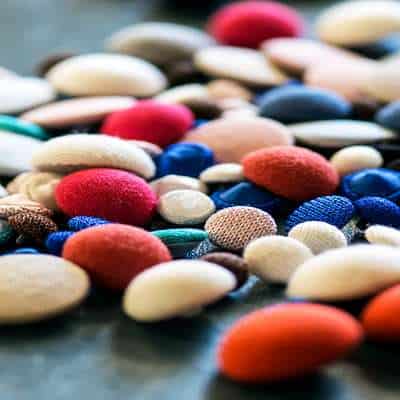
Covered buttons are formed from a metal or plastic base (called a blank) that is then wrapped with fabric and crimped or clamped at the back. The fabric covering is applied using heat-cement or mechanical crimping, and the completed button has a closed back with two to four thread holes. Standard fabric coverings include cotton twill, polyester gabardine, and woollen suitings. The textile covering must be compatible with the garment fabric to ensure colour-fastness and laundering performance.
Typical Uses
- Blouses and women’s shirts
- Tailored jackets
- Tops and knitwear
Horn Buttons
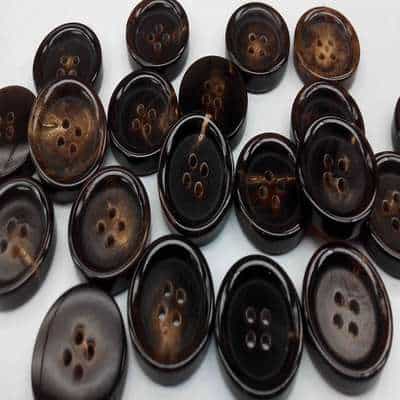
Horn buttons are produced from water buffalo horn through a process of boiling, slicing, tapering, and polishing. The raw horn material is first sterilised at 100 °C, then cut into slabs and stamped into button shapes. Natural horn buttons display distinctive translucent grain patterns and are resistant to boiling water and autoclave sterilisation, making them the preferred button for military and marine garments.
Typical Uses
- Jackets and traditional coats
- Marine and nautical garments
- Mil-Spec and uniform buttons
Metal Buttons
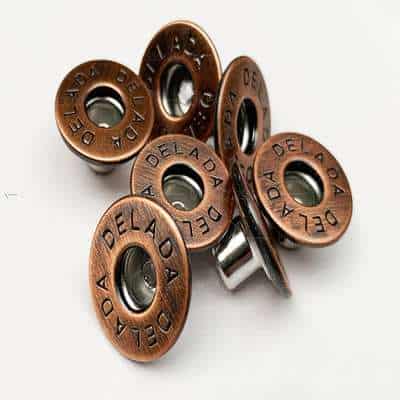
Metal buttons are produced from zinc alloy (cast), brass (stamped), or stainless steel (stamped or turned). The most common sizes for garment use are 20L (for shirts) and 32–36L (for outerwear). Cast metal buttons typically undergo polishing, electrophoretic painting, or PVD (physical vapour deposition) coating to achieve finishes ranging from bright nickel to antique brass, matte black, and gold. Stainless steel buttons are preferred for workwear and garments requiring corrosion resistance.
Typical Uses
- Denim and workwear jeans
- Leather jackets and waistcoats
- Uniform and outerwear garments
Jeans Buttons
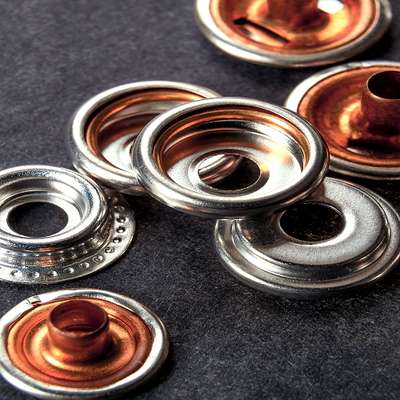
Jeans buttons — also called rivet buttons — consist of two interlocking metal disc components: a stationary socket (male part) and a capped pin (female part) that are assembled by crimping the pin through the fabric and into the socket. The standard jeans button size is 20L (12.7 mm face diameter) for standard denim and 24L (15.24 mm) for heavy canvas. The assembled joint withstands pull-out forces of 150–300 Newtons depending on the material thickness and interlocking design.
Typical Uses
- Denim jeans and jackets
- Cargo pants and work trousers
- Heavy canvas bags and accessories
Pearl Buttons
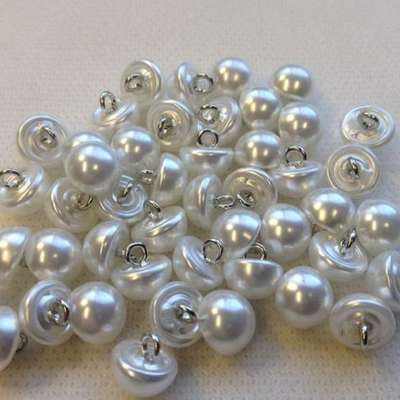
Pearl buttons are produced from mother-of-pearl — the iridescent inner lining of freshwater or marine mollusc shells (primarily Hyriopsis cumingii for freshwater pearls and Pinctada margaritifera for marine). The shell material is cut into wafers, bevelled, drilled, and polished. Mother-of-pearl has a hardness of 3.5–4.5 on the Mohs scale and is resistant to common laundry detergents but can be degraded by acidic substances (pH < 4). Simulated pearl buttons are produced from acrylic or urea-formaldehyde beads with a pearlescent coating.
Typical Uses
- Blouses and women’s shirts
- Easter and formal wear
- Baby and children’s garments
Wooden Buttons
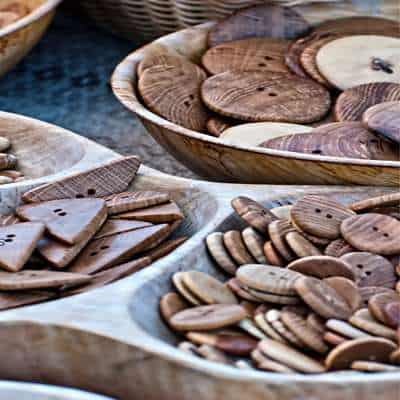
Wooden buttons are turned or laser-cut from hardwoods (typically tagua nut, also called vegetable ivory, or corozo) or from fast-growing plantation timbers such as poplar and birch. Tagua nut buttons have a specific gravity of 1.3–1.5 and a fine, uniform grain that takes dye evenly. Wooden buttons are finished with lacquer coatings (0.02–0.05 mm film thickness) to provide moisture resistance and surface hardness. They can be dyed to any Pantone colour and are available in sizes from 10 mm to 50 mm.
Typical Uses
- Pants and jeans
- Jackets and casual outerwear
- Children’s clothing
Nylon and Plastic Buttons
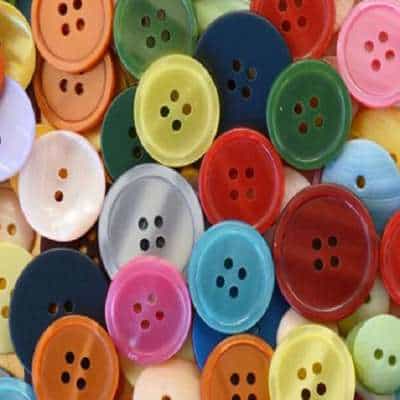
Nylon (polyamide) and polyester buttons are produced by injection moulding at temperatures of 260–300 °C. These polymer buttons offer high impact resistance, low moisture absorption (0.2–0.5% for nylon 6,6 at 23 °C / 50% RH), and excellent colour stability through mass pigmentation (pigment added to the polymer melt). They are the most economical button type, with production costs of USD 0.005–0.02 per button for standard sew-through sizes. Nylon buttons withstand industrial laundering at temperatures up to 95 °C.
Typical Uses
- Outerwear garments
- Workwear and uniforms
- Children’s clothing
Leather Buttons
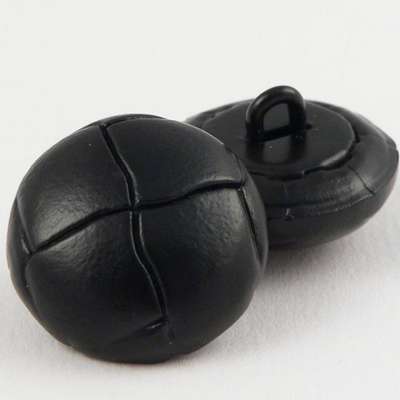
Leather buttons — often incorrectly described as “plastic” — are produced from compressed leather fibres or vegetable-tanned leather strips that are stamped, dyed, and lacquered. The best quality leather buttons are made from full-grain vegetable-tanned hide with a minimum thickness of 1.8 mm, which provides both durability and a premium aesthetic. Leather buttons are hand-stitched or attached with a leather cord shank and develop a patina over time, making them prized for premium fashion leather goods and artisan garments.
Typical Uses
- Leather jackets and waistcoats
- Premium fashion garments
- Craft and artisan accessories
Fabric Buttons
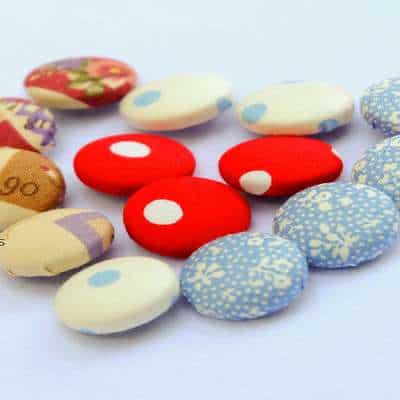
Fabric buttons are produced by covering a polymer or metal blank with woven or knitted fabric, similar to covered buttons, but specifically using dyeable fabrics (typically wool, cotton, or silk blends) that can be piece-dyed after construction. The defining characteristic is that fabric buttons are dyed in the same bath as the garment, ensuring a perfect colour match after laundering. They are typically attached with a simple sew-through construction using two to four holes.
Typical Uses
- Accessories and trims
- Craft projects
- Dyeable garment details
Toggle Buttons
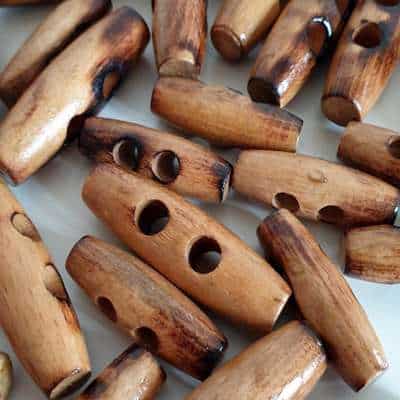
Toggle buttons — also called frog closers or toggles — consist of a braided cord loop (the female component) and a wooden, bone, or metal toggle bar (the male component) that passes through the loop and a corresponding fabric hole. Toggle closures are designed to withstand repeated opening and closing cycles, with the braided cord loop rated for a minimum of 5,000 actuation cycles before fibre abrasion becomes significant. They are popular in traditional outerwear and heritage-style garments where they also serve a decorative function.
Typical Uses
- Jackets and coats
- Traditional and heritage outerwear
- Cardigan and knitwear closures
Lapel Buttons
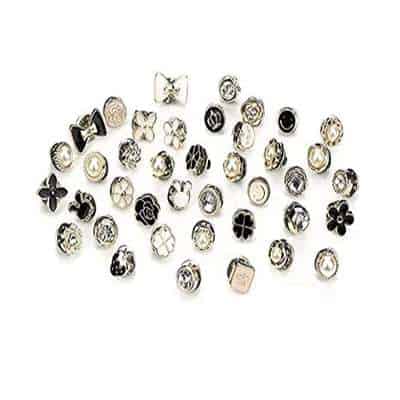
Lapel buttons (also called lapel pins or collar pins) are small, decorative fasteners designed to hold the lapels of a jacket or coat together at the collar point. They range from 8 mm to 20 mm in diameter and are typically produced from brass with enamel fill (cloisonné) or from injection-moulded zamak alloy with a brushed or polished finish. Some lapel buttons incorporate a chain and hook for adjustable closure tension.
Typical Uses
- Jackets and blazers
- Coats and overcoats
- Formal wear lapel closures
Decorative Buttons
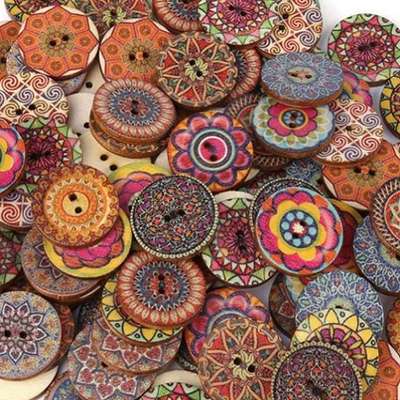
Decorative buttons — also called sew-on buttons or flatback buttons — are designed primarily for aesthetic impact rather than load-bearing fastening. They are produced in unlimited shapes (round, square, star, heart, novelty) using acrylic rhinestones, glass beads, enamel, carved bone, or resin. Decorative buttons are attached with a simple sew-through technique and are used to complement garments, create visual patterns, or serve as closures on light-duty applications such as ornamental pockets and collar tabs.
Decorative buttons are a staple of the craft and handmade garment industry. Artisans use them to create decorative closures on items such as cushion covers, pillow shams, and artisan bags, where the button functions as both a fastener and a design element.
Typical Uses
- Decorative jacket and coat closures
- Craft projects and pillow closures
- Collar and pocket accents
Shell Buttons
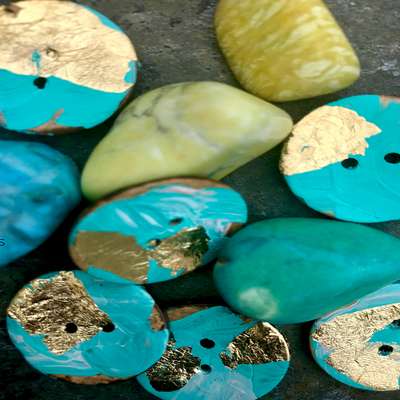
Shell buttons are produced from the shells of marine molluscs — primarily the brownlip pearl oyster (Pinctada margaritifera) and the gold-lip pearl oyster (Pinctada maxima) — which yield shell material with superior hardness (Mohs 4.5) and a distinctive iridescent surface. The shell is cut into strips, shaped, bevelled, drilled, and polished. Shell buttons are categorised by thickness (thin: 1.0–1.5 mm; medium: 1.5–2.5 mm; thick: 2.5–4.0 mm) and are among the most durable natural-material buttons available.
Typical Uses
- Jackets and tailored coats
- Formal and evening wear
- Premium shirt buttons
Bead Buttons
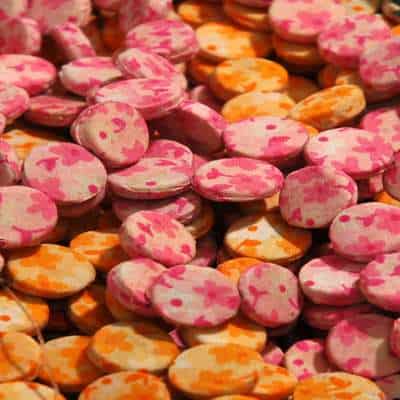
Bead buttons are constructed from glass, acrylic, or wooden beads arranged on a fabric or metal base and stitched through a central hole. They range from 6 mm to 30 mm in diameter and are typically used as decorative accents rather than primary fasteners, though small bead buttons (under 15 mm) can function as light-duty closures on children’s garments and craft items. The most common construction uses a nylon thread passed through four or more beads to form a stable, flexible closure surface.
Typical Uses
- Accessories and craft projects
- Children’s garment accents
- Decorative closures on soft furnishings
Zippers as Button Alternatives
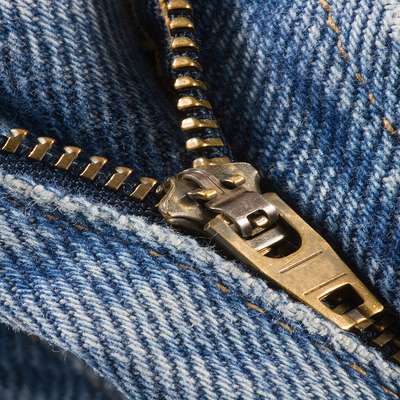
Zippers are slide fasteners comprising two opposing textile tapes with interlocking metal or plastic teeth (elements) that are joined or separated by a slider. The textile industry classifies zippers by element material (metal, moulded plastic, or coil), by size (3号/3Y to 15号/15Y, corresponding to approximately 3 mm to 15 mm closed width), and by end use (open-bottom, closed-bottom, or separable). Nylon coil zippers are the most common type for garments, accounting for approximately 65% of global zipper production by volume.
Typical Uses
- Jackets and coats
- Pants, jeans, and trousers
- Skirts and dresses
Final Words
Buttons are a small component with a significant impact on garment functionality, durability, and aesthetic appeal. The global button market produces over 60 billion buttons annually, with the majority originating from Qiaotou, Yongjia County, China. Understanding the distinctions between button types — mounting system, material composition, size standard, and intended use — enables designers, manufacturers, and crafters to select the correct button for each application.
Plastic buttons are the most affordable option, offering good durability for standard garments at a production cost of USD 0.005–0.02 per button. Metal buttons provide superior durability and an elegant appearance but at higher cost. Natural-material buttons (horn, shell, wood) offer unique aesthetic qualities and are preferred for premium and heritage garments, though they require more careful laundering.
Selecting the correct button type, size (measured in lignes), and material for a specific garment is essential to achieving both functional performance and visual coherence. The choice between a sew-through flat button and a shank button, for instance, is not merely aesthetic — it directly affects how securely the garment fastens and how the button interacts with the fabric structure over repeated wear cycles.
References
- Wikipedia. (2024). Button (clothing). Wikimedia Foundation. https://en.wikipedia.org/wiki/Button
- CottonWorks. (2024). Buttons — Sourcing Terms and Definitions. Cotton Incorporated. https://www.cottonworks.com/topics/sourcing-terms/trims/buttons/
- Nayak, R., & Padhye, R. (2018). Garment Manufacturing Technology. Elsevier. https://www.elsevier.com/books/garment-manufacturing-technology/nayak/978-1-78242-232-7


