
Garment Trimmings & Accessories

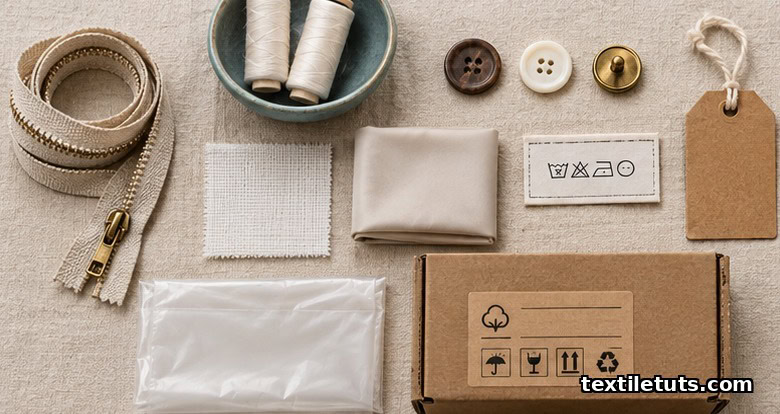
Garment trimmings and accessories encompass all materials except the main fabric used in apparel manufacturing. These components are essential for functional performance, aesthetic enhancement, and proper garment construction.
Purposes of Using Trimmings and Accessories in Garment Manufacturing
Trimmings and accessories serve two distinct purposes in garment manufacturing:
- Functional Purpose — Includes zippers, buttons, interlinings, and sewing threads that provide structural integrity and usability
- Decorative Purpose — Includes motifs, lace braids, embroidered patches, and ornamental trims that enhance visual appeal
Garment Trimmings Defined
Trimmings are components sewn with the main fabric of a garment specifically for functional purposes. The garment industry uses hundreds of different trimmings, not all of which are visible externally—some remain in the inner portion of a garment, such as interlining.
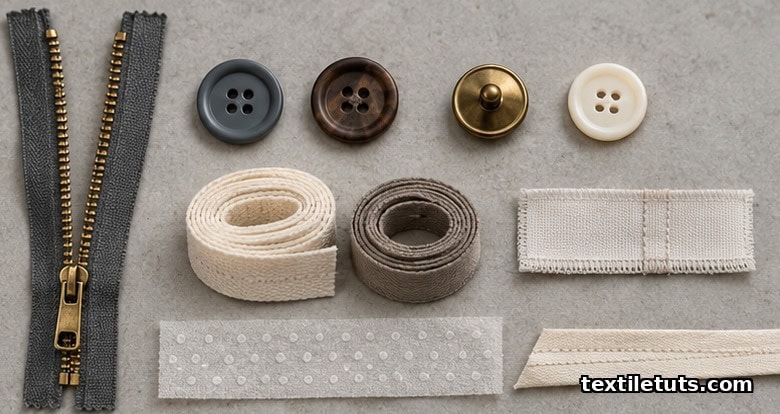
Common trimmings used in garment manufacturing include:
1. Sewing Thread; 2. Button; 3. Lace Braid & Elastic; 4. Label & Motif; 5. Zipper; 6. Interlining; 7. Lining; 8. Hook & Loop Fastening; 9. Wadding; 10. Shoulder Pad
Requirements of Trimmings for Quality Garment Production
Garment manufacturers must verify that trimmings meet specific requirements before incorporation. Failure to meet these standards results in deteriorated garment quality and premature rejection during quality control inspection.
Lifetime Matching of Trimmings and Garments
The service life of trimmings must match the expected lifetime of the finished garment. When trimmings degrade before the garment itself, the entire piece fails quality inspection. Premium outerwear typically requires trimmings rated for 500+ wash cycles.
Trimmings undergo rigorous shrinkage testing before production use. Industry standards require shrinkage not exceeding 2% after five wash cycles at 40°C (104°F) for most garment applications.
Color Fastness Standards for Garment Trimmings
Colorfastness is critical—trimmings must resist fading or bleeding from light exposure (rated Grade 4 minimum on the ISO 105-B02 grey scale), washing at 60°C (140°F), rub cycles (minimum Grade 3 dry and wet rub resistance), and exposure to human perspiration with pH levels ranging from 4.0 to 8.5.
Comfort Performance Requirements
Trimmings must match the comfort characteristics of the main fabric. They shall not cause skin irritation or discomfort—this requirement is mandated under Oeko-Tex Standard 100, which limits formaldehyde content to 75 mg/kg and prohibits azo dyes that release carcinogenic amines above 30 mg/kg.
Types of Trimmings: Visible and Invisible
Trimmings fall into two distinct categories based on their visibility in the finished garment:
- Visible Trimmings — Components found on the exterior of the garment, including buttons, zippers, and decorative motifs
- Invisible Trimmings — Components positioned inside the garment that remain concealed, including interlining, fusible backing, and shoulder pads
Garment Accessories Defined
Accessories are materials used in garment production that are not attached by sewing. These items serve decorative and functional purposes during finishing and packaging stages but are removed or discarded before end use.
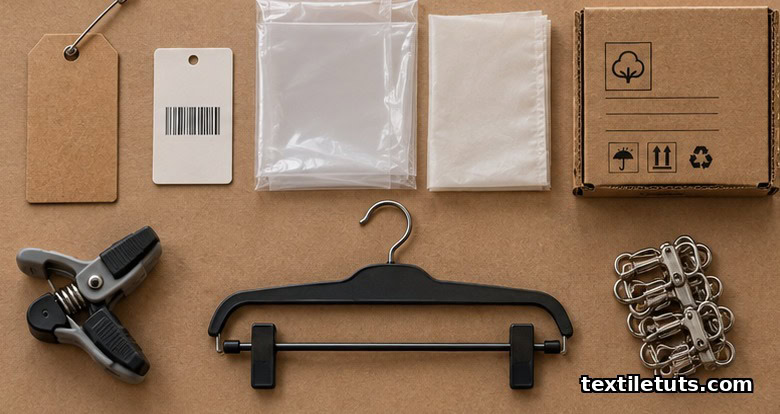
Common accessories in the garment industry include:
1. Neck Board; 2. Hang Tag; 3. Price Tag; 4. Collar Stand; 5. Carton; 6. Poly Bag; 7. Plastic Clip; 8. Tape; 9. Barcode; 10. Tag Pin; 11. Hanger; 12. Butterfly Clasp; 13. Security Sticker
Key Differences Between Trimmings and Accessories
Understanding the distinction between trimmings and accessories is fundamental to garment manufacturing:
| Trimmings | Accessories |
|---|---|
| 1. Attached to garments by sewing stitches using industrial sewing threads at 12-18 stitches per centimeter | 1. Not attached to garments by sewing—applied temporarily during production or packaging |
| 2. Serve primarily functional purposes including load distribution and garment closure | 2. Serve decorative and finishing purposes during production and packaging stages |
| 3. Remain on the garment throughout its entire service life | 3. Removed before garment reaches the end consumer or discarded during unpacking |
| 4. Examples: sewing thread, interlining, fusible interfacing, zipper, button | 4. Examples: polybag, carton box, plastic clip, price tag, hang tag |
Garment Trims and Accessories: Bangladesh’s Export Growth Catalyst
The garment trims and accessories industry has been instrumental in Bangladesh achieving record-high exports. Bangladesh’s RMG (Readymade Garment) sector generated $47.74 billion in exports in FY 2023-2024, with high-quality trims and accessories contributing to enhanced product value and international competitiveness.
Essential Details on Major Trimmings and Accessories
Label Specifications and Requirements
- Labels contain essential garment information including fiber content (percentage by weight), care instructions following ASTM D5489 standards, country of origin, and manufacturer identification
- Functional labels are typically made of woven fabric (polyester taffeta at 170-190 denier) or direct thermal paper rated for 200+ wash cycles
- Labels are sewn into the inner back neckline using lock stitches at 10-12 stitches per centimeter
Motif Specifications and Application Methods
- Motifs enhance garment aesthetics through company logos, trademarks, or decorative symbols embroidered at thread densities of 400-800 stitches per square centimeter
- Application methods include machine embroidery (polyester thread 120/2 count), screen printing (ink deposit 30-50 g/m²), and ultrasonic welding for thermoplastic transfers
- Motifs positioned on outer garment surfaces undergo 50+ home wash cycle testing without significant degradation
Zipper Specifications and Performance Standards
- Zippers consist of interlocking components: tape (polyester weave at 75-100 denier), teeth (metal alloy or molded polymer), slider, chain, top stop, and bottom stop
- Zipper strength ratings: Light-duty (30 N minimum), Medium-duty (60 N minimum), Heavy-duty (120 N minimum) tested per ASTM D2061
- YKK Corporation produces approximately 90% of global zipper demand, with chain strength ranging from 300-1800 N depending on size
- Four primary zipper types: Conventional (exposed teeth), Invisible (concealed teeth), Separating (joins two garment halves), and Continuous (sold by the meter for industrial applications)
Lining Specifications and Performance Properties
- Linings are inner fabric layers (typically acetate, polyester, or viscose at 60-90 g/m²) that separate from shell fabrics and provide shape, drape, and comfort
- Moisture management linings feature 2000-5000 g/m²/24hr breathability ratings per ASTM E96
- Thermal linings incorporate 80-150 g/m² polyester wadding for insulation in outerwear applications
Button Specifications and Industry Standards
- Buttons are disc or knob fasteners produced from polymer plastics (acrylic, polycarbonate, urea-formaldehyde), natural materials (coconut shell, corozo nut, bone), or metals (zinc alloy, brass)
- Standard button sizes: 14 ligne (9 mm), 16 ligne (10 mm), 18 ligne (11.5 mm), 20 ligne (13 mm), 24 ligne (15 mm), 28 ligne (18 mm), 32 ligne (20 mm), 40 ligne (25 mm)
- Button attachment requires 8-12 stitches per button hole using polyester thread 120/2 count with shank buttons tested to 150 N pull-out resistance per ASTM D7142
Interlining Types and Application Standards
- Interlinings provide shape retention, reinforcement, and stiffness to collar, cuff, facing, front panel, waistband, and hood regions
- Fusible interlinings bond to fabric under heat press at 120-160°C (248-320°F) for 15-25 seconds at 2-4 bar pressure
- Sewn interlinings are basted at 5-8 stitches per centimeter using bias-cut strips for flexible shaping
Hook and Loop Fastener (Velcro) Specifications
- Hook and loop fasteners provide 300-1500 N/m² shear strength and 5-30 N/cm² peel strength depending on filament density
- Standard cycle life ratings range from 10,000 to 50,000 open-close cycles before significant strength degradation
- Common applications include children’s clothing, adaptive wear for elderly or disabled users, sports footwear, and luggage
Shoulder Pad Construction and Materials
- Shoulder pads maintain garment silhouette, add bulk, and range from 3 mm (blouse) to 25 mm (coat) in thickness
- Materials include polyurethane foam (density 20-35 kg/m³), polyester wadding, felted wool, and crinoline (horsetail hair woven with cotton)
Hang Tag Standards and Information Requirements
- Hang tags are finishing items attached by plastic staple or string containing brand name, style number, fiber content, care instructions, and suggested retail price
- Standard sizes range from 40 × 60 mm (retail) to 100 × 150 mm (luxury) using 200-400 g/m² cardstock
Price Tag Components and Barcode Standards
- Price tags display retail pricing in UPC-A, EAN-13, or QR code formats compliant with GS1 standards
- Barcode labels typically measure 25 × 10 mm with minimum print resolution of 300 DPI for scannability
Polybag Specifications for Garment Protection
- Poly bags used for garment storage and shipping are manufactured from low-density polyethylene (LDPE) at 20-50 μm thickness
- Biodegradable alternatives use oxo-biodegradable polyethylene or PLA (polylactic acid) compostable films
Carton Box Specifications for Garment Shipping
- Garment cartons are manufactured from EB-flute corrugated board (3-5 mm thickness) with 30-50 kg compression strength per box
- Standard garment carton dimensions accommodate 20-50 garments per box with moisture resistance rating of 85-90% RH protection
Tape Types and Applications in Garment Manufacturing
- Trimming tapes are narrow fabric strips (10-50 mm width) in cotton, linen, or polyester with tear strength of 50-200 N
- Applications include tying garment bundles, securing hem allowances, and decorative edge binding
Hanger Specifications for Retail Display
- Hangers are manufactured from polystyrene (budget), ABS plastic (retail), or hardwood (luxury) with load ratings of 5-15 kg
- Clip hangers for bottoms feature spring-loaded clamps with rubber grip pads preventing fabric marking
Tassel Construction and Decorative Applications
- Tassels are decorative ornaments manufactured from spun polyester threads (150-300 denier) or silk, featuring cord lengths of 80-150 mm
- Applications include curtain tiebacks, curtain pelmet edges, cushion trim, and ladies’ garment hemlines
References
- American Society for Testing and Materials. (2024). ASTM D2061-23 Standard Test Methods for Zipper Strength. ASTM International.
- International Organization for Standardization. (2023). ISO 105-E04:2023 Textiles — Tests for colour fastness — Part E04: Colour fastness to perspiration. ISO.


