
How to Wash Cotton T-Shirts (And Prevent Shrinking and Fading)


Washing cotton t-shirts correctly prevents the two most common problems: shrinkage from heat and color fading from friction and UV exposure. The optimal method is 30°C on a gentle cycle, turned inside-out, with a cold rinse — this combination preserves color, prevents pre-shrunk cotton from additional shrinkage, and extends the life of printed graphics. Most people wash cotton t-shirts hotter than needed; 30°C cleans effectively while protecting the fabric.
Why Cotton T-Shirts Shrink and Fade (The Causes)
Cotton is a natural cellulosic fiber with specific physical behavior under heat and mechanical stress. Understanding these mechanisms is the first step toward preventing damage.
Shrinkage: How Heat Damages Cotton Fibers
Cotton fibers are composed of long-chain cellulose molecules that swell when exposed to moisture and heat, then contract as they dry. This process — called relaxation shrinkage — causes the fabric to compress and lose dimensions. Pre-shrunk cotton t-shirts have already been through a controlled relaxation shrinkage process during manufacturing, which removes 3–5% of potential shrinkage before the garment reaches the consumer. However, even pre-shrunk cotton can shrink an additional 1–3% when exposed to temperatures above 40°C, particularly in tumble drying. High-temperature washing at 60°C or above causes the most aggressive shrinkage and is only necessary for sanitization purposes — such as washing soiled medical garments or items exposed to illness.
Fading: Why Colors Lose Intensity
Color fading in cotton occurs through two primary mechanisms. The first is mechanical abrasion: as garments tumble inside the wash barrel, fiber surfaces rub against each other and against the drum interior. This friction literally abrades dye molecules off the fiber surface — a process called dye migration. The second mechanism is thermal: hot water accelerates the kinetic energy of dye molecules, causing them to release from the fiber more rapidly than in cold water. This is why 30°C water preserves color noticeably better than 40°C or higher. Line-drying in direct sunlight introduces a third fading mechanism — UV photodegradation — which breaks the chemical bonds (chromophores) in synthetic dye molecules, causing colors to lighten and shift over time.
Graphic Damage: Heat and Agitation
Heat-transfer graphics, plastisol print designs, and screen-printed images on cotton t-shirts are particularly vulnerable to heat and agitation. At temperatures above 40°C, the adhesive bonding the transfer graphic to the fabric begins to soften and break down. Mechanical agitation causes cracked, lifted, or peeling edges on prints. The adhesive in many plastisol prints also absorbs UV radiation, making printed graphics especially susceptible to fade damage from line-drying in sunlight. Turning graphic tees inside-out and washing at 30°C on a gentle cycle dramatically reduces all three damage mechanisms.
Recommended Wash Settings for Cotton T-Shirts
Use this table as a quick reference every time you launder cotton t-shirts. The right temperature and cycle depends on the t-shirt’s color, fabric treatment, and whether it has printed graphics.
| T-Shirt Type | Temperature | Cycle | Inside-Out? |
|---|---|---|---|
| White cotton | 40°C | Normal/Gentle | No (UV whitening helps) |
| Dark cotton (navy, black, charcoal) | 30°C | Gentle | Yes — always |
| Light colors | 30°C | Gentle | Yes |
| Graphic/printed | 30°C | Gentle | Yes — always |
| Pre-shrunk basics (Hanes, Gildan) | 30–40°C | Normal | Optional |
| Raw/unwashed cotton | 40°C | Normal | Optional |
Step-by-Step: Washing Cotton T-Shirts
Follow this sequence for every wash cycle. Each step addresses a specific damage mechanism and together they maximize cotton t-shirt longevity.
- Sort by color — Wash dark colors together, lights together, and whites separately. Even small amounts of loose dye from a new dark garment can transfer permanently to lighter fabrics in the same load.
- Turn t-shirts inside-out — This is the single most effective step for preserving both color and graphic prints. Turning garments inside-out protects the visible outer surface from direct wash barrel abrasion.
- Close any zips in the same load — Zips, metal buttons, and hardware on companion garments scratch cotton fiber during the agitation phase, causing pilling and surface abrasion. Fasten all zips before starting the cycle.
- Set machine to 30°C for colors; 40°C for whites — Cotton is safe at 40°C and the temperature is sufficient for adequate cleaning and sanitization in domestic machines. The lower the temperature, the more color and fiber integrity is preserved.
- Select gentle or normal cycle — Cotton tolerates regular agitation well, but a gentle cycle reduces mechanical stress measurably. Ring-spun cotton and blended fabrics benefit most from the gentler setting.
- Use liquid detergent; skip fabric softener — Liquid detergent dissolves more completely in water and rinses cleanly from cotton fibers. Fabric softener deposits a waxy silicone residue on cotton that reduces its natural colorfastness and moisture absorbency — both key properties that make cotton comfortable to wear.
- Select cold rinse — A cold rinse after the wash phase rapidly lowers fiber temperature, helping lock in dye and prevent the continuation of any color loss that began during the wash.
- Remove promptly when cycle ends — Damp cotton left crumpled in the wash drum is a breeding ground for mildew and creates permanent crease lines that no amount of ironing removes. Take laundry out immediately the cycle completes.
Drying Cotton T-Shirts
Drying is where many people undo the careful work of correct washing. Cotton can be tumble dried or air dried, but both methods have specific rules to follow.
Air Drying (Best Method)
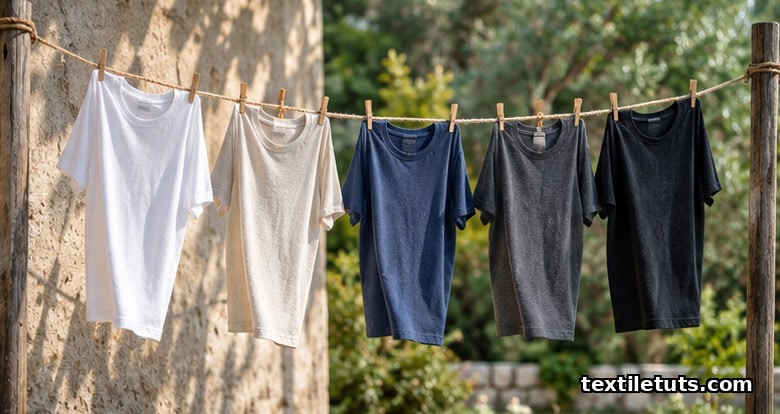
Air drying is the gentlest option and produces zero heat damage. Hang cotton t-shirts on a clothesline or drying rack by the bottom hem — not by the shoulders. Hanging by the shoulder seam over time causes the fabric to stretch and distort, permanently altering the garment’s drape. White t-shirts can be dried face-out in direct sunlight for natural UV whitening — this is an effective and chemical-free bleaching method. Colored t-shirts should always be dried in the shade, inside-out, to prevent UV photodegradation of the dye.
Tumble Drying
Tumble drying is acceptable on a medium heat setting. Remove t-shirts while they are still slightly damp — typically after 20–25 minutes in a standard dryer — and hang them to finish air drying. This prevents over-shrinkage from extended heat exposure and stops permanent creases from setting into the fabric. Never tumble dry cotton t-shirts on high heat. High heat over-dries cotton fibers, causing them to become brittle and more prone to shrinkage during the final cooling phase, and it sets deep creases that become nearly impossible to remove.
Key Rules for Both Methods
- White cotton t-shirts: dry face-out in sunlight for UV whitening
- Colored cotton t-shirts: dry inside-out in shade
- Never tumble dry on high heat
- Remove slightly damp and hang to finish
Keeping White Cotton T-Shirts White
White cotton yellows over time due to a combination of sweat compounds, body oils, fabric softener buildup, and storage conditions. Preventing and reversing this yellowing requires a different approach from colored garments.
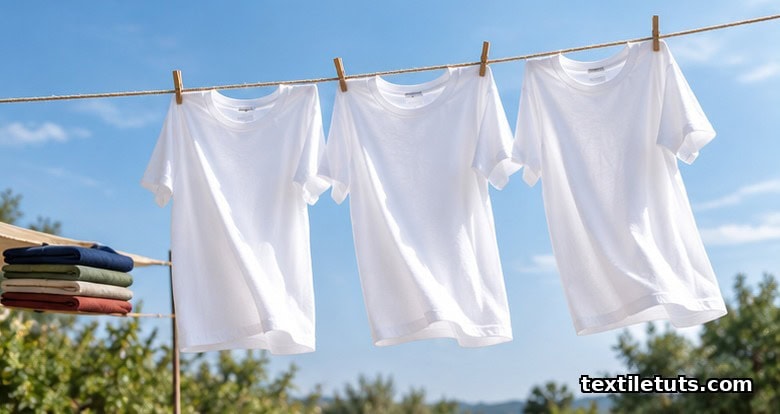
- Wash at 40°C — White cotton should be washed at 40°C rather than 30°C. The higher temperature is significantly more effective at breaking down the complex nitrogenous compounds found in sweat and body oils that cause yellowing in collar and underarm areas. These compounds are chemically resistant to cold water washing.
- Add oxygen bleach periodically — OxiClean (sodium percarbonate, an oxygen bleach) should be added to every third white cotton wash to prevent yellowing buildup. Oxygen bleach is chemically gentler than chlorine bleach — it releases oxygen rather than free chlorine, which means it whitens without the fiber degradation that chlorine bleach causes with repeated use. Chlorine bleach weakens ring-spun cotton fibers by oxidizing the cellulose chains, progressively thinning the fabric over dozens of washes.
- Line dry in direct sunlight — UV light naturally bleaches cotton through a photochemical reaction that breaks down the molecular structures causing yellowing. This is the same mechanism used in industrial textile whitening but delivered safely at home. The sun’s UV radiation is a powerful and completely free whitening agent.
- Avoid damp storage — Never store white cotton t-shirts while they are still damp. Moist warm environments accelerate the Maillard reaction — the same chemical process that browns food — causing yellowing to develop even in clean garments stored for extended periods. Ensure whites are completely dry before folding and storing.
- Skip fabric softener entirely on white cotton — Fabric softener buildup is a primary cause of grey, dull appearance on white cotton. It leaves a residue that traps soils and creates a grey film on the fabric surface. This residue is particularly noticeable in the collar and cuff areas where it builds up most rapidly.
For persistent underarm yellowing on white cotton, treat the affected areas with a paste of baking soda and water before washing. This helps lift the embedded sweat compounds that regular detergent alone cannot fully remove. If you regularly deal with heavy sweat staining on white shirts, our guide to removing sweat stains from white shirts covers targeted pre-treatment methods.
Keeping Dark Cotton T-Shirts from Fading
Dark cotton dyes — particularly deep navy, black, and charcoal — are the most prone to visible fading because the dye concentration is higher and the contrast between faded and original color is more noticeable. Fading in dark garments is cumulative and irreversible, so prevention is essential.
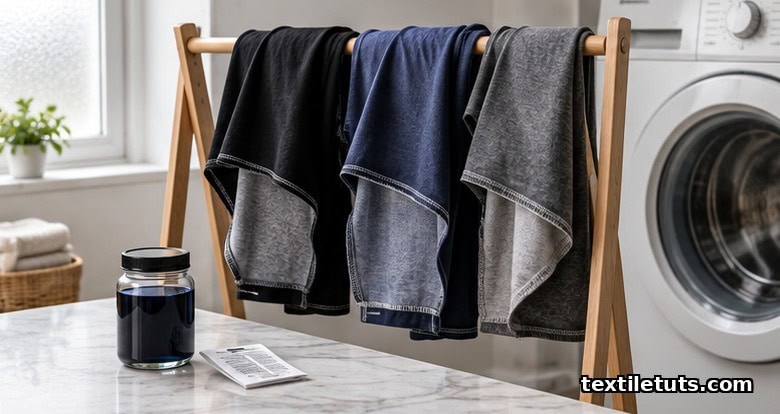
- Always wash inside-out — This is non-negotiable for dark cotton. Turning garments inside-out eliminates direct friction between the outer dye surface and the wash barrel, reducing the mechanical abrasion that physically removes dye molecules from fiber surfaces.
- Always use cold or 30°C water — Lower wash temperatures significantly slow dye release from cotton fibers. Even 10°C makes a measurable difference in colorfastness preservation over the lifetime of the garment.
- Use detergent formulated for darks — Products like Woolite Dark, Perwoll Black, and similar dark-specific detergents contain reduced or zero bleaching agents, higher levels of dye-transfer inhibitors (chemicals that capture loose dye molecules in the wash water before they can re-deposit on other garments), and pH-balanced formulas specifically designed to be gentle on dark dyes.
- Line dry inside-out in shade (or tumble dry on low) — UV exposure from line drying is one of the fastest fading mechanisms for dark cotton. If using a dryer, a low-heat tumble dry cycle is preferable to sun drying. If line drying is the only option, always turn dark garments inside-out and position them in full shade.
- Reduce washing frequency — Dark cotton t-shirts worn for short periods without heavy sweating or staining can often be air-exposed overnight or lightly misted with water and hung to refresh, rather than full machine washed. Each wash cycle contributes to cumulative fading. The general guidance is to wash dark t-shirts after 2–3 wears, compared to whites which benefit from more frequent laundering.
Storage Tips for Cotton T-Shirts
Proper storage extends the wearable life of cotton t-shirts just as much as correct washing — yet it is the most commonly skipped step in cotton garment care.
- Fold and stack for long-term storage — Hanging cotton t-shirts causes shoulder distortion over time as the fabric stretches under its own weight, particularly with heavier ring-spun cotton fabrics. Folding and stacking distributes the fabric’s weight evenly and prevents any deformation. Fold along the original construction seams for the cleanest results.
- Hanging is fine for daily wear rotation — For t-shirts in active rotation, a proper shirt hanger with contoured shoulders — not wire hangers — is acceptable. The contoured shape supports the natural shoulder slope and reduces point stress on the fabric at the shoulder seam.
- Store whites separate from colors — Even clean colored fabric carries trace residual dye that can transfer to adjacent white garments during long-term storage. This is particularly relevant for new dark cotton garments, which may not be fully colorfast after their first few washes. Store dark and light garments in separate stacks or in garment bags for extended periods.
If you need to intentionally shrink a cotton garment — for example, if a new cotton shirt is slightly too large — our intentional shrinkage guide covers the correct methods using controlled heat exposure. Conversely, for treating stained white cotton clothing, our guide to removing stains from white clothes has comprehensive pre-treatment and wash instructions.
Frequently Asked Questions
How hot should you wash cotton t-shirts?
Wash colored cotton t-shirts at 30°C and white cotton t-shirts at 40°C. Temperatures above 40°C cause progressive shrinkage of 1–3% per wash cycle and accelerate color fading significantly. High-temperature washing at 60°C is only necessary for sanitizing items exposed to illness or heavy contamination.
How do you stop cotton t-shirts from shrinking?
Wash at 30–40°C maximum, remove from the dryer while still slightly damp, and air dry when possible. Pre-shrunk t-shirts — which includes most branded garments — have already undergone controlled shrinkage during manufacturing, removing 3–5% of potential shrinkage. However, exposure to temperatures above 40°C can cause an additional 1–3% shrinkage with each wash cycle.
Can you wash cotton with other fabrics?
Yes — cotton washes safely with synthetic blends and most other durable fabrics. Sort by color, not fabric type. However, avoid washing cotton with delicate fabrics such as silk or wool that require cold-water-only washing or hand-wash cycles, as the agitation and temperature suitable for cotton may damage these materials.
Does turning t-shirts inside-out really make a difference?
Yes — turning t-shirts inside-out is the single most effective step for preserving both color and graphic prints. This technique eliminates direct friction between the outer dye surface and the wash barrel, reducing mechanical abrasion that physically removes dye molecules from fiber surfaces. For printed graphics, inside-out washing also protects the transfer adhesive from heat and mechanical stress that causes cracking and peeling.
References
- Cotton Incorporated. (n.d.). Cotton Care Guide. cottonworks.com
- ASTM International. (n.d.). ASTM D3136 — Standard Specification for Maintenance Labeling of Textile Floor Coverings. astm.org
- AATCC. (n.d.). Technical Manual of the American Association of Textile Chemists and Colorists. aatcc.org
- Textile Exchange. (n.d.). Preferred Fiber and Materials Report. textileexchange.org
- IWTO. (n.d.). International Wool Textile Organisation — Textile Care Guidelines. iwto.org


