
Zippers: Coil, Metal, Molded — When to Use Each

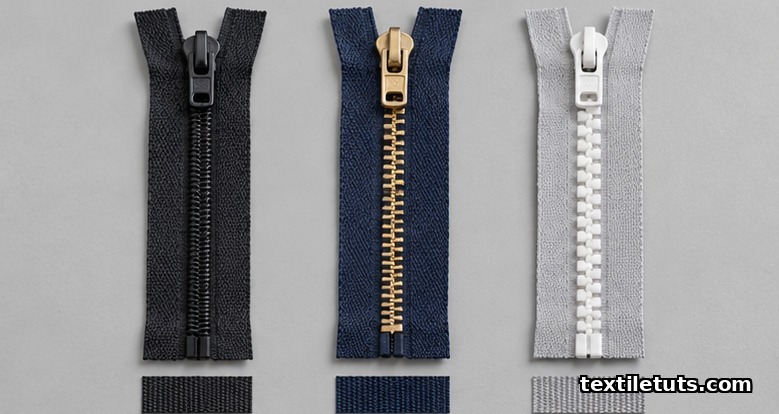
A coil zipper is made from a continuous spiral of polyester or nylon monofilament with a typical element width of 3 to 10 mm and a transverse pull strength of 200 to 500 N at the slider, while a metal zipper uses individually stamped brass, nickel, or aluminum teeth rated at 600 to 1,200 N, and a molded zipper uses injection-molded acetal resin (POM, also called polyoxymethylene) teeth rated at 400 to 800 N. Picking the wrong type for the application is the single most common reason a zipper fails in the field, so the choice has to be made before the fabric is cut.
This guide walks through each zipper type by construction, strength, and the garments and products it suits. Engineers, pattern makers, and home sewists should walk away knowing which one to specify for denim, leather, outerwear, luggage, and marine or upholstery work.
How a Zipper Is Built: The Three Constructions
The “type” of a zipper refers to how its interlocking elements (the teeth) are made. The slider, the locking pin or box, and the top and bottom stops are similar across types; what changes is the teeth and the tape that carries them. ASTM D2050 defines the chain sizes (#3, #5, #8, #10, #15, #20) and the slider geometries used across the industry.
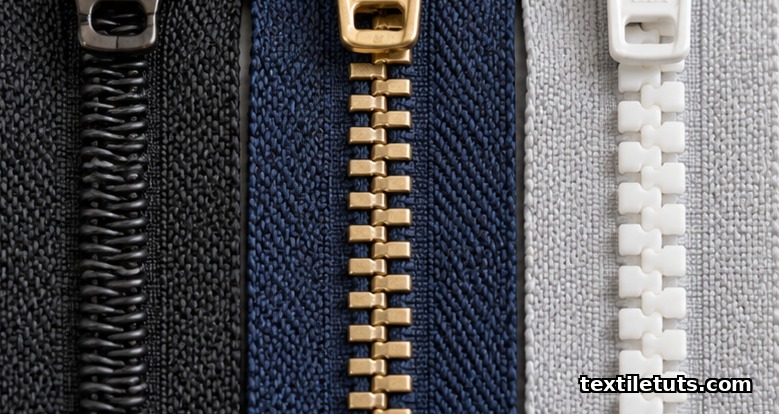
Coil zippers, often called nylon or polyester coil, use a single continuous monofilament of polyester or nylon that is spiral-wound onto a woven or knitted polyester tape and then heat-set. The slider opens and closes the spiral by spreading and pressing adjacent coils apart and back together. Coil construction is the lightest of the three and tolerates lateral curve better than the others, which is why it dominates curved applications such as luggage panels, sleeping bags, and footwear.
Metal zippers use individually cut teeth stamped from a flat coil of brass, nickel, or aluminum alloy, then clamped onto the tape. Brass is the most common alloy for apparel because it is corrosion-resistant, takes dye and plating well, and produces the characteristic “jeans” look. Aluminum is lighter but softer; nickel is harder and more common in outerwear and workwear. Each tooth is a separate piece, so a damaged section can be replaced without rebuilding the chain.
Molded zippers use an injection molding process: molten acetal resin (POM, marketed under brand names such as Delrin and Celcon) is shot into a die that forms each tooth individually along the tape. The result is a chunkier, more rigid element than coil. Because the polymer is hydrophobic and chemically stable, molded zippers handle UV, saltwater, and dry cleaning solvents far better than nylon coil, which is why they are the default for marine, automotive, and outdoor gear.
Strength Numbers: How the Three Types Compare
ASTM D2061 is the standard test method most manufacturers use to publish zipper strength. It measures four properties: transverse strength (pulling the chain sideways at the slider), chain crosswise strength (pulling the two tapes apart across the chain), chain lengthwise strength (pulling the chain along its length), and slider pull-off strength (the force needed to yank the slider off the chain). All zipper tests are conditioned under ISO 139 at 20 degrees C and 65 percent relative humidity.
| Property (ASTM D2061) | Coil (#5 polyester) | Metal (#5 brass) | Molded (#5 acetal) |
|---|---|---|---|
| Transverse strength at slider | 200 to 500 N | 600 to 1,200 N | 400 to 800 N |
| Chain crosswise strength | 250 to 450 N | 700 to 1,100 N | 500 to 900 N |
| Slider pull-off | 80 to 150 N | 200 to 400 N | 150 to 300 N |
| Open/close cycle rating (typical supplier data) | 500+ | 1,000+ | 500+ |
| Cold-crack tolerance | Good to minus 30 degrees C | Good to minus 40 degrees C | Good to minus 20 degrees C (becomes brittle below) |
| UV and saltwater resistance | Moderate (nylon yellows; polyester better) | High (96 h ASTM B117 salt spray on brass/nickel) | High (hydrophobic polymer; no filament to fray) |
The numbers above are typical #5 size ranges reported by major zipper manufacturers; specific lots vary by plus or minus 15 percent based on supplier and lot. Chain size (#3, #5, #8, #10) matters as much as the type. A #3 coil is roughly 3 mm wide and handles shirt plackets and light pockets; a #10 metal or molded is 10 mm wide and is used for heavy tents, marine covers, and industrial curtains. The British Standard BS 3084 specifies the chain dimensions and tolerance classes that most European manufacturers still publish against.
Coil Zippers: When to Specify
Pick coil when the application is lightweight, curved, or sees lots of flex. The polyester or nylon element flexes with the fabric and resists splitting when sewn across a curved seam, which is why coil dominates in:
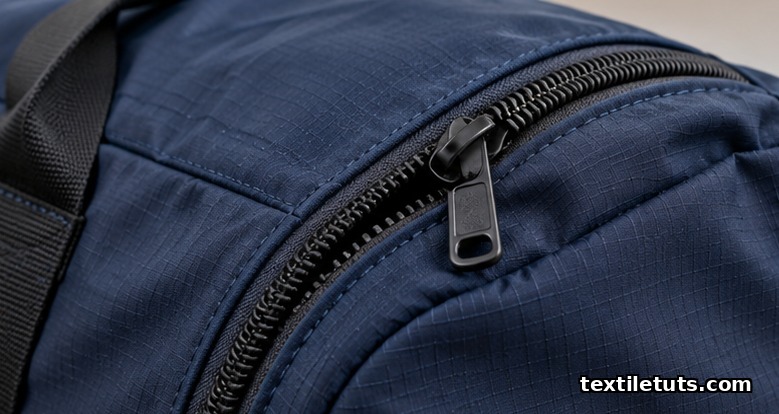
- Luggage and travel bags, including curved suitcase panels.
- Sleeping bags, down jackets, and other down-filled garments (the flex prevents tooth-line blow-outs).
- Footwear zippers, where the chain must bend with the upper.
- Light apparel plackets, dress zippers, and concealed pocket closures.
- Children’s clothing, where the soft element is safer against skin.
Coil zippers are also the cheapest of the three to manufacture at scale. Industry data put global zipper production in the tens of billions of meters per year, with YKK (Japan) holding roughly 45 percent of the world market, followed by SBS (China), YBS, and IDEAL. The dominance of coil in this volume market is one reason the technology keeps improving: recent polyester coil variants carry color-matched dye lots, water-repellent tape finishes, and reflective threads that match outdoor fabric specifications.
Metal Zippers: When to Specify
Pick metal when the application needs the highest tensile strength and a defined aesthetic. The stamped teeth resist pull-apart forces better than the other two types and produce the audible “click” that consumers associate with durable garments. Typical uses include:
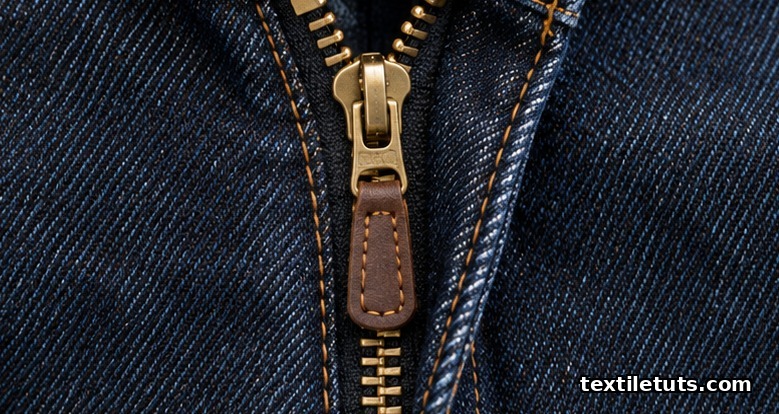
- Denim jeans, jackets, and work trousers (brass teeth are the industry default).
- Leather goods: jackets, boots, bags, motorcycle gear.
- Boots and rugged footwear where the slider must survive repeated kicks.
- Boat canvas and upholstery where the look is part of the brand.
- Heavy outdoor gear such as fire-resistant (FR) coveralls and tactical vests.
Brass and nickel both pass 96 h salt-spray testing under ASTM B117, the threshold most outdoor brands require. Aluminum zippers are lighter but softer and are usually reserved for fashion applications where the tooth is more visible than functional. Stainless steel is the strongest and most corrosion-resistant, but it costs more than brass and is harder to stamp cleanly, so it appears in specialty workwear rather than mass-market apparel.
One common specification note: ASTM D2051 measures the durability of zipper finishes to laundering cycles, and most brass zipper finishes hold up across five or more standard washes without flaking. If the project requires more than that, switch to nickel or specify a protective lacquer top coat.
Molded Zippers: When to Specify
Pick molded when the application exposes the zipper to UV, salt water, solvents, or extreme temperatures that would degrade a nylon coil. Because each acetal tooth is a separate molded unit with no exposed filament, the chain does not unravel when cut, and the polymer does not absorb water. Typical uses include:
- Marine enclosures, sail covers, and boat cushions.
- Ski jackets, snowboard pants, and other cold-weather shells.
- Automotive upholstery and seat covers.
- Tents, tarpaulins, and outdoor gear exposed to direct sun.
- Children’s outerwear (molded teeth are smoother and less likely to nick skin).
Molded zippers are heavier than coil of the same size (a #5 molded is roughly 1.5 times the linear weight of a #5 coil), so they are rarely chosen for lightweight applications where every gram counts. They are also stiffer across curved seams, which is why luggage and footwear designers still prefer coil.
Size, Tape, and the Other 20 Percent of the Decision
Type is half the decision. The other half is size, slider type (auto-lock, non-lock, pin-lock, double pull), tape width, and finishing. A few rules of thumb that hold up across most production environments:
- Match chain size to fabric weight: #3 for under 150 GSM, #5 for 150 to 300 GSM, #8 or #10 above 300 GSM.
- Use auto-lock sliders on children’s wear, outdoor gear, and any product where the consumer will carry it vertically.
- Choose polyester tape (not cotton) for outdoor and marine applications to avoid tape rot.
- For flame-resistant (FR) workwear, specify aramid or FR-treated polyester tape and metal teeth only; coil and molded acetal can melt under arc flash.
- For garments that will be dyed after assembly, choose a zipper with the same dye lot and a compatible dye class (disperse for polyester, acid for nylon).
Frequently Asked Questions
What is the strongest type of zipper?
Metal zippers, specifically brass or stainless steel, hold the highest published tensile values on ASTM D2061 testing: a #5 brass chain typically reaches 600 to 1,200 N of transverse strength at the slider, well above a comparable coil (200 to 500 N) or molded (400 to 800 N) chain. For the highest strength available, specify stainless steel in #10 or #15 size.
Are molded zippers the same as plastic zippers?
Yes. “Plastic” and “molded” describe the same manufacturing process, where acetal resin (POM, also sold under the brand names Delrin and Celcon) is injection-molded into individual teeth. “Vinyl” zippers are a related but lighter construction made from PVC, common in cushion covers and inexpensive bags.
Can a home sewing machine handle metal zippers?
Yes, with a universal or jeans needle (size 90/14 or 100/16) and a zipper foot. Sew slowly across the teeth and use a longer stitch length (3.0 to 3.5 mm) to avoid breaking needles. Brass teeth will blunt a standard needle faster than coil, so plan on replacing the needle after two or three jeans.
Which zipper should I use for outdoor jackets?
Molded zippers are the standard for waterproof and weather-resistant shells because acetal teeth resist UV and do not absorb water. Coil zippers with a water-repellent (WR) tape finish are acceptable for less technical jackets, and metal zippers are reserved for fashion-forward shells where the look matters more than weight savings.
How long should a zipper last?
ASTM D2051 measures the durability of finish to laundering and similar wash protocols, not mechanical life. Mechanical life is published as cycle counts: most #5 coil and molded zippers are rated for 500+ open/close cycles in supplier data, and metal zippers for 1,000+. In practice, a zipper that fails inside its first 100 cycles almost always has a manufacturing defect; one that fails after a few years has usually been mis-specified for its environment.
References
- ASTM International. ASTM D2061: Standard Test Methods for Strength Tests for Zippers. ASTM International, West Conshohocken, PA. Defines the four strength tests (transverse, crosswise, lengthwise, slider pull-off) used to rate zipper chain, slider, and tape.
- ASTM International. ASTM D2050: Standard Terminology Relating to Zippers. ASTM International. Defines chain size (#3, #5, #8, #10, #15, #20), element types, and slider types used across the industry.
- ASTM International. ASTM D2051: Standard Test Method for Durability of Finish of Zippers to Laundering. ASTM International. Five-wash cycle protocol used to rate zipper finishes for wash durability.
- ASTM International. ASTM B117: Standard Practice for Operating Salt Spray (Fog) Apparatus. ASTM International. The salt-spray chamber protocol (96 h threshold) used to qualify brass and nickel zipper finishes for marine and outdoor use.
- British Standards Institution. BS 3084: Specification for Zippers. BSI Group, London. The UK national standard for chain dimensions, strength classes, and finish.
- International Organization for Standardization. ISO 139: Textiles, Standard Atmospheres for Conditioning and Testing. ISO, Geneva. Defines the 20 degrees C / 65 percent RH conditioning environment required by ASTM D2061 and similar zipper tests.
This article is the working reference for selecting between coil, metal, and molded zippers. Editorial by Kazi Sifat Muntasir, TextileTuts. Sources: ASTM D2061, ASTM D2050, ASTM D2051, ASTM B117, BS 3084, ISO 139 as cited.


