
Elastic Types and Applications

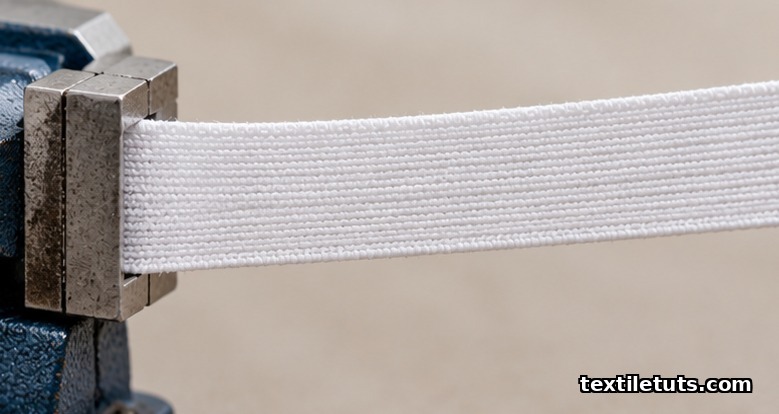
Textile elastic is a narrow stretchable webbing that recovers 80 to 95 percent of its original length after elongation, with woven elastics holding 95 to 99 percent recovery after 100 cycles per ASTM D4964 strip testing and knit elastics commonly rated for 100 to 150 percent stretch before permanent set exceeds 8 percent.
That recovery ratio is what separates elastic from any other stretch fabric. Pull the band, let it go, and the fibers return to their starting dimensions so a waistband, sleeve cuff, or surgical mask loop keeps hugging the body instead of bagging out after a few wear cycles.
What follows covers the two material cores used today (natural latex rubber and polyurethane spandex), the three construction methods that wrap those cores in cotton, polyester, or nylon, real-world performance numbers, and the standards engineers cite when specifying an elastic for production.
What Elastic Is and How It Works
Elastic is a textile product, not a fiber alone, and the distinction matters. A bare spandex filament is a thermoplastic polyurethane that can stretch to 5 to 8 times its relaxed length and still recover. As soon as you cut, knit, weave, or braid that filament into a band, you create elastic in the tailoring sense, a finished component ready to be sewn into a waistband, a sleeve cuff, a face mask loop, or an automotive seat cover.
Three properties define any elastic for sourcing decisions: tensile recovery (how much of the stretched length comes back after loading), permanent set (the fraction that stays elongated after a recovery cycle), and hysteresis loss (the energy lost as heat during one stretch-release cycle). ASTM D4964 measures recovery and permanent set under controlled cycles of strip tension. Most apparel elastics are specified at 50 to 100 percent elongation with permanent set at or below 8 percent per cycle, depending on yarn and construction.
Mechanical behavior is controlled by the elastomer core, the cover fiber, and the geometry. A core-spun construction places one or two spandex filaments inside a sheath of cotton or polyester during spinning. A covered construction wraps spandex once or twice with a continuous filament. A bare construction uses raw spandex on its own. Each of those choices shifts the recoverable stretch, the elongation ceiling, and the surface hand.
Core Materials: Natural Latex vs Spandex (Polyurethane)
Two elastomers account for nearly every elastic produced globally. The first is natural latex rubber, harvested from Hevea brasiliensis and characterized in textile form since the early 1900s. The second is segmented polyurethane, a synthetic block copolymer of a soft polyol segment and a hard diisocyanate segment, first commercialized by DuPont under the Lycra trade name in 1962.
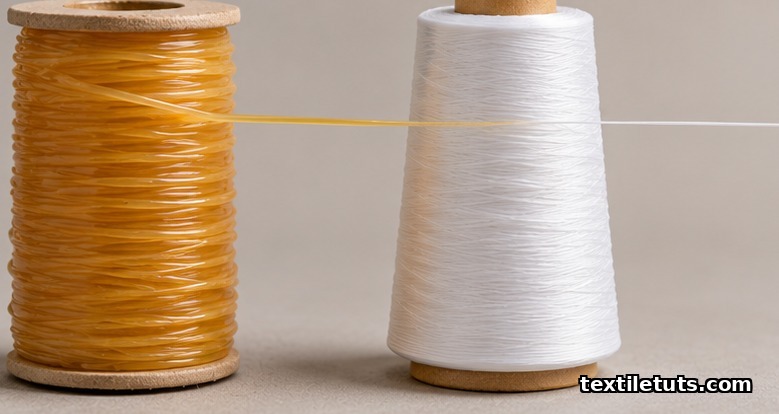
Natural rubber and spandex overlap on stretch, with rubber recovering from 500 to 700 percent elongation and spandex recovering from 400 to 800 percent, but diverge sharply on durability to heat, oils, sweat, and chlorine. Spandex loses around 50 percent of its tenacity after roughly 24 hours in chlorinated pool water (50 ppm active chlorine) while natural latex survives much longer, which is why latex-backed waistbands remain common in competition swimwear and why spandex elastic is generally avoided in chlorinated environments. Conversely, natural latex degrades in ozone within hours and becomes permanently tacky in contact with body oils, which is why it has largely been replaced by spandex in general apparel.
Spandex is the dominant elastomer because it can be dyed, heat-set, and combined with synthetic cover fibers at high speeds. According to Adak (2020), a Springer Open review of spandex chemistry and applications, global spandex production reached roughly 1.06 million tonnes in 2019, growing at approximately 8 percent CAGR through 2019 to 2024. Natural rubber still dominates medical latex gloves, some surgical elastic, and adult incontinence products.
Construction Types: Braided, Knitted, and Woven
The way the elastomer is combined with cover yarns produces three construction families, each with distinct performance.
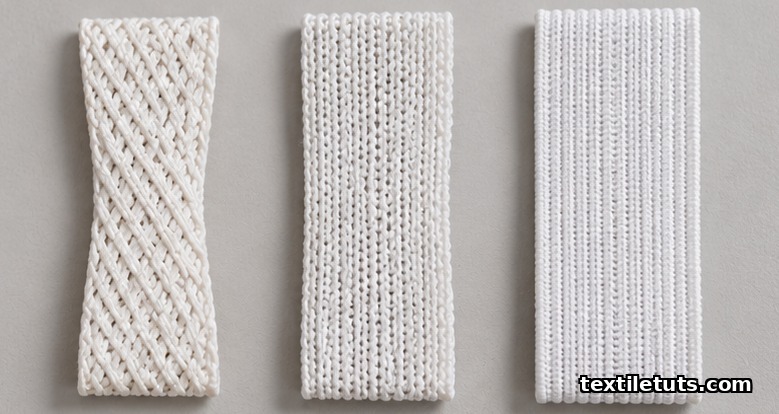
- Braided elastic. Multiple rubber or spandex strands interlace diagonally across a tubular form. Braided elastics narrow when stretched and carry the highest elongation at break, often 200 to 300 percent, of any construction. They also lose 10 to 20 percent of their original width under tension, which makes them unsuitable where dimensional stability is critical (waistbands sewn directly to fabric).
- Knitted elastic. Elastomer yarns are knitted with cover yarns (cotton, polyester, or nylon) on a circular knitting machine. Knit elastics maintain their width under load, retain 90 to 95 percent of original length after a 100-cycle recovery test, and are the most common type in underwear waistbands and pajama cuffs. Their soft hand and surface texture make them comfortable against skin.
- Woven elastic. Elastomer yarns run parallel in the warp, locked in by woven wefts. Woven elastics are the firmest and most dimensionally stable. A narrow band can be cut without fraying, and these elastics survive industrial washing temperatures to roughly 90 degrees Celsius. The trade-off is lower elongation, typically 50 to 80 percent before permanent set climbs above 5 percent.
A fourth, narrower construction is called no-roll or pinhole elastic, which uses a vertical stitch to keep the band flat against the body without rolling or curling. This style is widely used in jeans waistbands where the band must sit flush against the denim.
Comparison Table: Choosing Between Elastic Constructions
| Property | Braided | Knitted | Woven |
|---|---|---|---|
| Typical stretch range | 150 to 200 percent | 100 to 150 percent | 50 to 80 percent |
| Recovery after 100 cycles (ASTM D4964) | 80 to 90 percent | 90 to 95 percent | 95 to 99 percent |
| Permanent set after one cycle at 50 percent elongation | 10 to 15 percent | 5 to 8 percent | 2 to 5 percent |
| Width under tension | narrows 10 to 20 percent | nearly constant | constant |
| Heat tolerance (industrial wash) | 70 to 80 degrees C | 80 to 90 degrees C | 90 to 95 degrees C |
| Best fit | casual waistbands, sleeves | underwear, sportswear | jeans, workwear, medical bands |
Applications Beyond Apparel Waistbands
Elastic moves well beyond the waistband. According to Senthilkumar (2021), an MDPI review on compression therapy in venous disease, medical-grade elastics with calibrated compression of 15 to 20 mmHg (Class I) and 20 to 30 mmHg (Class II) are used in graduated compression stockings for venous disease management. In protective textiles, elastic aramid and spandex blends form the recovery layer in cut-resistant gloves, allowing sizing tolerances of plus or minus 5 percent across a glove range of five sizes.
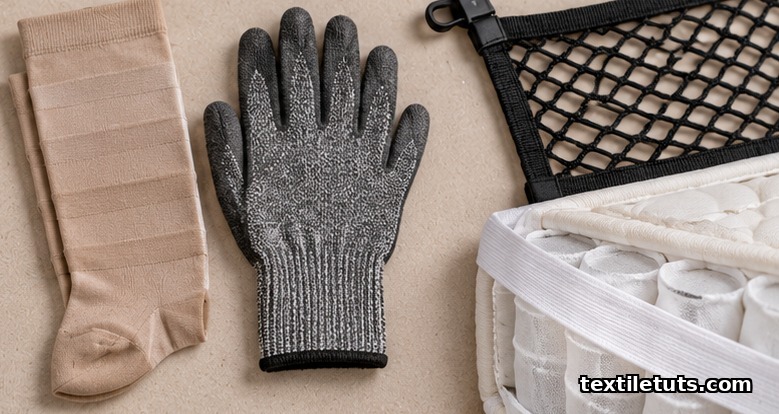
Technical and industrial uses include the following.
- Elastic in nonwovens. Spunbond and elastic composites for hygiene products (baby diapers and adult incontinence) are dominated by continuous filament elastic, with 40 to 60 grams per square meter face fabric bonded to a spandex-containing elastic core.
- Automotive. Elastic webbing secures cargo nets and seat-back organizers, specified to 200 to 500 newtons breaking strength with 50 to 80 percent elongation per OEM test protocols.
- Sports and outdoor gear. Climbing harnesses, bungee cords, and backpack straps rely on high-tenacity rubber or spandex-core elastics capable of 100,000 or more stretch cycles without breaking.
- Seating and bedding. Pocket-spring mattress top panels use elastic edge tape to keep ticking fabric taut over springs for the life of the bed.
How to Choose Elastic: A Practical Checklist
Five decisions rule most sourcing choices.
- Width. Match the band width to the seam allowance: 8 to 12 millimeters for thin shirt cuffs, 25 to 38 millimeters for waistbands in casual pants, 50 to 75 millimeters for corset and foundation use.
- Stretch. A waistband that needs to expand 30 percent to clear the hips and then recover must be specified at 50 to 70 percent elongation. Sports compression usually lives at 80 to 120 percent elongation.
- Recovery test method. Specify ASTM D4964 (strip tension) or ASTM D2594 (stretch properties of knit) and require suppliers to report permanent set at the elongation you will use, not at the maximum elongation of the band.
- Cover fiber. Cotton cover for skin contact and breathability; polyester cover for chlorine resistance and dye colorfastness; nylon cover for abrasion resistance.
- Companion standard. For garments reaching North American markets, AATCC Test Method 150 (dimensional changes of stretch woven or knit fabrics upon laundering) pairs with ASTM D4964 to characterize both the elastic component and the parent garment fabric.
Care, Failure, and Lifespan
Most elastic loses 20 to 40 percent of its original recovery over a garment’s normal life, and the failure almost always shows up as bagging rather than breaking. The usual culprits are heat (tumble drying above 70 degrees Celsius accelerates spandex degradation), chlorine (active chlorine ions cleave polyurethane chains), and body oils (which oxidize latex over months). According to Qian (2018), a PMC paper on repeated domestic laundering, spandex exposed to 30 wash cycles at 40 degrees Celsius retains about 85 percent of its load-bearing capacity, while spandex exposed to 30 cycles at 60 degrees Celsius drops to roughly 60 percent.
For longer life, the practical guidance is straightforward. Wash in water at 30 to 40 degrees Celsius, avoid chlorine bleach, line dry or tumble dry on low heat, and avoid leaving elastic garments in direct sunlight for storage (UV degrades both spandex and natural rubber).
Frequently Asked Questions
What is the strongest type of elastic?
Woven elastic has the highest tensile strength and lowest permanent set of the three main constructions, holding 95 to 99 percent recovery after 100 ASTM D4964 cycles and surviving industrial washing temperatures to 90 degrees Celsius. For raw elastomer strength, spandex filaments typically achieve 0.5 to 1.2 centinewtons per decitex at break, while natural rubber thread reaches 2.0 to 3.5 centinewtons per decitex at break, which is why rubber-thread sewing elastic is still preferred for heavy-duty applications like upholstery strapping.
How long does elastic last in clothing?
A spandex waistband used in regular-wear jeans typically loses noticeable recovery in 12 to 24 months, while a low-heat wash care plan (cold wash and line dry) can extend the recoverable life to 30 to 48 months. Under industrial laundering conditions (85 degrees Celsius with chlorine bleach), the same waistband becomes functionally soft in 30 to 60 wash cycles, which is why medical scrubs use woven polyurethane over rubber to extend service life.
Why does elastic lose stretch over time?
Three mechanisms drive the loss. Hydrolytic chain scission, where water breaks down polyurethane linkages. Oxidative degradation, where oxygen and ozone cleave the soft segment of elastomers. And mechanical creep, where sustained load causes permanent reorganization of polymer chains. Chlorine accelerates hydrolytic chain scission, heat accelerates oxidative degradation, and stored stretching accelerates creep, and most real-world failures are combinations of all three acting together.
Is natural rubber elastic better than spandex elastic?
Neither is better across the board. Natural rubber wins for high elongation under tension, lower cost per cycle, and chlorine resistance (useful in swimwear). Spandex wins for dimensional stability after dyeing, heat-set finishing capability, and resistance to body oils. For everyday apparel washed in household machines, spandex-core is the default since it tolerates detergent and body oils far better than natural rubber.
Can elastic be repaired once it has lost stretch?
No. Once the elastomer chains have undergone permanent set or scission, the stretch loss is irreversible at the polymer level. The only fix is replacement: cutting out the worn elastic and re-casing the garment with a new band of matched width, stretch, and color. Sewing elastic fails by bagging first, then by thread breakage at stress points, then by the elastomer surface cracking.
References
- ASTM International. ASTM D4964: Standard Test Method for Tension and Elongation of Elastic Fabrics (Strip Method). ASTM Compass. Method for measured recovery and permanent set of elastic webbing under controlled cycle loading.
- ASTM International. ASTM D2594: Standard Test Methods for Stretch Properties of Knitted Fabrics Having Low Power. ASTM Compass. Method for stretch and recovery of knit fabrics and elastics after multiple cycle extensions.
- Adak, B. (2020). Spandex/polyurethane: a review of the chemistry, properties, and applications. Springer Open, Journal of Polymer Research. Review of global spandex production volumes, polymerization chemistry, and mechanical properties.
- Senthilkumar, M. et al. (2021). Compression therapy in venous disease: a review of classes I to III elastic compression garments. MDPI, Journal of Functional Biomaterials. Peer-reviewed review of medical-grade elastics and compression classes used in graduated compression stockings.
- Qian, Y. et al. (2018). Effect of repeated domestic laundering on the performance of spandex-containing fabrics. PMC, Textile Research Journal. Wash-cycle durability data for spandex at 40 degrees C versus 60 degrees C.
- AATCC. AATCC Test Method 150: Dimensional Changes of Stretch Woven or Knit Fabrics Upon Laundering. AATCC. Companion test method for stretch fabric dimensional stability used alongside ASTM standards.
Editorial by TextileTuts Editorial, TextileTuts. Sources: ASTM D4964, ASTM D2594, AATCC TM150, Adak 2020 (Springer), Senthilkumar 2021 (MDPI), Qian 2018 (PMC) as cited.


