
ZDHC (Zero Discharge of Hazardous Chemicals)


The Zero Discharge of Hazardous Chemicals (ZDHC) Foundation, founded in November 2011 by Adidas, C&A, H&M, Levi Strauss & Co., Nike, and PVH Corp., governs an industry program built on a Manufacturing Restricted Substances List (MRSL) that caps more than 190 hazardous substances at the chemical-formulation stage of textile, leather, and footwear production. The current ZDHC Wastewater Guidelines (version 2.1, published 2022) add a second layer of control by defining effluent limits for 196 parameters including heavy metals, per- and polyfluorinated alkyl substances (PFAS), and adsorbable organic halides (AOX).
This guide explains what ZDHC requires of wet-processing facilities, how the MRSL differs from a brand-level Restricted Substances List (RSL), and what a supplier must do to achieve performance-level alignment under the ZDHC InCheck scheme.
What ZDHC Is and Why Six Brands Created It
The ZDHC Foundation launched in 2011 as a direct response to Greenpeace’s Detox campaign, which challenged major apparel brands to eliminate all releases of hazardous chemicals from their supply chains by 2020. The founding signatories committed to a single, shared chemicals-management framework rather than each maintaining a parallel restricted-substances program. Today the Foundation counts more than 100 contributing organizations, including brands, chemical suppliers, and accredited solution providers, and its documents are cross-referenced by the Sustainable Apparel Coalition’s Higg Facility Environmental Module (FEM).
ZDHC’s working premise is that controlling chemicals at the formulation stage (what comes into the factory) is more effective than only testing finished products. The MRSL therefore restricts substances in chemical products used by tanneries, dye houses, printers, and finishing units, while the Wastewater Guidelines limit what those facilities may discharge, regardless of where the chemicals originated. The two-layer structure mirrors the preventive controls found in ISO 14001 environmental management systems and EU REACH registration dossiers.
The Manufacturing Restricted Substances List (MRSL)
The current ZDHC MRSL (version 3.1, released December 2023) covers chemical substances grouped into 16 chemical families, including alkylphenols and alkylphenol ethoxylates (APEOs), short-chain chlorinated paraffins (SCCPs), medium-chain chlorinated paraffins (MCCPs), phthalates such as DEHP and DBP, per- and polyfluorinated substances (PFAS), heavy metals (lead, cadmium, mercury, hexavalent chromium), organotin compounds, and chlorinated solvents. The list sets concentration limits expressed in parts per million (ppm), with most entries capped between 50 ppm and 1,000 ppm depending on the substance class. For PFAS the limit is expressed as “not intentionally added” combined with a 100 ppm total-fluorine screening threshold, an approach that mirrors the EU REACH universal PFAS restriction proposal published in February 2023.
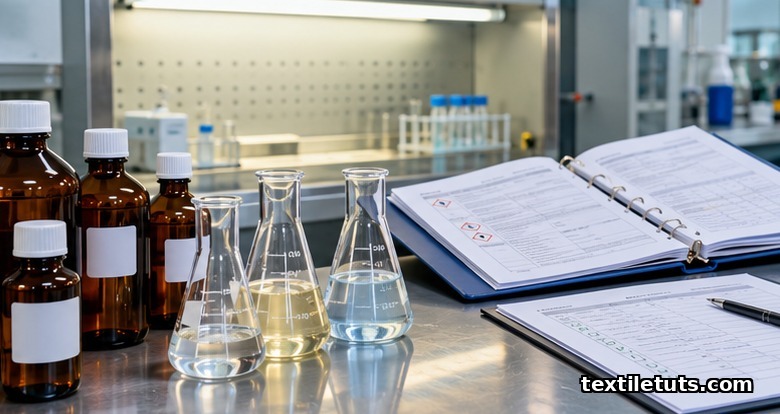
Compliance is verified through Safety Data Sheet (SDS) screening plus chemical-formulation testing against accredited laboratories. The ZDHC-accredited lab network operates under ISO/IEC 17025 and currently includes more than 30 laboratories worldwide, each listed in the ZDHC Approved Wastewater Laboratory register. Chemical suppliers that have completed the ZDHC ChemCheck program can be searched by brand buyers through the ZDHC Gateway, which serves as the central data-exchange platform.
ZDHC Wastewater Guidelines v2.1
Published in 2022, the Wastewater Guidelines specify effluent limits for 196 parameters across conventional wastewater treatment systems and advanced effluent treatment trains. Substances regulated include total suspended solids (TSS) capped at 50 mg/L for conventional effluent, biochemical oxygen demand (BOD) at 50 mg/L, heavy metals such as lead (Pb ≤ 0.1 mg/L), cadmium (Cd ≤ 0.05 mg/L), and mercury (Hg ≤ 0.005 mg/L), and indicator parameters such as AOX (≤ 1 mg/L) and PFOS (≤ 10 ng/L). The numerical limits are aligned with the Best Available Techniques (BAT) Reference Document for the textiles industry published by the European Commission’s Joint Research Centre in 2023.

Facilities that wish to demonstrate compliance must sample effluent through a ZDHC-accredited laboratory, follow chain-of-custody protocols, and submit results through the ZDHC Gateway platform, where brand buyers can review verified data without re-testing. The sampling schedule requires a minimum of one annual wastewater test for InCheck Performance reporting, plus targeted tests whenever a new chemical class is introduced into the facility.
ZDHC InCheck: Foundational and Performance Levels
InCheck is the self-reporting mechanism through which a wet-processing facility declares its MRSL conformance. Reports are categorized as either Foundational (Level 1) or Performance (Level 2). Foundational reports capture basic chemical inventory data and SDS screening. Performance reports require evidence of full MRSL screening against formulation-level chemical analyses plus at least one ZDHC Wastewater Guideline test in the prior 12 months. As of the 2024 ZDHC Annual Report, more than 9,000 InCheck reports had been generated across 50+ countries, with the largest concentrations in Bangladesh, India, Turkey, Vietnam, and China.
Foundational reports give a facility a baseline. Performance reports translate into commercial advantages such as inclusion in a brand’s preferred supplier list and eligibility for multi-buyer acceptance of test results. Both report types are reviewed by a ZDHC-Approved Solution Provider (ASP) to certify that the underlying evidence is complete. The ASP also acts as the importer of chemical inventory data into the Gateway and is the facility’s primary contact for any follow-up clarification.
ZDHC MRSL vs. Brand RSL: What’s the Difference
| Attribute | ZDHC MRSL | Brand RSL |
|---|---|---|
| Scope | Chemical formulations used in production | Finished product (garment, shoe, accessory) |
| Stage | Input (chemical product) | Output (finished good) |
| Number of substances | 190+ | Varies (typically 100-500) |
| Limits expressed in | ppm in chemical formulation | ppm or mg/kg in finished article |
| Verification | SDS review plus chemical formulation testing | Finished-product testing (e.g., ISO 17075 for chromium VI) |
| Adoption | Multi-brand, cross-industry | Single brand or retailer |
| Update cadence | Foundation-managed, annually | Brand-managed, varies |
The two lists are complementary, not competing. A supplier can be fully MRSL-conformant yet still fail a brand RSL test on a finished product if contamination occurs during storage or transport. ZDHC therefore frames the MRSL as a preventive control that reduces, but does not replace, finished-product testing.
Implementation Path for a Wet-Processing Facility
Step-by-step, a textile wet-processing supplier follows this sequence to reach Performance level:
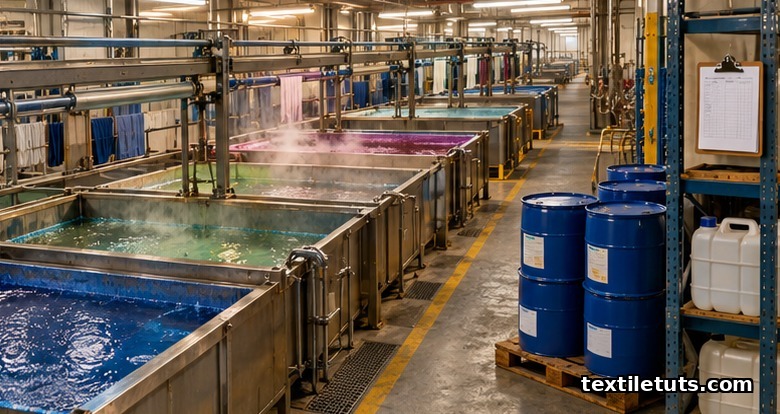
- Sign the ZDHC Joint Roadmap commitment at zdhc.org and obtain a Gateway account.
- Compile the chemical inventory of every formulation used on site, then screen each Safety Data Sheet against the current MRSL.
- Replace non-conforming chemicals with ZDHC-Certified ChemCheck alternatives where available.
- Engage a ZDHC-Approved Solution Provider (ASP) to upload Foundational-level data.
- Conduct annual wastewater testing through a ZDHC-accredited lab and address parameters that exceed Guideline v2.1 limits.
- Have the ASP upgrade the report to Performance level once SDS screening, chemical-formulation testing, and wastewater test results are all uploaded and verified.
For many factories the bottleneck is not the testing itself but the formulation replacement: identifying a ZDHC-compliant alternative for a specialty finish (water-repellent, softener, dye-fixation agent) can take 3-6 months of lab trials. ZDHC publishes a list of certified alternative chemistries for the most common high-risk applications to shorten this search.
Frequently Asked Questions
What does ZDHC stand for and what is its goal?
ZDHC stands for Zero Discharge of Hazardous Chemicals. Its stated goal is the elimination of hazardous chemical discharges across the textile, leather, and footwear value chain through shared chemical-management standards, wastewater guidelines, and supplier reporting tools. The Foundation’s stated target year for full implementation is 2030.
Is ZDHC certification mandatory for a textile supplier?
ZDHC is not legally mandatory. It is a voluntary industry program, but several major brands require Performance-level InCheck reports as a condition of doing business with new wet-processing suppliers. In Bangladesh, Vietnam, and Pakistan, key brand buyers have integrated ZDHC reporting into their standard supplier-onboarding questionnaires.
What is the difference between ZDHC MRSL 3.1 and the EU REACH SVHC list?
The ZDHC MRSL is broader than REACH Substances of Very High Concern (SVHC) in scope and stricter in application. The REACH Candidate List currently lists around 247 entries; the ZDHC MRSL 3.1 covers 190+ substances grouped by chemical family and assigns concentration thresholds for each. REACH regulates placing substances on the EU market, while ZDHC MRSL limits their use in chemical formulations supplied to global brands worldwide.
How are PFAS regulated under the ZDHC MRSL?
Per- and polyfluoroalkyl substances (PFAS) are listed under ZDHC MRSL 3.1 with a “not intentionally added” requirement plus a 100 ppm total-fluorine screening threshold. The ZDHC PFAS Guide, published as a separate document, also requires facilities to obtain supplier declarations of PFAS absence from each chemical supplier.
Can a small dyeing facility afford ZDHC Performance-level compliance?
Yes, though costs scale with facility size. SDS compilation is largely internal labor. Chemical-formulation testing is the largest line item, ranging from USD 1,500 to USD 5,000 per supplier audit. Wastewater testing through a ZDHC-accredited lab typically costs USD 2,000-USD 6,000 for a full panel covering 190+ parameters. Most brand buyers cover these costs directly through supplier-development programs.
References
- ZDHC Foundation. Manufacturing Restricted Substances List (MRSL) v3.1. https://www.zdhc.org — the industry-standard MRSL covering 190+ substances across 16 chemical families.
- ZDHC Foundation. Wastewater Guidelines v2.1. https://www.zdhc.org — effluent limits for 196 parameters across conventional and advanced treatment systems.
- European Commission Joint Research Centre. Best Available Techniques (BAT) Reference Document for the Textiles Industry. https://op.europa.eu — the technical reference cited by ZDHC Wastewater Guidelines.
- International Organization for Standardization. ISO/IEC 17025:2017 — General requirements for the competence of testing and calibration laboratories. https://www.iso.org — the standard governing ZDHC-accredited laboratories.
- Kant, R. (2012). Textile dyeing industry an environmental hazard. Natural Science, 4(1), 22-26. https://www.mdpi.com — peer-reviewed analysis of textile-dye effluent contamination.
- Yaseen, D. A., & Scholz, M. (2019). Textile dye wastewater characteristics and constituents of synthetic effluents: a critical review. International Journal of Environmental Science and Technology, 16(2), 1193-1226. https://link.springer.com — peer-reviewed review of textile dye effluent chemistry.
- Sustainable Apparel Coalition. Higg Facility Environmental Module (FEM). https://apparelcoalition.org — the FEM module that cross-references ZDHC Wastewater Guidelines.
This article is the working reference for ZDHC (Zero Discharge of Hazardous Chemicals). Editorial by Shahrukh Islam, TextileTuts. Sources: ZDHC Foundation (MRSL v3.1, Wastewater Guidelines v2.1); European Commission JRC BAT Reference Document; ISO/IEC 17025:2017; peer-reviewed studies as cited.


