
bluesign Certification

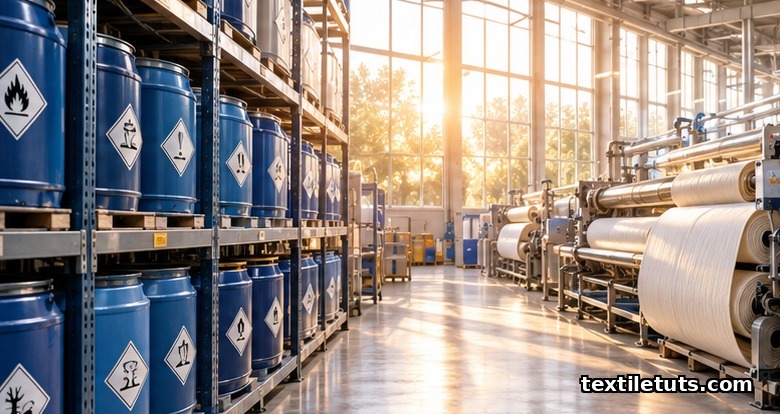
Bluesign is a Swiss-origin chemical and resource management standard for the textile industry, applied to more than 30,000 commercially traded chemical products and adopted by over 900 brands worldwide to screen for roughly 900 restricted substances in fiber, yarn, and fabric production.
It goes beyond restricted-substance lists by auditing factory-level emissions to air and water, occupational exposure limits, and resource efficiency, making it one of the few textile certifications that integrates input chemistry, process chemistry, and end-product safety in a single framework.
This article explains what bluesign actually verifies, how its five-component assessment works, where it sits alongside GOTS and OEKO-TEX, and what it does and does not guarantee to a buyer of finished garments.
What Bluesign Certification Is
Bluesign Technologies AG, founded in 2000 in St. Gallen, Switzerland, built the bluesign system as a pre-competitive sustainability platform. Instead of testing finished garments only, it screens chemical products at the input stage (dyes, auxiliaries, finishes), audits the manufacturing site where they are used, and then labels the resulting textile components.
The system is built on five pillars: resource efficiency, consumer safety, occupational health and safety, water emissions, and air emissions. Each pillar has its own quantitative pass/fail criteria, which is what separates bluesign from a one-off chemical-compliance test report.
The Five-Component Assessment
When a textile mill or chemical supplier enters the bluesign assessment, auditors evaluate the site against five interlocking criteria. Passing one pillar does not waive the others; the lowest-scoring pillar sets the certification ceiling.

1. Resource efficiency. Auditors benchmark energy, water, and raw-material consumption per kilogram of textile output against best-available-technology baselines. Mills commit to reduction plans; annual reporting shows whether those targets are met.
2. Consumer safety. The bluesign criteria list (formerly the bluesign bluefinder) contains approximately 900 substances grouped by hazard class, including perfluorinated compounds (PFOA, PFOS, and shorter-chain PFAS under phased thresholds), phthalates, alkylphenol ethoxylates (APEOs), heavy metals, formaldehyde, and disperse dyes classified as sensitizers. Limits are often tighter than EU REACH Annex XVII minimums.
3. Occupational health and safety. Workers’ exposure to solvents, dyes, acids, and noise is measured against occupational exposure limits drawn from science-based references such as the United States National Institute for Occupational Safety and Health (NIOSH) recommended exposure limits and analogous European indicative occupational exposure limit values (IOELVs) published by the European Chemicals Agency.
4. Water emissions. Effluent samples are taken at discharge and tested for heavy metals, adsorbable organically bound halogens (AOX), chemical oxygen demand (COD), biological oxygen demand (BOD), and color. Acceptance thresholds follow Best Available Techniques (BAT) reference documents under the EU Industrial Emissions Directive 2010/75/EU.
5. Air emissions. Volatile organic compound (VOC) emissions from drying, stentering, and printing are measured and capped per kilogram of substrate produced.
Bluesign Product Labels: BLUEFIN, APPROVED, BLACK, SELECTED
The bluesign system labels materials and finished goods at four tiers, which is where most sourcing teams first encounter it.
- bluesign APPROVED applies to chemical products (dyes, auxiliaries, finishes) verified by bluesign against the criteria list. As of 2024, more than 30,000 commercial chemical products carry this label, according to bluesign’s own public disclosures.
- bluesign SELECTED is a transitional label for chemical products that meet a subset of criteria and have a roadmap to full approval; it signals the supplier is engaged but not yet compliant on every line.
- bluesign BLUEFIN marks fabrics and trims that are produced exclusively with bluesign APPROVED chemicals at a bluesign-verified mill.
- bluesign BLACK marks finished garments, footwear, or hardware that contain only bluesign BLUEFIN fabrics and approved components, with verified chain-of-custody from the brand.
A finished jacket carrying the bluesign BLACK label therefore has a traceable chemical-management trail back through every dye, finish, and fabric supplier involved.
How a Mill Becomes Bluesign-Verified
Becoming a bluesign system partner is not a one-time test. The process has three stages, each on a defined cadence.

On-site assessment. Bluesign auditors (most of whom are chemists or chemical engineers) visit the mill, map the unit operations from fiber preparation through finishing, take effluent and emission samples, and review the chemical inventory against the criteria list. The output is an action plan with quantified improvement targets.
Implementation phase. The mill substitutes flagged chemicals with bluesign APPROVED alternatives, installs or upgrades wastewater treatment where BAT gaps are identified, and updates process parameters. Typical timelines run 12 to 24 months for complex dyehouses.
Ongoing verification. Audits are repeated, and chemical products are re-checked against the criteria list at least annually. The criteria list itself is updated whenever a new substance of concern is identified, which is how bluesign incorporated PFAS phase-outs and certain bisphenol restrictions ahead of binding regulation.
Bluesign vs. OEKO-TEX and GOTS
Sustainability and chemistry claims in textile sourcing rarely use the same vocabulary. The table below shows where bluesign sits next to the two most-cited alternatives.
| Attribute | bluesign | OEKO-TEX STANDARD 100 | GOTS |
|---|---|---|---|
| Scope | Chemical inputs + factory emissions + resource use + occupational health | Finished-textile substance testing only | Fiber origin (organic) + processing criteria + social criteria |
| Audits factory operations | Yes, annually | No (lab testing) | Yes, annually |
| Tests effluent / air | Yes | No | Yes (wastewater treatment requirement) |
| Restricts chemical inputs at formulation | Yes (criteria list) | Indirect, via finished-good limits | Yes (positive list of approved inputs) |
| Worker safety audited | Yes (exposure limits) | No | Yes (social criteria) |
| Covers organic fiber requirement | No | No | Yes (≥70% organic fibers) |
| Recognised for restricted substance list alignment | Yes (used in ZDHC MRSL 2.0) | Limited | Yes (own positive list) |
The short version: OEKO-TEX STANDARD 100 tests the textile you can hold in your hand; bluesign audits the chemical and process management behind that textile; GOTS adds a fiber-origin dimension on top.
Substances Bluesign Tightens Beyond REACH
EU REACH (Registration, Evaluation, Authorisation and Restriction of Chemicals) is the legal baseline in the European Union. Bluesign typically sets limits at or below REACH SVHC (Substances of Very High Concern) thresholds. A few representative examples show how much tighter the standard is in practice:
- Formaldehyde: bluesign caps free and released formaldehyde in textiles at 20 to 75 ppm depending on end-use (lower limits for babywear), versus the general REACH limit of 75 ppm for adult textiles.
- APEOs: REACH restricts nonylphenol and nonylphenol ethoxylates above 0.1% by weight; bluesign requires APEO-free formulations across its criteria list.
- Short-chain chlorinated paraffins (SCCPs): bluesign banned these in 2011, predating the Stockholm Convention listing in 2017.
- PFAS: bluesign introduced phased PFAS restrictions from 2015 onward, with a full phase-out target by 2023 for outdoor apparel applications in partner brands.
These thresholds are expressed in milligrams per kilogram (mg/kg) of textile and are recalibrated as analytical chemistry advances; for instance, total fluorine screening by combustion ion chromatography has lowered the limit of detection that any test method must meet.
Where Bluesign Falls Short
Bluesign is rigorous about chemistry and emissions, but the system does not by itself certify a fiber origin (it can be applied to recycled polyester, organic cotton, or conventional cotton alike) and does not directly verify living-wage or worker-rights practices beyond occupational safety. Brands that need organic-fiber traceability pair bluesign with GOTS; brands that need social audits pair it with Fair Wear Foundation or the Social & Labor Convergence Program (SLCP).
A second limitation is scope: bluesign screens chemistry but does not certify a garment’s full life-cycle carbon footprint. For that, brands use ISO 14040/14044 life cycle assessment (LCA) or product carbon-footprint standards such as ISO 14067.
Frequently Asked Questions
Is bluesign the same as OEKO-TEX?
No. OEKO-TEX STANDARD 100 is a finished-textile substance test carried out in accredited labs; bluesign audits the chemical management at the mill and screens individual chemical products against a published criteria list. OEKO-TEX tells you what is not in the fabric; bluesign also tells you what was used to make it and how the mill handled wastewater and air emissions.
Does a bluesign label mean the garment is organic?
No. Bluesign certifies chemical and process management, not fiber origin. A bluesign BLACK garment may use conventional cotton, recycled polyester, or organic cotton. For organic-fiber certification, look for GOTS (Global Organic Textile Standard) on the same garment.
Are bluesign limits stricter than REACH?
In most cases, yes. Bluesign’s criteria list sets thresholds at or below EU REACH SVHC levels, and bans some substance classes (such as APEOs across all input chemistries) that REACH only restricts above defined concentrations. For brands selling into multiple markets, bluesign compliance is typically accepted as a stronger baseline than REACH compliance alone.
How much extra does bluesign certification cost?
Bluesign does not publish a flat fee. Mills pay annual system-partner fees plus audit costs that scale with site size and complexity, and chemical suppliers pay per-substance screening fees. In practice, mills report that bluesign-approved chemistry carries a 5 to 15 percent price premium over standard equivalents, which is partly offset by reduced wastewater treatment costs and lower rejected-batch rates.
Can a factory lose its bluesign status?
Yes. If an audit finds a non-conformance against the criteria list, the mill receives a defined remediation period; failure to close the gap suspends the site, after which bluesign APPROVED chemicals may no longer be purchased for that site’s production. Re-qualification requires a fresh on-site audit.
References
- European Chemicals Agency (ECHA). Understanding REACH. echa.europa.eu — ECHA’s regulatory explainer for REACH registration, evaluation, authorisation, and restriction of chemicals, including SVHC procedures.
- European Commission. Industrial Emissions Directive 2010/75/EU, Best Available Techniques Reference Document (BREF) for the Textiles Industry. eur-lex.europa.eu — BAT conclusions on water and air emissions for textile finishing operations.
- International Organization for Standardization. ISO 14040:2006 / ISO 14044:2006 — Environmental management — Life cycle assessment. iso.org — Principles, requirements, and guidelines for life cycle assessment.
- International Organization for Standardization. ISO 14001:2015 — Environmental management systems — Requirements with guidance for use. iso.org — The EMS standard on which bluesign’s resource-efficiency component draws.
- International Organization for Standardization. ISO 45001:2018 — Occupational health and safety management systems. iso.org — OHS framework referenced by bluesign’s occupational exposure assessments.
- Bluesign Technologies AG. The bluesign system — Five components of sustainability. bluesign.com — The standard holder’s own description of the five-pillar assessment, current criteria list scope, and product-label tiers.
- American Association of Textile Chemists and Colorists. AATCC Test Method 112 — Formaldehyde Release from Fabric, Determination of. aatcc.org — The standard test method used to verify the formaldehyde limits cited in the bluesign criteria list.
Editorial by Shahrukh Islam, TextileTuts. Sources: European Chemicals Agency, European Commission Industrial Emissions Directive, ISO 14001/14040/14044/45001 standards, bluesign Technologies AG, and AATCC Test Method 112, as cited above.


