
Yarn Twist: ISO 2061


ISO 2061:2015 specifies a direct counting method for determining yarn twist by removing and counting the turns required to straighten a known length of yarn, requiring a minimum of 50 specimens drawn from at least 10 packages and using a pre-tension of 0.5 cN/tex for cotton-system yarns before any untwisting begins. The standard is the single most cited reference for twist testing of single, plied, and cabled yarns made from natural or man-made staple fibres, and its results feed directly into yarn-strength, hairiness, and pilling behaviour downstream.
This guide explains what ISO 2061 actually prescribes, how the procedure differs from the parallel ASTM methods, and how the numbers you collect from the twist tester translate into the twist multiplier your mill buyers will ask about.
What ISO 2061 Actually Covers (and What It Does Not)
ISO 2061:2015 is titled “Textiles, Determination of twist in yarns, Direct counting method.” It applies to single (spun) yarns, plied yarns, and cabled yarns constructed from staple fibres, and also covers the determination of twist direction (S or Z). It does not apply to monofilament yarns, multifilament yarns without twist, or yarns on packages where the take-off tension cannot be controlled. For filament yarns, ISO 1890 (“Determination of twist in textured filament yarns”) and ISO 17202 (“Determination of twist in textured filament yarns”) are the applicable references.
The standard is explicit about what “twist” means in this context: the number of turns about its axis per unit length in an untwisted state, expressed in turns per metre (tpm) for SI reporting or turns per inch (tpi) for inch-based reporting. The conversion is mechanical: 1 tpm × 0.0254 = 0.0254 tpi, or conversely 1 tpi × 39.37 = 39.37 tpm. Most yarn-testing laboratories now report tpm because the rest of the SI yarn-count system (tex, dtex) is also metric.
Equipment, Gauge Length, and the Pre-Tension Rule
The apparatus is a mechanical or electronic twist tester with two clamps, one fixed and one rotatable, separated by an adjustable gauge length. The fixed clamp holds the specimen under a defined pre-tension applied through a calibrated load. ISO 2061 specifies pre-tension based on yarn linear density according to the yarn-classification system in use. For cotton-system yarns (Ne-based), the nominal pre-tension is 0.5 cN/tex, equivalent to roughly 5 gf/tex. For metric (Nm/tex) yarns, the same 0.5 cN/tex value applies unless the standard or a buyer specification states otherwise. For woollen and worsted yarns, the pre-tension is reduced to about 0.2 cN/tex because of the higher bulk and lower breaking extension of wool.
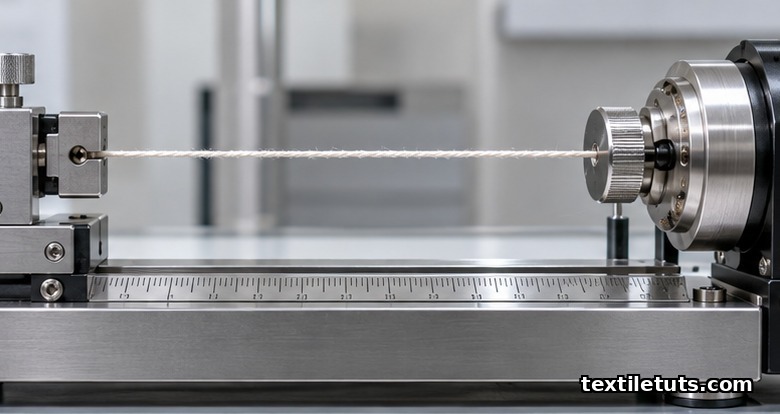
The gauge length, defined as the distance between the two clamps at the start of the test, is one of the most consequential decisions a lab technician makes. ISO 2061 allows 10 mm or 50 mm gauge lengths for short-fibre spun yarns, with 50 mm being the default for most ring-spun cotton, polyester/cotton, and 100% polyester yarns. Short-fibre yarns (cotton, rayon, short polyester) tested at 10 mm yield tighter coefficient-of-variation (CV) values because the operator is averaging over a longer fibre-aligned section. The standard warns explicitly that gauge length is part of the test report and cannot be changed between specimens in a single test series without invalidating the comparison.
The Direct Counting Procedure, Step by Step
The procedure is mechanical but it requires a trained hand. The technician first mounts the yarn in the fixed clamp, applies the pre-tension, and threads the other end into the rotatable clamp. The rotatable clamp is then turned in the direction that visually reduces twist, while the technician observes the yarn under low magnification against a dark background. For a Z-twist yarn, the clamp is rotated clockwise; for an S-twist yarn, counter-clockwise. The yarn is considered fully untwisted when, under the pre-tension, the fibres become parallel and any residual twist can no longer be detected visually.

For plied yarns, the procedure has two stages. First, the plying twist is removed from the whole yarn until the component singles lie parallel. The number of turns recorded at this stage gives the ply twist. Then the technician untwists each component single in turn and records its singles twist. The standard requires both values to be reported, because ply-twist balance against singles-twist direction is what determines yarn liveliness, torque, and snarling in downstream knitting and weaving.
For crepe yarns and other highly twisted constructions, the standard allows a variant in which the operator retwists in the opposite direction until the original yarn length is restored, then divides the recorded turns by two. This “untwist-retwist” variant reduces operator error when the original twist level is so high that fully straightening the fibres under tension would break the specimen.
Twist Direction, Twist Multiplier, and What the Numbers Mean
Twist direction in ISO 2061 follows the ISO 2 visual convention. Z-twist has the spirals running in the same direction as the middle of the letter Z when the yarn is held vertically; S-twist has them running in the same direction as the middle of the letter S. Most ring-spun cotton-system yarns are Z-twist singles and S-twist plies; open-end (rotor) yarns are typically Rotor-Z singles, which behave mechanically similarly to ring-spun Z singles but with different hairiness and strength.
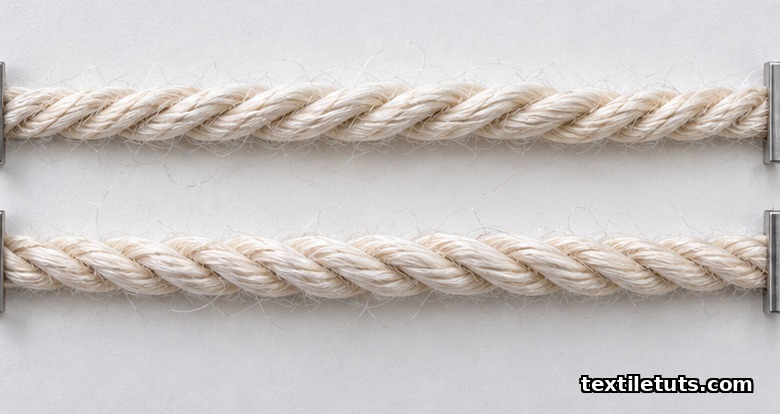
The twist multiplier (TM) is not defined in ISO 2061 itself but is a derived metric that the standard’s results are used to compute. For tex-system yarns the metric formula is TM = tpm × √tex / 1000. For cotton-count (Ne) yarns the imperial equivalent is TM = tpi / √Ne. A common ring-spun cotton weaving yarn targets TM ≈ 3.8 to 4.2; a knitting yarn targets TM ≈ 3.2 to 3.6 because lower twist gives softer hand and better loop formation. The TextileTuts yarn-count to GSM calculator accepts both tpm and tpi inputs and returns TM directly, which makes it useful for cross-checking the lab’s output against a buyer’s specification.
Sampling, Repeatability, and Reporting
ISO 2061 sets a minimum sample of 50 specimens, distributed across at least 10 packages (5 specimens per package is typical). For production-lot acceptance testing, the lot is divided into sublots, and a stratified random draw is taken. The reported result is the arithmetic mean twist in tpm, with the coefficient of variation (CV%) computed across all specimens. A CV% under 8 for ring-spun cotton yarn is considered well-controlled; over 12 indicates process instability that will show up as dye-barré and weave-barre downstream.
The standard gives expected precision values based on inter-laboratory trials. For 20 tex ring-spun cotton yarn at 50 mm gauge length, the repeatability limit r (within one lab, 95% probability) is roughly 30 tpm, and the reproducibility limit R (between labs) is roughly 60 tpm. Two labs measuring the same production lot should therefore agree within about 60 tpm, which sets the practical floor for any twist specification that crosses a mill-to-mill handover.
Comparison: ISO 2061 vs ASTM D1422 and D1423
ISO 2061 and the ASTM standards address the same physical quantity but use different default conditions, which matters when a buyer specification cites one but not the other. ASTM D1422 (“Twist in Yarns by Direct Counting”) is the closest equivalent and is technically interchangeable for most ring-spun yarns. ASTM D1423 (“Twist in Yarns by Short-Length Specimen”) uses a 10 mm gauge length and is intended for finer yarns where a 50 mm gauge length gives too many fibre breaks during untwisting.
| Parameter | ISO 2061:2015 | ASTM D1422 | ASTM D1423 |
|---|---|---|---|
| Method | Direct counting | Direct counting | Direct counting (short specimen) |
| Gauge length | 10 or 50 mm (typical 50 mm) | 50 mm default | 10 mm |
| Pre-tension | 0.5 cN/tex (cotton), 0.2 cN/tex (wool) | Variable by yarn type | Variable by yarn type |
| Sample size | ≥ 50 specimens, ≥ 10 packages | ≥ 20 specimens typical | ≥ 20 specimens typical |
| Reporting unit | tpm (or tpi) | tpi (or tpm) | tpi (or tpm) |
| Best for | All spun yarn constructions | Ring-spun staple yarns | Fine filament-like spun yarns |
When a buyer specification cites “ISO twist,” the lab should report tpm, mean, and CV%. When it cites “ASTM twist,” the lab should confirm whether the buyer expects tpi or tpm, because the unit ambiguity is the single most common source of dispute in cross-border shipments.
Frequently Asked Questions
What is the difference between ISO 2061 and ISO 1890?
ISO 2061 covers staple-fibre spun yarns, including singles, plied, and cabled constructions. ISO 1890 covers textured filament yarns, where twist is locked into the yarn by heat-setting rather than by fibre migration, so the untwisting procedure must avoid relaxing the texture. Use ISO 2061 for cotton, polyester-cotton, wool, acrylic, and similar spun yarns, and ISO 1890 for textured polyester and textured nylon used in knit and hosiery applications.
How many specimens should a textile lab test under ISO 2061?
ISO 2061 sets the floor at 50 specimens drawn from at least 10 packages, typically 5 specimens per package for ring-spun yarns. For process-control monitoring inside a single mill, 20 specimens from 4 packages is a common reduced plan that gives a usable trend chart without exhausting the QA budget. For buyer-acceptance or dispute testing, run the full 50-specimen plan and report both the mean and the CV%.
Why does my ISO 2061 result not match my supplier’s certificate?
The most common cause is a gauge-length mismatch. A 50 mm specimen gives a different mean twist reading than a 10 mm specimen from the same yarn, and the difference is not a simple scaling factor. The second most common cause is pre-tension: a yarn pre-tensioned at 0.5 cN/tex behaves differently under the rotating clamp than one pre-tensioned at 1.0 cN/tex, and the higher tension stretches the fibres so they appear to untwist more easily. Always ask for gauge length, pre-tension, and tpm/tpi unit together when comparing certificates.
Can ISO 2061 be used for open-end (rotor) and air-jet spun yarns?
Yes, the procedure is mechanically applicable, but the absolute twist values for open-end yarns run lower than for ring-spun yarns at the same yarn count because rotor spinning wraps wrapper fibres around the core rather than binding by full fibre migration. Air-jet yarns are typically tested under the same procedure, but their twist is non-uniform along the length, so a single 50 mm gauge length test gives a higher variance than a ring-spun equivalent. The standard recommends reporting the CV% prominently for these yarn constructions so the buyer is not misled by a tight mean.
What is a “good” twist CV% for a 30 tex cotton ring-spun yarn?
For a well-controlled ring-spun 30 tex cotton yarn tested at 50 mm gauge length, a CV% under 6 indicates tight process control, 6 to 10 is typical for normal production, and over 12 suggests a process issue such as traveller wear, ring-rail eccentricity, or drafting-roller pressure drift. CV% is often a more useful production metric than the mean itself, because the mean can be on target while the variance has drifted, and high-variance yarn will dye unevenly long before it shows up in a strength test.
References
- International Organization for Standardization. ISO 2061:2015, Textiles, Determination of twist in yarns, Direct counting method. Geneva: ISO. The primary standard, with full apparatus, sampling, and reporting requirements.
- ASTM International. ASTM D1422 / D1422M, Standard Test Method for Twist in Yarns by Direct Counting. West Conshohocken: ASTM. The closest ASTM equivalent to ISO 2061, used by mills serving North American buyers.
- ASTM International. ASTM D1423 / D1423M, Standard Test Method for Twist in Yarns by Short-Length Specimens. West Conshohocken: ASTM. Short-gauge variant for fine spun and filament-like yarns.
- International Organization for Standardization. ISO 1890:2006, Textiles, Determination of twist in textured filament yarns. Geneva: ISO. Companion standard for textured filament constructions outside the ISO 2061 scope.
- Klein, W. Manuals of Textile Technology: A Practical Guide to Yarn Twist. Manchester: The Textile Institute. Industry reference covering twist multiplier, twist direction, and the relationship between twist and yarn properties.
- Lawrence, C. A. Advances in Yarn Spinning Technology. Cambridge: Woodhead Publishing (now Elsevier). Peer-reviewed book chapter material on the relationship between spinning system and measured twist under ISO 2061 conditions.
- Hunter, L. Yarn Twist: A Critical Review of the Literature. SAWTRI (South African Wool and Textile Research Institute) Technical Report. Classic review of twist testing precision and the inter-laboratory variance data cited in ISO 2061’s precision statement.
This article is the working reference for yarn-twist testing under ISO 2061. Editorial by Iftay Khairul Alam, TextileTuts. Sources: ISO 2061:2015, ASTM D1422, ASTM D1423, ISO 1890:2006, Textile Institute, Woodhead Publishing, and SAWTRI as cited.


