
Yarn Count by Weight: ISO 2060

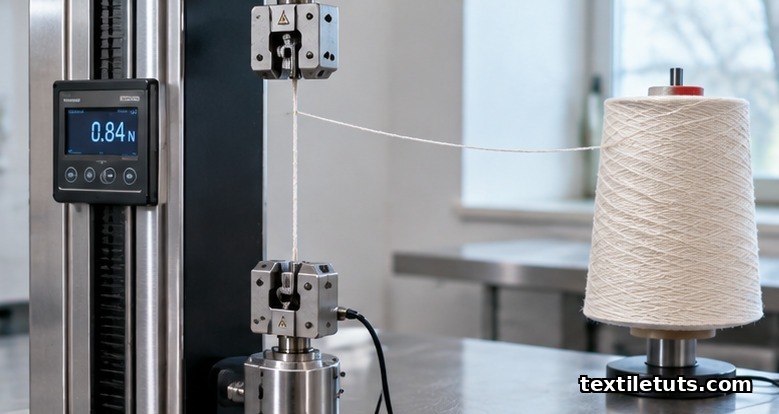
ISO 2060:2010 specifies the constant-rate-of-extension single-end tensile test for yarn drawn from packages, with a 500 mm nominal gauge length and a 20 ± 3 second time-to-break under a pretension of 0.5 cN/tex for spun yarns and 2.0 cN/tex for filament yarns.
Yarn count by weight, properly called linear density, is measured separately under ISO 1144 in the Tex system, where 1 tex equals 1 gram per 1,000 meters and a 30 tex cotton yarn therefore weighs 30 g per kilometer; the two standards are routinely reported together on a yarn test certificate because ISO 2060 alone gives only a force reading that cannot be compared across yarn counts.
What follows covers how ISO 2060 is run on the bench, how ISO 1144 and ASTM D1907 measure linear density, the conversion math linking Tex, denier, Nm, and Ne, and the quality-control numbers a spinner or knitter should expect from a properly tested yarn.
What ISO 2060:2010 Actually Covers
ISO 2060:2010 “Textiles, Yarn from packages, Determination of single-end breaking force and elongation at break using constant rate of extension (CRE) tester” is the second edition of the standard, replacing the 1994 first edition. It tells a laboratory how to pull a single strand of yarn from a package (cone, cheese, cop, pirn), condition it, mount it on a CRE tensile tester, and break it, so that breaking force and elongation can be reported in a comparable way across machines and across countries.
Three test parameters are fixed by the standard. The gauge length is 500 mm by default, with 250 mm permitted for very fine filament yarns where longer specimens slip in the clamps. The crosshead speed is set so that the specimen breaks in 20 ± 3 seconds, which corresponds to roughly 500 mm/min for a typical spun yarn. The pretension applied before clamping is 0.5 cN/tex for spun yarns and 2.0 cN/tex for filament yarns, a step that removes the slack from the package and makes the result independent of how the technician handled the yarn.
The reported outputs are breaking force in centinewtons (cN) and elongation at break as a percentage of the original gauge length. When the linear density is known, ISO 2060 allows the result to be normalised into tenacity (cN/tex) and specific breaking elongation (%), which lets a 20 tex cotton yarn be compared with a 20 tex wool yarn on the same scale.
Why Yarn Count by Weight Matters for ISO 2060 Results
Yarn count by weight, the technical name is linear density, is the mass per unit length of a yarn. ISO 2060 deliberately does not fix a count system because textile trade uses four parallel scales: Tex (universal, grams per 1,000 m), denier (filament, grams per 9,000 m), metric count Nm (meters per gram), and English cotton count Ne (840-yard lengths per pound). The standard lets the laboratory report count in whichever scale the buyer uses, then converts to Tex for the tenacity calculation.
This matters because tensile force scales with the number of fibers in the cross-section. A 30 tex cotton yarn carries roughly 30 micrograms of fiber per millimeter of length, and doubling the Tex at the same fiber quality roughly doubles the expected breaking force. Without a known linear density, an ISO 2060 force number is meaningless in isolation: a 200 cN yarn could be a strong 10 tex yarn or a weak 60 tex yarn.
Most spinning-mill quality control therefore runs ISO 2060 tensile testing and a separate count test on the same lot. The combined report gives the buyer tenacity in cN/tex (a quality measure that does not depend on count) and elongation, which together describe how the yarn will survive weaving, knitting, or braiding.
The Tex System: ISO 1144 in Practice
ISO 1144:2016 “Textiles, Universal system for designating linear density (Tex System)” is the standard that formalises Tex, decitex (dtex = 0.1 tex), and millitex (mtex = 0.001 tex). It is the preferred scale for textile-engineering communication because Tex is an absolute metric unit with no conversion factors tied to specific fiber types, so a 30 tex polyester filament and a 30 tex cotton spun yarn are unambiguously the same mass per length.
A 1 tex yarn weighs 1 gram per 1,000 meters. A standard 30 tex ring-spun cotton yarn therefore weighs 30 g per kilometer, or 30 mg per meter. Knitting yarns for apparel typically fall in the 14 to 30 tex range; weaving yarns for shirting sit at 10 to 20 tex; carpet yarns run 100 to 500 tex. Below 10 tex the yarn is fine (hosiery, lace), above 100 tex it is coarse (rope, carpet, denim weft).
Conversion to the older scales is straightforward. Tex equals 1,000 divided by Nm (metric count, meters per gram). For English cotton count Ne, the relation is Tex = 590.5/Ne, derived from 1 Ne = 840 yards per pound, 1 yard = 0.9144 m, and 1 lb = 453.59 g, which gives 1 Ne = 1.693 m/g and therefore Tex = 1000/(1.693 × Ne) = 590.5/Ne. For filament yarn, Tex = denier/9, because a denier is grams per 9,000 m. Other English count bases (worsted at 560 yds/lb, woolen run, linen wet-spun at 300 yds/lb) follow the same formula with different constants; ASTM D2260 tables give the full conversion matrix used in commercial trade.
How Linear Density Is Measured on the Floor: ASTM D1907 and ASTM D1059
Two standard methods dominate the spinning-mill QC bench. ASTM D1907/D1907M uses the skein method: a known length of yarn, usually 100 m or 120 yd, is wound on a wrap reel, conditioned at 20 °C and 65% relative humidity under ISO 139, weighed on a balance, and the linear density calculated as mass divided by length. The skein method is the reference procedure because the long length averages out the twist-induced mass variation that occurs along the yarn.
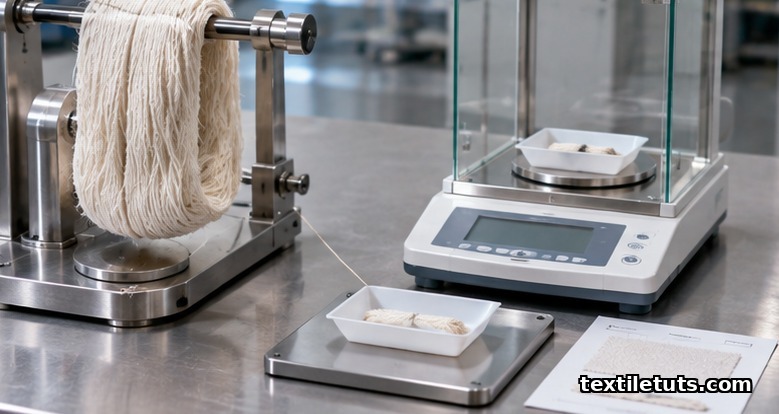
ASTM D1059 uses short-length specimens: a single 10 cm length of yarn is cut, weighed on a sensitive balance with 0.1 mg resolution or better, and the result multiplied by 10,000 to express Tex. This method is faster and uses less yarn, but it has higher variance because it does not average over many meters. It is suited to production checks rather than certification testing.
ISO 1144 itself does not prescribe a method, only the unit and reporting format. The method choice is left to ISO 2060 (for tensile on packages), ASTM D1907 (for skein-based count), or ASTM D1059 (for short-length count), depending on what the customer contract specifies. ISO 7211-5 is the equivalent standard for fabric (mass per unit area from small specimens), not yarn, and should not be confused with ISO 1144.
Worked Example: 30 Tex Cotton Yarn on the Bench
Imagine a 30 tex ring-spun cotton yarn on a 200 g cone coming off a ring frame. The technician conditions the cone for 24 hours at 20 °C and 65% RH (the ISO 139 atmosphere), then reels a 100 m skein on a wrap reel. The skein weighs 3.05 g on the balance, giving 30.5 tex actual versus 30 tex nominal, a 1.7% deviation that sits well inside the typical 2.5% USTER tolerance for ring-spun cotton yarn count CV.
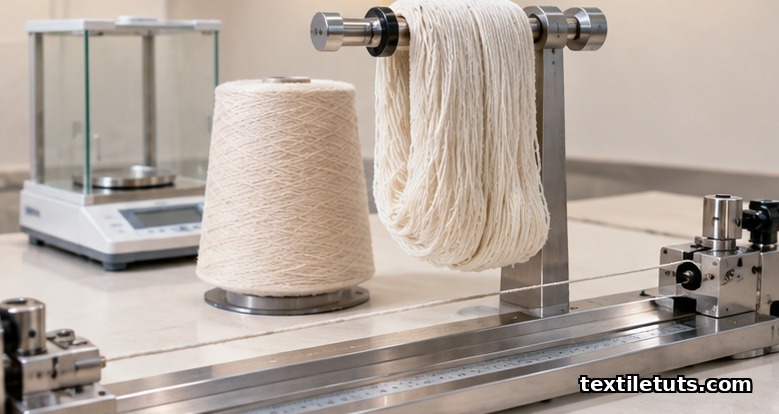
The same cone goes to the CRE tester for ISO 2060. The technician pulls 20 single ends, sets the gauge to 500 mm, applies 0.5 cN/tex pretension (15 cN for a 30 tex yarn), and breaks each end at a crosshead speed calibrated to give a 20 ± 3 second time-to-break. Average breaking force comes back at 480 cN, average elongation at 6.8%. Tenacity is then 480 cN divided by 30 tex, which gives 16.0 cN/tex, a typical value for a medium-quality ring-spun cotton knitting yarn.
If the customer wants USTER statistics, the lab reports single-end tenacity CV (around 10 to 12% for ring-spun cotton), count CV (the 1.7% from the skein), and the elongation distribution. This three-number summary is the lingua franca of commercial yarn trading and is what most international tenders request on the test certificate.
Linear Density and Twist: Why Two Yarns of the Same Tex Behave Differently
Linear density tells you the mass per length, but it does not tell you how tightly the fibers are held together. Twist is the second variable, expressed as turns per meter (TPM) or twist multiplier (TM = TPM divided by the square root of Tex). A 30 tex cotton yarn at TM 4.0 has 21.9 TPM; the same 30 tex yarn at TM 4.5 has 24.6 TPM and feels noticeably firmer in the hand.
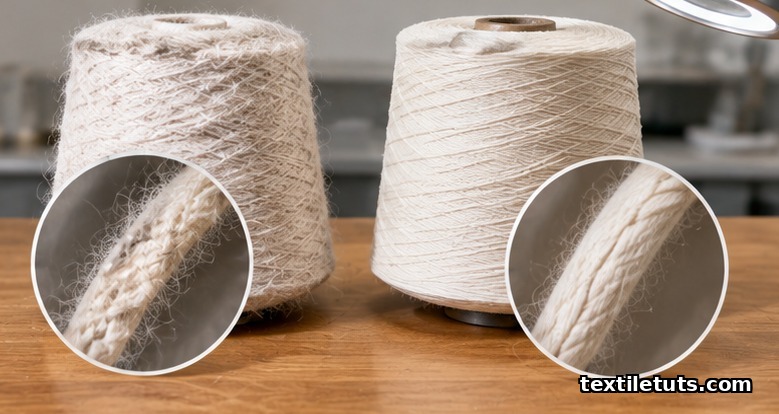
Higher twist raises tenacity up to an optimum, then drops it as the fibers become too angled to bear axial load. For ring-spun cotton the optimum TM is around 3.8 to 4.2; for rotor (open-end) cotton, 4.5 to 5.0 because rotor yarn fibers are more disoriented and need more twist to compensate. ISO 2060 results on a 30 tex yarn can vary 20% in tenacity depending on which side of the optimum the spinner is operating, which is why a yarn without a twist reading cannot be fully specified.
This is why an ISO 2060 test certificate without a parallel ISO 1144 count and a twist reading is incomplete. Three numbers (count, twist, tenacity) describe a yarn; one number alone describes a string.
How Count Conversions Trip Up Buyers and Sellers
The most common commercial error is mixing up cotton count Ne and worsted count. Both are called Ne, but Tex = 590.5/Ne for cotton and Tex = 885.7/Ne for worsted (560 yds/lb), so a “30 Ne” yarn could be either 19.7 tex (cotton) or 29.5 tex (worsted). A buyer expecting 20 tex who receives 30 tex because the seller used the worsted conversion has just imported yarn 50% heavier than the order.
Woolen run and linen use different constants again (woolen run around 1600 yds/lb, linen wet-spun at 300 yds/lb, giving Tex = 310/Ne and Tex = 1653/Ne respectively). Metric Nm (meters per gram) is the only single-system count: Tex = 1000/Nm regardless of fiber, which is why many European and Asian mills prefer Nm for invoicing. Denier is restricted to filament: Tex = denier/9, so a 75 denier polyester filament is 8.33 tex and a 150 denier is 16.67 tex.
ASTM D2260 “Standard Tables for Conversion of Yarn Number Between Various Numbering Systems” lists all of these conversions in tabular form. Spinners and knitters use it daily; the tables are also embedded in most ERP systems in the textile industry. ISO 1144 is the European equivalent for the Tex system, and the two standards are written to be compatible.
Quality Control: Putting ISO 2060 and ISO 1144 Together in the Mill
A modern spinning mill runs count and tenacity every lot, with twist checked every fifth lot. ISO 2060 tensile on 20 single ends takes about 8 minutes on a Statimat or Uster Tensorapid; ASTM D1907 skein weighing takes about 5 minutes; twist takes another 3 minutes. Total QC time is roughly 16 minutes per lot, which lines up with the 15 to 20 minute lot release cycle in a ring-spinning plant.
The data feeds the USTER Statistics bulletin, the global benchmark for yarn quality since 1957. A 30 tex ring-spun cotton knitting yarn at the 50% USTER level has a count CV of about 1.8%, a tenacity CV of 10%, and a single-end tenacity of 16 to 18 cN/tex. Top 5% mills achieve count CV under 1.3%, which is what premium knitwear buyers demand and what competitive mills chase.
For handcrafts and small-scale buyers, ISO 2060 is overkill; a simple wrap-reel skein and a kitchen scale give a usable Tex reading to within 3% if the skein length is 50 m or more. For anything that goes into safety-critical textiles (seat belts, harnesses, parachute cord, climbing rope), ISO 2060 plus ISO 1144 is mandatory, with the certificate dated and traceable to the package lot number on the cone.
Frequently Asked Questions
What is the difference between ISO 2060 and ISO 1144?
ISO 2060 is the tensile testing standard for single yarn ends pulled from packages, reporting breaking force in centinewtons and elongation as a percentage. ISO 1144 is the designation standard for linear density, formalising the Tex, decitex, and millitex units. The two are used together on a yarn test certificate: ISO 1144 gives the count in Tex, ISO 2060 gives the force, and the ratio (cN/tex) gives the tenacity that lets you compare yarns of different counts on a single scale.
Is ISO 2060 still current, or has it been superseded?
ISO 2060:2010 is the second edition and remains the active published standard for yarn tensile testing on a CRE machine. The first edition (ISO 2060:1994) used slightly different reporting conventions and was widely replaced by the 2010 edition, which standardised on the 500 mm gauge and the 20 ± 3 second time-to-break geometry that most modern tensile testers already implement.
Why is yarn count by weight measured in Tex instead of grams per meter?
Grams per meter gives small decimal numbers for typical yarns: a 30 tex yarn is 0.030 g/m, which is awkward to write and easy to misread. Tex is the same ratio scaled by 1,000, putting the typical commercial range between 10 and 500 in whole numbers. ISO 1144 adopted Tex because the unit is unambiguous, metric, and works for spun yarns, filament yarns, and industrial textiles on the same scale.
Can ISO 2060 be used if the yarn is on a beam rather than a cone?
ISO 2060 is written for “yarn from packages,” which includes cones, cheeses, cops, and pirns. Warp beams are not packages in this sense and ISO 2060 does not cover them directly. For warp yarn on a beam, you would wind a sample package first or use a separate method such as ISO 6939 for yarn taken from a warp, which uses a similar CRE geometry but a different sampling protocol.
How does ISO 2060 differ from ASTM D2256?
ASTM D2256 is the US equivalent standard for tensile properties of yarn by the single-end method. The two standards share most parameters (500 mm gauge, CRE tester, similar crosshead speed) but differ in conditioning atmosphere defaults and reporting format. ASTM D2256 is mandatory in contracts governed by US ASTM rules; ISO 2060 is the international standard for EU, Asian, and most global tenders. Most commercial labs can run both on the same machine with a parameter switch.
References
- International Organization for Standardization. ISO 2060:2010 Textiles, Yarn from packages, Determination of single-end breaking force and elongation at break using constant rate of extension (CRE) tester. 2nd ed. Geneva: ISO, 2010.
- International Organization for Standardization. ISO 1144:2016 Textiles, Universal system for designating linear density (Tex System). 2nd ed. Geneva: ISO, 2016.
- ASTM International. ASTM D1907/D1907M Standard Test Method for Linear Density of Yarn (Yarn Number) by the Skein Method. West Conshohocken, PA: ASTM International.
- ASTM International. ASTM D1059 Standard Test Method for Yarn Number Based on Short-Length Specimens. West Conshohocken, PA: ASTM International.
- ASTM International. ASTM D2260 Standard Tables for Conversion of Yarn Number Between Various Numbering Systems. West Conshohocken, PA: ASTM International.
- Miao, M., and Y. L. How. Yarn to fabric: the contribution of yarn linear density and twist to fabric mechanical properties. Textile Research Journal, vol. 74, no. 10, 2004, pp. 881 to 887.
- International Organization for Standardization. ISO 139:2005 Textiles, Standard atmospheres for conditioning and testing. Geneva: ISO, 2005.
This article is the working reference for yarn count by weight and ISO 2060. Editorial by Iftay Khairul Alam, TextileTuts. Sources: ISO 2060:2010, ISO 1144:2016, ASTM D1907, ASTM D1059, ASTM D2260, Miao and How 2004, ISO 139:2005 as cited.


