
Yarn Strength: ISO 2062

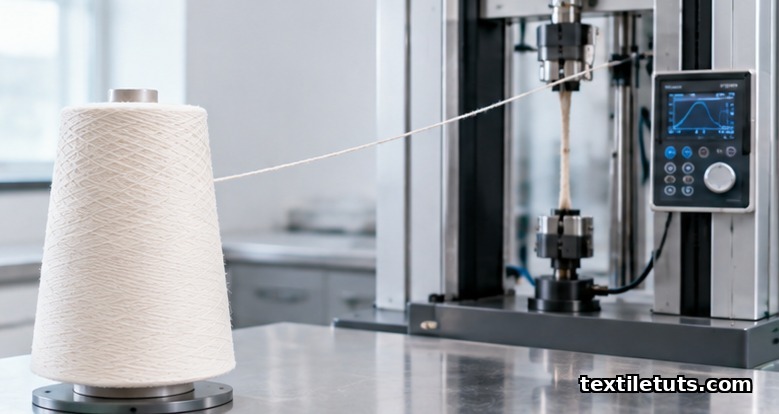
ISO 2062 specifies the single-end (single-strand) method for measuring yarn breaking force and elongation at break on a Constant Rate of Extension (CRE) tensile tester, using a 500 mm gauge length, a 5000 mm/min crosshead speed for low-elongation yarns, and 50 specimens conditioned at 20 °C and 65 % relative humidity per ISO 139, with results reported as breaking force in newton (N) and tenacity in cN/tex.
The standard is the most widely referenced yarn-strength test in textile laboratories, and the values it produces feed directly into knitting and weaving forecasts, quality acceptance criteria, and downstream fabric-strength estimates. This article walks through the test principle, the apparatus, the procedure, the calculation of tenacity and breaking elongation, and where ISO 2062 sits next to ASTM D2256, ISO 2061, and related yarn standards.
What ISO 2062 actually covers
ISO 2062, titled “Textiles, Yarns from packages: Determination of single-end breaking force and elongation at break using constant rate of extension (CRE) tester,” applies to yarns taken directly from packages such as cones, cheeses, cops, bobbins, or pirns. It covers spun, filament, and cabled yarns, and it is the reference single-strand tensile method in most international commercial and academic testing protocols. The current edition was updated in 2024 and supersedes ISO 2062:2009, which itself replaced earlier versions from 1972, 1993, and 1995.
The standard is intentionally narrow in scope. It does not prescribe a way to estimate yarn strength from skein or loop tests, and it does not cover the bundle (lea) methods that survive in a few regional standards. ISO 2062 measures only what happens to a single strand pulled along its own axis, which is why the result correlates well with how a yarn behaves in weaving and knitting tension zones.
Test principle: single-end CRE tensile testing
A single yarn specimen is clamped between two jaws of a CRE-type tensile tester and stretched until it breaks. The tester extends the specimen at a controlled, constant rate, and load cells record the force throughout the cycle. From the recorded force-elongation curve the operator reads the maximum force (breaking force) and the extension at that point (elongation at break), then calculates tenacity by normalising the force to yarn linear density.
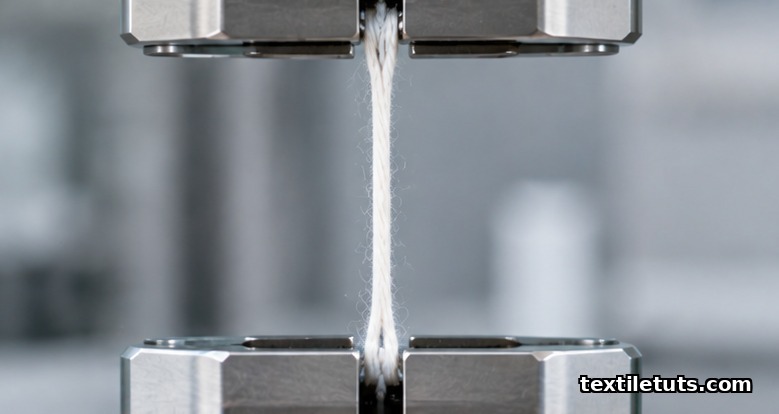
The “constant rate of extension” wording is not decorative. ISO 2062 accepts only CRE machines, not the older Constant Rate of Load (CRL) or Constant Rate of Traverse (CRT) designs. CRE testers reach the target jaw speed almost instantly at the start of the test, which matters for high-tenacity filament yarns where the first few per cent of extension can include the whole elastic region.
Apparatus and specimen preparation
The required equipment is straightforward but tightly specified:
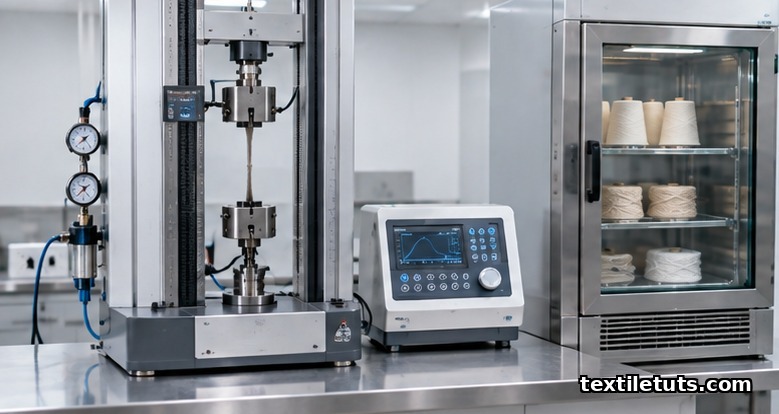
- CRE tensile tester with an effective jaw span of 500 mm, capable of 5000 mm/min ± 10 % for low-elongation yarns (2000 mm/min for high-elongation yarns above 50 % break elongation), and a load cell accurate to within ± 1 % of the indicated force.
- Pneumatic or capstan jaws with a clamping face wide enough to grip the yarn without slippage or crushing; common jaw faces are 25 mm to 50 mm wide.
- Pre-tensioning device to set the starting load at 0.5 cN/tex ± 0.1 cN/tex, applied without shock to the specimen.
- Climatic conditioning cabinet or laboratory maintained at 20 °C ± 2 °C and 65 % ± 4 % relative humidity per ISO 139.
- Linear density reference from ISO 2061 (yarn count) or the package label, needed to convert force to tenacity.
Specimens are withdrawn from the package using a yarn withdrawal device that gives a low, consistent pull, not by hand. The yarn is conditioned for at least 24 hours in the standard atmosphere before testing, and it remains in that atmosphere throughout the test.
Test procedure, step by step
- Condition the package and the laboratory to 20 °C and 65 % RH for a minimum of 24 hours.
- Set the gauge length (jaw separation) to 500 mm and the crosshead speed to 5000 mm/min for low-elongation yarns, or 2000 mm/min for yarns with breaking elongation above 50 %.
- Apply a pre-tension of 0.5 cN/tex ± 0.1 cN/tex to the specimen just before clamping the second jaw.
- Clamp the yarn in the upper jaw, then clamp the lower jaw without shock, ensuring the specimen is vertical and centred between the jaw faces.
- Start the tester and record the force-elongation curve until the yarn breaks.
- Discard any specimen that breaks within 5 mm of either jaw; such failures usually signal jaw slippage or damage and are not representative.
- Repeat for at least 50 specimens drawn from at least 10 different positions on the package (or across multiple packages for lot-level testing).
- Record breaking force in newton (or centinewton) and elongation at break in millimetres, then convert elongation to a percentage of the original 500 mm gauge length.
At least 50 valid breaks are preferred, and at least 30 are required for a valid test. Operators typically calculate the arithmetic mean, standard deviation, and 95 % confidence interval before reporting.
Calculating breaking force, tenacity, and elongation
The primary outputs are straightforward:
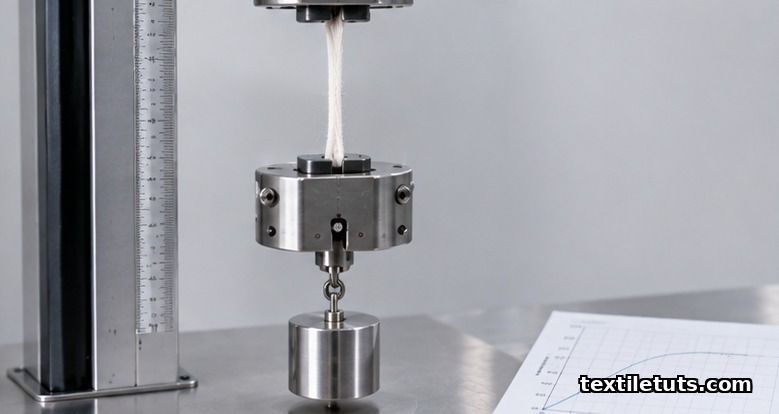
- Breaking force (F) in newton, read directly from the load cell as the peak of the force-elongation curve.
- Tenacity (specific strength) in cN/tex, calculated as Tt = (F × 100) / ρ, where F is in newton and ρ is linear density in tex.
- Elongation at break (ε) in %, calculated as ε = (ΔL / L0) × 100, where ΔL is the extension at break and L0 is the original gauge length (500 mm).
For a 30 tex polyester filament yarn with a mean breaking force of 18 N, tenacity works out to (18 × 100) / 30 = 60 cN/tex, which sits inside the typical 50 to 65 cN/tex range for partially oriented polyester filament yarn used in knitting. A 20 tex ring-spun cotton yarn might break at 3.5 N, giving a tenacity of around 17.5 cN/tex, consistent with values reported in peer-reviewed surveys of spun-yarn tensile properties.
Reporting always includes both the mean and the coefficient of variation (CV%) of breaking force, since yarn strength is highly variable along a single package and CV% often matters more than the mean for predicting downstream fabric behaviour.
ISO 2062 versus related yarn-strength standards
ISO 2062 is not the only standard in the field, and choosing between them depends on whether the yarn is a single strand or a skein, and whether the equipment available is CRE, CRL, or CRT. The table below summarises the most common alternatives.
| Standard | Method type | Tester | Gauge length | Typical output |
|---|---|---|---|---|
| ISO 2062:2024 | Single-end | CRE | 500 mm | Breaking force (N), tenacity (cN/tex), elongation (%) |
| ASTM D2256/D2256M-21 | Single-end (CRE or CRL option) | CRE or CRL | 250 mm or 500 mm | Breaking force, tenacity, elongation |
| ASTM D2259 (CRT, legacy) | Single-strand (CRT) | CRT | 250 mm | Breaking force, elongation |
| ISO 6939 (skein, now rarely used) | Skein breaking force | CRE | n/a | Skein breaking force |
| ISO 2061:2015 | Yarn count (linear density) | n/a | n/a | Linear density (tex) |
ASTM D2256 is the closest peer standard and is largely harmonised with ISO 2062 for the CRE option. ISO 6939 covers skein-based breaking force and is retained mainly for historical comparison, because the skein method generally overestimates the strength contribution of weaker yarn sections.
Practical tips from the testing floor
Three points consistently cause variance in ISO 2062 results and are worth flagging for textile engineers new to the method:
- Jaw slippage looks like a low break. If too many specimens break at the jaw or below 2 % elongation, switch to pneumatic jaws with higher clamping pressure or use capstan wraps.
- Pre-tension is not optional. Under-tensioned specimens record artificially high elongation; over-tensioned specimens pre-load and break at lower force. Stay inside 0.5 ± 0.1 cN/tex.
- Sample across the package. A single cone can show 10 to 15 % variation in breaking force from inner to outer layers; drawing all 50 specimens from one traverse position overstates yarn uniformity.
Frequently Asked Questions
What is the difference between breaking force and tenacity?
Breaking force is the absolute load, in newton, needed to rupture a single yarn strand. Tenacity is the same force normalised by yarn linear density, reported in cN/tex. Tenacity lets you compare a 30 tex yarn with a 60 tex yarn on equal footing, which is why most yarn-specification sheets list tenacity rather than raw force.
What crosshead speed should I use for high-elongation yarns?
For yarns whose breaking elongation exceeds 50 %, ISO 2062 calls for a reduced crosshead speed of 2000 mm/min. The slower speed keeps the specimen in thermal and mechanical equilibrium throughout the test and prevents the result from being inflated by dynamic effects at the faster 5000 mm/min setting.
How many specimens do I need for a valid ISO 2062 test?
At least 50 valid specimens are preferred, with a minimum of 30 accepted by the standard for a reportable result. Specimens that break within 5 mm of either jaw are discarded, so plan to test more than 50 if your jaw-slip rate is high.
Can ISO 2062 results predict fabric strength?
They correlate well, but they do not equal fabric strength. Fabric tensile testing, per ISO 13934-1 (strip) or ISO 13937 (grab), includes yarn-yarn friction, crimp, and weave geometry that ISO 2062 cannot capture. Treat single-end yarn strength as a useful upper-bound estimator, not a substitute for fabric testing.
Why is the coefficient of variation (CV%) often reported alongside the mean?
Yarn breaking force varies a lot along a single package, and downstream weaving and knitting performance is limited by the weakest sections, not by the mean. CV% of breaking force is a sensitive indicator of yarn evenness and is a much better predictor of loom stoppages and knitting breaks than the average force alone.
References
- International Organization for Standardization. ISO 2062:2024, Textiles, Yarns from packages: Determination of single-end breaking force and elongation at break using constant rate of extension (CRE) tester. iso.org. The definitive method standard referenced throughout this article.
- ASTM International. ASTM D2256/D2256M-21, Standard Test Method for Tensile Properties of Yarns by the Single-Strand Method. astm.org. Closely harmonised single-strand method used in North American labs.
- International Organization for Standardization. ISO 139:2005, Textiles, Standard atmospheres for conditioning and testing. iso.org. Defines the 20 °C and 65 % RH conditioning atmosphere required before ISO 2062 testing.
- International Organization for Standardization. ISO 2061:2015, Textiles, Yarn from packages: Determination of linear density (mass per unit length) by the skein method. iso.org. Source of the tex values used to calculate tenacity from breaking force.
- ResearchGate (peer-reviewed textile testing surveys). Tensile properties of spun yarns: a review. researchgate.net. Background values for typical tenacity ranges of ring-spun cotton, polyester, and blended yarns.
- PMC (PubMed Central). Mechanical characterisation of textile yarns. pmc.ncbi.nlm.nih.gov. Open-access review covering the relationship between single-end yarn testing and downstream fabric strength.
- Textile Institute. Handbook of Textile Testing. textileinstitute.org. Reference work covering CRE, CRL, and CRT tensile methods and their interpretation.
Editorial by Iftay Khairul Alam, TextileTuts. Sources: ISO 2062:2024, ASTM D2256/D2256M-21, ISO 139:2005, ISO 2061:2015, ResearchGate, PMC, and the Textile Institute Handbook of Textile Testing as cited.


