
Yarn Twist and Twist Direction: Z-Twist vs S-Twist

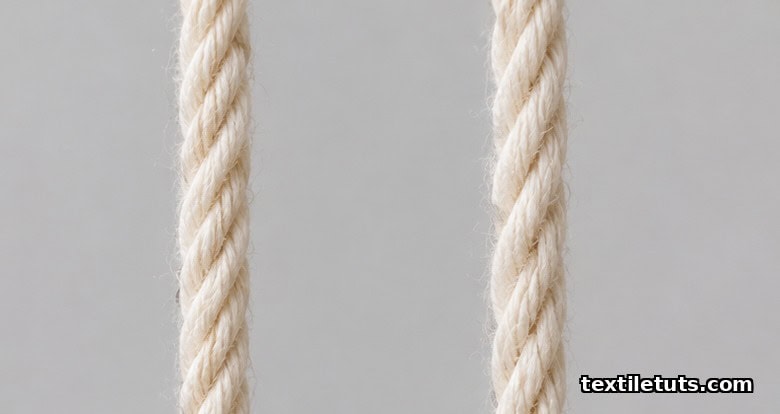
Yarn twist direction follows two standardized conventions defined in ISO 2:1973: Z-twist (also called right-hand or conventional twist) shows fiber bands sloping upward to the right, while S-twist shows fiber bands sloping upward to the left, with the direction named after the diagonal stroke of the respective letter when a vertical yarn is held and viewed from the side.
This naming system was formalized to end decades of trade confusion caused by regional terms such as “crosswise,” “with-way,” or “against-way.” Every modern short-staple spinning frame defaults to one direction, and every plying operation runs in the opposite direction to produce a balanced yarn. Choosing the right twist direction, and the right level of twist, decides whether a yarn is strong or soft, smooth or textured, snag-resistant or absorbent.
This article explains how Z-twist and S-twist are defined, how each behaves in single and plied constructions, how twist level affects fabric performance, and how to tell the two apart on the shop floor.
What Yarn Twist Actually Is
Twist is the spiral binding of fibers, filaments, or plies around the yarn axis. It is produced by the rotation of the drafting and twisting elements in ring spinning, by the rotor in open-end rotor spinning, or by the friction surface in friction spinning. The amount of twist is measured in turns per meter (TPM, used worldwide) or turns per inch (TPI, still common in U.S. textile references).
Without twist, a bundle of cotton fibers is just a loose rope that falls apart under tension. Twist generates lateral pressure between neighboring fibers, which creates friction along the fiber length and allows the bundle to carry load. Twist also compresses the yarn radially, reducing hairiness and improving evenness.
Most spun-yarn specifications express twist in a normalized form known as the twist multiplier (TM). For cotton and other short-staple systems:
TM = TPI / √(English cotton count, Ne)
or the metric equivalent using TPM and tex. A TM of 4.0 on a 30 Ne cotton yarn equals roughly 21.9 turns per inch, or about 860 turns per meter. Weaving warp yarns typically sit between TM 3.8 and 4.5; knitting yarns between TM 3.0 and 3.8; and high-twist crepe or voile yarns can exceed TM 5.5.
How Z-Twist and S-Twist Are Defined
Hold a single yarn vertically in front of you. Look at the diagonal pattern of fiber bands running across the surface.

- If the bands slope upward from left to right, like the middle stroke of the letter Z, the yarn has Z-twist.
- If the bands slope upward from right to left, like the middle stroke of the letter S, the yarn has S-twist.
The convention dates to a 1956 proposal by the British Standards Institution that was adopted internationally as ISO 2 (first edition 1957, confirmed 1973, and revised for textile vocabulary harmonization in subsequent updates). It replaced an earlier system of “crosswise” and “with-way” labels that proved unreliable across language borders. Today, ISO 2:1973 is the reference for every commercial yarn invoice and every yarn-testing protocol in the ASTM D1422/D1422M and D1423 series.
In practical terms, the choice of direction is mostly a matter of convention. Most ring frames worldwide are wired for Z-twist in single yarns (the cotton system is almost universally Z), while filament and many worsted yarns are produced in S-twist because that is the historical default of the machines used to spin them.
Why Direction Matters in Plied Yarns
Direction is most visible when two or more single yarns are twisted together to form a plied yarn or a cord. A balanced plied yarn uses the opposite direction to the singles: Z-twist singles are plied with S-twist, and S-twist singles are plied with Z-twist. The notation is written as Z on S or S on Z.
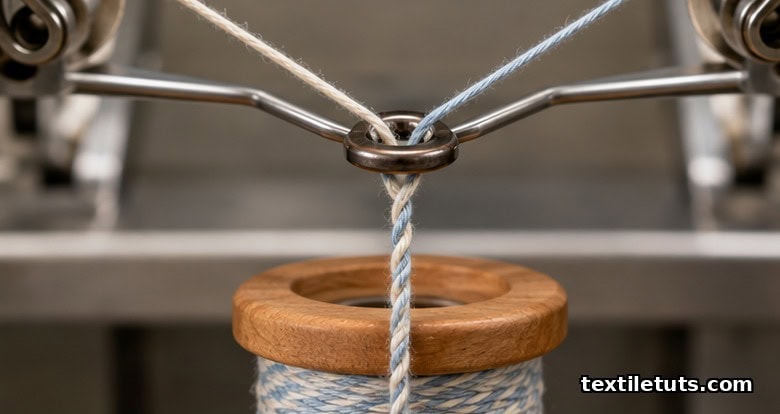
Balanced plying cancels the residual torsional moment of the singles. The result is a yarn that lies flat, opens easily from the package, and shows low liveliness. If both the singles and the ply run in the same direction (Z on Z or S on S), the result is called a unbalanced or re-entrant yarn. Such a yarn will corkscrew on itself, snag in the loom, and produce fabrics with severe skew. Some specialty crepe yarns are deliberately unbalanced to build torque energy into the fabric for a pebbled surface texture.
How Direction Affects Fabric Behavior
Twist direction leaves a measurable fingerprint on the finished cloth, even when the same fiber, count, and weave are used.
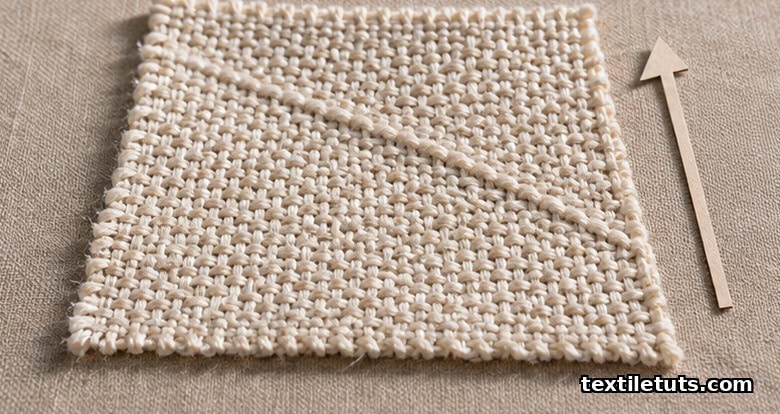
Skew in woven fabric. A fabric woven with unbalanced or wrongly directed single yarns develops a diagonal distortion off the perpendicular. Filling-wise skew occurs when the weft direction is twisted into alignment with the warp by the beat-up motion. Testing for skew uses AATCC TM 179 and is typically reported in percent of fabric width.
Pilling tendency. Higher-twist yarns lock more fiber ends into the yarn body, reducing pilling. Studies published in the Textile Research Journal show that pilling grade on knit fleece improves by roughly half a grade when twist multiplier is raised from 3.6 to 4.4 in 30 Ne cotton yarn (Textile Research Journal, vol. 92, issue 21–22).
Dye uptake. Looser-twist yarns absorb dye liquor faster and reach deeper shades in shorter cycles, because dye liquor reaches more accessible amorphous regions. Tightly twisted yarns show better wash fastness on cellulosic fibers because less loose dye sits on the fiber surface. This effect is well documented in reactive dyeing process notes from Cotton Incorporated (cottoninc.com).
Hand and luster. Z-twist and S-twist cottons of equal count and TM, when woven as plain cloth, feel almost identical. The hand difference becomes more obvious in filament yarns and in textured filament knits, where the geometry of loops reflects the torque stored in the yarn.
Common Twist Levels by Application
The following table summarizes typical twist multiplier (TM) ranges used in cotton-system yarn spinning for mainstream applications. Values are drawn from Cotton Incorporated technical bulletins and from ring-spinning reference data published by spinners’ associations.
| Application | Typical TM range (English cotton, Z singles) | Twist direction (single → ply) |
|---|---|---|
| Warp yarn, plain weave | 3.8 to 4.5 | Z (plied S if 2-ply) |
| Weft yarn, plain weave | 3.4 to 4.0 | Z (plied S if 2-ply) |
| Knitting yarn, single jersey | 3.0 to 3.6 | Z (plied S if 2-ply) |
| Knitting yarn, rib and interlock | 3.2 to 3.8 | Z (plied S if 2-ply) |
| Voile and high-twist crepe | 5.0 to 6.5 | Z singles, often used single |
| Core-spun sewing thread | 4.5 to 5.2 (singles), final Z | Z singles, plied Z (balanced with resin finish) |
How to Tell Z-Twist from S-Twist at the Workstation
Three quick checks work on any single or plied yarn with no special equipment.
1. Hold-and-look. Pull a short length (about 100 mm) of yarn from the package and hold it vertical at eye level. Identify the diagonal direction of the surface bands. Match to Z or S as described above. Repeat on three segments to confirm, because a poorly wound package can show one short twisted section in the wrong sense.
2. Twist unraveling. Untwist the yarn by rotating the upper end counter to the apparent direction. If the yarn loosens (becomes hairy and weak), you have been rotating with the twist, so the original direction is opposite. If the yarn tightens into a rigid cord, you have been rotating against the twist, confirming the original direction.
3. Snarling test. Cut a 250 mm length, hold both ends, and bring them together. A yarn with high residual torsional moment will form a snarl loop or coil. The number of snarls per centimeter correlates with the imbalance between single and ply direction.
For laboratory testing, ASTM D1422/D1422M (the “short-specimen” or untwist-twist method) is the most common quantitative reference. ASTM D1423 covers the direct-counting method for plied yarns. AATCC TM 84 is used for single yarns in mill labs and is broadly equivalent.
Frequently Asked Questions
Are Z-twist and S-twist equally common in industry?
No. Z-twist singles dominate cotton, spun polyester, and most short-staple spinning worldwide, because the standard ring-spinning draft and traveler geometry is set up for Z. S-twist is more common in filament yarns, some worsted systems, and some specialty crepe constructions. In any given yarn catalog, expect to see roughly 80 to 90 percent of single spun yarns listed as Z-twist.
Can two single yarns of the same count and twist multiplier feel different just because of direction?
In staple spun yarns of the same fiber, count, and TM, the hand difference from direction alone is small, often below the threshold of casual touch. The difference becomes obvious in plied or filament constructions, where the torsion stored in the yarn interacts with knitting or weaving geometry. Direction-driven behavior is far more visible in finished fabric (skew, pilling, surface texture) than in the yarn itself.
What happens if the wrong twist direction is used in weaving or knitting?
Three predictable problems appear. First, fabric skews diagonally because weft torque is not balanced against warp torque. Second, the yarn snarls on the package and through guides, causing more stoppages. Third, fabrics may bias off-grain after washing because the residual twist energy releases unevenly. If skein shrinkage and ASTM D1422 tests are run on suspect lots, both the absolute TPM and the direction should be reviewed against the order.
How does twist direction interact with sewing thread?
Most cotton and polyester-core spun sewing threads are finished as Z-twist singles. The thread is then plied in Z direction, and the residual twist is locked by a resin or mercerization finish. This is an exception to the rule of opposite-direction plying, and it works only because the finish stabilizes the torsion. Removing or breaking the finish (through harsh laundering or solvent spotting) can make the thread corkscrew again, which is one cause of sewing thread looping on industrial machines.
Does twist direction affect yarn strength?
Direction itself has no measurable effect on yarn tensile strength, all other factors being equal. Strength is governed by twist level, fiber length, fiber fineness, and blend composition, not by Z or S. Direction matters only when two yarns of opposing torsion interact, as in plying, weaving, or knitting loops, where the torque energy either balances or compounds.
References
- International Organization for Standardization. ISO 2:1973, Textiles, Designation of the direction of twist. iso.org. Defines the Z/S naming convention used in all current yarn specifications.
- ASTM International. ASTM D1422 / D1422M, Standard Test Method for Twist in Single Spun Yarns by the Short-Specimen Method. astm.org. The most widely cited quantitative twist test.
- ASTM International. ASTM D1423, Standard Test Method for Twist in Yarns by Direct Counting. astm.org. Covers plied and cabled yarns.
- AATCC. AATCC TM 84 — Twist in Yarn (Single Yarn Method). aatcc.org. Mill-friendly equivalent used in quality-control labs.
- Cotton Incorporated. Yarn Twist and Twist Multiplier Technical Bulletin. cottoninc.com. Reference data on TM ranges for woven and knit cotton applications.
- Textile Research Journal, vol. 92, issues 21 to 22 (2022). “Effect of twist multiplier on pilling and abrasion of cotton knit fabrics,” peer-reviewed study correlating TM with pilling grade.
Editorial by Iftay Khairul Alam, TextileTuts. Sources: ISO 2:1973, ASTM D1422/D1422M, ASTM D1423, AATCC TM 84, Cotton Incorporated technical bulletin, and Textile Research Journal (2022) as cited.


