
Vortex Spinning: Murata Vortex and Competitive Technologies


Murata Vortex Spinning (MVS) operates at production speeds of 350 to 450 meters per minute, roughly 13 times faster than conventional ring spinning (25 to 30 m/min), and processes 100% cotton yarns in the count range Ne 12 to Ne 80 by applying a rotating air vortex inside a stationary spindle.
The yarn exits the MVS spindle with a wrapper-fiber sheath twisted around a parallel-core bundle, producing a smoother surface (Zweigle S3 hairiness of 0.8 to 1.5 versus 4.0 or higher for ring-spun cotton) and a tenacity of 12 to 15 cN/tex for Ne 30 cotton, compared to 16 to 19 cN/tex for ring-spun equivalent tested under ASTM D2256.
This article explains how MVS works, the yarn it produces, where it sits against competitive spinning systems, and which end-uses it serves best.
How Murata Vortex Spinning Works
Murata Machinery, Ltd. (Kyoto, Japan) introduced the first commercial vortex spinner in 1995 after roughly a decade of development that built on its earlier Murata Jet Spinner (MJS, 1981). The MVS design replaces the MJS tandem two-nozzle arrangement with a single conical spindle that houses a stationary twist-imparting needle along its central axis.
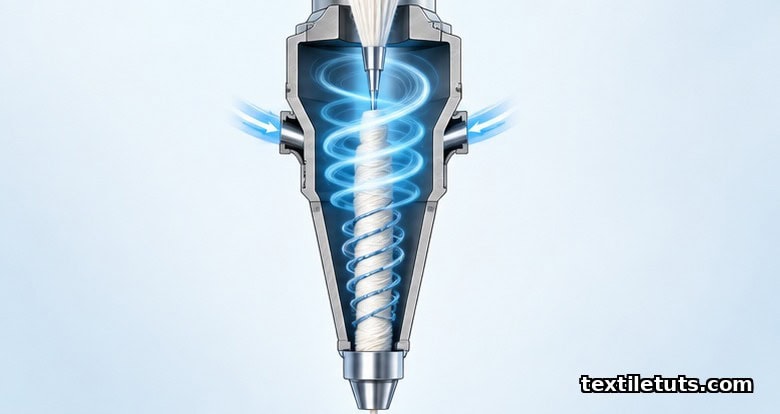
Drafted sliver enters the spindle through the needle tip. Compressed air enters tangentially through slots in the spindle wall and spirals down the inner cone, creating a high-velocity rotating vortex. The vortex applies a false twist to the fiber bundle as it travels toward the yarn exit, while the air pressure differential simultaneously pulls the fibers through and propels the finished yarn onto a take-up package at delivery speeds between 350 and 450 m/min, depending on count and fiber length.
Because the false twist is applied and removed within the same short spindle (typically 30 to 40 mm long), the outer fibers wrap helically around a relatively parallel core rather than receiving a true helical twist through the cross-section. The standard twist multiplier in MVS is around 3.5 to 4.0, compared to 3.8 to 4.2 for ring spinning, and the resulting yarn has a two-zone structure: a high-twist wrapper skin and a low-twist, near-parallel core. Lawrence’s review of vortex spinning describes this wrapper-core structure as the source of both the hairiness advantage and the tenacity penalty compared with ring spinning.
Yarn Structure and Physical Properties
The wrapper-core structure is the defining feature of MVS yarn and explains most of its downstream behavior. Yarn evenness testing of Ne 30 cotton MVS yarn shows CV% values of 11 to 13% under ASTM D1425 and ISO 16549 capacitance testing, comparable to ring-spun equivalents. Hairiness, measured by the Zweigle S3 method (loose fibers longer than 3 mm projecting from the yarn body) per AATCC TM 89, is the most consistent advantage: MVS S3 values run 0.8 to 1.5, while ring-spun Ne 30 cotton frequently registers S3 values above 4.0.
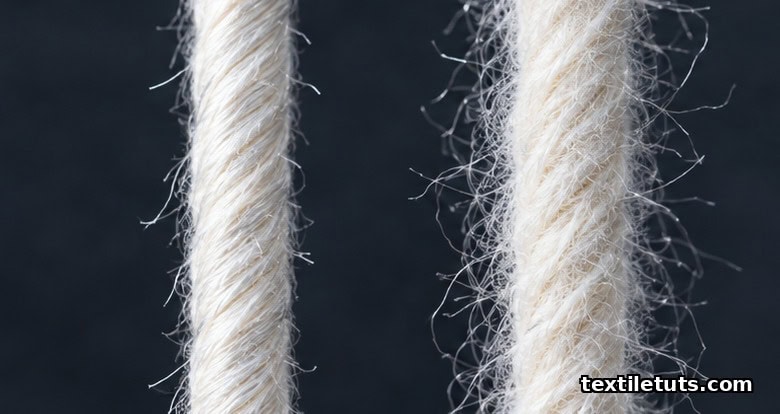
Tenacity comes at a cost. Because the core fibers are not fully bound by helical twist, MVS yarn tenacity lands at roughly 70 to 80% of ring-spun values for the same fiber blend and count, measured per ASTM D2256 and ISO 20602 with a gauge length of 250 mm. For Ne 30 cotton, that typically means 12 to 15 cN/tex for MVS versus 16 to 19 cN/tex for ring. Elongation at break is also lower, often 6 to 8% compared to 7 to 10% for ring-spun equivalent yarn.
The wrapper sheath does positive work in weaving and knitting: fewer protruding fibers mean fewer machine stoppages from lint accumulation, fewer fly fibers contaminating the shed, and reduced pilling in finished fabrics. The same low-hairiness profile makes MVS yarn attractive for next-to-skin knits and for printing grounds where surface uniformity matters more than maximum tenacity.
Production Economics: Speed, Labor, and Waste
Three economic levers define vortex spinning’s commercial position. First, throughput: MVS delivery speeds of 350 to 450 m/min translate to 8 to 12 kg per spindle-hour on Ne 30 cotton, roughly three times the output of a modern ring frame running at 25 to 30 m/min. Second, labor: one operator can manage 8 to 12 MVS positions versus 2 to 4 ring frames, because MVS packages are larger (typically 2 to 4 kg) and doffing is automated on most installations.
Third, waste: MVS eliminates the roving process entirely. Ring spinning requires a speed frame between the drawframe and the ring frame to produce roving; MVS takes drawn sliver directly into the spindle. That removes one machine, one energy step, and the 1 to 2% roving-frame waste typical in a short-staple ring route. The offset is higher electricity consumption per kilogram because of the compressed-air requirement, with each MVS position using roughly 35 to 40 Nm³/h of compressed air at 5 to 6 bar to generate the rotating vortex.
The count range is narrower than ring spinning. Murata’s published operating window for cotton tops out around Ne 80 and bottoms out around Ne 12; finer counts need longer fibers (typically 28 to 32 mm staple), and coarser counts become uneconomic because of the vortex air requirements. Man-made fibers such as polyester and viscose can be processed up to Ne 100 with appropriate modifications to the spindle geometry.
Application Areas and End-Uses
MVS yarn has found its commercial center of gravity in knitwear (especially single-jersey and interlock for T-shirts, polo shirts, and fleece), home textiles (sheets, pillowcases, and terry towels where low hairiness improves comfort and dye uniformity), and weaving of lightweight shirting and lining fabrics. The lower tenacity is rarely the limiting factor in these end-uses because the fabric construction, not the yarn, carries most of the load.

In denim, MVS weft is more common than MVS warp. The low hairiness of MVS weft improves indigo dye uniformity and reduces white yarn exposure in the warp-face pattern, but MVS warp at coarser counts shows lower abrasion resistance than ring warp, so most denim mills that adopt MVS restrict it to the weft position. Industry surveys show MVS uptake concentrated in knit and home-textile end-uses, where its surface-quality benefits outweigh the tenacity gap.
Blending with polyester is routine: 65/35 and 50/50 polyester-cotton MVS yarns serve the knit-hosiery and fleece-knit markets that would otherwise consume rotor-spun blends. The fiber-length constraint becomes more permissive with synthetic staple, and the wrapper sheath reduces pilling in polyester-rich knits compared with ring-spun equivalents.
Comparison with Other Spinning Systems
The table below summarizes key operating parameters for cotton yarn spun on the four systems most commonly compared with MVS. Values are typical mill figures for Ne 30 cotton; specific results vary by fiber blend, machine vintage, and process tuning.
| Property | Ring Spinning | Compact Ring | Rotor (Open-End) | Murata Vortex (MVS) |
|---|---|---|---|---|
| Delivery speed (m/min) | 25 to 30 | 25 to 30 | 100 to 200 | 350 to 450 |
| Tenacity (cN/tex, Ne 30 cotton) | 16 to 19 | 17 to 21 | 11 to 14 | 12 to 15 |
| Elongation at break (%) | 7 to 10 | 7 to 10 | 7 to 10 | 6 to 8 |
| Yarn evenness CV% | 11 to 13 | 10 to 12 | 11 to 14 | 11 to 13 |
| Hairiness S3 (Zweigle) | 4.0+ | 3.0+ | 2.0+ | 0.8 to 1.5 |
| Yarn count range (Ne, cotton) | 6 to 120 | 6 to 120 | 4 to 40 | 12 to 80 |
| Positions per operator | 2 to 4 frames | 2 to 4 frames | 2 to 3 frames | 8 to 12 positions |
The decisive trade-offs: ring and compact ring deliver the highest tenacity and the widest count range, with rotor offering the fastest short-staple throughput at the cost of yarn structure (twisted wrapper around the entire bundle, lower strength efficiency). MVS sits between rotor and ring on tenacity, well above rotor on hairiness, and far above both on delivery speed.
Competitive Vortex-Style and Related Technologies
Several spinning systems compete in the same fabric territory as MVS, either by adopting air-jet or vortex principles or by addressing the same end-uses through different mechanisms.
Murata Jet Spinning (MJS): the 1981 predecessor to MVS. MJS uses two nozzles in tandem (a primary nozzle for false twist and a secondary nozzle for final twist) and produces a true twisted yarn rather than the wrapper-core MVS structure. MJS yarn tenacity is closer to ring-spun than MVS is, but production speed is lower (200 to 250 m/min) and hairiness is higher. Basu’s review of air-jet spinning documents the MJS-to-MVS evolution and the structural shift from true twist to wrapper-core yarn. Most MJS capacity has been retired in favor of MVS, but specialty installations remain.
Rotor (open-end) spinning: the dominant competitor for coarse-count knit yarn. Rotor speeds (100 to 200 m/min) are well below MVS, but rotor frames are simpler, cheaper per position, and tolerate shorter fibers (down to 25 mm). For coarse-count fleece and towel yarn in the Ne 8 to 20 range, rotor is often the lower-cost choice. Rotor yarn shows higher hairiness than MVS but higher tenacity than MVS for coarse counts.
Friction spinning (DREF): the DREF-II and DREF-III systems from Dr. Ernst Fehrer use two rotating drums to apply false twist to a sliver fed between them. DREF excels at coarse-count technical yarn and waste-fiber blends (including recycled cotton and wool shoddy) at speeds up to 250 m/min. DREF yarn has a parallel-core wrapper structure similar in principle to MVS but with a much looser construction, limiting it to non-apparel end-uses.
Compact ring spinning: not a vortex system but the most direct competitor for high-quality fine-count knit and woven yarn. Compact spinning adds a pneumatic condensing zone at the front drafting rollers, reducing the floating-fiber zone and improving hairiness by 30 to 50% versus conventional ring. Production speed matches ring (25 to 30 m/min), so compact does not match MVS throughput, but it preserves the ring-spun yarn structure that downstream weavers and knitters already understand and spec for.
Electrostatic and Bobtex: niche technologies from the 1970s and 1980s. Electrostatic spinning uses an electric field to align fibers before twist insertion; Bobtex uses an adhesive-core structure with fibers bonded around a soluble filament. Neither achieved commercial scale comparable to MVS, rotor, or ring spinning, and they appear in the textile-engineering literature mainly as historical references.
Frequently Asked Questions
What is the main difference between Murata Vortex Spinning and Ring Spinning?
Ring spinning inserts true helical twist through the fiber bundle at 25 to 30 m/min, producing the highest-tenacity yarn but with a hairy surface. Murata Vortex Spinning uses a high-velocity rotating air vortex inside a stationary spindle at 350 to 450 m/min, producing a wrapper-core structure with much lower hairiness (Zweigle S3 of 0.8 to 1.5 versus 4.0 or higher for ring) but tenacity at roughly 70 to 80% of ring-spun equivalent measured per ASTM D2256.
Why is Murata Vortex yarn less strong than ring-spun yarn?
The vortex removes and reapplies false twist within a 30 to 40 mm spindle, so the outer fibers wrap around the bundle but the core fibers remain largely parallel rather than receiving true helical twist. Without full fiber-to-fiber twist binding, load transfer across the yarn cross-section is less efficient, reducing tenacity per ASTM D2256 and ISO 20602 to 12 to 15 cN/tex for Ne 30 cotton versus 16 to 19 cN/tex for ring-spun equivalent.
Can MVS replace ring spinning for denim warp?
Not in most mills. MVS warp at coarser counts shows lower abrasion resistance than ring warp, so denim mills that adopt MVS typically restrict it to the weft position where low hairiness improves indigo dye uniformity. For warp, ring or compact ring remains the industry default, particularly when weaving high-density indigo constructions that depend on warp-yarn abrasion tolerance.
What fiber length and count range does MVS accept?
The published operating window for cotton runs from Ne 12 to Ne 80. Fiber length must be 28 to 32 mm or longer; shorter fibers are ejected by the vortex air and show up as waste or fly. With polyester or viscose staple, MVS can process counts up to Ne 100 with appropriate modifications to the spindle geometry and air pressure settings.
How much compressed air does MVS consume?
Each MVS position consumes roughly 35 to 40 Nm³/h of compressed air at 5 to 6 bar pressure to generate the rotating vortex. This is a meaningful operating cost; mills typically install dedicated high-pressure compressors for MVS rooms and monitor air cost per kilogram of yarn as a key production KPI alongside electricity and labor cost per kilogram.
References
- AATCC. Test Method 89: Hairiness of Yarn by Photoelectric Apparatus. American Association of Textile Chemists and Colorists. Photoelectric method for measuring yarn hairiness length and count, referenced for Zweigle S3 values throughout this article.
- ASTM. ASTM D2256 / D2256M: Standard Test Method for Tensile Properties of Yarns by the Single-Strand Method. ASTM International. Single-strand tensile test referenced for MVS and ring-spun tenacity values, with 250 mm gauge length.
- ASTM. ASTM D1425 / D1425M: Standard Test Method for Evenness of Yarns Using Capacitance Testing. ASTM International. Capacitance-based evenness test referenced for CV% values in the comparison table.
- ISO. ISO 20602: Textiles – Yarns from Packages – Determination of Single-End Breaking Force and Elongation at Break Using Constant Rate of Extension (CRE) Tester. International Organization for Standardization. ISO equivalent of ASTM D2256, used in laboratories outside North America for MVS tenacity reporting.
- Lawrence, C. A. Advances in Yarn Spinning Technology. Woodhead Publishing (Elsevier). Covers MVS mechanism, spindle geometry, wrapper-core yarn structure, and the historical MJS-to-MVS evolution.
- Basu, A. Progress in Air-Jet Spinning. Textile Progress (The Textile Institute). Peer-reviewed review article covering MJS, MVS, and related air-jet and vortex spinning systems with quantitative performance data.
Editorial by Iftay Khairul Alam, TextileTuts. Sources: AATCC TM 89, ASTM D2256, ASTM D1425, ISO 20602, Lawrence (Woodhead/Elsevier), and Basu (Textile Progress, Textile Institute) as cited.


