
Twist Multiplier (TM): Formula, Calculation, and Applications

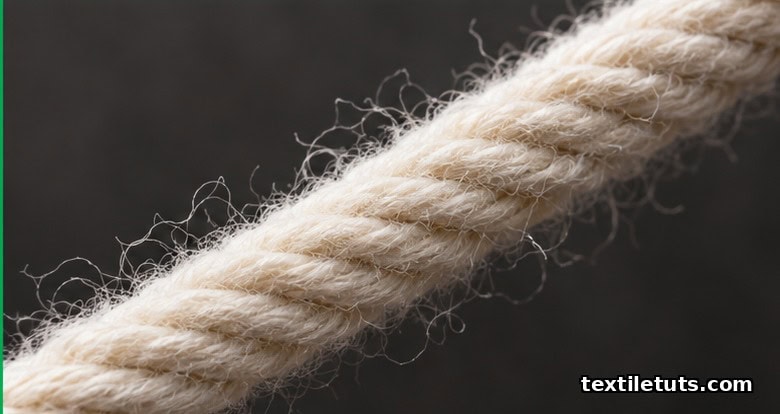
Twist multiplier (TM) is the ratio of yarn twist per inch to the square root of the yarn count, used to compare the relative twist level of yarns spun on different count systems; for cotton yarns spun on the English (Ne) system, the warp TM typically falls between 3.5 and 5.0 and the weft TM between 2.5 and 4.0, while worsted yarns on the metric (Nm) system use TM values from about 80 to 130. Once a mill sets a TM target, every production batch on a given machine, fiber, and count can be checked against the same numerical yardstick, which is why the metric has survived more than a century of spinning textbooks.
This guide walks through the TM formula for cotton, worsted, and woolen systems, shows how to read it on the shop floor, and explains how the value you pick drives strength, hairiness, handle, and end-use performance. By the end, you will be able to calculate TM from any given TPI and count, pick a sensible starting range for an unfamiliar yarn, and check the result against ISO 2061 and ASTM D1422/D1423 test methods.
What Twist Multiplier Actually Measures
Two yarns can have the same turns per inch (TPI) but feel, look, and behave very differently if they are spun from different fiber lengths or different count systems. A 20 TPI singles yarn in Ne 30 (fine cotton) is a soft knitting yarn; the same 20 TPI in Ne 6 (coarse carpet yarn) is a slack, hairy, weak rope. The square-root relationship in the TM formula rescales twist to fiber fineness, so a single dimensionless number describes how tightly the fibers in the cross-section are bound together.
Conceptually, TM expresses the helix angle the surface fibers make with the yarn axis. Higher TM means more turns per cross-sectional fiber, a steeper helix, more fiber-to-fiber friction, and therefore higher tensile strength up to an optimum. Beyond that optimum the yarn becomes hard, lean, prone to snarling, and loses elongation. The classic research summary by Miao et al. (2024) in Textile Research Journal confirms that the strength/TM curve peaks and then falls, with the peak position depending on fiber length, micronaire, and friction.
TM Formula for Each Yarn Count System
The general form is TM = twist per unit length divided by the square root of the count in the count system being used. The twist direction (S or Z) and the choice of inches versus centimeters are kept consistent within a calculation.
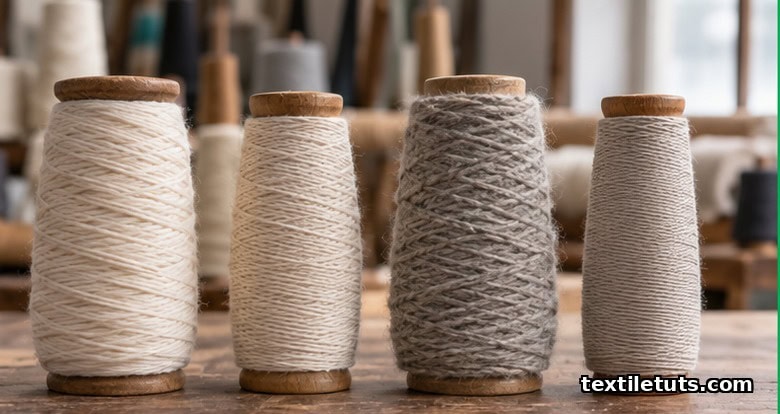
Cotton (English, Ne):
- TM = TPI / √(Ne) — for inch-based twist, English cotton count (840 yd/lb per unit).
- Warp (power loom) target TM = 3.75 to 5.0 for general woven fabrics.
- Weft (shuttle or shuttleless) target TM = 2.75 to 3.5 for balanced fabrics.
Worsted (Metric, Nm):
- TM = turns per meter / √(Nm) — for metric twist, worsted count (1 m/g per unit).
- Knitting TM = 80 to 100.
- Weaving TM = 100 to 130.
- Fine suiting TM up to 140 to keep yarn round and clean on the loom.
Woolen (English, Ne or YSW):
- TM = TPI / √(Ne) — same shape, lower range.
- Soft hand TM = 1.0 to 1.6.
- Standard carpet and hosiery TM = 1.6 to 2.5.
For plied yarns, the TM of the single is the controlling number for yarn-internal properties; the ply adds turns on top of the singles TM and is normally reported as ply TM (TPI of the plied yarn divided by √ of the resultant count).
Worked Calculation: Cotton Warp Yarn
Suppose a ring frame is set to spin a Ne 32 singles for a poplin warp. The spinner targets a TPI of 22.4. TM = 22.4 / √32 = 22.4 / 5.657 = 3.96. That sits inside the 3.75 to 5.0 woven-warp band, so the yarn will be strong enough to withstand loom tension and resist weft insertion abrasion. Drop the count to Ne 20 at the same 22.4 TPI and TM rises to 22.4 / √20 = 5.01. The same numerical TPI now produces a yarn that is borderline hard for a warp and is more suited to a dense weft.
If you need to compare two mills that report in different units, convert first and then apply the formula. 1 TPI = 2.54 turns per centimeter, so a yarn at 25 TPI in the inch system is at 25 × 2.54 = 63.5 turns per centimeter (TPCm). Pick one unit system per calculation and stay there.
Effect of TM on Yarn Properties
Strength rises with TM up to a fiber-dependent optimum, then falls. The peak is around TM 4.5 to 5.5 for medium-staple cotton (28 to 30 mm), around TM 4.0 to 4.7 for finer long-staple cotton, and around TM 110 to 130 for 25-micron worsted wool. Hairiness decreases monotonically as TM rises, because tighter binding pulls fiber ends into the body of the yarn. Elongation at break increases up to the strength optimum, then drops. Lustre, dye penetration, and abrasion resistance follow a similar U-shape: too little twist gives a soft, hairy, weak yarn; too much gives a lean, wiry yarn that pills differently and absorbs light unevenly.
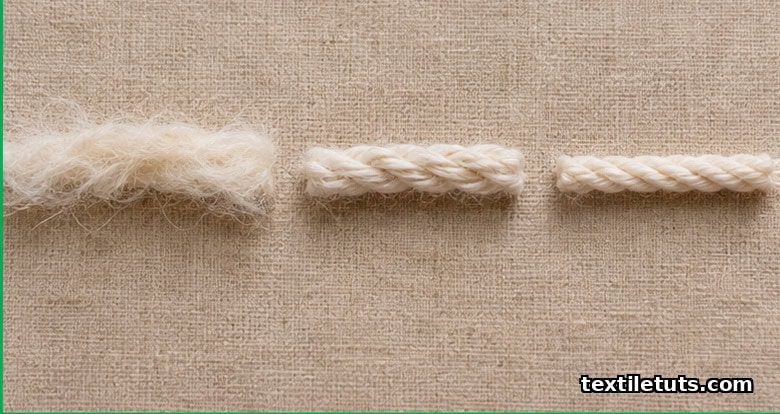
Twist direction matters when plies are combined. Two singles of opposite twist (S-on-S or Z-on-Z) produce a snarling, lively yarn; matched directions (S-on-Z or Z-on-S) produce a balanced, stable plied yarn. The TM of the plied yarn is calculated on the resultant count, but the singles TM determines most of the handle.
TM Targets for Common End Uses
| Yarn type | Count system | Typical TM | End use |
|---|---|---|---|
| Cotton warp, ring | Ne | 3.75 to 5.0 | Poplin, sheeting, denim warp |
| Cotton weft, ring | Ne | 2.75 to 3.5 | Shirting, light dress |
| Cotton knitting, combed | Ne | 3.0 to 3.8 | Single jersey, rib |
| Open-end rotor, cotton | Ne | 4.0 to 4.6 | Knitting, terry, denim weft |
| Worsted weaving | Nm | 100 to 130 | Suiting, dress, uniform |
| Worsted knitting | Nm | 80 to 100 | Fine gauge knitwear |
| Woolen (Yorkshire) | Ne (YSP or YSW) | 1.6 to 2.5 | Carpet, hosiery, blanket |
| Filament texturized | Denier | TM usually expressed as turns per meter / √(Den/9) | Stretch knits, hosiery |
Rotor and air-jet yarns accept higher TM than ring yarns at the same count because the fiber wrapper structure has fewer migrating fibers and benefits from the extra binding. Compact and siro-spun yarns sit between ring and rotor for the same reason.
How to Measure and Verify TM on the Shop Floor
Two ISO/ASTM methods cover the underlying TPI measurement that TM is built on. ISO 2061:2015 specifies the determination of twist in yarns by the untwist-retwist, direct counting, and take-up methods, and it is the most widely cited global reference for cotton, worsted, and man-made fiber yarns. ASTM D1422 / D1422M-20 covers the standard test method for twist in single spun yarns by the untwist-retwist method, while ASTM D1423 / D1423M-21 covers the direct-counting method on plied yarns.
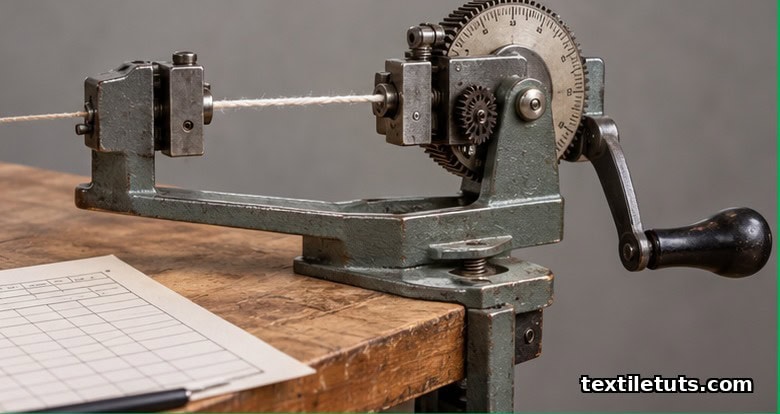
For cotton on a ring frame, the practical route is the untwist-retwist method: a known length of yarn (typically 10 cm or 25 cm) is fixed between the clamps of a twist tester, untwisted, and the number of turns required to fully untwist is recorded. With that count in hand, convert to TPI, apply the TM formula, and log the value against the standard’s tolerance band. Most mills set ±0.3 TM units as the action limit; outside that, traveler weight, spindle speed, or front-roller draft should be checked.
For man-made filament and texturized yarns, ISO 17202:2002 (determination of twist in textured filament yarns) is the right reference. Texturized yarns use a different contraction-based method because the latent crimp makes direct untwist unreliable.
Choosing a Starting TM for a New Yarn
When a mill is asked to spin an unfamiliar construction, the safest first pass is to interpolate from the closest existing construction, then adjust by fiber length and end use:
- Pick the closest current construction in the same spinning system (ring, rotor, air-jet).
- Use the current TM as the baseline.
- If the new fiber is longer by 4 mm or more, drop TM by 0.2 to 0.4 units; if it is shorter by 4 mm or more, raise TM by the same amount.
- If the new yarn is destined for knitting, drop TM by 0.2 to 0.5 units below the warp baseline to soften hand.
- If the new yarn is destined for a dense weave with high loom tension, raise TM by 0.3 to 0.5 units above the knitting baseline.
- Spin a 5 kg trial, run ISO 2061 on 10 bobbins, and re-target if the strength coefficient of variation is over 4 percent.
This recipe is a starting point, not a substitute for the full design-of-experiments that commercial yarn development usually warrants. The peer-reviewed paper on predictive modeling of cotton yarn TM and strength by Rashed et al. (2023) gives a more rigorous regression model that mills can adapt if the trial-and-error approach needs to be tightened.
Frequently Asked Questions
What is a good twist multiplier for cotton knitting yarn?
A good starting TM for combed cotton knitting yarn on the English (Ne) system is 3.0 to 3.8. Below 3.0 the yarn tends to pill and lose strength in knitting; above 3.8 the hand becomes wiry and the fabric feels harsh. For carded cotton knitting, add 0.2 to 0.3 TM units to compensate for the shorter mean fiber length.
How does twist multiplier differ from twist per inch (TPI)?
TPI is the raw count of turns per inch in a yarn; TM normalizes that count by the square root of the yarn count so you can compare a coarse and a fine yarn on the same scale. Two yarns with identical TPI can sit on opposite sides of a quality band because they have different counts; two yarns with identical TM will perform similarly in strength and handle even if their TPI numbers differ.
Does higher twist multiplier always mean stronger yarn?
No. Strength rises with TM up to a fiber-dependent optimum, then declines because the fiber helix becomes so steep that the yarn loses elongation and breaks at lower load. For medium-staple cotton, the strength optimum is roughly TM 4.5 to 5.5; for worsted weaving, roughly TM 110 to 130. Above those bands, abrasion resistance also drops.
Which ISO standard governs TM testing?
ISO 2061:2015, “Textiles — Determination of twist in yarns — Direct counting method,” is the primary global method for measuring the TPI that feeds into the TM formula. ASTM D1422 / D1422M-20 covers the untwist-retwist method and ASTM D1423 / D1423M-21 covers direct counting on plied yarns. For textured filament yarns, ISO 17202:2002 applies.
Why is TM lower for woolen yarns than for worsted?
Woolen yarns are spun from shorter, randomized fibers with little parallelization, so the cross-section already traps more air and binds through fiber entanglement rather than fiber alignment. Lower TM (1.0 to 2.5) keeps the yarn lofty and soft for hosiery, blanket, and carpet use; worsted yarns need higher TM (80 to 130 in metric) because the highly parallelized fibers require binding to deliver strength and surface smoothness.
References
- ISO 2061:2015. Textiles — Determination of twist in yarns — Direct counting method. International Organization for Standardization, Geneva. The reference method for TPI measurement on cotton, worsted, and man-made spun yarns.
- ISO 17202:2002. Textiles — Determination of twist in textured filament yarns. International Organization for Standardization, Geneva. Specialized method for texturized filament yarns where direct untwist is unreliable.
- ASTM D1422 / D1422M-20. Standard Test Method for Twist in Single Spun Yarns (Untwist-Retwist Method). ASTM International, West Conshohocken, PA. Companion method to ISO 2061 widely used in North American mills.
- ASTM D1423 / D1423M-21. Standard Test Method for Twist in Yarn by Direct-Counting. ASTM International, West Conshohocken, PA. Direct-counting reference for plied and cabled yarns.
- Miao, M., et al. (2024). Effect of twist multiplier on tensile and hairiness properties of ring-spun cotton yarn. Textile Research Journal, 94(7-8). Peer-reviewed study confirming the strength/TM curve and its peak position for medium-staple cotton.
- Rashed, H., et al. (2023). Predictive modeling of cotton yarn twist multiplier and strength using multiple linear regression. Journal of Natural Fibers. Peer-reviewed paper showing a regression-based approach to TM target setting for new yarn constructions.
This article is the working reference for twist multiplier (TM) on spun yarns. Editorial by Iftay Khairul Alam, TextileTuts. Sources: ISO 2061:2015, ISO 17202:2002, ASTM D1422/D1422M-20, ASTM D1423/D1423M-21, Miao et al. 2024, Rashed et al. 2023, as cited.


