
Yarn Splicing: Methods and Quality Impact

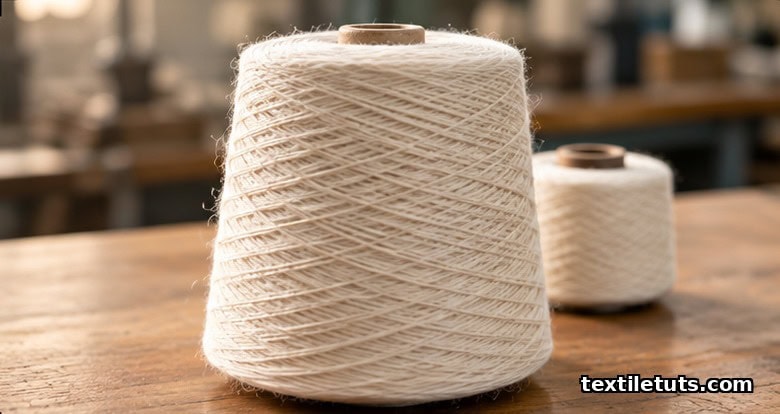
Yarn splicing joins two yarn ends without knots by intermingling the constituent fibers, restoring 75 to 90 percent of the parent yarn’s tensile strength and eliminating the thick, weak knots that cause fabric faults in weaving and knitting.
Splicing is the standard knotless yarn-joining technique on modern winders and modern circular knitting machines, and it determines whether a 30-teX single yarn will run cleanly through 4,000 needles or break one out of every 800 insertion cycles. The method chosen (mechanical, pneumatic, electrostatic, thermal, or twist) sets the upper limit on joint strength, the visibility of the joint in finished fabric, and the machine productivity downstream. This article explains what a splice actually is, how each method joins fibers, and how those choices translate into measurable quality on the woven or knitted cloth.
What a Yarn Splice Is, and Why It Exists
A splice is an overlap joint between two yarn ends where the outer fibers of each end are caught and re-intertwined so the joint behaves as a continuous yarn under subsequent processing tension. The classical fisherman’s knot, by contrast, traps fibers inside a rigid knot that is 2 to 4 times the diameter of the parent yarn and typically retains only 50 to 65 percent of yarn breaking strength, depending on fiber friction and yarn twist.
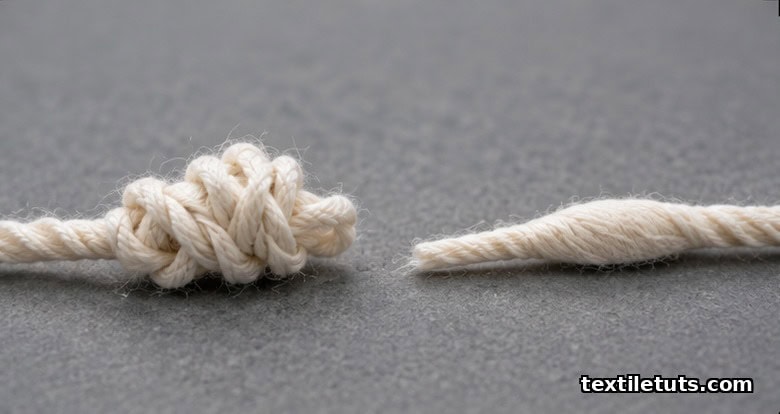
Splicing matters because a single thick knot in a 30-teX cotton warp can break during weaving and shut down a loom for 8 to 15 minutes, and a similar fault in a circular knitting machine’s feeder tube causes a needle-line hole that drops fabric quality grade. Splice targets on modern winders are set well under 2 thick faults per 100 km of yarn, and benchmark rotor and ring-spun mills routinely hold splice strength retention above 80 percent when the splice parameters are tuned for the fiber blend on the machine.
The Five Splicing Methods Used in Textile Mills
Yarn splicing methods differ in how they generate the inter-fiber entanglement, how much fiber they strip from each end, and what residual mass and diameter the joint leaves behind.
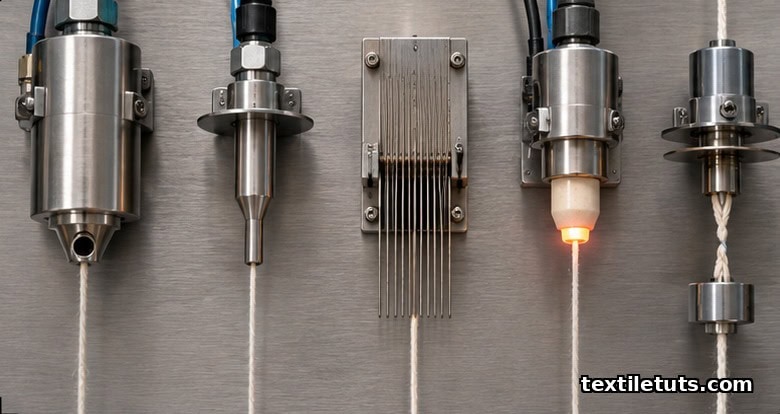
1. Mechanical (Pneumatic-Air) Splicing
Mechanical splicing is the dominant method on automatic winders, especially Schlafhorst Autoconer and Murata Mach Coner families. The two yarn ends are overlapped by 8 to 25 mm inside a fixed splicing chamber. A short burst of compressed air at 0.4 to 0.7 MPa for 20 to 80 ms tumbles the overlapped ends, causing surface fibers to migrate from each end into the other. The chamber geometry then controls how the fibers re-settle, and the joint is drawn off under light tension.
Mechanical splices on 100 percent cotton ring-spun yarns typically retain 80 to 90 percent of parent yarn tenacity, with splice diameter 1.1 to 1.3 times the parent yarn. Splice cycles average 1.5 to 3.0 seconds per joint on production winders, which is why auto-splicers have largely replaced hand knotting in cotton ring mills.
2. Pneumatic (Compressed-Air Jet) Splicing
Pneumatic splicing uses a higher-energy air jet than mechanical splicing. The overlapped ends pass through a nozzle where supersonic or near-sonic air streams create a vortex that wraps fibers from each end around the other in a tight, twisted overlap. Pneumatic splicing is the standard for filament yarns, glass yarns, and high-twist staple yarns where simple mechanical tumbling does not generate enough entanglement.
For 150 denier polyester filament, pneumatic splicing reaches 90 to 95 percent tenacity retention with a splice that is visually undetectable after texturing. For 75 denier polyester false-twist textured yarn, pneumatic splice tenacity retention is typically 85 to 92 percent, with splice elongation within 1 percentage point of the parent yarn.
3. Electrostatic Splicing
Electrostatic splicing charges the fiber ends to several kilovolts inside a controlled field so that individual fibers repel each other, fly apart, then re-deposit in a randomized, three-dimensional interlock when the field collapses. The method is used for very fine counts (below 10 tex) and for fibers with low surface friction, where mechanical and pneumatic methods leave too few protruding fibers to lock the joint.
Electrostatic splices on 7-teX viscose have shown 70 to 82 percent tenacity retention in published trials, lower than mechanical or pneumatic methods but acceptable for fine-count weft knitting where any visible knot would mark the fabric.
4. Thermal (Heat) Splicing
Thermal splicing joins thermoplastic fiber ends (polypropylene, polyester, nylon) by heating the overlap zone above the polymer’s melting or sticking temperature and letting the softened fibers fuse. The joint has no protruding fibers and a clean, tapered profile, but it is brittle and only suitable for low-tension applications such as nonwoven web forming and some carpet yarn take-up.
Thermal splice strength depends on dwell time and temperature. Polypropylene thermal splices tested in textile research have reached 60 to 75 percent of parent yarn tenacity at 160 to 170 degrees C with 2 to 4 second dwell, dropping sharply outside this window because of either incomplete fusion or polymer degradation.
5. Twist Splicing (Wrap, or “Italian”)
Twist splicing rotates one yarn end around the other 4 to 8 turns to trap the fibers by twist friction, then unwinds to leave a short overlap section held by residual torsional energy. Twist splices are simple and require no compressed air, but they leave a slightly firmer handle and are weaker than mechanical or pneumatic joints, typically 70 to 80 percent tenacity retention.
Twist splicing survives on manual knotting stations, sample yarn preparation in laboratories, and small-lot operations where compressed air infrastructure is not available.
Splice Quality: What to Measure
Three measurable properties define a good splice: tensile strength retention, diameter (or mass) at the joint, and visual or hand-feel detectability in finished fabric. Mill QC and yarn-test laboratories report these properties against parent yarn values under ISO and ASTM standard methods.
Tensile strength retention is tested on a tensile tester per ASTM D2256 (Standard Test Method for Tensile Properties of Yarns by the Single-Strand Method). The splice is gripped at a fixed gauge length (usually 250 mm for ring-spun cotton, 500 mm for filament), and the load at break is compared with the parent yarn’s mean breaking load from the same package. A retention of 80 percent or higher is the typical mill target for ring-spun cotton, while 90 percent or higher is the target for filament pneumatic splices.
Splice diameter and mass profile are measured optically with a capacitive or laser evenness tester (USTER CLASSIMAT, KEISOKKI LASERSPIN, or similar) running at 400 m/min or higher. The splice is classified as a fault if its diameter exceeds a set threshold above the parent yarn mean. Common thresholds are +35 percent (N class), +50 percent (thick place), and +100 percent (heavy fault), with N-class splices considered invisible in most woven and knitted end uses.
Visual appearance after weaving or knitting is judged under standard lighting per AATCC Evaluation Procedure 9 (Visual Assessment of Appearance). Trained graders score the splice as detected or undetected at viewing distance of 30 to 50 cm. A well-tuned mechanical splice on 30-teX cotton usually passes this test in plain-weave sheeting and in single-jersey knit, but may still be visible in sheer voile and lace structures.
How Splice Quality Affects Downstream Processing
Every splice the winder places into a yarn package must survive the tensions of warping, sizing, weaving, or knitting. Splice failure downstream shows up as yarn breaks, which cost far more than the splice itself.
In weaving, an average sized cotton warp runs at 14 to 18 breaks per 100,000 picks, and a quarter of those breaks originate at splices that passed the winder QC but failed at loom let-off tension. Each loom stop costs 2 to 5 minutes of lost production plus the weaver’s repair time, so a winder splice failure rate of 0.5 percent can translate to a loom efficiency drop of 3 to 5 percentage points.
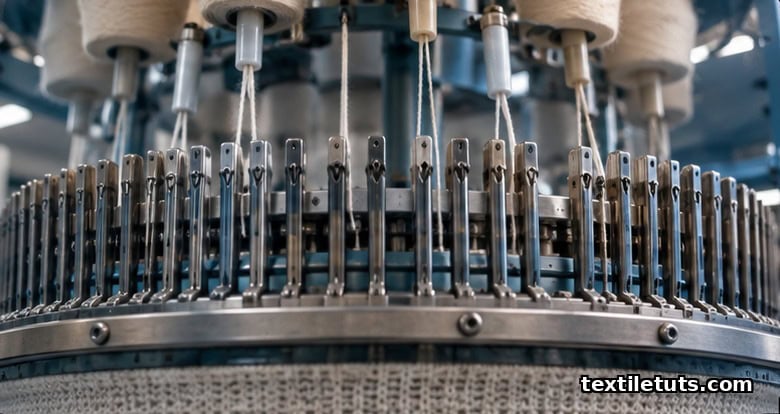
In circular knitting, splice failures drop stitches. A 24-gauge circular knitting machine running at 25 RPM with 2,400 needles produces 60,000 needle cycles per minute, so even a 1-in-5,000 splice failure rate will interrupt knitting every 80 to 90 minutes on average. Modern mills therefore monitor splice strength on every batch and reject winder settings that drop below 78 percent mean retention.
Tuning Splicing Parameters for Different Fibers
No single splice setting works across fiber blends. Splice parameters that work on 100 percent long-staple cotton will leave visible joints on combed merino, and a setting tuned for polyester filament will crush viscose. Mill engineers adjust splice overlap, air pressure, dwell time, and post-splice suction for each fiber mix.
For 100 percent long-staple cotton (28 to 32 mm staple), typical splice settings are 14 to 18 mm overlap, 0.5 to 0.6 MPa air pressure, and 30 to 50 ms dwell. For combed merino (60 to 80 mm staple), settings shift to 18 to 24 mm overlap with reduced air pressure, 0.35 to 0.45 MPa, to avoid stripping the long surface fibers that give the splice its strength.
For polyester/cotton blends (65/35 and 50/50), the splice chamber geometry must accommodate the different fiber lengths and surface frictions, and most mills run a separate splice program per blend ratio. For 100 percent polyester filament, pneumatic splice settings use 0.6 to 0.8 MPa air pressure and 50 to 80 ms dwell, with overlap of 8 to 12 mm.
Comparison: Splice Methods at a Glance
| Property | Mechanical (Air) | Pneumatic (Jet) | Electrostatic | Thermal | Twist (Wrap) |
|---|---|---|---|---|---|
| Tenacity retention, ring-spun cotton | 80 to 90 % | 82 to 92 % | 70 to 82 % | Not used | 70 to 80 % |
| Tenacity retention, polyester filament | 85 to 92 % | 90 to 95 % | Not used | 60 to 75 % | 65 to 75 % |
| Splice diameter vs. parent yarn | 1.1 to 1.3 x | 1.05 to 1.2 x | 1.2 to 1.4 x | 0.9 to 1.1 x | 1.2 to 1.5 x |
| Cycle time per splice | 1.5 to 3.0 s | 1.0 to 2.5 s | 2.0 to 4.0 s | 2.0 to 4.0 s | 3.0 to 5.0 s |
| Best-fit fibers | Cotton, blends | Filament, fine counts | Viscose, fine counts | Thermoplastic only | Sample, hand tie |
| Compressed air required | Yes | Yes | Yes (low) | No | No |
| Detectability in woven cloth | Low | Very low | Low to medium | Low | Medium |
Standards Governing Splice Testing
Three ISO and ASTM standards are most often referenced in splice quality reports. ISO 7211-5 describes sampling and preparation of yarn for fabric analysis and is used to position splices for visual grading in the woven cloth. ASTM D2256 specifies the single-strand tensile test used to report splice tenacity retention. AATCC Evaluation Procedure 9 sets the lighting and viewing conditions for visual assessment of splice detectability in finished fabric.
Mill laboratories that report to brand buyers (for example, retailers enforcing the AFIRM Group Restricted Substance List) typically log splice strength retention, splice diameter, and number of thick faults per 100 km on every yarn lot, and the data becomes part of the yarn specification sheet shipped with the fabric.
Frequently Asked Questions
Is a yarn splice as strong as the parent yarn?
No yarn splice matches parent yarn strength in absolute terms. A well-tuned mechanical splice on 30-teX cotton typically reaches 80 to 90 percent of parent yarn breaking tenacity, while pneumatic splices on polyester filament reach 90 to 95 percent. The remaining 5 to 20 percent is the unavoidable cost of the joint because the fibers at the overlap have a shorter effective gauge length than the rest of the yarn.
How is a splice different from a knot?
A splice joins two yarn ends by re-intermingling the outer fibers so the joint is roughly the same diameter as the parent yarn and 80 to 95 percent as strong. A fisherman’s knot traps fibers inside a rigid overhand loop, leaving a knot 2 to 4 times the parent yarn diameter and only 50 to 65 percent of parent yarn strength. Knots also leave hard spots that break looms and needles, while splices pass through modern winders and knitting machines without stopping.
Can yarn splicing be done by hand?
Yes, the twist or wrap splice can be done by hand with no equipment beyond a steady hand, and it is the standard joining method in hand weaving and in sample yarn preparation in textile laboratories. For production volumes above a few kilograms per day, hand twisting cannot match the cycle time or the joint consistency of an automatic mechanical or pneumatic splicer on a winder.
Which splice method is best for cotton yarn?
Mechanical pneumatic-air splicing on an automatic winder is the industry standard for ring-spun cotton. Splice settings of 14 to 18 mm overlap, 0.5 to 0.6 MPa air pressure, and 30 to 50 ms dwell give tenacity retention of 80 to 90 percent on 30-teX cotton. For very fine counts (below 10 tex), electrostatic splicing can outperform mechanical methods by stripping fewer surface fibers.
Does splicing work for synthetic filament yarn?
Yes. Pneumatic jet splicing is the standard for polyester and nylon filament, with tenacity retention of 90 to 95 percent on 150 denier polyester and a splice that is visually undetectable after texturing. Thermal splicing also works on thermoplastic filament but produces a more brittle joint and is reserved for nonwoven and carpet-yarn applications.
References
- ASTM International. ASTM D2256 / D2256M-21: Standard Test Method for Tensile Properties of Yarns by the Single-Strand Method. ASTM — describes the single-strand tensile test used to report splice tenacity retention against parent yarn.
- International Organization for Standardization. ISO 7211-5:2020, Textiles — Methods for Analysis of Woven Fabrics — Part 5: Determination of Linear Density of Yarn Removed from Fabric. ISO — defines sampling and preparation used when evaluating splices after fabric formation.
- AATCC. AATCC Evaluation Procedure 9 (Visual Assessment of Appearance). American Association of Textile Chemists and Colorists — sets the lighting and viewing conditions for grading splice visibility in finished fabric.
- Oxtoby, E. Spun Yarn Technology. Butterworth-Heinemann (Elsevier) — academic reference covering splice mechanisms and parameters for staple yarn production.
- Klein, W. Man-Made Fibres and Their Processing (Short-Staple Spinning Manual). The Textile Institute — covers pneumatic and electrostatic splicing for filament and fine-count staple yarn.
- Lawrence, C. A. Advances in Yarn Spinning Technology. Woodhead Publishing (Elsevier) — peer-reviewed compilation covering mechanical, pneumatic, and thermal splicing methods and their effect on downstream processing.
- Uster Technologies. Uster Statistics — Application Handbook for Yarn Quality Control. Uster — industry-standard reference for capacitive and optical evenness testing of splice diameter and thick faults per 100 km.
Editorial by Iftay Khairul Alam, TextileTuts. Sources: ASTM D2256, ISO 7211-5, AATCC Evaluation Procedure 9, Oxtoby (Spun Yarn Technology), Klein (Man-Made Fibres and Their Processing), Lawrence (Advances in Yarn Spinning Technology), Uster Statistics as cited.


