
Two-For-One Twisting: Process and Applications

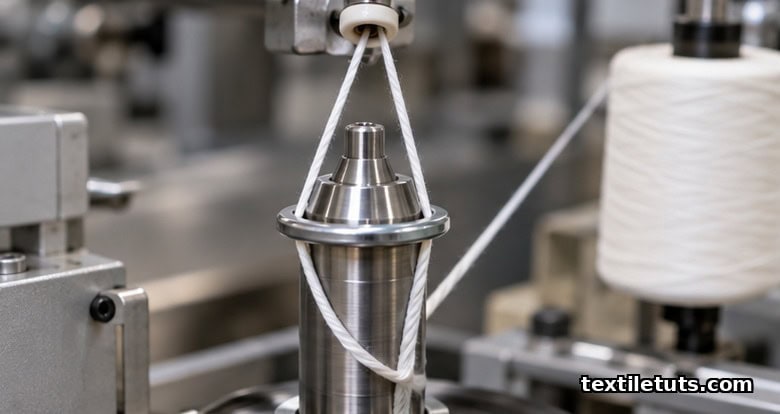
Two-for-one (TFO) twisting inserts two turns of twist per spindle revolution, allowing modern TFO machines to run at 15,000 to 25,000 rpm and deliver 1.6 to 2.2 times the production speed of ring twisting while consuming 30 to 40 percent less energy per kilogram of yarn.
This productivity gain is why TFO accounts for an estimated 70 percent of global sewing-thread production and a growing share of hosiery, embroidery, and industrial yarn twisting. The technology, commercialized in the late 1960s by Volkmann in Germany, changed yarn processing by replacing the take-up twist of ring frames with a captive spindle that twists the yarn against itself in a single passage.
This article walks through the TFO process step by step, explains how machine parameters affect yarn quality, compares TFO with ring twisting in a side-by-side table, surveys the main industrial applications, and answers the questions textile engineers and students ask most often about the method.
What Two-For-One Twisting Means in Practice
In a ring twister, one spindle revolution inserts one turn of twist and the package is wound at the same time. In a TFO machine, the yarn first passes through a stationary element (the disk or guide), then loops around a rotating spindle, and finally returns back through the spindle’s hollow axis. The spindle therefore inserts one twist as the yarn descends to the package and a second twist as it ascends from the spindle to the take-up. Two twists per revolution, hence the name.
The principle was first patented in 1934 and industrialized by Volkmann GmbH in 1966. By 2020, ITMF surveys placed installed TFO spindles above 4 million worldwide, with the densest concentrations in China, India, Turkey, and Pakistan. The format is now standard for any mill that twists cotton, polyester, or blended yarns at counts finer than 60 tex (English cotton count 30s and finer).
How the TFO Process Works Step by Step
A modern two-for-one twisting frame contains four functional zones that work in sequence: supply, twisting, take-up, and winding.
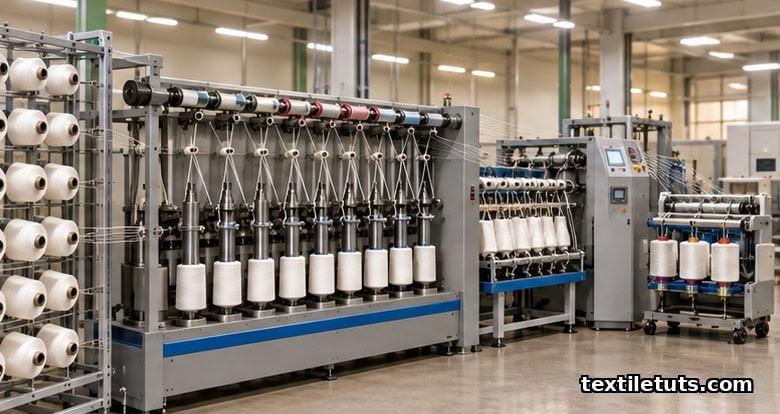
- Supply zone: the input yarn is drawn from a creel-mounted package under controlled pretension, typically 5 to 15 cN depending on yarn count and fiber blend. Modern creels use yarn break sensors that stop the spindle within 50 milliseconds.
- Twisting zone: yarn passes through a ceramic or hard-coated guide, travels down outside the rotating spindle, wraps around the spindle’s lower pulley or balloon-control ring, and then runs back up through the hollow spindle axis. Each spindle revolution adds two twists, one in the downward strand and one in the upward strand.
- Take-up zone: the twisted yarn exits the spindle top and is laid onto a take-up package using a reciprocating traverse. Package shape (straight or tapered) and density (0.85 to 1.05 g/cm³) are programmed through the traverse stroke and winding tension.
- Winding zone (downstream): many plants add a separate precision winding machine to transfer the take-up package to a cross-wound bobbin suitable for dyeing, sewing-thread finishing, or warp preparation.
Spindle drive is usually tangential belt or individual direct-drive motors. Tangential belt drives run the spindle at a fixed ratio to a common shaft (typically 1:12 to 1:18) and dominate in plants built before 2010. Direct-drive spindles, introduced by Saurer and others after 2015, allow per-spindle speed variation up to 30,000 rpm and cut energy use by another 12 to 18 percent.
Key Process Parameters and Their Effect on Yarn
The four parameters an operator adjusts most often are spindle speed, twist multiplier, pretension, and balloon control.
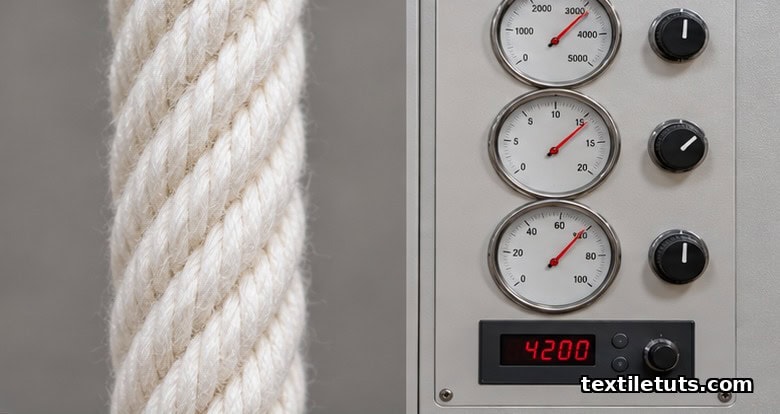
- Spindle speed. Higher rpm means higher productivity, but excessive speed raises temperature at the spindle bearing and can drop twist efficiency. For cotton 30s to 50s, 18,000 to 22,000 rpm is a common production range. For fine polyester 60s to 80s, 20,000 to 25,000 rpm is typical.
- Twist multiplier (TM). Defined as turns per inch divided by the square root of the English cotton count, TM controls hand, strength, and stability. Sewing thread uses a TM of 3.8 to 4.5 (S or Z direction). Hosiery uses 2.8 to 3.4. Tire cord uses 4.0 to 5.0.
- Pretension. Set on the creel disc or gate. Too low and the balloon collapses, causing slough-offs. Too high and the yarn loses elongation. A working rule is pretension at 8 to 12 percent of yarn breaking strength.
- Balloon control ring. Positioned around the spindle, it limits balloon diameter, which reduces hairiness and airborne fiber fly. Setting the ring within 3 mm of the calculated maximum balloon diameter is standard practice.
Modern TFO frames expose these settings through a programmable logic controller, allowing recipe storage per yarn count and quick changeover between cotton, polyester, and blends.
TFO Twisting Compared with Ring Twisting
The table below summarizes the main differences between two-for-one and conventional ring twisting for a typical cotton sewing-thread count (Ne 30/1, 20 tex).
| Parameter | Two-For-One (TFO) | Ring Twisting |
|---|---|---|
| Spindle speed (typical) | 18,000 to 25,000 rpm | 8,000 to 12,000 rpm |
| Twists per spindle revolution | 2 | 1 |
| Production per spindle | 1.6 to 2.2 times higher | Baseline |
| Energy use (kWh/kg) | 0.18 to 0.25 | 0.28 to 0.38 |
| Package form | Cross-wound, dye-ready | Cylindrical, requires rewinding |
| Twist direction flexibility | S or Z, set by guide path | Spindle rotation only |
| Suitable yarn count range | 10 to 200 tex (fine to medium) | 10 to 400 tex (fine to heavy) |
| Capital cost per spindle | Higher (1.4 to 1.8x) | Lower |
The trade-off is clear: TFO wins on productivity, energy, and package quality, while ring twisting retains an edge on very heavy yarns and on twist uniformity at low twist levels where TFO’s two twists per revolution can over-twist the yarn.
Main Industrial Applications
TFO is the dominant process wherever plied yarns need to be twisted, dyed, and finished in a single package. The largest end uses are:
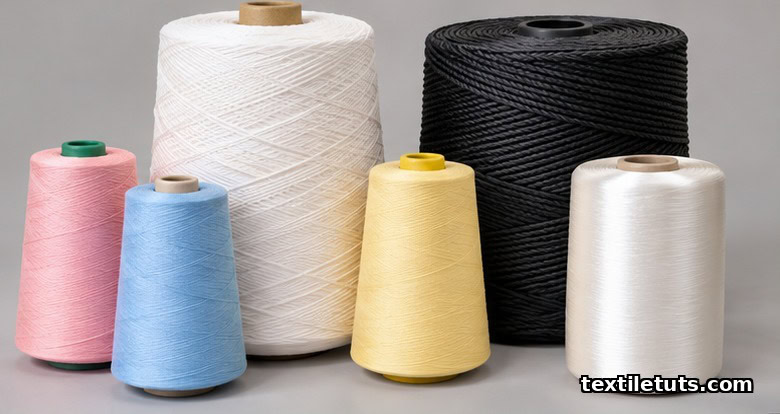
- Sewing thread. Cotton, polyester, and core-spun threads for apparel and footwear. The cross-wound package goes straight to lubrication and waxing without rewinding.
- Hosiery. Nylon and polyester hosiery yarns are TFO-twisted at 2.8 to 3.4 TM for soft hand and high stretch recovery.
- Embroidery thread. Viscose and polyester embroidery yarns use TFO because the dye-ready package reduces a rewinding step.
- Tire cord and industrial yarn. High-tenacity polyester, nylon 6, and nylon 6.6 are TFO plied for tire reinforcement, conveyor belts, and hoses, typically at 4.0 to 5.0 TM.
- Fishing nets and ropes. Polyolefin and polyethylene TFO-twisted multi-plies give uniform strength and good abrasion resistance.
- Carpet yarn. Wool and wool-blend carpet yarns are TFO twisted to lock in the twist against foot traffic.
A growing niche is technical textiles, where TFO twisting of aramid, basalt, or conductive blend yarns provides the exact tension control needed for weaving and braiding preforms.
Quality Testing Standards Used in TFO Yarns
Three ISO and ASTM standards govern the testing of TFO-twisted yarns. Mills routinely run them in the lab before shipping.
- ISO 2:1973, Textiles — Designation of the direction of twist in yarns and related products. Defines S and Z twist. Every TFO yarn is labeled S or Z on its carton.
- ASTM D1422 / D1423, Standard Test Methods for Twist in Single and Plied Yarns. Specifies the untwist-retwist method used to verify turns per inch or turns per meter on the finished package.
- ISO 17202, Textiles — Determination of single-end breaking force and elongation at break using constant rate of extension (CRE) tester. Used to confirm that the additional handling on a TFO machine has not damaged the yarn’s tenacity.
Process control in a TFO plant usually targets a twist CV (coefficient of variation) below 4 percent across the package and a breaking-strength CV below 6 percent. Anything outside those bands points to balloon-control, pretension, or bearing problems.
Frequently Asked Questions
What does “two-for-one” mean in yarn twisting?
It means each spindle revolution inserts two turns of twist: one as the yarn descends to the spindle and one as it ascends back through the hollow spindle axis. A TFO spindle running at 20,000 rpm therefore produces 40,000 turns per minute of effective twist insertion.
What yarn counts are best suited for TFO twisting?
TFO machines are most efficient in the 10 to 200 tex range, which covers cotton sewing thread from Ne 20s to Ne 60s, polyester embroidery yarn, and most hosiery counts. Very coarse yarns above 200 tex are still twisted on ring frames because the balloon on a TFO spindle becomes difficult to control.
How does TFO twisting affect yarn hairiness and strength?
Hairiness drops by 20 to 35 percent compared with ring twisting because the balloon-control ring strips loose fibers before they can escape into the air. Tenacity is usually 3 to 8 percent higher because the two twists per revolution lock the fibers more uniformly into the yarn structure.
What is the energy advantage of two-for-one twisting?
Per kilogram of yarn, TFO consumes 30 to 40 percent less electrical energy than ring twisting because the spindle does the work of two ring spindles. Direct-drive TFO frames introduced after 2015 add another 12 to 18 percent saving by removing belt losses.
What are the most common defects in TFO yarn and how are they prevented?
The four defects to watch are slough-offs (yarn slipping off the package, caused by low pretension), soft packages (winding tension too low, target 0.85 to 1.05 g/cm³ density), broken filaments at the spindle eye (caused by a worn ceramic guide), and uneven twist (a sign of belt slip or a worn spindle bearing). Routine checks of pretension, traverse stroke, and guide condition every 200 spindle-hours prevent most of these problems.
References
- ISO. ISO 2:1973, Textiles — Designation of the direction of twist in yarns and related products. International Organization for Standardization, Geneva — defines S and Z twist direction used worldwide in TFO labeling.
- ASTM International. ASTM D1422 / D1423, Standard Test Methods for Twist in Single and Plied Yarns. ASTM, West Conshohocken — the standard untwist-retwist method applied to TFO-twisted yarn.
- ISO. ISO 17202:2021, Textiles — Determination of single-end breaking force and elongation at break using constant rate of extension (CRE) tester. ISO, Geneva — method used to confirm TFO yarn tenacity.
- ResearchGate. A review on two-for-one twisting technology. ResearchGate publication — peer-reviewed summary of TFO machine design, spindle dynamics, and process parameters.
- MDPI. Effect of spindle speed and twist multiplier on the properties of TFO-twisted polyester sewing thread. MDPI Textiles journal — empirical study on productivity and quality at different spindle speeds.
- The Textile Institute. Textile Terms and Definitions. Textile Institute, Manchester — defines TFO, ring twisting, and related yarn-processing vocabulary.
- Springer. Yarn Production: Theoretical and Technological Aspects. Springer textbook chapter on modern twisting — covers TFO physics and balloon-control theory.
This article is the working reference for two-for-one twisting on TextileTuts. Editorial by Iftay Khairul Alam, TextileTuts. Sources: ISO 2:1973, ASTM D1422/D1423, ISO 17202:2021, ResearchGate, MDPI, The Textile Institute, and Springer as cited.


