
Comber vs Carder: Role in Yarn Quality

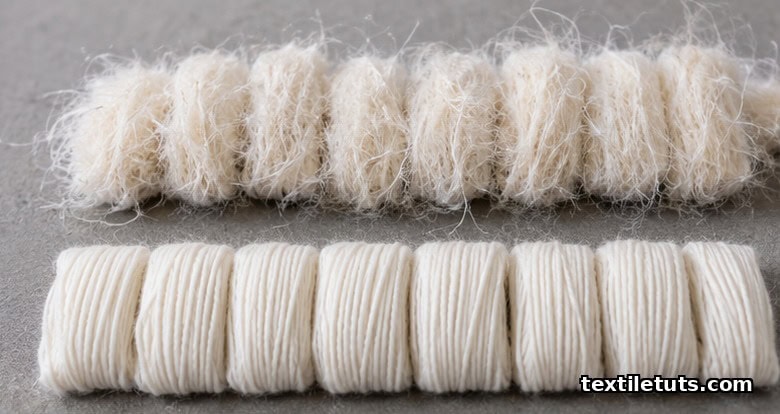
Combed cotton yarn removes 10 to 25 percent of short fibers (those shorter than 12.7 mm, or 0.5 inch) through a dedicated combing step, while carded yarn retains most of them, producing measurable differences in tensile strength (typically 20 to 30 percent higher for combed yarn), yarn evenness (15 to 25 percent lower CV), and surface hairiness (40 to 60 percent fewer protruding fiber ends).
The choice between a comber and a carder is not a minor upstream preference. It is the single decision that most strongly differentiates an entry-level cotton yarn from a premium one, and it cascades through pilling resistance, dye uptake uniformity, fabric hand, and downstream price.
This article walks through what each machine actually does to the fiber, where they sit in the spinning sequence, how their outputs differ on lab measurements, and when a spinner should pay the combing premium. By the end you will know which yarn your fabric needs, and why a combed-cotton T-shirt feels smoother and lasts longer than a carded-cotton one made from the same bale.
Where Carding and Combing Sit in the Spinning Sequence
Carding and combing are both preparation steps that follow opening, cleaning, and drawing, but they perform fundamentally different tasks on the fiber assembly. Carding is a disentangling step; combing is a purifying step.
After the bale is opened and foreign matter is removed at the blowroom, fibers arrive at the card as a low-density lap or chute feed. The card’s main cylinder and worker/stripper arrangement separates fiber tufts into individual fibers, removes a large fraction of trash and neps, and lays the fibers into a carded sliver of roughly 4 to 6 ktex. This sliver may go directly to draw frames and then to the ring, rotor, or air-jet spinning frame. That is the carded route.
For the combed route, the card sliver is first converted into a combed sliver preparation on a lap former or directly fed through a modern draw-frame-fed combing machine. The comber then removes additional short fibers, remaining neps, trash particles, and immature fibers before the sliver proceeds to a second draw-frame passage and then to the spinning frame. The waste extracted at the comber is called noil, and it typically represents 10 to 25 percent of the input weight, depending on the fiber length distribution and the comber’s setting.
What a Carder Actually Does
The cotton card is a rotating assembly of a main cylinder, one or more licker-ins, a flats chain or stationary flats, and a doffer. Its job is to take a tangled mass of fibers and individualize them so every fiber is free to be drafted in the next machine.
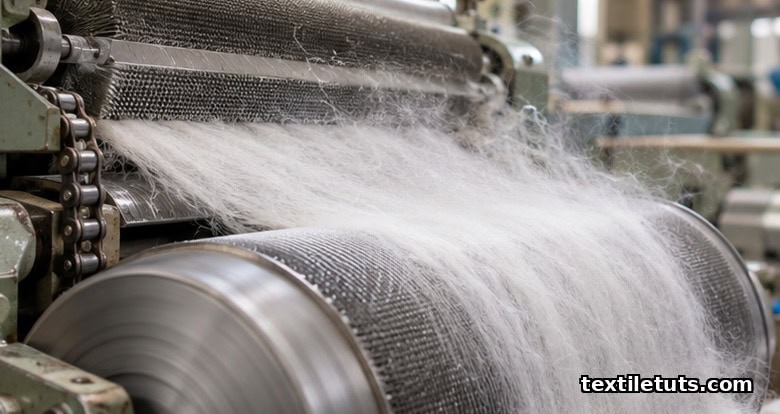
Three measurable outcomes of carding define its quality:
- Trash removal: a modern high-production card removes 80 to 90 percent of trash particles larger than 500 micrometers and the majority of smaller impurities.
- Nep reduction: carding typically cuts nep counts from 200 to 400 per gram in the chute feed down to 30 to 80 per gram in the card sliver, though it also generates some new fiber neps.
- Sliver evenness: a well-tuned card delivers a sliver with a coefficient of variation (CV) of about 3.5 to 5 percent by weight at 1 m cut length.
What the card does not do is sort fibers by length. It accepts everything it can individualize, including short fibers (commonly defined as below 12.7 mm, or 0.5 inch, in cotton count terms), immature fibers, and neps that are smaller than its cleaning grid.
What a Comber Actually Does
Combing is a much more selective process. The classical cotton comber (rectilinear, with a needle bar, a top comb, and a detaching roller) takes a lap of fiber in the form of small tufts clamped between the nipper jaws, draws them past a bed of needles (the top comb), and detaches only the portion that has been combed. The uncombed fringe, which contains the shortest fibers and remaining trash, is swept away as noil.
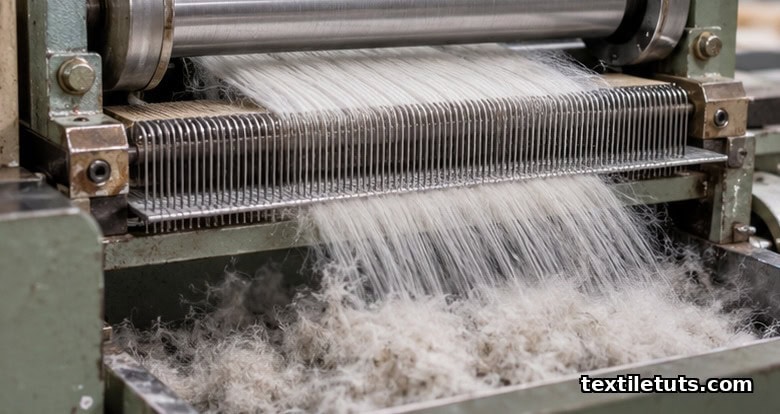
The modern draw-frame-fed comber (such as the Rieter E 66 or the Trützschler TC 15) replaces the lap with a sliver feed and uses a rotary segmented top comb. It achieves similar purification at higher production speeds (up to 600 meters per minute feed).
What the comber removes that the carder cannot:
- Short fibers: depending on the gauge and feed setting, 80 to 95 percent of fibers shorter than 12.7 mm are removed.
- Neps: the comber typically reduces nep counts to under 10 per gram, often by 70 to 90 percent compared with the carded sliver.
- Trash and immature fibers: additional 30 to 50 percent reduction in visible trash and a comparable reduction in immature-fiber content, which matters for dye uptake uniformity.
The cost is the noil. The noil percentage is a key process parameter: lower noil (for example, 8 to 10 percent) preserves more fiber but also retains more short fibers; higher noil (20 to 25 percent) yields a cleaner, more uniform yarn but increases raw material cost. Most spinners targeting combed-cotton quality run between 12 and 18 percent noil.
Yarn Quality Differences, Measured
The measurable consequences of combing show up on every standard yarn test. The table below summarizes the typical differences between carded and combed ring-spun cotton yarns of the same nominal count (for example, Ne 30/1, or 19.4 tex), spun from the same bale on the same machine, with the combed version at approximately 15 percent noil.
| Property | Carded ring-spun yarn | Combed ring-spun yarn |
|---|---|---|
| Yarn evenness (CVm %) | 14 to 17 | 11 to 13.5 |
| Thin places per km (-50%) | 40 to 90 | 10 to 25 |
| Thick places per km (+50%) | 120 to 220 | 40 to 90 |
| Neps per km (+200%) | 180 to 350 | 30 to 80 |
| Tenacity (cN/tex) | 15 to 19 | 19 to 24 |
| Breaking elongation (%) | 5.5 to 7.0 | 5.5 to 7.5 |
| Hairiness (S3 value, lower is smoother) | 5.0 to 7.5 | 2.5 to 4.0 |
| Yarn imperfections total per km | 340 to 660 | 80 to 200 |
Two notes on reading this table. First, evenness values are sensitive to the test instrument and the segment length; the Uster Statistics 2018 publication reports similar ranges for cotton ring-spun yarns of comparable count. Second, the differences narrow substantially when the carded yarn is made from a long-staple cotton (for example, Pima or Egyptian) rather than a short-staple Upland cotton, because long-staple fibers entering carding already have low short-fiber content. Combing a long-staple cotton removes fewer fibers, but it still removes neps and immature fibers, so the gains shift from “length uniformity” to “cleanliness.”
How These Differences Show Up in Finished Fabric
The yarn-level numbers above translate directly into fabric-level performance, which is what the buyer actually feels.
Pilling resistance
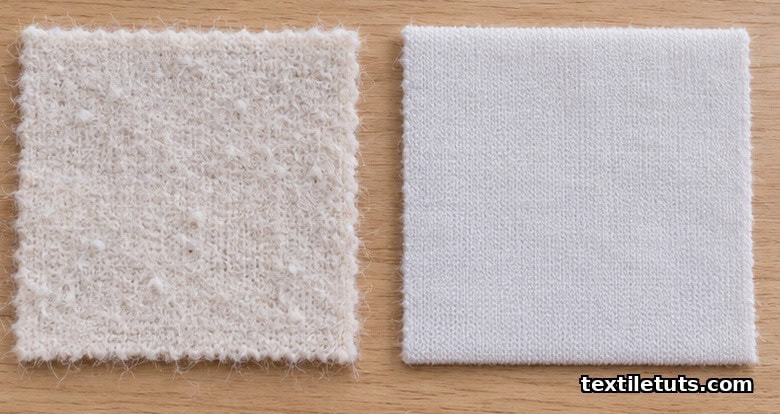
Combed yarns pill less because there are fewer loose fiber ends on the surface to work into pills. In a Martindale pilling test (ISO 12945-2) at 5,000 rubs, a combed-cotton plain-weave fabric typically rates 4 to 5 on a 1 to 5 scale (5 being best), where a carded-cotton equivalent of the same construction rates 2 to 3.
Dye uptake uniformity
Neps dye darker than mature fibers because immature fibers reflect light differently and often accept less dye uniformly. Reducing neps by 70 to 90 percent at the comber translates into a visibly cleaner fabric surface after dyeing, especially in pastel shades where every speck stands out.
Fabric hand and drape
Combed yarns are smoother, so the resulting fabric feels softer against the skin and drapes more cleanly. Carded yarns feel warmer and slightly rougher, an effect some wearers prefer for heavy fleece-back knits.
Strength and abrasion
The 20 to 30 percent tenacity gain translates into approximately 15 to 25 percent higher fabric tensile strength (ISO 13934-1, strip method) and measurably better abrasion resistance (ISO 12947, Martindale), which is why combed cotton dominates in socks, premium knit undergarments, and workwear that has to survive industrial laundering.
Cost and Production Trade-offs
Combing costs more in three distinct ways: the capital cost of the combing machine (roughly USD 200,000 to 400,000 per head in 2025 for a modern draw-frame-fed unit), the labor and energy to run it (about 0.5 to 1.5 kWh per kg of sliver processed), and the noil loss (12 to 18 percent of input fiber is sold as comber noil at roughly 50 to 70 percent of the price of raw cotton).
A useful rule of thumb from a 2022 ITMF survey of cotton spinners in South Asia: combing adds approximately 12 to 25 percent to the spinning cost of a Ne 30/1 yarn compared with the same count spun carded, before considering the noil credit. After the noil credit, the net cost increase is closer to 6 to 14 percent.
This is why combing is concentrated in yarns of Ne 30 and finer, where the quality premium matters most and where the yarn price can absorb the added cost. Combing is uncommon above Ne 40 in some markets because rotor and air-jet spinning already deliver acceptable evenness at coarser counts without the combing step.
When to Choose Carded vs Combed Yarn
Use the simple decision framework below when specifying yarn for a fabric.
- Choose carded yarn when the end use tolerates some surface hairiness (denim, fleece, terry towel, heavy canvas, blankets), when the price ceiling is tight, and when the spinner is using a long-staple cotton that does not need aggressive short-fiber removal.
- Choose combed yarn when the fabric will be dyed in light or pastel shades, knitted or woven at fine counts (Ne 40 and finer), printed with fine motifs, or sold on hand-feel and pilling performance (premium shirting, fine-gauge knitwear, hosiery, lightweight lining).
A practical middle path is compact ring spinning without combing, which can deliver a hairiness level comparable to combed conventional ring spinning at a lower cost, though it still cannot match a combed yarn on short-fiber content and nep removal.
Frequently Asked Questions
Does combed cotton shrink less than carded cotton?
Shrinkage is governed primarily by the finishing process (mercerization, sanforization) and the fabric construction, not by combing. However, because combed yarn has fewer short fibers and a more even structure, it tends to shrink slightly less in repeated laundering, typically 2 to 4 percent residual shrinkage after pre-shrinking compared with 3 to 6 percent for an equivalent carded-cotton fabric.
Is combed cotton always longer-staple cotton?
No. Combing is a process applied to whatever cotton the spinner chooses. Most combed yarns are made from medium- to long-staple cotton (28 to 36 mm upper-half-mean length) because the combing step yields the most visible benefit on those fibers. A spinner can comb a short-staple Upland cotton, but the noil percentage will climb above 20 percent and the resulting yarn will only be marginally better than the carded version, which is rarely economical.
How can I tell if my T-shirt is made of combed cotton?
Look for one of three signals: the fiber content label often states “combed cotton,” reputable brands use the term in product copy, and a simple hand test will show smoother surface feel, less surface fuzz after a few washes, and clearer printing definition. A definitive laboratory test is the yarn evenness measurement against ASTM D1425 and tensile testing per ASTM D2256; a combed-cotton yarn will show an evenness CVm below 13.5 for a Ne 30/1.
Does combing make a yarn stronger or just smoother?
Both. Removing short fibers is the direct cause of the tenacity gain (20 to 30 percent, because the load-bearing fibers are now uniformly longer). Removing neps and trash is what gives the smoother surface. The two effects reinforce each other: a smoother, more uniform yarn also resists abrasion better, so the strength gain shows up in the fabric as well.
Why do some “combed cotton” products still pill?
Pilling is influenced by fiber length, yarn twist, fabric construction, and finishing. Combing helps but cannot eliminate pilling if the yarn is twisted too loosely, if the fabric is knitted loosely (for example, a single jersey at 28 stitches per inch rather than 32 or above), or if the finishing process is too aggressive on the surface. A combed, loosely knitted yarn will still pill.
References
- ASTM International. ASTM D2256/D2256M-21: Standard Test Methods for Tensile Properties of Yarns by the Single-Strand Method. ASTM Standards. Specifies CRE-based tensile testing of single yarn ends, used here for tenacity and elongation reporting.
- ASTM International. ASTM D1425/D1425M-20: Standard Test Method for Evenness of Textile Strands Using Capacitance Testing. ASTM Standards. The reference method for the CVm, thin places, thick places, and neps per kilometer values quoted above.
- International Organization for Standardization. ISO 2061:2015, Textiles, Yarn from Packages, Determination of Single-End Breaking Force and Elongation at Break Using Constant Rate of Extension (CRE) Tester. ISO Standards. Cross-referenced tensile method, equivalent in scope to ASTM D2256.
- International Organization for Standardization. ISO 12945-2:2020, Textiles, Determination of Fabric Propensity to Surface Pilling, Fuzzing, or Matting, Part 2: Modified Martindale Method. ISO Standards. Reference method for the pilling-grade values cited in the fabric-performance section.
- International Textile Manufacturers Federation. ITMF Spinning Cost Survey 2022: Cotton. ITMF, Zurich. Source for the 12 to 25 percent spinning-cost increment and noil-credit figures for combed ring-spun cotton yarn.
- Klein, W. Manual of Textile Technology: Short-Staple Spinning. The Textile Institute, Manchester. Classical reference on the rectilinear combing cycle, noil formation, and combing settings.
- Lord, P. R. Handbook of Yarn Production: Technology, Science and Economics. Woodhead Publishing, Cambridge. Authoritative reference on the comparative economics and machine settings of carded and combed cotton yarn routes.
This article is the working reference for yarn preparation differences between carded and combed cotton. Editorial by Iftay Khairul Alam, TextileTuts. Sources: ASTM D2256, ASTM D1425, ISO 2061, ISO 12945-2, ITMF Spinning Cost Survey 2022, Klein’s Short-Staple Spinning manual, and Lord’s Handbook of Yarn Production as cited.


