
Yarn Feeders in Knitting Machines

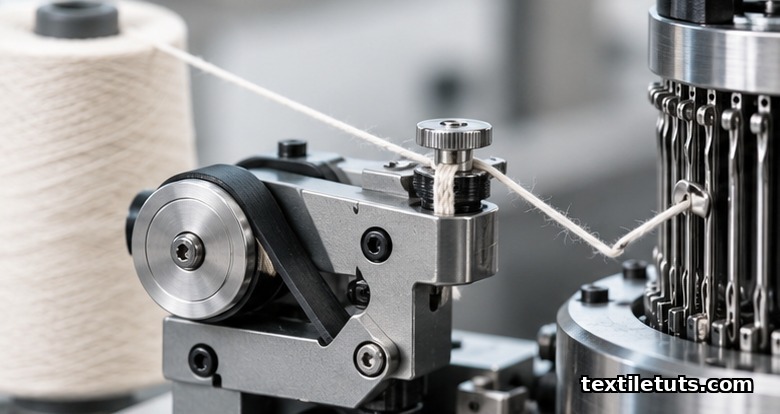
A positive yarn feeder delivers weft yarn to a circular knitting machine at a programmed rate of roughly 0.1 to 4 meters per minute per feeder, holding running tension between 1 and 15 centinewtons (cN) and limiting course-length variation in the finished fabric to within 2 to 3 percent across all feeders.
That delivery is governed by a small electromechanical assembly mounted on the knitting machine frame: the yarn feeder. For circular and flat knitting machines producing anything from single-jersey t-shirts to technical spacer fabrics, the feeder’s accuracy determines yarn consumption, course length uniformity, and downstream defect rates such as barre and yarn mass variation.
This guide walks through the physics, the four main feeder families, the tension ranges used in mill practice, the troubleshooting signs a knitting floor operator actually sees, and the ISO and DIN standards that govern measurement.
What a Yarn Feeder Does in a Knitting Machine
A yarn feeder, also called a yarn feed device, yarn carrier, or yarn delivery system, is the interface between the yarn package (cone, cheese, or beam) and the knitting elements. Every course the machine knits requires an exact length of yarn, delivered at a controlled tension, with no sudden acceleration or slack.
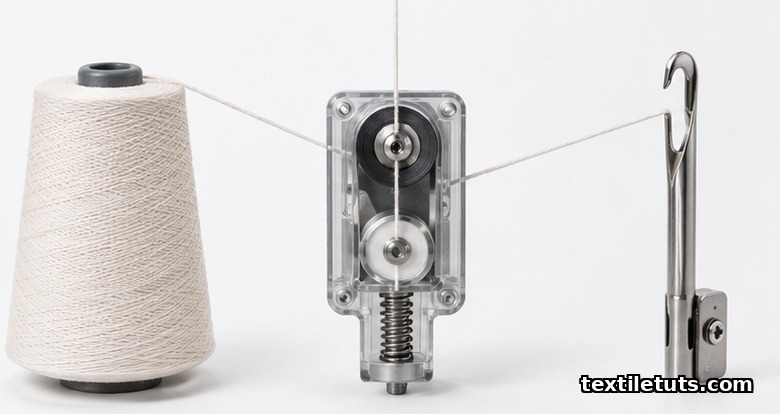
On a modern circular weft knitting machine with 90 feeders, between 90 and 110 meters of yarn per minute can be supplied to the knitting zone across the full feeder array when running at 24 rpm and 28 gauge. Each individual feeder typically receives yarn from one or more packages, runs it through a tensioner, often through a yarn clearer, sometimes through a storage wheel, and finally into the needle hook.
The feeder’s three jobs, summarized: meter the correct length, maintain the tension window, and detect or stop the machine on yarn breakage.
Four Types of Yarn Feeders Used in Weft Knitting
1. Negative (passive) feeders
The most basic design. The yarn is pulled from the package by the knitting needles themselves, with the only control being a disk or gate tensioner. These feeders are inexpensive and rely on package unwinding characteristics. They are common on small-diameter hosiery machines and on the dial of older circular knits. Modern mills typically reserve negative feeders for coarse counts (below Ne 12) where yarn stiffness outweighs tension-control concerns.
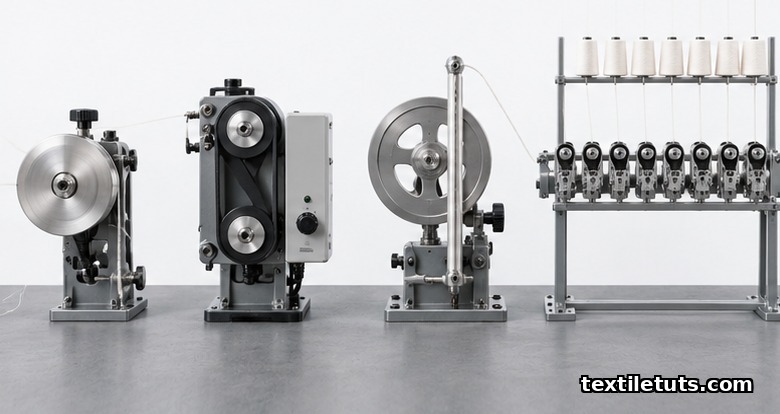
2. Positive (controlled) feeders
Positive feeders use a driven belt, wheel, or drum to meter yarn to the needles at a programmed rate. The two commercial leaders in weft knitting are the IRO Memminger (LGL) range and the BTSR (Precix) range. The drive signal typically comes from the machine control system based on machine RPM, stitch length, and the number of feeds per revolution.
Positive feeders dominate the fine-gauge single-jersey market because they remove the yarn-speed variation that causes horizontal streaks (barre). On a 30-inch, 28-gauge circular machine running cotton Ne 30, switching from negative to positive feed typically cuts barre-related second-quality fabric by 60 to 80 percent.
3. Storage feeders (yarn accumulators)
A storage feeder is an intermediate unit that holds a reserve loop of yarn between the package and the needle. When the knitting zone momentarily demands more yarn (during needle overlap on a cam transition), the storage wheel pays out. When the demand drops, it winds up the excess. The Memminger Bistre and HP-12 units are typical examples.
Storage feeders reduce peak tension transients by 50 to 70 percent compared with direct feed, according to knitting-machine supplier application notes. They are standard on elastane plating and on every elastic-tape feeding application.
4. Creel-mounted positive feeders (multi-feed systems)
On a knitting machine creel, a separate positive feeder sits at each package position. This lets every yarn end arrive at the knitting point with the same tension profile. The category overlaps with categories 2 and 3 but is treated separately because the creel feeder typically handles 24 to 120 ends simultaneously.
Yarn Tension: The Number That Matters Most
Yarn tension is the single most monitored parameter in weft knitting. For cotton Ne 30, mill practice holds the running tension between 2 and 5 cN at the knitting point. For elastane plating on a single-jersey machine, the elastane is fed at 4 to 12 cN over a 2x stretch.
ISO 8388 covers the terminology for knitting machines, including the three feeder types above, while ISO 14717 specifies vocabulary for textile-machinery accessories. ISO 17202 sets out the test method for determining yarn tension in knitting machines, and DIN 53846-1 is the equivalent German national standard used by many European knitting lines.
Tension outside the working window produces recognizable defects:
- Too low: loose stitches, laddering, dropped stitches, fabric dimensional drift.
- Too high: yarn breaks, needle hook damage, elastane snap-back on plating lines.
Course Length Uniformity and Feeder Setting
Course length, the actual length of yarn consumed per knitting course, is the metric most sensitive to feeder behavior. The loop length formula for plain weft knitting is:
L = 1 / (Courses per cm × Wales per cm × Kc)
Where L is loop length in centimeters and Kc is the machine constant (usually 4.7 to 5.0). Course-length CV (coefficient of variation) directly controls the fabric’s GSM (grams per square meter) and dimensional stability.
Mills target a course-length CV below 2.5 percent for first-quality single jersey. Anything above 4 percent usually sends the roll into the B-grade bin. Per ISO 3801, fabric mass per unit area is measured after conditioning for 24 hours at 20 °C and 65 percent relative humidity.
Troubleshooting: Reading the Feeder’s Behavior
Three practical signs that a feeder is drifting out of spec:
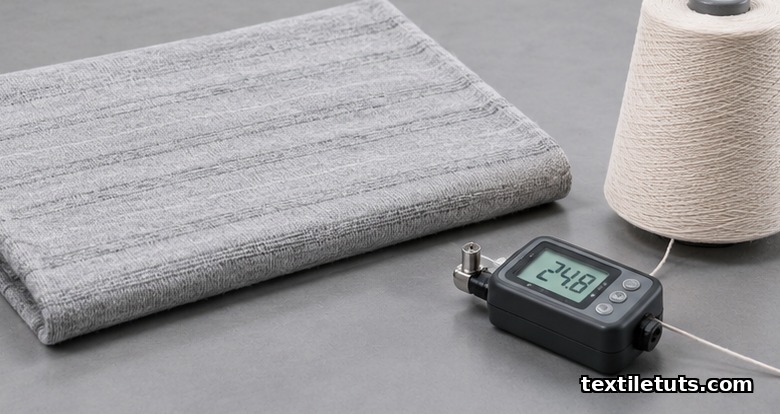
Horizontal streaks (barre): Usually a tension mismatch between feeders. Verify that all running tensions are within 0.5 cN of each other, and that storage wheels are cleaning at the same rate across the machine.
Yarn breaks concentrated on one feeder: The tension disk is dirty, glazed, or the tension spring has weakened. Per Memminger technical literature, a yarn break rate exceeding 4 per 100 kg signals that the feeder is due for service.
Fabric weight drift over the roll: The positive feeder’s belt is wearing. On belt-driven feeders, scheduled replacement is typically at 8,000 running hours.
Specialized Feeders: Spandex, Plating, and Technical Yarns
Spandex (elastane) plating on a single-jersey circular machine needs dedicated positive feeders running 2 to 4 times the elongation. The plating feeder is set to overfeed, typically 2.5x to 4x, and a separate storage feeder holds the elastane inside its tension window. Without this two-feeder arrangement, the elastane cannot be evenly distributed across the fabric width.
For technical textiles, weft-inserted knit fabrics used in automotive or filtration applications use coarse positive feeders capable of handling 500 to 2000 denier yarns at tensions up to 50 cN. Roj and Memminger are the common brands in this segment.
Feeder Density and Machine Selection
The number of feeders on a circular knitting machine varies with diameter and gauge. Common configurations:
| Diameter (inches) | Gauge (needles/inch) | Typical feeder count |
|---|---|---|
| 12 | 24 | 30 |
| 26 | 24 | 64 |
| 30 | 28 | 90 |
| 34 | 18 | 72 |
A 30-inch diameter machine at 28 gauge running 90 feeders at 24 revolutions per minute (RPM) consumes roughly 90 meters of cotton yarn per minute across all feeders combined. From an engineering standpoint, the feeder is the binding constraint on machine output.
Standards Governing Feeder Terminology and Test Methods
Several ISO and DIN standards apply directly to yarn feeders:
- ISO 8388: terminology for knitting machines, including positive, negative, and storage feeders.
- ISO 14717: vocabulary for textile-machinery accessories for knitting machines.
- ISO 17202: determination of yarn tension in knitting machines (test method).
- DIN 53846-1: measurement of yarn tension in textile machines, the German national standard.
- ISO 3801: woven and knitted fabric mass per unit area after standard conditioning.
Mill engineers and knitting trainers refer to these documents when qualifying a new feeder model or running acceptance tests.
Frequently Asked Questions
What is the difference between a positive feeder and a negative feeder?
A positive feeder drives the yarn to the knitting elements at a programmed rate using a belt, drum, or wheel. A negative feeder lets the needles pull yarn from the package through a passive tension device. Positive feeders are more accurate and dominate modern circular knitting, while negative feeders are still used on coarse-count and small-diameter machines.
What tension should a yarn feeder deliver at the knitting point?
For cotton Ne 30, working tension is typically 2 to 5 cN. For elastane plating, the elastane is run at 4 to 12 cN over a 2x stretch. Fine synthetic filaments at Ne 80 may run as low as 1 cN. The exact value depends on yarn count, twist, friction, and machine gauge.
How many feeders does a circular knitting machine have?
Feeder count scales with diameter and gauge. A 30-inch circular machine at 28 gauge commonly has 90 feeders. Smaller hosiery machines may have only 4 feeders; large technical-textile circular machines can exceed 120.
Why does a knitting machine show horizontal stripes even when all feeders are set to the same tension?
Unequal yarn tension between feeders is the most common cause, but it is not the only one. Other causes include yarn count variation between cones (different lots, splices), uneven package density, and storage-wheel malfunction. Diagnose by sampling course length on three feeders and comparing.
How is course length controlled by the feeder?
The positive feeder’s electronic control takes inputs from machine RPM, stitch-length setting, and feeds per revolution, then delivers a fixed length per course. Course-length CV under 2.5 percent is typical for first-quality single jersey. CV above 4 percent indicates the feeder needs adjustment.
References
- ISO. ISO 8388:2022 — Knitting machines — Vocabulary. iso.org — terminology for knitting machines including positive, negative, and storage feeders.
- ISO. ISO 14717:2014 — Textile machinery — Accessories for knitting machines — Vocabulary. iso.org — defines feeder types and machine interfaces.
- ISO. ISO 17202:2019 — Textiles — Knitting machines — Determination of yarn tension. iso.org — test method for measuring knitting-point tension.
- ISO. ISO 3801:1977 — Textiles — Woven fabrics — Determination of mass per unit length and mass per unit area. iso.org — conditioning standard for fabric mass measurement.
- DIN. DIN 53846-1:1989 — Testing of textiles; measurement of yarn tension in textile machines. din.de — German national standard for yarn tension measurement.
- Memminger-IRO GmbH. Positive Yarn Feeders Technical Documentation. memminger-iro.com — supplier reference for positive-feeder setup and troubleshooting.
- Ray, S.C. Fundamentals of Weft Knitting. Woodhead Publishing India — textbook reference for knitting-machine feeder types and operating principles.
Editorial by Iftay Khairul Alam, TextileTuts. Sources: ISO 8388, ISO 14717, ISO 17202, ISO 3801, DIN 53846-1 as cited.


