
Knitting Needle Types: Bearded, Latch, Compound

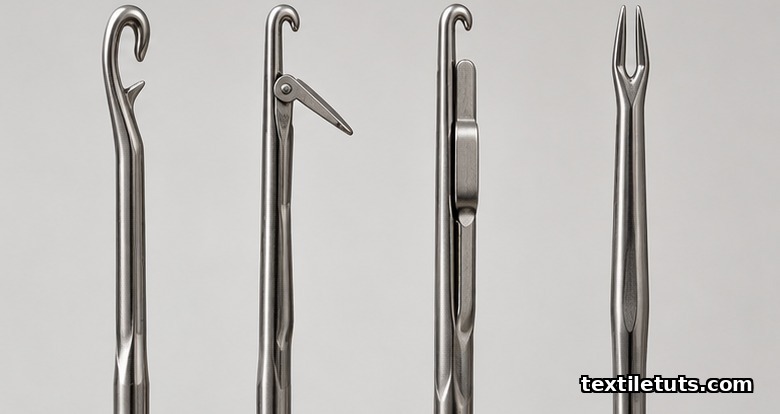
Bearded needles operate at up to 1,800 courses per minute on legacy Cotton’s-pattern frames, latch needles run modern circular knitting machines at feed rates of 25 to 35 m/min, and compound needles exceed 50 m/min on high-speed warp knitting machines such as tricot and raschel; the three needle systems differ in hook closure mechanism, yarn tension tolerance, and gauge range. Choosing the right needle geometry separates a stable 28-gauge single jersey from a runaway press-off, and it sets the maximum sustainable machine rpm before yarn breakage.
This article covers the three needle families used in weft and warp knitting machines: how each hook closes, what yarns and gauges suit it, where it is used industrially, and what failure modes each carries.
Why Needle Geometry Matters in Knitting
Every loop in a knitted fabric is formed by a single needle performing four mechanical actions: rise to clear the old loop, receive new yarn at the hook, knock-over to cast the old loop off, and draw the new loop through. The way the hook closes during that cycle defines whether a needle can run at 5 rpm or 5,000 rpm, handle a 12-denier filament or a coarse 2/12 Nm wool, and knit tight interlock at 40 needles per inch or open lace at 8 needles per inch.
ISO 8116-1:2004 (Textile machinery, Knitting machines, Vocabulary) defines needle geometry, hook closure method, and needle-bed arrangement as the three machine-defining parameters used to classify weft and warp knitting frames. ISO 8187:1989 standardizes the Nm (needles per inch) gauge convention across all three needle types.
Spencer (Knitting Technology, Woodhead Publishing, 2001) reports that maximum stable rpm scales with the inverse of hook closure time. Bearded needles need an external presser to close the beard, latch needles close themselves with a swing of 6 to 9 degrees at the latch pivot, and compound needles use a slider that translates linearly along the needle stem. That difference is why a raschel machine can run at 3,500 rpm while a bearded Cotton’s frame tops out near 1,800 rpm.
Bearded Needles: The Original Weft Knitting Needle
Bearded needles are the oldest of the three needle types still in production. They consist of a solid stem, a hook carved into the top, and a flexible wire extension (the “beard”) that bends under pressure to close the hook. A separate presser bar, mounted across the needle bed, physically bends the beard across the hook every cycle.
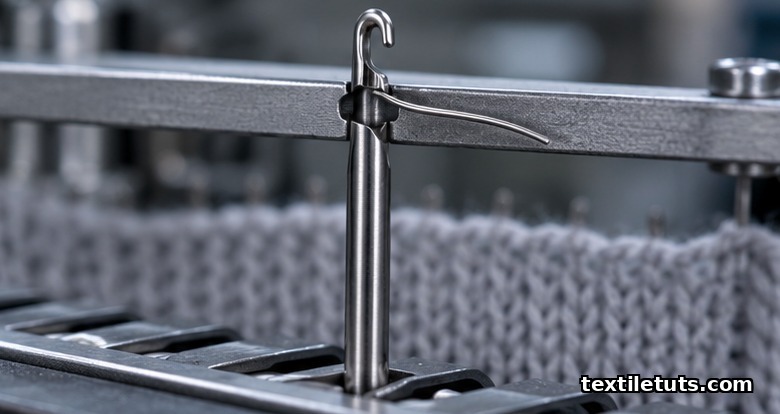
The bearded needle was used in William Lee’s 1589 stocking frame, the machine that gave weft knitting its name, and remained dominant through the 19th and early 20th centuries, including Cotton’s 1864 patent frame that was the workhorse of the Nottingham hosiery industry.
Mechanically, the bearded needle has three weak points. It requires a precisely aligned presser that must travel the entire needle bed length, which limits machine width. The beard flexes at roughly 5,000 to 8,000 cycles per minute in service, and the steel wire work-hardens, so needle life is typically 30 to 90 days. The open hook above the beard can snag adjacent yarn on missing needles, producing press-off defects that propagate across a course.
Bearded needles survive in two niches. Fully-fashioned flat knitting frames for shaped knitwear (shirts, sweaters, hosiery panels) keep bearded needles because the presser gives a clean, well-controlled loop that suits hand-finished linking seams. A small population of bearded-needle raschel machines remains in service for niche technical fabrics where loop uniformity matters more than speed.
Latch Needles: The Modern Circular Knitting Workhorse
The latch needle closes itself. It has a solid hook at the top, a slot cut into the stem, and a small pivoting latch blade that rotates to bridge the hook and trap the yarn inside. As the needle rises to take new yarn, the old loop slides up the stem and pushes the latch open; as the needle descends, the latch springs back over the hook and locks the new loop in place. No external presser is required.
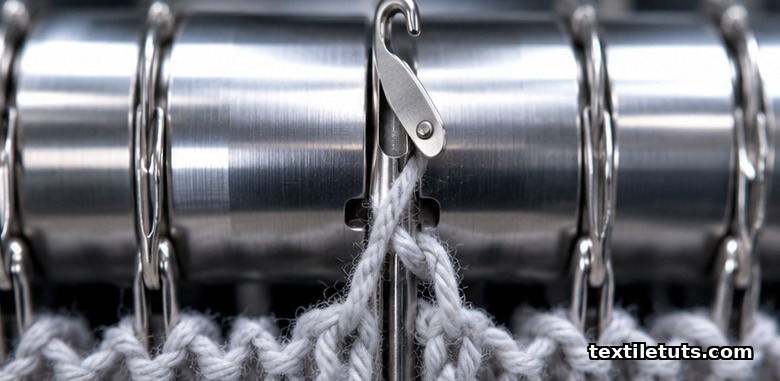
Latch needles were patented in the 1840s but did not displace bearded needles until high-cam circular knitting frames (Singer, Wildman, later Mayer & Cie and Pai Lung) became dominant in the 20th century. Today the latch needle is the standard in single jersey, rib, interlock, and purl circular knitting machines and in most computer-controlled flat-bed knitting machines (CMS, Stoll ADF).
Speed on a modern latch-needle circular machine depends on diameter, gauge, and yarn. A 30-inch, 24-gauge machine knitting cotton at 18 rpm produces roughly 25 to 30 m of fabric per minute. Fine-gauge (E40) jersey machines knitting 14 tex cotton run at 22 to 25 rpm. Coarser gauges (E8 to E14) knitting acrylic or wool blends can reach 35 to 40 rpm on the same machine platform. Mayer & Cie’s Relanit and Pai Lung’s PL-X platforms report 1.2 to 1.6 million stitches per 24 hours per head at E28 gauge.
Latch needles tolerate a broader yarn range than bearded needles because the latch pivots rather than flexes. They handle everything from 8 denier polyamide filament in fine hosiery to coarse 2/12 Nm wool in chunky rib. They are sensitive to latch-blade wear: a worn latch that does not seat fully produces a vertical channel defect (“needle line”) running down the fabric. Needle replacement cycles are typically 18 to 36 months for plain jersey and 6 to 12 months for abrasive yarns such as linen or stainless-steel blends.
If you are running a circular or flat-bed weft knitting machine at any gauge finer than E32, the needle is almost certainly a latch needle, and the failure mode you are most likely to see is a worn latch pivot, not a deformed hook.
Compound Needles: The High-Speed Choice for Warp Knitting
The compound needle is a two-part needle. The body is a hollow stem with a fixed hook at the top, and a separate sliding element (called a slider, tongue, or closing element) moves axially inside the stem to close the hook. Because the closing element translates rather than flexes or pivots, the loop is fully closed in roughly one-tenth of the angular displacement needed for a bearded or latch needle.
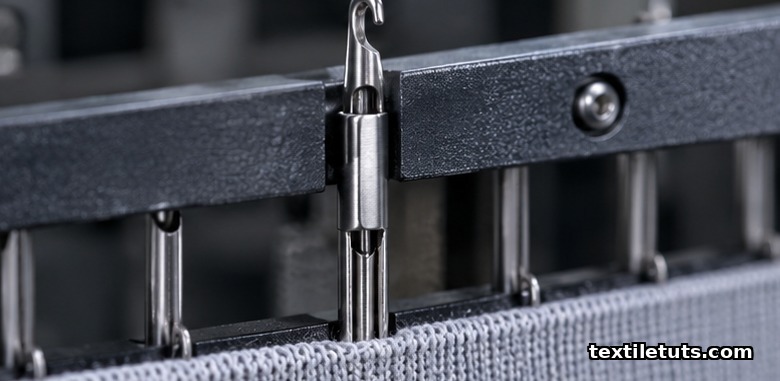
Compound needles were developed in the 1920s and became the standard needle for warp knitting when Karl Mayer introduced the high-speed tricot and raschel machines in the 1950s. They are also used in some modern high-speed circular knitting machines, particularly fine-gauge jersey machines from Mayer & Cie (the SB series uses compound needles in selected diameters) and in whole-garment knitting for technical textiles.
Speed is where compound needles win decisively. A Karl Mayer HKS tricot machine runs at 3,500 rpm at E28 gauge, producing more than 60 m/min of fabric. Modern raschel machines with compound needles reach 2,800 rpm. Compound needles also handle finer gauges more reliably than latch needles because the closing element does not have the swing-clearance problem of a latch pivoting across the hook at very narrow hook widths.
The trade-off is mechanical complexity. The closing element is a precision-ground slider that must slide inside the needle stem without binding, even when yarn fibers or lubricant residue accumulate. Compound needles are more expensive and more sensitive to needle-bed alignment, and most mills send them back to the maker for reconditioning rather than redressing them in-house.
Comparison Table: Bearded vs Latch vs Compound
| Property | Bearded Needle | Latch Needle | Compound Needle |
|---|---|---|---|
| Hook closure mechanism | External presser bends flexible beard | Pivoting latch blade | Axially sliding closing element |
| Typical machine rpm | 1,200 to 1,800 | 20 to 40 | 2,500 to 3,500 |
| Production speed (m/min) | 3 to 8 | 25 to 35 | 50 to 80 |
| Typical gauge range (needles/inch) | E6 to E28 | E5 to E40 | E20 to E50 |
| Yarn range tolerance | Narrow (mid-count spun yarns) | Broad (8 denier filament to coarse wool) | Broad; preferred for filament |
| Common machine types | Fully-fashioned flat, Cotton’s-pattern | Circular jersey, rib, interlock, flat-bed | Warp knitting (tricot, raschel), selected circular |
| Principal failure mode | Beard work-hardening, press-off | Latch pivot wear, needle line | Slider binding, needle-bed misalignment |
| Needle life (typical) | 30 to 90 days | 6 to 36 months | 12 to 24 months; redressed by maker |
| Relative needle cost | Low | Low to medium | Medium to high |
Selecting a Needle Type for a New Knitted Fabric
The choice between bearded, latch, and compound is driven by four questions in roughly this order of weight.
First, what machine do you have? A circular knitting machine from Mayer & Cie, Pai Lung, Terrot, Orizio, or a flat-bed CMS or Stoll uses latch needles. A Karl Mayer tricot or raschel uses compound needles. Bearded-needle machines are specialty items for fully-fashioned knitwear.
Second, what yarn are you knitting? Filament yarns (polyamide, polyester, elastane) run cleanly on all three needle types but reach their highest speeds on compound needles in warp knitting. Spun yarns (cotton, wool, acrylic, blends) are dominated by latch-needle circular knitting; the latch self-aligns with the irregular yarn cross-section in a way the bearded needle cannot.
Third, what gauge and fabric structure do you need? Fine gauges above E32 are practical only on latch needles (circular) or compound needles (warp knitting for tulle, net, fine tricot). Open structures, lace, and laid-in yarns are warp-knitting territory. Shaped knitwear with fashioning marks still uses bearded needles.
Fourth, what is your tolerance for needle maintenance? A circular knitting mill with a well-equipped needle room will specify latch needles for the simple redressing economics. A warp knitting mill that ships compound needles back to the maker accepts that trade for the speed.
Two process checks confirm needle type and condition on a running machine. A missing needle defect (a vertical hole one wale wide) on a latch-needle circular machine usually traces to a worn latch pivot. On a bearded-needle machine it traces to a missing presser action or a broken beard. On a compound-needle machine it traces to a sticking slider or a misaligned needle bed. Stitch density at a fixed yarn and gauge drifts by 3 to 5 percent over a latch needle’s service life and by less than 2 percent on a compound needle; if drift exceeds that band on a compound machine, suspect needle-bed alignment before the needles themselves.
Frequently Asked Questions
What is the difference between a bearded needle and a latch needle in knitting?
A bearded needle closes its hook using a flexible wire extension that is bent across the opening by an external presser bar on every cycle. A latch needle closes its hook using a small pivoting latch blade mounted on the needle itself, so no external presser is required. This makes latch needles faster, simpler to maintain, and tolerant of a wider yarn range, which is why they replaced bearded needles in most circular knitting during the 20th century.
Why are compound needles faster than latch needles?
Compound needles close the hook by sliding a closing element axially inside the needle stem rather than by flexing a beard or pivoting a latch. The closing motion is linear, takes less angular displacement at the cam, and does not need the swing clearance that a latch blade requires. The result is a closure cycle roughly an order of magnitude faster, which is why compound-needle warp knitting machines reach 3,500 rpm while latch-needle circular machines plateau around 25 to 40 rpm.
Can a knitting machine use more than one needle type?
No. The needle bed, cam system, and yarn feeding arrangement are designed around one specific needle geometry. A circular knitting machine built for latch needles cannot accept bearded or compound needles without replacing the needle bed, the cams, the yarn feeders, and the sinker arrangement. Conversion between needle systems is treated as a new machine in textile-machinery catalogues.
Which needle type is most common in commercial knitting today?
The latch needle is the most common needle in commercial knitting worldwide because it powers the vast majority of circular knitting machines for jersey, rib, interlock, and purl, plus most computer-controlled flat-bed knitting machines for shaped knitwear. Compound needles dominate warp knitting (tricot and raschel) and certain high-speed circular machines. Bearded needles survive in fully-fashioned flat knitting for shaped knitwear.
How long does a knitting needle last before it needs replacing?
Service life depends on needle type, yarn, and machine. Bearded needles last 30 to 90 days before the beard loses spring. Latch needles last 6 to 36 months on standard spun yarns and 6 to 12 months on abrasive yarns such as linen. Compound needles last 12 to 24 months and are usually returned to the maker for reconditioning. A drifting stitch density above 2 percent on a compound-needle machine or 5 percent on a latch-needle machine is the practical signal to plan a needle change.
References
- International Organization for Standardization. ISO 8116-1:2004, Textile machinery, Knitting machines, Part 1: Vocabulary. Defines needle geometry and hook closure terminology.
- International Organization for Standardization. ISO 8187:1989, Knitting machinery, Needle numbering system. Standardizes the Nm gauge convention across bearded, latch, and compound needles.
- Spencer, D.J. Knitting Technology: A Comprehensive Handbook and Practical Guide. Woodhead Publishing, 2001. Standard textbook on weft and warp knitting machine mechanics, including hook-closure kinematics.
- Raz, S. Flat Knitting: The New Generation. Meisenbach Bamberg, 2014. Reference for latch-needle flat-bed knitting systems and needle-life data.
- ResearchGate (peer-reviewed). Loop formation and needle force analysis in high-speed warp knitting with compound needles. Textiles Research Journal / Springer Open. Provides measured needle force data underpinning the speed comparisons.
- MDPI. Textiles (Open-access journal, knitting machinery section). mdpi.com/journal/textiles. Peer-reviewed articles on circular knitting needle wear, latch failure modes, and compound-needle slider mechanics.
- Karl Mayer. Technical Documentation for HKS and RS Raschel Warp Knitting Machines. Public technical reference confirming 3,500-rpm operating envelope for compound-needle tricot frames.
This article is the working reference for needle-type selection in weft and warp knitting. Editorial by Iftay Khairul Alam, TextileTuts. Sources: ISO 8116-1:2004, ISO 8187:1989, Spencer (Woodhead 2001), Raz (Meisenbach 2014), Karl Mayer and Mayer & Cie technical datasheets, peer-reviewed knitting mechanics papers indexed at ResearchGate and MDPI as cited.


