
Yarn Count Determination Experiment (ASTM D1907)

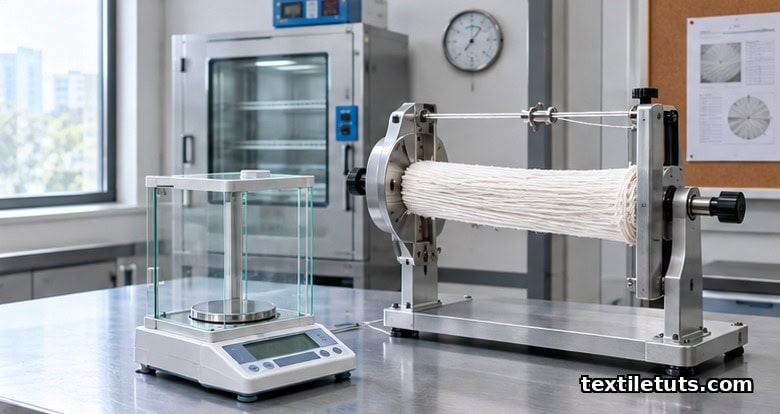
ASTM D1907 determines yarn linear density (yarn count) by winding a conditioned skein of known length on a wrap reel and weighing it on a precision balance, expressing the result in tex, denier, or other count systems with a published interlaboratory reproducibility of approximately ±1.0% at the 95% confidence level. The standard applies to spun yarns from ring, rotor, and friction spinning systems, plus glass and other inorganic yarns, and is the most widely cited skein-based method for lot-level quality control in cotton, worsted, and open-end yarn mills.
This article walks through the principle of ASTM D1907, the apparatus you need, the procedure step by step, the calculations for tex / denier / English cotton count, and the practical pitfalls that move your result by more than 1%. It is written for textile-engineering students running a yarn-count determination experiment in a yarn-manufacturing or testing lab.
Principle of the Test
Yarn count is mass per unit length. Because a single strand of yarn is too fine and too crimped to weigh directly with acceptable precision, ASTM D1907 amplifies the signal by winding a skein of fixed length (typically 100 m, sometimes 120 yd) and weighing the whole skein. Mass divided by length gives linear density; the count system you report depends on which units you divide by.
The skein method is a gravimetric test, not an optical or capacitive one. There is no calibration standard “yarn” you can plug in: you verify the wrap reel’s perimeter, the balance’s linearity, and the conditioning atmosphere, and from those three you derive the result. This is why ASTM D1907 interlaboratory trials consistently report coefficient of variation between 0.5% and 1.5% for combed cotton ring-spun yarns between 10 tex and 50 tex.
The method is officially titled “Standard Test Method for Linear Density of Yarn (Yarn Number) by the Skein Method” and is maintained by ASTM Subcommittee D13.58 on Yarn and Fiber Test Methods. The current revision is D1907 / D1907M – 12 (2018), with periodic re-approval cycles.
Apparatus and Materials
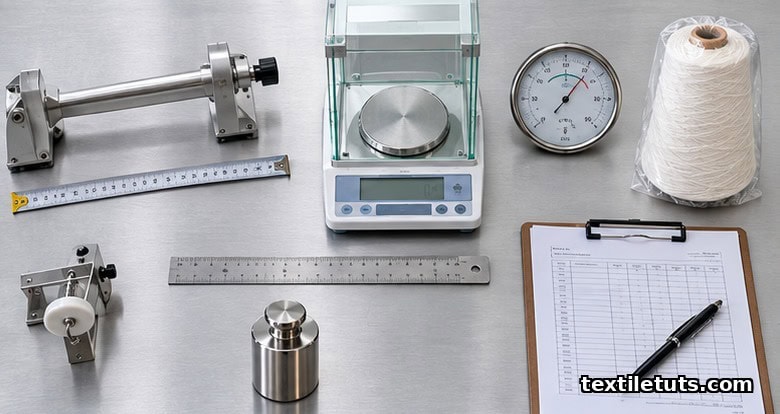
- Wrap reel (skein reel). A reel with a 1 m or 1.5 yd circumference, motor driven at a constant 100 to 300 rpm, with a yarn tension device and a traversing guide that lays the yarn evenly across the reel arm. ASTM D1907 specifies a reel perimeter accurate to ±0.1%.
- Wrap reel (alternative): A hand reel is acceptable for coarse yarns or short experiments, but the rotation rate must be uniform and below 300 rpm to avoid stretching the yarn.
- Analytical balance. Readability of 0.001 g for yarns up to 100 tex, and 0.0001 g for finer filament counts. Verify linearity with Class 1 calibration masses before each test session.
- Conditioning chamber. Standard atmosphere of 20 °C ± 2 °C and 65% ± 4% relative humidity per ISO 139 / ASTM D1776. The yarn must reach moisture equilibrium, typically 4 hours for spun cotton and 8 hours or more for wool and worsted.
- Yarn package holder. A yarn stand, package holder, or creel that allows the yarn to unwind without altering twist or applying extra tension.
- Specimen preparation. Pre-conditioning is required if the sample was taken from a non-standard environment: 4 hours at a relative humidity between 10% and 25% followed by conditioning to standard atmosphere.
Specimen Preparation
Take at least 20 yarn packages from the lot, or 10 packages for routine in-process checks, following a statistically valid sampling plan such as ISO 2859-1. Discard the first 5 m of yarn from each package to remove the disturbed outer layer. Set the wrap reel circumference to the specified length, normally 1 m, so that one revolution corresponds to 1 m of yarn.
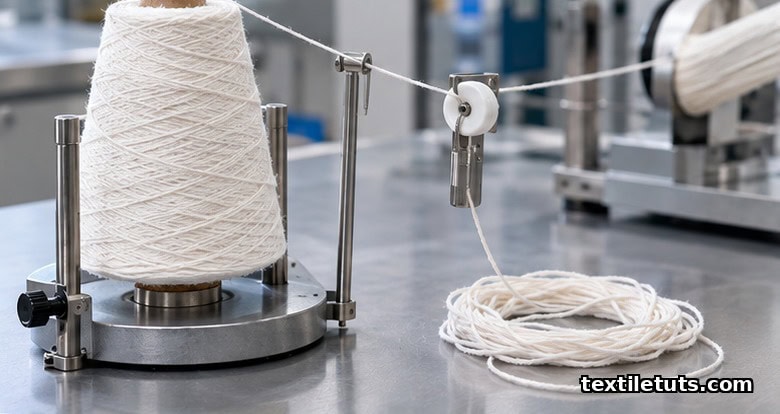
For routine lot testing, 100 m skeins (100 revolutions on a 1 m reel) are the default. For coarse carpet yarns or wrap tests of novelty yarns, 10 m or 25 m skeins may be used provided the calculation is adjusted to keep absolute mass above 1 g on the balance.
Step-by-Step Procedure
- Condition the yarn packages in the standard atmosphere for the time specified in ASTM D1776 (typically 4 hours for spun cotton, longer for hygroscopic fibers).
- Set the wrap reel to the chosen skein length, attach the yarn package to the holder, and thread the yarn through the tension device.
- Rotate the reel at a constant 100 to 300 rpm and wind the required number of revolutions. Use the traversing guide to spread wraps evenly; bunched wraps make the skein hard to dry and weigh.
- Without removing the skein from the reel, tie a loose knot or tuck the loose end under adjacent wraps to prevent snags during handling.
- Remove the skein carefully, supporting its full length to avoid stretching, and immediately weigh it on the analytical balance to 0.001 g resolution.
- Record skein mass, skein length, package number, and any observed irregularities (slubs, missing fibers, broken ends).
- Repeat for the remaining specimens.
- Calculate the linear density for each skein and the lot mean, standard deviation, and coefficient of variation.
Calculations
The general formula is linear density equals skein mass divided by skein length, multiplied by a system-specific constant. For tex (the SI unit used in most modern specifications):
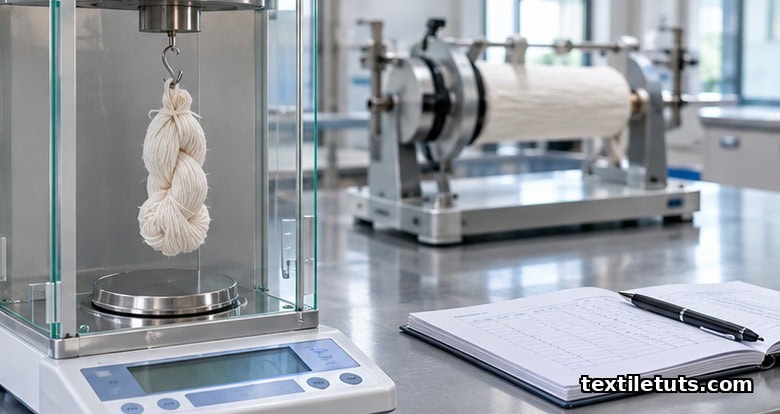
Tex = (mass in grams) × 1000 / (length in meters)
For denier, which is still common in filament yarn specifications:
Denier = (mass in grams) × 9000 / (length in meters)
For English cotton count (Ne), the indirect system used for cotton and worsted yarns, invert the relationship:
Ne = (length in yards × 840) / (mass in pounds)
Convert between systems using these exact factors: 1 tex = 9 denier; 1 Ne (cotton) = 590.5 / tex; 1 Ne (worsted) = 885.8 / tex. The metric count Nm is the inverse of tex in grams per kilometer: Nm = 1000 / tex.
Sources of Error and How to Control Them
The biggest contributor to out-of-spec yarn count is inadequate conditioning. Cotton yarn at 65% relative humidity holds about 7% moisture by mass; at 50% relative humidity the figure drops to roughly 5.7%, a swing of 1.3 percentage points. If you skip conditioning or measure a hot package straight off the spinning frame, your reported tex will run high by 1% to 3%.
The second biggest contributor is wrap-reel perimeter error. A reel arm measured at 0.995 m instead of 1.000 m under-counts length by 0.5% and inflates every tex result by the same 0.5%. Calibrate the reel at least quarterly with a steel tape.
Balance drift, static charge on dry yarn (especially polyester and acrylic), and stretch during skein removal each contribute on the order of 0.1% to 0.5%. For routine mill work those numbers are acceptable; for dispute resolution or referee testing they are not. In referee work the ASTM D1907 method must be paired with ASTM D1776 conditioning practice and a calibrated balance traceable to NIST or an equivalent national metrology institute.
Reporting the Result
Report the count system, the skein length used, the number of specimens tested, the mean linear density, the standard deviation, and the coefficient of variation. Example wording:
“Linear density by ASTM D1907: 29.6 tex (CV 1.8%), mean of 20 skeins of 100 m, conditioned 4 hours at 20 °C and 65% RH.”
Always include the conditioning reference and the balance readability so that the reading is fully traceable.
Yarn Count Determination Experiment: Worked Example
A student lab running an ASTM D1907 experiment on a 30 tex target ring-spun cotton yarn prepared five skeins of 100 m each and recorded the following masses: 2.94 g, 2.97 g, 2.95 g, 2.99 g, 2.96 g.
Calculate tex for each skein (mass × 1000 / 100): 29.4, 29.7, 29.5, 29.9, 29.6 tex. Mean = 29.62 tex. Standard deviation = 0.197. Coefficient of variation = 0.197 / 29.62 × 100 = 0.67%.
The lot is on target (30 tex nominal ±3% acceptance band would be 28.8 to 31.2 tex), CV is well below the 2% threshold typical for combed cotton ring yarn, and the experiment can be reported as a passing result with the conditions recorded on the data sheet.
Comparison: ASTM D1907 Skein Method vs Other Yarn Count Methods
| Property | ASTM D1907 (Skein) | ASTM D1059 (Short Length) | ASTM D2260 (Calculated) |
|---|---|---|---|
| Specimen length | 100 m (typical) | 0.5 to 5 m | From yarn construction data |
| Apparatus | Wrap reel + balance | Balance + length template | Calculator / formula |
| Reported precision | ±1.0% interlaboratory | ±2% to ±3% | Depends on input data |
| Best use | Lot QC, referee testing | Quick in-process checks | Pre-spinning estimates |
| Applies to | Ring, rotor, friction spun yarns | All spun and filament yarns | Yarns with known fiber density and cross-section |
Frequently Asked Questions
What is the difference between ASTM D1907 and ISO 2060?
ASTM D1907 and ISO 2060 cover the same principle: skein length and mass, expressed as linear density. ISO 2060 specifies a 50 m or 100 m skein depending on yarn count, while ASTM D1907 commonly uses 100 m but allows other lengths provided the calculation is adjusted. Both standards reference ISO 139 for conditioning. Either is acceptable for international shipments; the lab report should state which standard was used.
How many skeins do I need for a reliable yarn count result?
ASTM D1907 calls for at least 20 specimens per lot for referee or certification testing, and as few as 5 skeins for in-process mill checks. The 20-skein number comes from statistical sampling work that shows the half-width of the 95% confidence interval on tex falls below 1% once 20 specimens are averaged for a combed cotton yarn.
Why does my measured tex change if I test the same yarn on different days?
Day-to-day drift on the same yarn almost always comes from conditioning. Relative humidity swings from 55% to 70% can shift cotton yarn mass by 1% to 2%. Verify the chamber with a calibrated hygrometer, re-condition for the full ASTM D1776 time, and re-weigh. If the drift persists, check the balance with calibration masses.
Can I use ASTM D1907 on filament or textured yarns?
ASTM D1907 is written for spun yarns from ring, rotor, and friction systems, plus glass yarns. For continuous filament or textured filament yarns the recommended standards are ASTM D1907 (allowed by extension for filament) and ISO 2060, both of which use the same skein method. For very fine filaments below 5 tex, increase the skein length to 200 m or 500 m so the mass stays above 1 g.
What is the anxiety point: can a single bad skein ruin the result?
Yes, a single outlier can distort the mean and inflate the CV if the sample size is small. ASTM D1907 lets you discard a skein only when a documented break, slub, or operator error occurred. Never discard a result just because it is high or low. With 20 skeins, the influence of one outlier on the mean is only 5%, but on the standard deviation it can still be 10% to 15%. Use Dixon’s Q test or Grubbs’ test to decide objectively whether an outlier should be excluded.
References
- ASTM International. ASTM D1907 / D1907M – 12 (2018): Standard Test Method for Linear Density of Yarn (Yarn Number) by the Skein Method. ASTM International, West Conshohocken, PA. Defines the skein-length-and-mass procedure used in this experiment.
- ASTM International. ASTM D1776 / D1776M – 20: Standard Practice for Conditioning and Testing Textiles. ASTM International, West Conshohocken, PA. Specifies the 20 °C, 65% RH conditioning atmosphere referenced in ASTM D1907.
- International Organization for Standardization. ISO 139:2005 — Textiles — Standard atmospheres for conditioning and testing. ISO, Geneva. Source of the moisture-equilibrium condition used globally for yarn-count work.
- International Organization for Standardization. ISO 2060:1994 — Textiles — Yarn from packages — Determination of linear density (mass per unit length) by the skein method. ISO, Geneva. International counterpart to ASTM D1907; useful when shipping yarn across regions.
- International Organization for Standardization. ISO 2859-1:1999 — Sampling procedures for inspection by attributes. ISO, Geneva. Basis for selecting the 20-package sample size used in lot-level yarn-count testing.
- American Association of Textile Chemists and Colorists. AATCC Technical Manual, current edition. AATCC, Research Triangle Park, NC. Cross-reference for laboratory practice in cotton-yarn count work.
This article is the working reference for the yarn-count determination experiment under ASTM D1907. Editorial by Iftay Khairul Alam, TextileTuts. Sources: ASTM D1907/D1907M, ASTM D1776/D1776M, ISO 139, ISO 2060, ISO 2859-1, and the AATCC Technical Manual as cited.


