
Fabric GSM Measurement Experiment

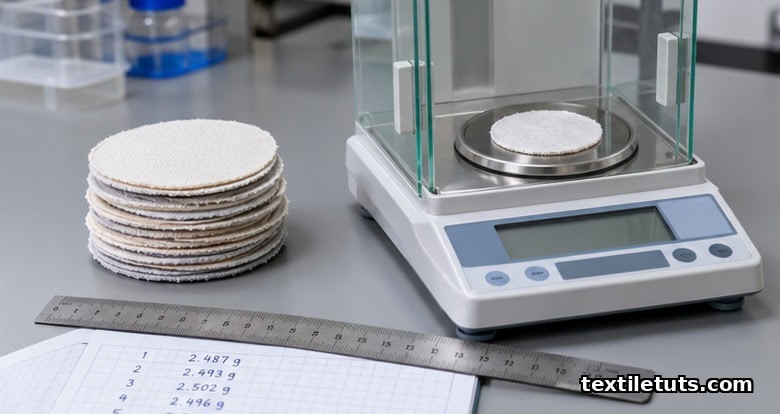
Fabric GSM (grams per square meter) is measured by conditioning five specimens at 20 °C and 65 % relative humidity per ISO 139, cutting each with a calibrated 100 cm² die, weighing on a balance accurate to 0.001 g, and multiplying the mean mass by 100, exactly as specified in ISO 3801:1977.
This procedure gives the laboratory value that production planners, merchandisers, and quality auditors use to convert a roll of fabric into the order quantity a buyer has requested. A 220 GSM single jersey behaves like a winter-weight T-shirt; a 140 GSM single jersey behaves like a summer shirting. The number is the contract.
What follows is the working protocol a textile-engineering student or QA technician can run on a single roll of fabric using equipment that fits on a bench: a balance, a circular cutter, and an environmental cabinet. Every step traces back to a published ISO or ASTM method, and the variables that matter (cutter area, sample count, conditioning time) are called out so you can audit the experiment against the relevant clause.
What GSM Actually Is, and Why the Test Has a Tolerance
GSM is mass per unit area, expressed in grams per square meter. Two fabrics can carry the same yarn count, the same stitch density, and the same finishing route and still finish at different GSM values if the finishing line stretches or compacts them by different amounts. ISO 3801:1977 governs woven fabric, while the woven counterpart for knits is normally handled by ASTM D3776/D3776M-20, which covers both woven and knitted fabrics in a single procedure.
The tolerance question matters because buyers specify GSM as a band, not a point. A buyer writing “180 ± 5 % GSM” means the shipment is acceptable from 171 to 189. The test method must be precise enough that two laboratories measuring the same roll do not disagree by more than roughly half the tolerance, which is why ISO 3801 specifies a five-specimen sample, a 0.001 g balance, and 24 hours of conditioning before the cut.
The Standards Behind the Experiment
Three documents control almost every GSM measurement you will run in a textile lab:
- ISO 3801:1977, “Textiles, Woven Fabrics, Determination of Mass per Unit Length and Mass per Unit Area.” Five specimens, each at least 0.01 m² (100 cm²), with results reported to the nearest 1 g/m².
- ASTM D3776/D3776M-20, “Standard Test Methods for Mass Per Unit Area (Weight) of Fabric.” Option A uses a 100 cm² die cutter; Option C uses full-width, full-length pieces.
- ISO 139:2005, “Textiles, Standard Atmospheres for Conditioning and Testing.” Specifies 20.0 ± 2.0 °C and 65.0 ± 4.0 % relative humidity, with a minimum 24-hour conditioning period for textile specimens.
If the question is “which standard do I cite?” for a peer-reviewed paper or a buyer compliance report, cite ISO 3801 for woven fabric and ASTM D3776 Option A for knitted fabric or for any lab running both on the same balance. For a thesis-style experiment in a university lab, citing both side by side is normal practice.
Equipment You Need
The full kit for a single-bench GSM experiment is shorter than most students expect.
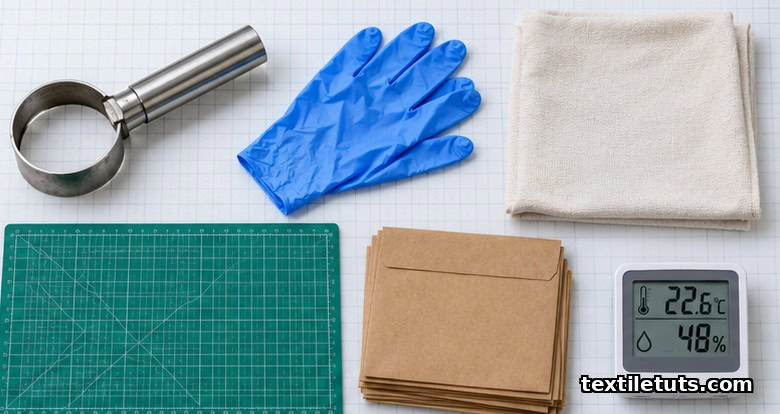
- Analytical balance, readable to 0.001 g (three decimal places). A 0.01 g balance is acceptable only if you cut a 0.05 m² specimen (500 cm²) and divide by 5.
- Calibrated circular die cutter, 100 cm² cutting area, with a sharpened edge that has been checked against a steel ruler within the last 12 months.
- Cutting mat, self-healing, sized to the cutter footprint.
- Environmental cabinet or conditioned lab space meeting ISO 139 (20 °C, 65 % RH).
- Gloves (cotton or nitrile, lint-free) to keep skin oils off the specimen.
- Pre-weighed sample envelopes or a desiccator tray for transfer from cabinet to balance.
The cutter is the variable that quietly ruins reproducibility. A blunt cutter compresses the fabric edge, the specimen rides up the bevel, and the actual cut area drifts below 100 cm². Testex and SDL Atlas both sell certified cutters; for academic work, the lower-cost option is a Grimm-style die that ships with a calibration certificate traceable to a national metrology institute.
Step-by-Step Procedure (ISO 3801 Style)
The protocol below condenses ISO 3801:1977 and ASTM D3776/D3776M-20 Option A into a single workflow that students and QA technicians can run end-to-end in about 90 minutes of hands-on time, plus the 24-hour conditioning step.
- Pre-condition the roll. Unroll the fabric and lay it flat in the conditioning room for at least 24 hours before cutting. ISO 139 calls for 20 °C and 65 % RH; if your facility runs at 23 °C and 50 % RH, leave the roll for 48 hours and note the deviation in the lab report.
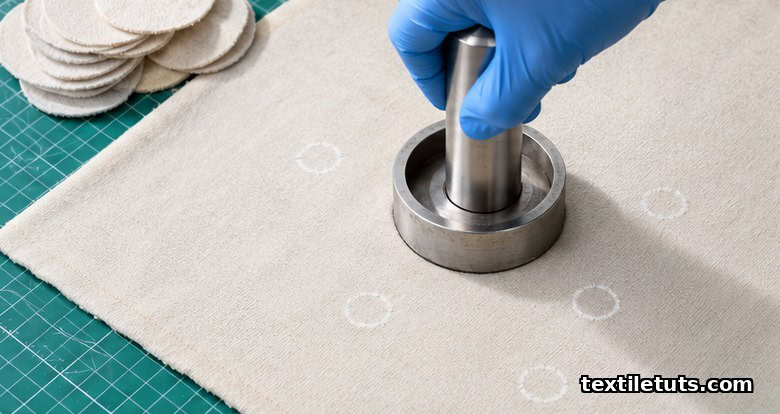
- Mark the sampling grid. ISO 3801 requires five specimens taken across the full width of the fabric, avoiding the selvedge by at least 5 cm and avoiding any visible defect. Mark each cutting position with a fabric pencil or a chalk marker that does not transfer dye.
- Cut the specimens. Place the cutter on the marked spot, apply even pressure, and rotate one full turn. Lift the die and confirm the specimen is fully detached. Repeat for all five positions.
- Re-condition the cuts. Return the five specimens to the conditioning atmosphere for at least 4 additional hours. This step catches moisture absorbed during handling.
- Weigh each specimen. Tare the balance, place the specimen on the pan, and record the mass to 0.001 g. Close the balance door and wait 10 seconds for the reading to stabilize before recording.
- Calculate GSM. For a 100 cm² die, GSM equals mass (g) multiplied by 100. Average the five specimens, report to the nearest 1 g/m², and state the standard deviation.
The whole procedure fits a single lab session once the conditioning is done, and a clean run on a 180 GSM single jersey typically yields a within-fabric standard deviation under 1.5 g/m².
Calculating GSM and Reporting the Result
The calculation itself is one line of arithmetic, but the report needs four numbers, not one.
| Variable | Definition | Typical value (180 GSM single jersey) |
|---|---|---|
| M (g) | Mean specimen mass, 5 cuts | 1.802 g |
| A (cm²) | Die cutter area | 100 cm² |
| GSM | (M / A) × 10,000 | 180.2 g/m² |
| SD | Standard deviation across the 5 cuts | 1.4 g/m² |
Report the four numbers together: mean GSM, standard deviation, sample count, and conditioning conditions. A buyer who receives “180 GSM” without the conditioning note cannot tell whether the lab followed ISO 139 or ran the test on a humid day in a non-conditioned space.
Common Sources of Error
GSM testing looks mechanical, but three failure modes appear in nearly every audit I have reviewed.
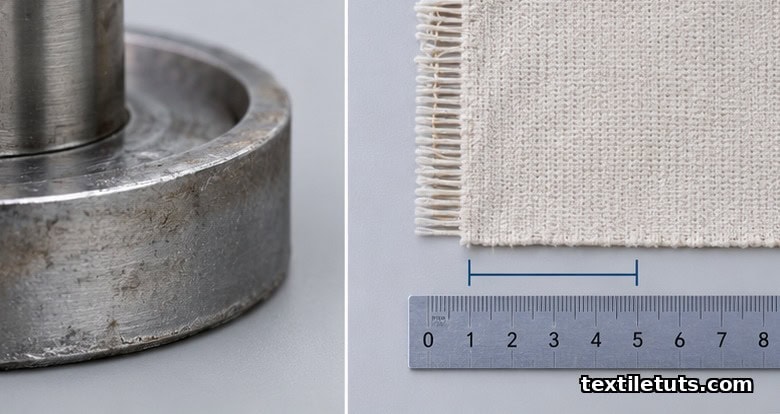
- Blunt cutter. A cutter that has cut more than about 500 specimens will have a bevel larger than the rated area. Replace or re-sharpen the cutter every 500 cuts, or sooner on heavyweight fabrics.
- Skipped conditioning. Wool, viscose, and modal can swing 2 to 4 % in mass across the 50 % vs 65 % RH boundary. Skipping the 24-hour conditioning step biases the result high on humid days and low on dry days.
- Selvedge bias. GSM is typically 5 to 8 % higher at the selvedge than in the body of a woven fabric, because the selvedge carries extra warp ends for stability. ISO 3801 explicitly excludes the first 5 cm of width for this reason.
Two more that show up in academic labs: not taring the balance after the door closes (air buoyancy), and weighing specimens with bare fingers (oils add 0.005 to 0.020 g per specimen, which becomes 0.5 to 2.0 GSM on a 100 cm² die).
ISO 3801 vs ASTM D3776: Side-by-Side
The two standards agree on the physics. They diverge on three practical points a student or QA technician needs to know.
| Parameter | ISO 3801:1977 | ASTM D3776/D3776M-20 |
|---|---|---|
| Scope | Woven fabrics | Woven and knitted fabrics |
| Specimen count | 5 specimens minimum | 3 specimens minimum (Option A) |
| Specimen area | ≥ 0.01 m² (100 cm²) | 100 cm² die or larger |
| Balance precision | 0.001 g or 0.1 % of mass | 0.1 % of mass |
| Conditioning standard | ISO 139 (20 °C, 65 % RH) | ASTM D1776 (21 °C, 50 % RH by default; 20 °C, 65 % RH optional) |
| Reporting unit | g/m² to nearest 1 | oz/yd² or g/m² |
The conditioning difference is the one that bites cross-border shipments. A roll tested at 21 °C and 50 % RH in a US lab may report 178 GSM on a fabric that would test 180 GSM at 20 °C and 65 % RH in a Bangladesh or EU lab. Both numbers are correct under their own standard; the difference is the standard atmosphere.
From Lab to Production: How GSM Links to Other Tests
A GSM result is rarely the final word. A buyer audit typically pairs the GSM test with three others, and the cross-checks catch errors a single test would miss.
- Fabric thickness per ISO 5084 or ASTM D1777 — confirms the GSM reading is consistent with the fabric’s nominal thickness. A 180 GSM single jersey at 0.65 mm and a 180 GSM fleece at 1.40 mm are very different fabrics with the same mass number.
- Stitch density or ends-and-picks count per ISO 7211-2 — gives structure-side context. A 180 GSM single jersey at 22 stitches/cm behaves like a stable shirting; the same 180 GSM at 16 stitches/cm behaves like a soft, drapey tee.
- Dimensional change after wash per AATCC TM135 or ISO 6330 — separates greige-state GSM from finished-state GSM. Cotton knits typically relax 8 to 12 % after the third industrial wash.
Running the three tests together takes an extra 3 hours of lab time but turns a one-number report into a four-number fabric profile that survives an audit.
Frequently Asked Questions
What is the smallest fabric sample I can use for a GSM test?
ISO 3801 sets the floor at 0.01 m², or 100 cm², because smaller specimens introduce edge-loss errors above 2 % on most fabrics. ASTM D3776 Option A uses the same 100 cm² die. If you must use a smaller specimen, scale the balance precision to keep the relative error under 0.5 %: a 0.0001 g balance and a 25 cm² cutter can work, but the cutter calibration becomes the dominant source of uncertainty and must be checked more often than the once-a-year minimum.
How long does fabric need to condition before GSM testing?
ISO 139 requires a minimum of 24 hours at 20 °C and 65 % RH for textile specimens, with an additional 4-hour re-conditioning after the cuts are made. Heavyweight denim and tightly woven worsteds benefit from 48 hours on the first pass. Skipping the conditioning step is the single largest source of inter-lab disagreement on GSM, particularly for cellulosic fibers that absorb 8 to 12 % moisture at 65 % RH versus 5 to 7 % at 50 % RH.
Does GSM change after washing?
Yes. A 180 GSM cotton single jersey typically relaxes to 195 to 210 GSM after the first industrial wash, and to 200 to 215 GSM after the third wash, depending on the finishing route. This is why garment buyers specify GSM after a defined number of wash cycles, usually 5, and test to AATCC TM135 or ISO 6330. Reporting a GSM value without naming the wash state is one of the most common buyer-side disputes, and the easiest one to settle by writing the wash cycles into the report.
Can I measure GSM without a circular cutter?
Yes, using ASTM D3776 Option C, which uses full-width, full-length pieces and a steel ruler. You cut a 25.4 cm by 25.4 cm (100 in²) square with a scalpel and ruler, weigh it, and convert. The ruler method is more accurate per square centimeter but takes longer; the cutter method is faster and the dominant choice in production labs because a single press of the die replaces four ruler-guided cuts.
What is the difference between GSM and oz/yd²?
GSM and oz/yd² both measure fabric mass per unit area, but in different units. 1 oz/yd² equals 33.906 g/m², so a 6 oz/yd² denim is roughly 203 GSM. US buyers in the workwear and denim segments still quote oz/yd²; EU and Asian buyers quote GSM. ASTM D3776 lets you report in either unit from the same weighing, and the TextileTuts Fabric GSM Calculator converts both directions for spec sheets.
References
- International Organization for Standardization. ISO 3801:1977, Textiles, Woven Fabrics, Determination of Mass per Unit Length and Mass per Unit Area. iso.org — the foundational standard for woven GSM testing, five-specimen minimum, 100 cm² die.
- ASTM International. ASTM D3776/D3776M-20, Standard Test Methods for Mass Per Unit Area (Weight) of Fabric. astm.org — the US counterpart covering both woven and knitted fabrics, three options for specimen geometry.
- International Organization for Standardization. ISO 139:2005, Textiles, Standard Atmospheres for Conditioning and Testing. iso.org — defines the 20 °C and 65 % RH conditioning atmosphere and the 24-hour minimum exposure.
- ASTM International. ASTM D1776/D1776M-20, Standard Practice for Conditioning and Testing Textiles. astm.org — US conditioning standard, default 21 °C and 50 % RH with 20 °C and 65 % RH as an option.
- American Association of Textile Chemists and Colorists. AATCC TM135, Dimensional Changes of Fabrics after Home Laundering. aatcc.org — the wash-cycle protocol used to define after-wash GSM in buyer specifications.
- International Organization for Standardization. ISO 6330:2021, Domestic Washing and Drying Procedures for Textile Testing. iso.org — the international counterpart to AATCC TM135, used outside North America for wash-cycle GSM reporting.
- International Organization for Standardization. ISO 7211-2:1984, Textiles, Woven Fabrics, Construction, Methods of Analysis, Part 2: Determination of Number of Threads per Unit Length. iso.org — sets the thread-count method that pairs with a GSM test in a full fabric profile.
This article is the working reference for laboratory GSM measurement under ISO 3801 and ASTM D3776. Editorial by Iftay Khairul Alam, TextileTuts. Sources: ISO 3801:1977, ISO 139:2005, ISO 6330:2021, ISO 7211-2:1984, ASTM D3776/D3776M-20, ASTM D1776/D1776M-20, and AATCC TM135 as cited.


