
Textile Engineering Lab Experiments: A Complete Guide

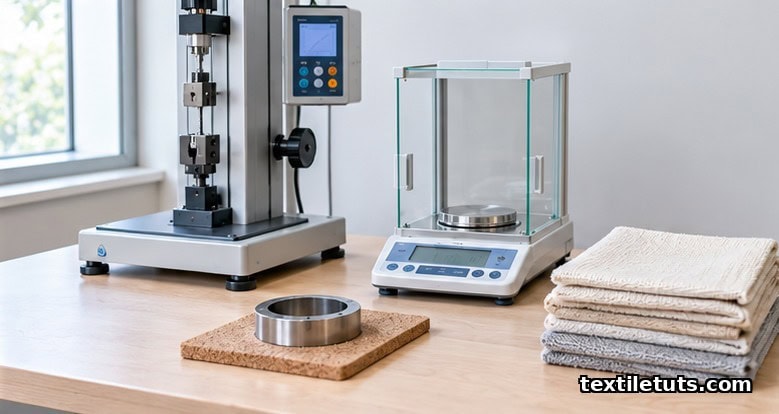
A textile engineering lab quantifies fiber, yarn, and fabric performance against published standards such as ISO 139, ASTM D5034, and AATCC 135, where a 5-specimen tensile test typically reports breaking strength with a coefficient of variation below 5% and a 95% confidence interval within ±2% of the mean. These standardized experiments convert subjective fabric feel into reproducible numbers that mills, brands, and researchers can compare across labs, batches, and seasons.
The same tests that graduate students run for a BSc thesis are also the ones a mill floor runs for shipment approval, which is why a working knowledge of these methods matters whether your goal is a textile engineering degree, a quality assurance career, or building a fabric library for a fashion line.
The guide below covers the experiments most textile engineering programs treat as core: tensile strength, yarn count, GSM, shrinkage, color fastness, pilling, abrasion, air permeability, and crease recovery. Each section states the standard, the apparatus, the specimen geometry, the calculation, and the typical reporting range so you can plan a lab session or interpret a supplier report with confidence.
Standard Atmosphere: The First Variable to Control
Every textile lab begins with conditioning. ISO 139 specifies a standard atmosphere of 20 ± 2 °C and 65 ± 4% relative humidity, with specimens pre-conditioned for at least 24 hours before testing. ASTM D1776 uses 21 ± 1 °C and 50 ± 2% RH. Cotton gains roughly 8% in weight when moved from 0% to 65% RH; wool moves even more. Skip this step and your tensile reading can drift by 10% or more from a properly conditioned sample.
A working lab records the lab temperature and humidity on every test sheet, and refuses to run tests when the room is outside the standard band. Cheap hygrometers and a wall thermometer are enough; calibrated data loggers are better.
Tensile Strength and Breaking Load
The grab method (ASTM D5034) and the strip method (ASTM D5035) are the two most common tensile tests on woven fabrics. ISO 13934-1 covers strip tensile for woven textiles; ISO 13934-2 covers the grab method. A 5-specimen warp sample and a 5-specimen weft sample is the minimum for a defensible mean.
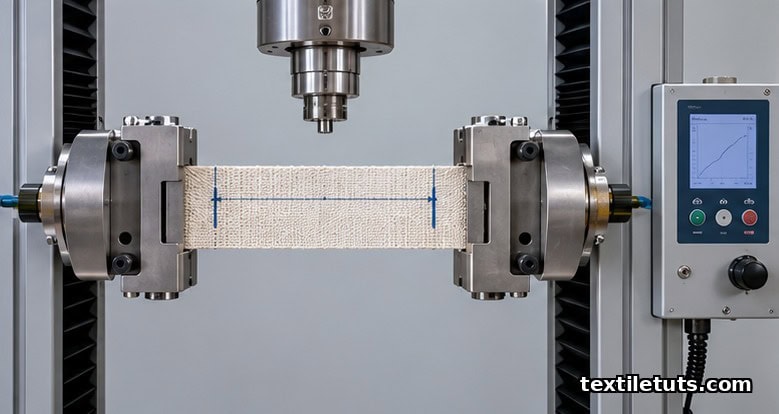
For a 150 mm × 25 mm strip on a constant-rate-of-extension (CRE) tensile machine with a 75 mm gauge length, a 100% cotton plain weave at 150 GSM should break between 400 N and 700 N warp, and 250 N to 450 N weft. Anything outside that range on a known-good control sample points to bad conditioning, a misaligned jaw, or a damaged grip face.
Yarn tensile follows ISO 2062. A single yarn is mounted between pneumatic clamps with a 250 mm gauge length and extended at 250 mm/min until rupture. Twenty tests per lot give a tolerable coefficient of variation; thirty tests are the textile-engineering norm for a published thesis. Report breaking force in cN/tex to compare across count systems, since raw newtons penalize finer yarns.
Yarn Count and Twist
Yarn count is the linear density, and three systems dominate: English cotton count (Ne), metric count (Nm), and tex. ISO 2061 specifies the method: take a 100 m or 200 m skein on a wrap reel, weigh it on a precision balance to 0.001 g, and calculate. For Ne, length in yards divided by weight in pounds; for tex, weight in milligrams per metre of yarn.
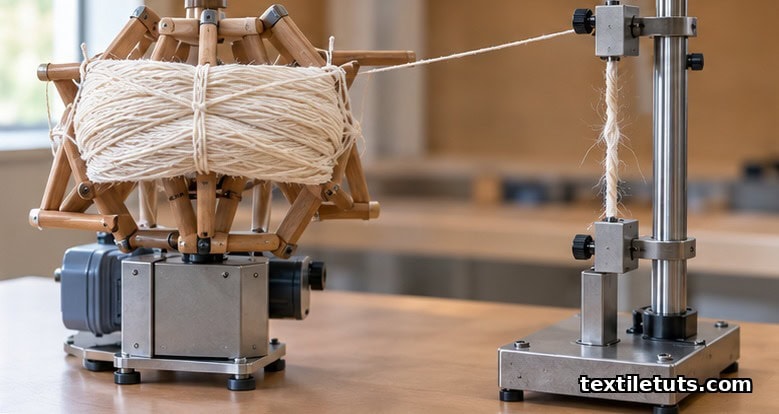
Twist follows ISO 2061 as well, using a twist tester. A 50 mm gauge with 25 mm twist-reversal length, untwist the yarn until individual fibers separate, count the rotations, and report turns per metre (TPM). A 30 Ne ring-spun cotton yarn typically runs 800 to 1,000 TPM; a 30 Ne rotor-spun yarn sits lower at 700 to 850 TPM. The twist multiplier (TM = TPM / √Ne) should fall between 3.5 and 4.5 for balanced ring-spun weaving yarn.
Use the TextileTuts Yarn Count Calculator to convert between systems once you have a primary measurement in tex.
GSM: Grams per Square Metre
GSM is the single most quoted fabric number, and ISO 3801 (with ASTM D3776 as the equivalent) gives the method. Cut five 100 cm² specimens (10 cm × 10 cm works), weigh each to 0.001 g, multiply by 100, and report the mean. A circular cutting die of 100 cm² is the lab-friendly tool; otherwise use a sharp razor and a steel template.
A 5-specimen sample should agree within 2% of the mean. A wider spread on a woven fabric signals uneven warp let-off or poor finishing. Knits show more variance because of loop distortion during cutting.
Shrinkage and Spirality
AATCC 135 and ISO 6330 both specify home-laundering cycles on a front-loading washer with controlled water temperature, spin speed, and detergent load. Mark a 25 cm × 25 cm square on the fabric with a fabric marker, run the prescribed cycle (typically 1 through 5), tumble dry, condition, and measure the new dimensions.
Report percent change as ((original – final) / original) × 100. A woven cotton at first home wash typically shrinks 3% to 5% warp and 1% to 3% weft if the mill did not pre-shrink. Knits often relax 5% to 8% in length on the first cycle. Spirality, the rotational skew common in single-jersey knits, is reported as the angle between a marked warp line and a line perpendicular to the selvedge after laundering; anything above 5% looks visibly off-grain to a consumer.
Color Fastness to Washing
ISO 105-C06 is the workhorse wash-fastness test. A 100 mm × 40 mm specimen is sewn to a multifiber adjacent strip, agitated in a steel-bath dyeing machine with steel balls at 40 °C or 60 °C for 30 minutes, rinsed, dried, and rated against the grey scale (ISO 105-A02 for change, ISO 105-A03 for staining).
Ratings run from 1 (severe change) to 5 (no change). A pass for a dark reactive-dyed cotton is a 4 on color change and 3 to 4 on staining of adjacent cotton. Anything below that on a commercial order is a rework.
Light fastness follows ISO 105-B02 on a xenon arc weatherometer; ratings of 5 and above are typical for automotive and outdoor applications.
Pilling Resistance
ISO 12945-2 specifies the Martindale pilling test. Mount the fabric face-to-face with itself in a circular holder, run the Martindale at 5,000 and 10,000 rubs under a 9 kPa load, and rate against photographic standards. A 5 means no pilling; a 1 means severe pilling across the surface.
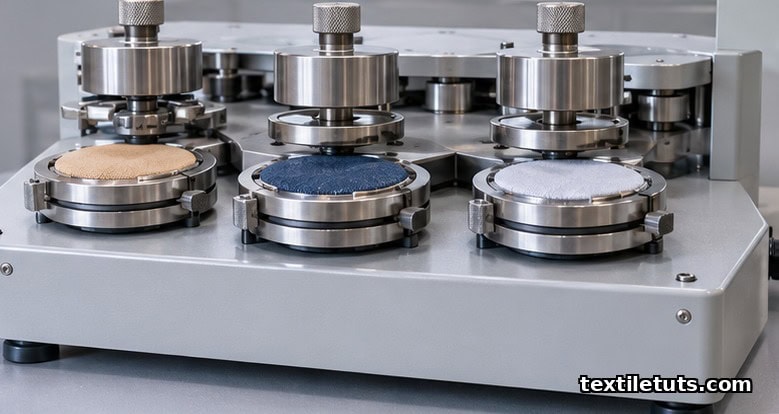
A good-quality woven cotton trouser fabric rates 4 to 5 after 5,000 rubs. Single-jersey cotton knits often drop to 3 on the same scale, which is normal for the category. A pill rating of 2 or below on a sample labelled “premium” is a quality failure.
Abrasion Resistance
The Martindale doubles as an abrasion test under ISO 12947. Mount the specimen under a 9 kPa or 12 kPa load, abrade against a standard wool abrasive, and count rubs to a defined endpoint (thread rupture for woven, mass loss threshold for knits). A woven upholstery fabric should survive 20,000 to 40,000 rubs before thread rupture; a heavy denim hits 50,000+. Light shirtings fail around 10,000 rubs, which is appropriate for the category.
The Wyzenbeek method (ASTM D4157) is the US equivalent and uses a double-rub count on an oscillating cylinder with cotton duck as the abrasive. The two methods are not interchangeable; a spec for European upholstery usually cites Martindale rubs, while North American upholstery cites Wyzenbeek double rubs.
Air Permeability and Comfort
ISO 9237 specifies air permeability. Clamp the fabric over a 20 cm² (or 5 cm² for low-permeability fabrics) orifice, apply a 100 Pa pressure drop, and read the airflow in cm³/s/cm². A standard T-shirt singlet at 150 GSM reads 200 to 400 cm³/s/cm². A tightly woven raincoat fabric at 100 GSM reads below 10.
Moisture management follows ISO 16862 or AATCC 195, depending on the lab. The AATCC 195 method drops a fixed volume of water onto the back of the fabric, lays the sample on a horizontal sensor plate, and records the spreading time, wetting time, and overall moisture management capacity (OMMC). A good activewear knit scores above 0.4 OMMC.
Crease Recovery
ISO 2313 (Shirley crease recovery) is the standard. Fold a 40 mm × 15 mm specimen under a 500 g load for 5 minutes, transfer to a clamp, allow 5 minutes recovery, and read the recovery angle. A 100% cotton shirting recovers 70° to 100° warp-plus-weft; a wool-blend suiting recovers 130° to 160°. Resin-finished cotton can reach 140° at the cost of tensile loss, which is why a mill balances the two tests rather than optimizing one.
Frequently Asked Questions
Q1: How many specimens do I need for a defensible tensile test report?
Use at least five specimens in each direction (warp and weft for fabric, single-yarn tests for yarn). Twenty specimens are the textile-engineering norm for thesis-level statistical claims. Report the mean, standard deviation, and coefficient of variation. A coefficient of variation above 7% on a woven fabric usually points to a sampling or conditioning problem rather than true material variability.
Q2: What is the standard atmosphere, and why does it matter so much?
ISO 139 calls for 20 ± 2 °C and 65 ± 4% relative humidity. ASTM D1776 uses 21 ± 1 °C and 50 ± 2% RH. The two standards are close but not identical, and reported numbers can shift by a few percent between them. Condition all specimens for at least 24 hours before testing. Skip conditioning and your tensile and GSM numbers will drift, sometimes by more than 10% on hygroscopic fibers such as cotton, wool, and viscose.
Q3: Can I use the same cutting template for both woven and knit GSM tests?
The 100 cm² die works for both, but the cutting technique matters. Knits stretch under the die if you press hard; use a sharp die with a cork board underneath and apply firm, even pressure without shearing the loops. Always cut specimens from different parts of the sample (corners and centre) to capture within-fabric variation. A single 100 cm² disc is never enough for a published report.
Q4: Which test should I run for shrinkage, AATCC 135 or ISO 6330?
Both are valid. AATCC 135 uses a top-loading or front-loading US-style washer with specific detergent and ballasts; ISO 6330 uses a European front-loading drum and ECE or AATCC detergent. AATCC 135 is the default for products sold in North America, ISO 6330 is the default for products sold in Europe and most of Asia. For a thesis, run both if you want a comparative data point, or pick whichever matches your downstream market.
Q5: Do lab results actually predict how the fabric will perform in real use?
Lab results are reproducible proxies, not full simulations. A Martindale abrasion rating predicts surface wear under controlled rubbing, not the multi-directional stress a trouser knee actually sees. A wash-fastness rating of 4 predicts industrial laundering tolerance, but cannot model the chlorine bleach a hotel laundry might add. Treat the lab number as a control-test pass or fail, then add a wear trial or a small-batch customer test before committing a fabric to a full production run. The lab tells you the fabric is consistent and within spec; the wear trial tells you whether the spec was right in the first place.
References
- ASTM International. ASTM D5034 Standard Test Method for Breaking Strength and Elongation of Textile Fabrics (Grab Method). https://www.astm.org/d5034 (grab tensile test method for woven fabrics).
- ASTM International. ASTM D3776 Standard Test Methods for Mass Per Unit Area (Weight) of Fabric. https://www.astm.org/d3776 (GSM and ounces-per-square-yard test method).
- AATCC. AATCC Test Method 135: Dimensional Changes of Fabrics After Home Laundering. https://www.aatcc.org (home-laundering shrinkage and spirality method).
- ISO. ISO 139:2005 Textiles, Standard Atmospheres for Conditioning and Testing. https://www.iso.org/standard/35179.html (20 °C and 65% RH standard atmosphere).
- ISO. ISO 13934-1:2013 Textiles, Tensile Properties of Fabrics, Part 1: Determination of Maximum Force Using the Strip Method. https://www.iso.org/standard/60676.html (strip tensile test on woven and knitted fabrics).
- ISO. ISO 12945-2:2020 Textiles, Determination of Fabric Propensity to Surface Pilling, Fuzzing or Matting, Part 2: Modified Martindale Method. https://www.iso.org/standard/76707.html (Martindale pilling test method).
- ISO. ISO 9237:1995 Textiles, Determination of the Permeability of Fabrics to Air. https://www.iso.org/standard/13793.html (air permeability test method).
- ISO. ISO 105-C06:2010 Textiles, Tests for Colour Fastness, Part C06: Colour Fastness to Domestic and Commercial Laundering. https://www.iso.org/standard/51022.html (wash fastness test method).
Editorial by Iftay Khairul Alam, TextileTuts. Sources: ASTM D5034, ASTM D3776, AATCC 135, ISO 139, ISO 13934-1, ISO 12945-2, ISO 9237, and ISO 105-C06 as cited. Last reviewed 2026-09-14.


