
Elastic Recovery: ASTM D4964

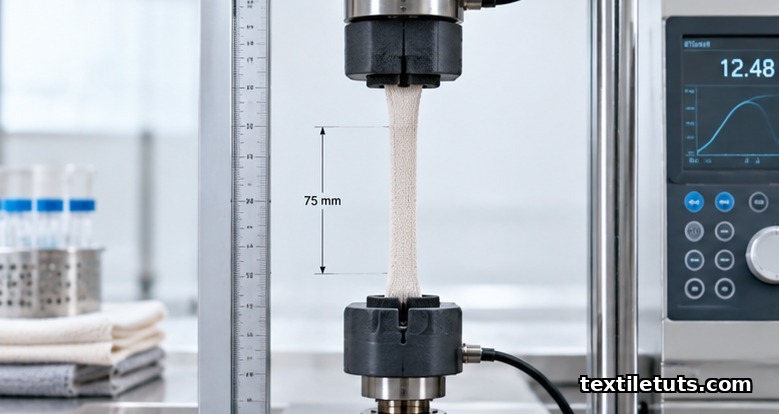
ASTM D4964 is the standard test method for measuring the elongation and tension properties of narrow elastic fabrics, specifying a 75 ± 1 mm gauge length stretched at 300 ± 10 mm/min to 75% of the elongation at a specified load, with elastic recovery calculated after a 30 ± 1 second hold and a 30 ± 1 second recovery interval.
Published by ASTM International (originally approved in 1989, reapproved with revisions through 2020), D4964 gives mills, brand quality teams, and testing laboratories a single, reproducible procedure for ranking narrow elastics by stretch behavior, residual elongation, and recovery after repeated cycles. It is the workhorse method for woven and knitted narrow elastic tapes, rubber thread, and elastomeric yarns used in intimate apparel, activewear waistbands, medical compression garments, and surgical face mask straps.
This article walks through what the standard actually prescribes (specimen dimensions, machine settings, calculation formulas), why the resulting numbers matter on the production floor and in a fit room, how D4964 sits next to related ASTM, ISO, and AATCC methods, and the practical questions sourcing, QA, and design teams ask before they accept or reject a lot of elastic.
What ASTM D4964 Measures, and Why It Exists
D4964 belongs to ASTM Subcommittee D13.59 on fabric test methods, family of “stretch and recovery” standards. The standard is titled “Standard Test Method for Tension and Elongation of Elastic Fabrics (Strip Method)” and was developed to replace the earlier D1775 method that applied to woven elastic fabrics only. D4964 broadened the scope to narrow elastic fabrics in general, whether the elastomer is natural rubber, spandex (elastane), polyisoprene, or a polyether-block-amide, and whether the construction is woven, knitted, or braided.
The core outputs are three numbers: load at a specified elongation (often called LASE or load at specified elongation), elongation at a specified load (EASL), and elastic recovery expressed as a percentage of the original applied stretch. These three values, taken together, describe whether an elastic will pull a garment tight enough to stay in place, stretch far enough to fit a range of body sizes, and recover enough that it does not bag out after a few wear cycles.
Two narrow elastic fabrics can have the same elongation at break yet behave very differently on a body. One may recover 95% of its stretched length after a 30-second hold, the other only 80%. That 15-percentage-point gap shows up as a waistband that holds its grip versus one that sags below the hips by lunchtime. D4964 is the test that surfaces that gap as a number, which is why most intimate apparel and athleisure specifications reference D4964 directly in their quality documents.
Specimen Preparation and Test Apparatus
The D4964 procedure calls for specimens cut to a width of 25.4 ± 1 mm (1 inch) and a gauge length of 75 ± 1 mm between the jaws of a constant-rate-of-extension (CRE) tensile testing machine. For very narrow tapes, ASTM allows a 50 ± 1 mm gauge length alternative provided the laboratory reports it. Specimens are conditioned at 21 ± 1 °C and 65 ± 2% relative humidity for at least 4 hours before testing, in line with ASTM D1776 conditioning practice.
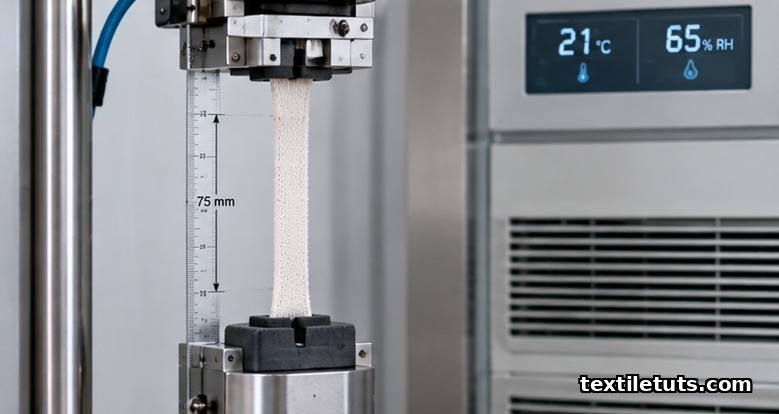
The tensile testing machine must conform to ASTM D76 for CRE-type apparatus, with a load cell accurate to within 1% of the indicated force and a jaw separation that can be set and held to within 0.5 mm. The standard rate of crosshead travel is 300 ± 10 mm/min. Five specimens are tested lengthwise and five widthwise (if applicable), and the test report cites both orientations separately, since stretch and recovery are highly anisotropic in woven elastics.
Jaws are flat-faced rubber-faced grips or pneumatic line-contact grips; serrated metal jaws alone will crush narrow elastic and skew elongation readings upward by as much as 8%, an effect the standard warns about in its precision and bias section. Most accredited third-party laboratories (Intertek, SGS, Bureau Veritas, QIMA) use pneumatic side-action grips with 25 mm × 75 mm rubber faces when they run D4964 for retailer-owned labs.
The Test Cycle: Stretch, Hold, Return, Recover
A single D4964 cycle has four discrete phases. In Phase 1, the specimen is extended from 0% to the target elongation, usually 50%, 75%, or 100% of the elongation at a specified load (EASL). In Phase 2, the crosshead is stopped and held at that extension for 30 ± 1 second. In Phase 3, the crosshead returns at the same rate to 0% extension. In Phase 4, the specimen is held at zero extension for a further 30 ± 1 second so it can elastically recover.
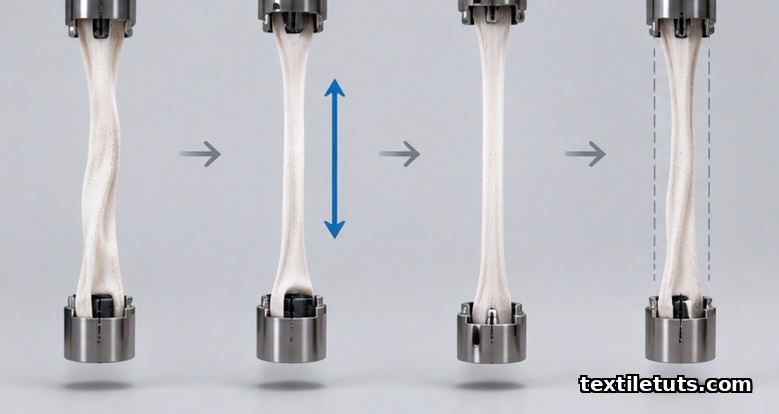
Elastic recovery (ER) is then calculated as:
ER (%) = 100 × (L0 − L1) / (L0 − Lr)
where L0 is the original gauge length (75 mm), L1 is the gauge length after the recovery hold, and Lr is the relaxed gauge length after the cycle. When Lr equals L0 (a perfectly elastic specimen), the formula collapses to 100% recovery; when L1 equals L0 (no recovery at all, the specimen stays permanently stretched to the target), recovery is 0%.
The standard also reports load at specified elongation (LASE), calculated from the force recorded when the specimen crosses the target extension. For a 75% LASE on a 25 mm wide elastic, a typical specification might call for 0.8 to 1.4 N at first cycle and no more than 15% drop in LASE after five repeated cycles, an internal benchmark used by several intimate-apparel mills to detect heat- or ozone-damaged spandex.
Why Elastic Recovery Matters on the Production Floor
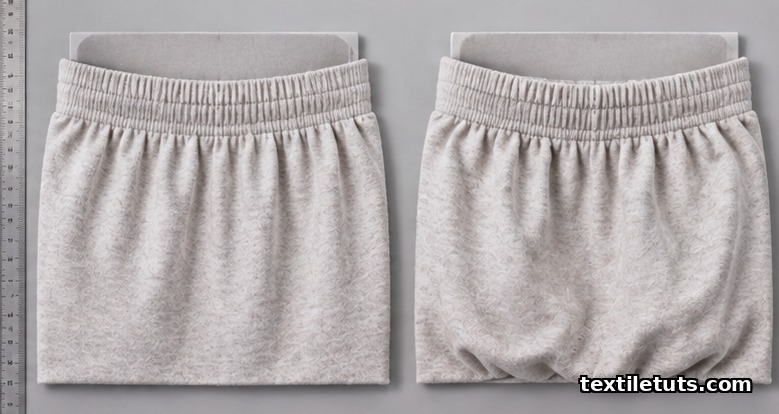
Garment manufacturers care about recovery because the consumer does. A waistband that recovers 95% will look identical after eight hours of wear to one that recovered 99% at the start of the day; a waistband that recovers 80% will visibly sag by the second wear. Brand-side QA teams typically write elastic recovery into their care-label and performance specifications at a minimum of 90% recovery after one cycle and 85% after five repeated cycles, with the five-cycle figure simulating roughly 20 wears.
For medical compression garments, the tolerance is tighter. The ISO standard for medical compression hosiery (ISO 14621, and the related ENV 12719 for compression classes) references elastic recovery measured by methods equivalent to D4964, with class II (23-32 mmHg) and class III (34-46 mmHg) stockings required to recover at least 88% of stretched length after a 24-hour wear simulation in laboratory tests. Compression-class products that fall short of this benchmark fail their notified-body review under EU MDR 2017/745.
For surgical face mask straps, the US ASTM F2100 barrier mask standard and the European EN 14683 surgical mask standard both require elastic recovery of the ear loop, with most manufacturer specifications setting the minimum at 80% recovery after a 30-second hold at 100% extension, run per the D4964 procedure on a single loop. A strap that does not recover pulls the mask off the face and breaks the seal, defeating the filtration layer underneath.
Comparison: D4964 vs Other Stretch and Recovery Methods
D4964 is one of several standards in this space, and brand specifications often call out multiple methods side by side. The table below lists the most common stretch-and-recovery standards, what each one measures, and where it is typically used.
| Standard | Scope | Specimen Geometry | Typical Use |
|---|---|---|---|
| ASTM D4964 | Strip method for narrow elastic fabrics | 25.4 mm × 75 mm, CRE at 300 mm/min | Intimate apparel, activewear, medical elastic |
| ASTM D3822 | Single-end tensile of textile fibers | Single filament or yarn | Yarn-level testing, fiber development |
| ASTM D5035 | Strip method for woven fabric tensile | 25.4 mm wide, CRE | General woven fabric tensile, not for elastic |
| ISO 20932-1 | Strip method for elastic fabrics (similar to D4964) | 25 mm × 75 mm, CRE at 100 mm/min | European intimate apparel supply chain |
| ISO 14704 | Tensile of narrow elastic strips in compression garments | 50 mm wide, specific extension | Medical compression stockings |
| AATCC TM 195 | Stretch and recovery of woven and knit elastic fabrics | 50 mm wide specimen | US athleisure and ready-to-wear brand specs |
The cross-method differences that catch QA teams most often are jaw speed (D4964 uses 300 mm/min, ISO 20932-1 uses 100 mm/min, AATCC TM 195 uses 500 mm/min) and the target extension point. Because elastomeric yarns are viscoelastic, the same elastic tested at 100 mm/min will read a lower load than at 500 mm/min, since slower stretches give the polymer chains more time to relax. When a brand specification lists multiple standards, the laboratory report should always cite which standard was actually run.
Practical Considerations: Specimen Count, Conditioning, and Repeatability
D4964’s precision and bias statement, drawn from a 1996 inter-laboratory study published in ASTM’s Journal of Testing and Evaluation, reports a within-laboratory coefficient of variation of 3.2% for elongation at specified load and 1.8% for recovery percentage. Between laboratories, those figures rise to 5.1% and 2.7% respectively. A 5% spread is small in absolute terms but can be the difference between passing and failing a minimum-90%-recovery specification on a borderline lot.
Five specimens per direction is the floor, not the ceiling. Mills running routine process control often test 10 specimens lengthwise and 5 widthwise, and flag a lot for review if any single specimen falls more than two standard deviations outside the running mean. The ASTM standard explicitly allows but does not require a 10-specimen protocol.
Conditioning is the most common source of silent error. Spandex absorbs atmospheric moisture at a different rate than cotton or polyester, and a specimen pulled out of a 25 °C, 80% RH cutting room and tested within 30 minutes will read measurably different from one conditioned for 4 hours at 21 °C and 65% RH. ASTM D1776 specifies a 4-hour minimum, and laboratories accredited to ISO 17025 will note in their reports whether the conditioning period was met.
Frequently Asked Questions
What is the gauge length used in ASTM D4964?
ASTM D4964 specifies a 75 ± 1 mm gauge length between the jaws of a constant-rate-of-extension tensile machine, with a specimen width of 25.4 ± 1 mm. The standard allows a 50 ± 1 mm gauge length as an alternative for very narrow tapes, provided the laboratory reports the deviation. Conditioning before the test is 4 hours at 21 ± 1 °C and 65 ± 2% relative humidity, per ASTM D1776.
How is elastic recovery calculated from a D4964 test?
Elastic recovery (ER) is calculated as 100 × (L0 − L1) divided by (L0 − Lr), where L0 is the original 75 mm gauge length, L1 is the gauge length after the 30-second recovery hold, and Lr is the relaxed gauge length after the test cycle. A perfectly elastic specimen that returns fully to L0 reports 100% recovery; a specimen that stays at the stretched length reports 0%.
What crosshead speed does D4964 require?
ASTM D4964 prescribes 300 ± 10 mm/min crosshead travel for the elongation phase and the same rate for the return phase. This sits between ISO 20932-1’s 100 mm/min and AATCC TM 195’s 500 mm/min, which is why laboratories running multiple standards on the same elastic routinely report a 4-8% difference in load at specified elongation between D4964 and ISO 20932-1 results on identical specimens.
Does D4964 apply to spandex fibers or only to elastic tapes?
D4964 was written for narrow elastic fabrics (tapes, webs, straps, waistbands) and elastomeric yarns in fabric form. For bare elastomeric yarn testing, laboratories typically use ASTM D3822 (tensile properties of single textile fibers) with elastane-specific grips. D4964 is the right standard when the elastomer is already incorporated into a woven, knitted, or braided fabric structure.
Why does my D4964 recovery number drift lower after five cycles?
Repeated cycling at the same extension fatigues the elastomeric polymer network; this is normal viscoelastic behavior, not a quality defect, up to a point. Most spandex-containing elastic loses 5-8% of its first-cycle recovery after five cycles and 10-15% after 20 cycles. A drop larger than 15% on the fifth cycle is usually a sign of heat damage during finishing (curing temperatures above 195 °C for more than 30 seconds), exposure to chlorine bleach, or improper storage near ozone-generating equipment, all of which degrade the polyether soft segment in spandex.
References
- ASTM International. ASTM D4964-20: Standard Test Method for Tension and Elongation of Elastic Fabrics (Strip Method). ASTM International, West Conshohocken, PA, 2020. https://www.astm.org/d4964-20.html — the primary standard, with specimen, machine, and calculation specifications.
- ASTM International. ASTM D76-21: Standard Specification for Tensile Testing Machines for Textiles. ASTM International, 2021. https://www.astm.org/d0076-21.html — defines the constant-rate-of-extension machine required by D4964.
- ASTM International. ASTM D1776-21: Standard Practice for Conditioning and Testing Textiles. ASTM International, 2021. https://www.astm.org/d1776-21.html — sets the 21 °C / 65% RH conditioning required before D4964 testing.
- International Organization for Standardization. ISO 20932-1:2018: Textiles — Determination of Elasticity of Fabrics — Part 1: Strip Tests. ISO, Geneva, 2018. https://www.iso.org/standard/69896.html — the European equivalent method, referenced when EU supply chains require ISO rather than ASTM.
- AATCC. AATCC Test Method 195-2017: Stretch and Recovery Properties of Woven and Knit Elastic Fabrics. AATCC, Research Triangle Park, NC, 2017. https://www.aatcc.org/testing/methods/ — the AATCC counterpart to D4964, used in many US athleisure brand specifications.
- Kadolph, S. J., Langford, A. L., and Hsia, A. L. Textiles (13th Edition). Pearson, 2017, Chapter 11 (“Stretch and Recovery Properties of Elastomeric Fibers”) — a textile-engineering textbook treatment of the D4964 recovery calculation and the viscoelastic behavior behind the cyclic drop.
This article is the working reference for ASTM D4964 elastic recovery testing on narrow fabrics. Editorial by Iftay Khairul Alam, TextileTuts. Sources: ASTM D4964-20, ASTM D76-21, ASTM D1776-21, ISO 20932-1:2018, AATCC TM 195-2017, and Kadolph Textiles 13th ed. as cited.


