
Woven Garment Construction

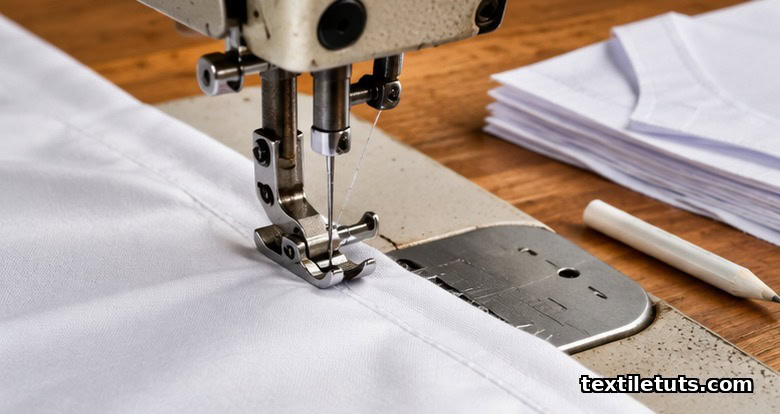
Woven garment construction is the engineered assembly of cut panels from a stable, low-stretch fabric into a finished apparel item, typically using lockstitch 301 seams at 8 to 12 stitches per inch, seam allowances of 10 to 15 mm, and one of six ISO 4915 stitch families chosen for the seam type classified under ISO 4916. The defining difference between a woven and a knit garment is panel behaviour under load: a woven fabric has less than 15% elongation at break in warp and weft (ASTM D5034), so every seam, dart, and ease allowance must be planned around that low stretch rather than the 60 to 100% stretch typical of a knit.
This article walks through the technical building blocks a production engineer uses to convert a flat woven roll into a wearable shirt, trouser, or jacket: pattern geometry, grain alignment, seam classification, stitch selection, seam allowance logic, and quality-control tests that catch failures before the garment leaves the line. Every numeric claim is tied to an ISO, ASTM, or AATCC standard.
1. Why Woven Construction Is Different From Knit Construction
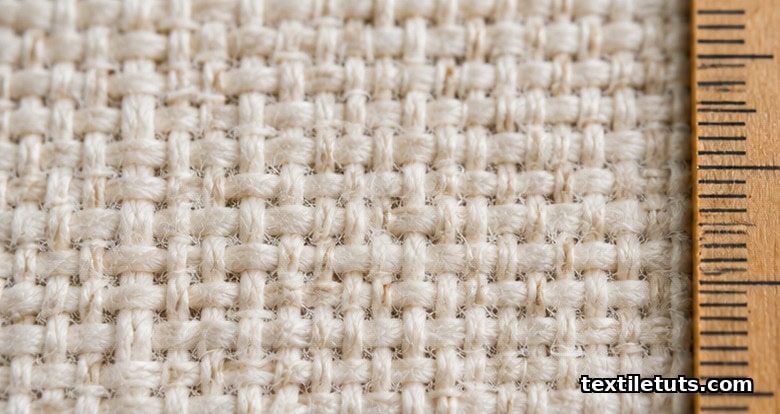
Woven fabric is made on a loom from two orthogonal yarn sets, warp and weft, interlaced at right angles. Because the yarns cross at fixed points, the fabric stretches mainly through yarn crimp interchange, giving a typical elongation at break of 5 to 15% in either direction. Knit fabric stretches 30 to 100% because its loops deform freely under load. The construction sequence must respect that difference at every step: grain alignment is enforced (off-grain cutting produces visible twist in trouser legs and one-directional skew in shirt panels); stretch is engineered in through darts, pleats, and ease, not through fabric give; and seams carry most of the stress, so stitch type, SPI, and seam allowance become structural decisions rather than cosmetic ones. Production planners therefore size woven seam allowances conservatively, commonly 10 mm for shirts and 15 mm for trousers and jackets.
2. Pattern Geometry and Grain
A woven pattern is drafted on a grid of warp and weft, and three grain lines matter. Lengthwise grain, parallel to the warp, is used for vertical panels such as centre front and centre back; warp yarns are usually higher in count and tighter in sett, so lengthwise panels resist vertical stretch and hold shape at hems. Crosswise grain, parallel to the weft, is used for sleeves, yokes, and gussets where a small amount of horizontal give is acceptable. Bias grain, at 45 degrees to warp and weft, elongates 15 to 25% under its own weight, which is why bias-cut garments drape fluidly and conform to curved body surfaces but also grow during wear. ISO 3635 standardises body-measurement definitions for clothing sizes, and ASTM D6554 / D6829 cover pattern-grading conventions.
3. Marker Making, Spreading, and Cutting
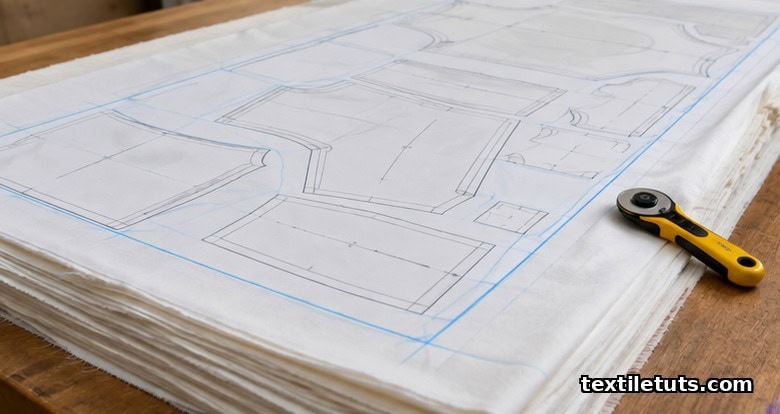
Once the pattern is finalised, the pieces are nested on a marker, a full-width template that arranges all panels in the most fabric-efficient layout. Marker efficiency (the ratio of pattern area to total fabric used) typically runs 80 to 88% for woven shirts and 82 to 90% for trousers; the rest is wasted as cuttings between panels. Spreading lays the fabric in uniform layers, usually 50 to 80 plies for shirts (table height around 1.4 m) and 30 to 50 plies for heavier suiting. Cutting tools depend on fabric weight: straight knives or rotary cutters for 60 to 120 GSM shirt cottons, band knives or die cutting for 300 to 600 GSM denim and canvas.
4. Stitch Types (ISO 4915) and Their Uses
ISO 4915 classifies sewing stitches into six families, numbered 100 through 600. Three families dominate woven garment construction:
| ISO 4915 class | Stitch type | Construction behaviour | Typical use in woven apparel |
|---|---|---|---|
| 100 | Chain stitch (single thread) | One thread forms a chain on the underside; one broken stitch can unravel the seam. | Temporary basting, buttonhole stitching, embroidery. |
| 300 | Lockstitch (two thread) | Two threads interlock inside the plies; failure of one stitch does not propagate. | Main structural seams on shirts, trousers, jackets. |
| 400 | Multi-thread chain stitch | Two or more threads form a chain with a looper; balanced or cover variations. | Side seams on trousers; hem coverstitch; serged seam finishes. |
| 500 | Overedge / overlock stitch | Looper threads wrap the fabric edge to prevent fraying. | Edge neatening on almost every woven garment. |
| 600 | Cover stitch | Two or three needles feed top threads, with a looper thread spanning them. | Hem covering on knit and stretch woven trousers; decorative flatlock. |
For structural seams, lockstitch 301 with an SPI of 8 to 12 is the workhorse: 8 SPI for lightweight poplin, 10 to 12 SPI for medium-weight twill, and 12 SPI for heavier denim.
5. Seam Types (ISO 4916)
ISO 4916 defines seam geometry by a six-digit code. The first digit is the seam location, the next two describe the seam configuration, the next two describe the stitching, and the final digit is a qualifier. The most common classes for woven apparel are:
- Class 1 (superimposed seam): one piece lies on top of another, joined with one or more rows of stitches. Default for side seams, sleeve inseams, and yoke attachments. Includes the plain lockstitch seam (1.01.01) and the topstitched variation (1.05.01).
- Class 2 (lapped seam): two pieces overlap with stitching through both layers. Used for jeans outseams and pocket mouth joins where flatness and reduced bulk matter.
- Class 3 (bound seam): a binding tape covers the raw edge. Standard for unlined jacket fronts and waistband facings.
- Class 4 (flat seam): pieces lie edge-to-edge and are joined by stitches that span both edges. Used where bulk must be minimised.
- Class 5 (decorative / ornamental seam): added for appearance rather than structure; topstitching, saddle stitching, felled seams.
- Class 6 (edge neatening): single-needle operations that finish an edge without joining panels; hemming, serging, blind-hemming.
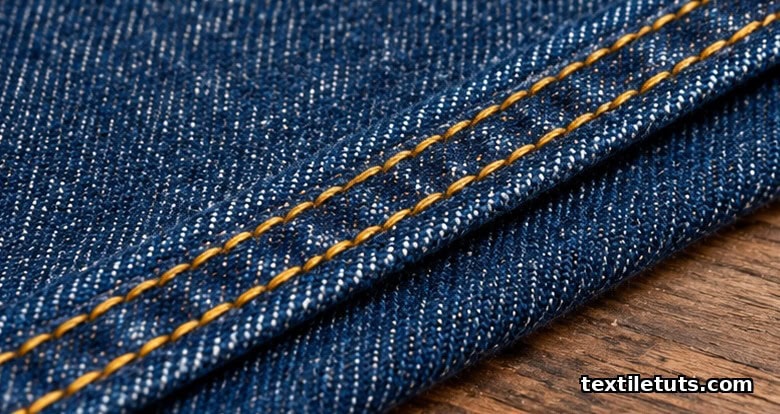
The classic flat-felled seam on denim jeans combines class 5 and class 6: topstitched twice with the raw edge enclosed inside the fold. ISO 4916 code 5.03.01 / 6.03.01 covers this construction, which survives 50 to 80 industrial wash cycles before the first visible fray.
6. Seam Allowance, SPI, and Thread Tension
Seam allowance is the fabric between the seam line and the cut edge. Common allowances for woven garments are 10 mm (3/8 in) for shirt side seams, 15 mm (5/8 in) for trouser and jacket seams where alterations may be needed, and 20 to 25 mm for structured jacket centres and princess seams where multiple fittings are expected.
Stitches per inch (SPI) control seam strength, elasticity, and appearance. Higher SPI increases seam strength up to a fabric-specific optimum and reduces seam slippage, but it also consumes more thread and can perforate lightweight cloth. ASTM D1683 sets a minimum seam efficiency of 80% of the fabric tensile strength for general apparel and 90% for safety garments. Achieving those targets means tuning SPI to fabric weight: 8 SPI on a 90 GSM cotton poplin, 10 SPI on a 180 GSM twill, and 12 SPI on a 360 GSM denim. Thread tension is balanced per machine, fabric, and thread combination; an unbalanced lockstitch pulls the bobbin thread to the surface or loops on the underside, lowering seam efficiency and showing up immediately in AATCC 88B smoothness ratings.
7. Interlinings, Linings, Trims, and Pressing
Fusible interlinings are bonded to collar, cuff, and front-band panels at 140 to 165 °C for 10 to 15 seconds at 0.5 to 1.5 bar. Bond strength is tested by ASTM D2724, with a minimum peel strength of 0.6 N/cm common for shirt collars. Lining fabrics (woven viscose, cupro, or polyester) are cut on the bias or cross-grain to allow the jacket to slip easily over a shirt. Trims must match the garment: 12 to 14 Ligne buttons for shirts, #3 or #5 coil zippers for trousers, #5 or #8 metal zips for jeans. ISO 6330 covers industrial laundering procedures used to qualify trims before bulk production. Pressing sets the shape: wool and wool blends at 140 to 160 °C with a damp cloth and light pressure; cotton at 180 to 200 °C; synthetic woven polyester at 140 to 160 °C to prevent shine.
8. Quality Control Tests and Common Defects
Three tests gate every production lot of woven garments: ASTM D1683 (failure in sewn seams), ASTM D434 (yarn slippage, where slippage of more than 6 mm at 180 N typically fails for shirting), and AATCC 88B (seam smoothness after five home-laundering cycles, with grades 4 to 5 acceptable for dress shirts). Other common tests include ISO 13936 for seam slippage and AATCC 135 for dimensional change.
Three failure modes show up disproportionately. Seam slippage: yarns pull out at low loads, fixed by raising SPI by 1 to 2 units or switching to a higher-density weave. Seam puckering: wavy or pulled stitching along the seam, fixed by rebalancing tensions and pre-shrinking the panels. Needle cutting or yarn severance: holes along the stitch line because the needle is too large, fixed by switching to a ballpoint or stretch needle of the next smaller size, typically from 14 to 12 or 12 to 10.
Frequently Asked Questions
What is the most common stitch used in woven garment construction?
Lockstitch 301, the two-thread stitch of ISO 4915 class 300, is the default for the structural seams of woven shirts, trousers, blouses, and jackets. It resists runline failure, looks balanced on both sides, and is produced on the single-needle lockstitch.
How many stitches per inch should a woven seam have?
Eight to 12 SPI is the working range. Use 8 SPI on lightweight shirt cloth around 80 to 120 GSM, 10 SPI on medium-weight twill around 150 to 220 GSM, and 12 SPI on denim and heavier woven fabrics from 280 GSM upward.
What seam allowance is standard for a woven shirt or trouser?
Shirt side seams are cut with a 10 mm (3/8 in) allowance and trouser and jacket seams with a 15 mm (5/8 in) allowance. Larger allowances of 20 to 25 mm are reserved for tailored jackets where the garment may be altered during fittings.
Why does a woven garment feel stiffer than a knit one?
Woven fabric elongates only 5 to 15% before breaking because warp and weft yarns cross at fixed points, while knit fabric elongates 30 to 100% because its loops deform freely. The lower elongation means a woven garment cannot stretch over body curves; shape must be engineered with darts, pleats, and panel cut.
How is seam strength measured and what value is acceptable?
Seam strength is measured by ASTM D1683, which pulls a sewn seam in a tensile tester until rupture. General woven apparel should reach a seam efficiency of 80%, defined as seam strength divided by fabric tensile strength (ASTM D5034), while safety garments such as workwear should reach 90%. A seam that fails below those numbers usually has low SPI, mismatched tension, or an incorrect needle size.
References
- International Organization for Standardization. ISO 4915:1991 Textiles: Stitch types – Classification and terminology. iso.org.
- International Organization for Standardization. ISO 4916:2010 Textiles: Seam types – Classification and terminology. iso.org.
- ASTM International. ASTM D1683 / D1683M-22 Standard Test Method for Failure in Sewn Seams of Woven Apparel Fabrics. astm.org.
- ASTM International. ASTM D434-95 Standard Test Method for Resistance of Slippage of Yarns in Woven Fabrics Using a Standard Seam. astm.org.
- ASTM International. ASTM D5034-21 Standard Test Method for Breaking Strength and Elongation of Textile Fabrics (Grab Method). astm.org.
- AATCC. AATCC Test Method 88B-2018 Smoothness of Seams in Fabrics after Repeated Home Laundering. aatcc.org.
- International Organization for Standardization. ISO 139:2005 Textiles: Standard atmospheres for conditioning and testing. iso.org.
- International Organization for Standardization. ISO 3635:1981 Size designation of clothes: Definitions and body measurement procedure. iso.org.
- International Organization for Standardization. ISO 6330:2021 Domestic washing and drying procedures for textile testing. iso.org.
- International Organization for Standardization. ISO 13936-1 Textiles: Determination of the slippage resistance of yarns at a seam in woven fabrics. iso.org.
This article is the working reference for woven garment construction. Editorial by Kazi Sifat Muntasir, TextileTuts. Sources: ISO 4915, ISO 4916, ASTM D1683, ASTM D434, ASTM D5034, AATCC 88B, ISO 139, ISO 3635, ISO 6330, ISO 13936-1.


