
Activewear Construction

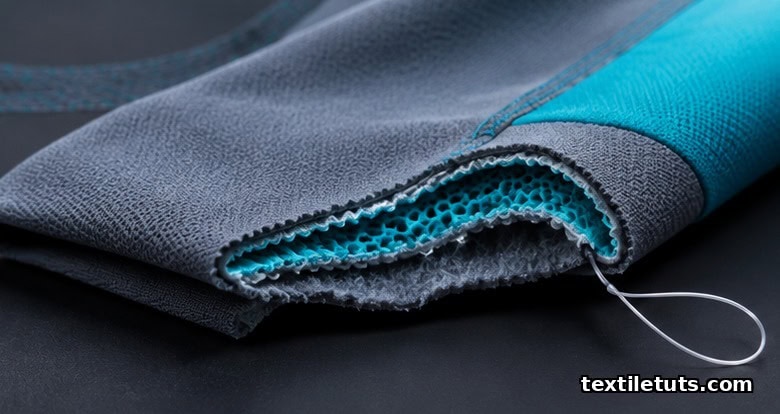
Activewear construction specifies knit fabric at 80–90% synthetic fiber (polyester or nylon) with 10–20% elastane, built on circular or warp-knit machines and assembled with four-thread overlock or flatlock seams at 8–12 stitches per inch, to deliver one-way moisture transport indices above 0.4 per AATCC TM 195 and stretch recovery above 90% after 500 stretch cycles.
Unlike woven casualwear, every layer in an activewear garment, from the base layer against the skin to the outer shell, must move with the body at skin-surface temperatures of 32–34 °C while shedding sweat at rates that can exceed 200 g/m²·h during high-output exercise.
This article walks through the fiber, knit, seam, finish, and standards choices that turn a roll of fabric into a garment engineered for sustained physical output. The topic sits inside the Garment Construction cluster at TextileTuts and builds on the same logic used in our seam-strength and textile-testing guides.
What “Activewear Construction” Covers
Activewear construction is the engineering of a garment for repeated, high-intensity body movement, sweat exposure, and skin-contact friction. It spans four interacting decisions: which fibers go into the yarn, which knit structure holds the fibers, which seam joins the panels, and which surface treatment controls moisture. The garment category is usually divided into three tiers by intensity:
- Light support: walking, yoga, and gym sessions of 30–60 minutes, paired with light to medium compression (10–15 mmHg).
- Medium support: running, cycling, and court sports, paired with engineered knit panels, targeted ventilation, and 15–20 mmHg compression.
- High support / impact: high-intensity training and distance running, paired with compressive knits at 20–30 mmHg and engineered body mapping.
Each tier tightens the tolerance on fiber selection and seam integrity. A garment that fails at seam slippage or recovers poorly after stretching will visibly sag within 10–20 wash cycles, well before its fabric is structurally worn out.
Fiber Selection: Why Synthetic Filaments Dominate
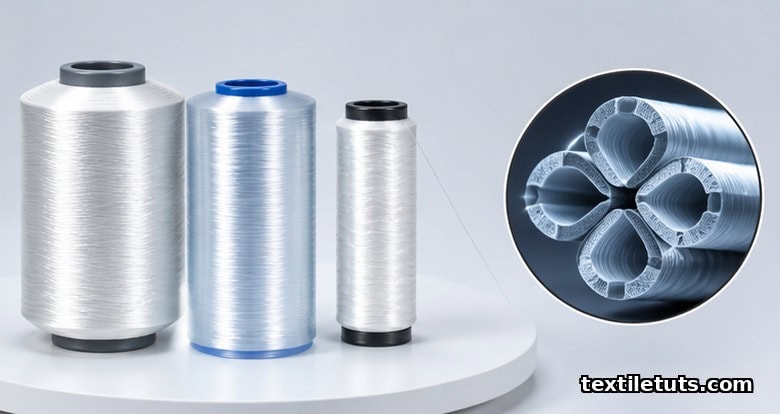
Natural fibers like cotton absorb sweat, swell, and lose up to 50% of their tensile strength when wet, which is why cotton is avoided for performance wear. Synthetic filament fibers dominate because they are hydrophobic, dimensionally stable when wet, and extrudable in fine deniers (typically 30D–150D for activewear) that give soft hand and rapid capillary wicking.
| Fiber | Typical Activewear Role | Key Property |
|---|---|---|
| Polyester (PET) | Base layers, jerseys, mesh linings | Hydrophobic; wicks via capillary geometry; melts at 255–260 °C |
| Nylon (PA 6, PA 6.6) | Compression knits, abrasion zones | Higher tensile strength than PET; softer hand; absorbs 3.5–4.5% moisture |
| Elastane (Spandex / Lycra) | Stretch and recovery | Stretches 500–700%; recovers above 90% when finishing stays below 120 °C |
| Polypropylene (PP) | Base layers, thermal underwear | Lightest textile fiber (0.91 g/cm³); near-zero moisture regain |
Elastane content is the most performance-critical number. Below 8% the fabric feels loose and bags at the knees or elbows; above 25% it loses wicking surface area and traps heat. Most commercial activewear sits between 12% and 20% elastane, the range that passes AATCC TM 150 wash-cycle protocols without permanent deformation.
Knit Construction: The Geometry Behind the Stretch
Activewear is almost exclusively knitted, never woven, because knit loops can deform 30–60% under tension and recover. The choice of knit geometry decides whether a fabric stretches in one direction (weft) or two (warp / four-way), and whether it breathes through holes or through yarn geometry.
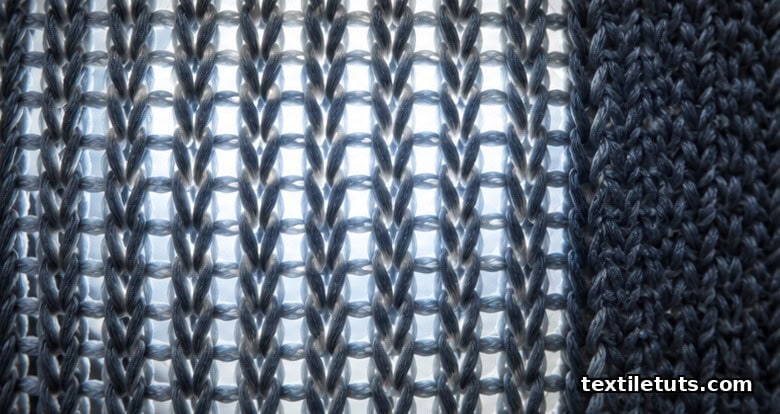
- Single jersey (weft knit): lightest and cheapest; stretches mainly in width; used in T-shirts and base layers at 140–180 g/m² (GSM).
- Interlock (double jersey): two jersey layers knitted together; balanced stretch; opaque; common at 180–240 GSM for mid-support garments.
- Tricot and raschel (warp knit): stable in the length direction; high lengthwise strength; used in linings, mesh inserts, and compression panels.
- Engineered circular knit (Jacquard / spacer): allows zone knitting where ventilation mesh, compression, and opaque zones are knitted in one piece, eliminating sewn side seams and chafing.
Knit GSM (grams per square meter) drives perceived weight and opacity. Light base layers sit between 110 and 150 GSM, mid-weight knits between 160 and 220 GSM, and compression knits between 240 and 320 GSM. Compression fabrics need higher GSM because the elastane must represent a larger share of fabric mass to deliver the 15–30 mmHg pressure on the body.
Seam Engineering: Stitches That Move With the Body
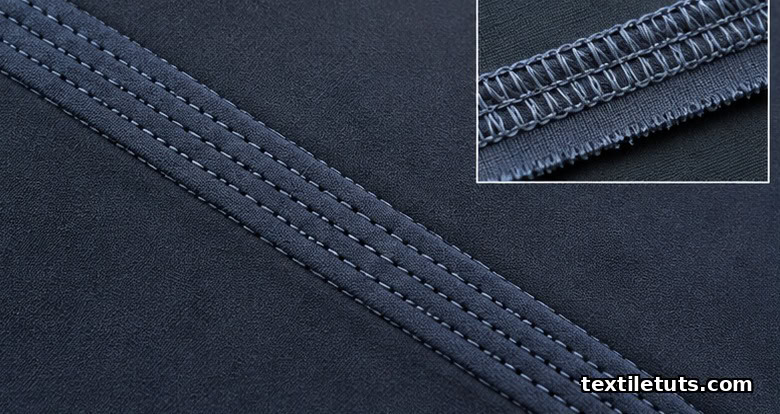
The seam is the failure point in most activewear, not the fabric. A flatlock seam in activewear is not the decorative flatlock seen on denim; it is a four-needle six-thread or three-needle five-thread construction that joins panels edge-to-edge without a raised ridge, so the seam sits flat against the skin and reduces friction blisters on multi-hour runs.
| Seam / Stitch Type | Where Used | Why |
|---|---|---|
| Four-thread overlock | Side seams, panel joins | Encloses raw edges, allows stretch, fast |
| Flatlock (3-needle 5-thread or 4-needle 6-thread) | Skin-contact seams (yoga, base layers) | Flat against skin; no ridge; minimal chafing |
| Coverstitch (2-needle) | Hems on knit garments | Stretchy hem without bulk |
| Bartack (301 lockstitch, dense) | Stress points: pocket corners, elastic joins | Localized reinforcement, 8–12 stitches per inch over a 10–15 mm bar |
| Zigzag (304 lockstitch) | Attaching elastic, finishing openings | Allows stretch without breaking thread |
Stitch density matters: 8–12 SPI (stitches per inch) is the activewear range. Below 6 SPI the seam opens under lateral stress; above 14 SPI the perforation density weakens lightweight knits and creates unnecessary bulk. Needle choice is equally critical. Ballpoint (or “stretch”) needles push between knit loops rather than piercing them, preventing laddering during sewing.
Stretch, Recovery, and Compression Mechanics
Stretch alone is not the goal; recovery is. A fabric that stretches 80% but recovers only 70% will sag visibly after one hour of wear. AATCC TM 150 and ISO 14704-style protocols test recovery by stretching a fabric to a target elongation, holding it, releasing, and measuring the residual deformation after a defined relaxation period.
Compression garments add a quantitative pressure target. Medical-grade compression (used in some recovery tights) is rated at 18–21 mmHg at the ankle with graduated decrease up the leg; sports compression garments typically deliver 15–25 mmHg uniform pressure for proprioceptive support rather than medical therapy.
Three engineering levers drive compression without sacrificing comfort:
- Higher elastane ratio (18–25%) increases the restoring force.
- Higher GSM (240–320) increases the surface area pressing on the body.
- Tighter knit stitch length (2.6–2.9 mm per needle loop on a 28-gauge circular machine) increases modules without adding weight.
Moisture Management Finishes and Coatings
Synthetic fibers are hydrophobic, so the wicking seen on a polyester shirt is not absorption; it is capillary transport through the spaces between filaments. Two finishing routes exist:
- Mechanical / structural: shaping fiber cross-sections (for example four-channel or grooved polyester) to create capillary channels that pull sweat outward; durable for the life of the garment.
- Chemical: hydrophilic surface finishes or plasma treatments that spread sweat laterally on the fabric face; faster initial wicking but the effect decays over 30–50 wash cycles.
AATCC TM 195 (Moisture Management Properties of Textile Fabrics) is the standard test, measuring wetting time, absorption rate, spreading speed, and the one-way transport index on the fabric’s inner and outer faces. A “good” activewear fabric scores above 0.4 on the one-way transport index (it pushes moisture from the skin side to the outer side) and below 3 seconds wetting time on the inner face.
Antimicrobial finishes (silver-ion, zinc pyrithione, or quaternary ammonium treatments) are common on base layers to control odor, but they are surface treatments and degrade with washing. ASTM E2149 and ISO 20743 are the two standard test methods used to quantify antimicrobial activity on treated textiles.
Care, Durability, and the Standards That Verify Them
Activewear fails in predictable ways: pilling at inner-thigh and underarm zones, seam slippage at side seams, elastic degradation at waistbands, and color loss on fluorescent panels. Each failure mode is testable.
| Failure Mode | Standard Test | Acceptance Threshold (typical) |
|---|---|---|
| Pilling | ISO 12945-2 (Martindale, 7,000 rubs) | Grade 3–4 (low pilling) |
| Seam slippage | ISO 13936-2 (fixed-load method) | ≤ 6 mm at 40 N load |
| Bursting strength (knits) | ISO 13938-1 (hydraulic) | ≥ 400 kPa for compression knits |
| Stretch and recovery | AATCC TM 150 | ≥ 90% recovery after 500 cycles |
| Colorfastness to laundering | AATCC TM 135 | Grade 4 (slight color change) after 20 cycles |
| Dimensional change after wash | AATCC TM 135 / ISO 6330 | ± 3% length, ± 5% width for knits |
Care labels on activewear should reflect the fiber blend. Polyester/nylon/elastane knits tolerate 30–40 °C machine wash with mild detergent and low-heat tumble dry, but should avoid chlorine bleach (degrades elastane), fabric softener (coats capillary channels and kills wicking), and ironing above 110 °C (melts PET fibers). These limits are not arbitrary; they come from the same ISO 6330 and AATCC TM 135 protocols used to qualify the fabric in the first place.
Frequently Asked Questions
What fabric weight (GSM) is best for running shirts?
Lightweight running shirts sit between 110 and 150 GSM in single-jersey polyester or polyester/elastane knits; this weight balances opacity (the fabric should not be see-through when wet) with rapid drying. Below 100 GSM the fabric becomes translucent when saturated with sweat, and above 180 GSM it holds sweat against the skin and dries slowly.
How is compression different from regular stretch in activewear?
Stretch describes a fabric’s ability to elongate, typically 50–100% in activewear knits. Compression describes the pressure the fabric exerts when worn, measured in mmHg. A normal stretch knit at 180 GSM delivers negligible pressure; a 280 GSM knit with 20% elastane at tight stitch length can deliver 15–25 mmHg, the range used for sports compression tights.
Why do my activewear seams pucker after a few washes?
Seam puckering in activewear almost always traces back to three causes: thread tension set too high for the knit (the seam pulls the fabric into ripples), needle size too large for the fabric weight (perforations distort the loops), or elastane degradation from heat or chlorine exposure (the fabric shrinks unevenly against the thread). Switching to a ballpoint needle, dropping top-thread tension by 10–15%, and washing at 30 °C without chlorine bleach corrects most cases.
Is flatlock really better than overlock for skin contact?
Yes, for garments worn directly against the skin during sustained movement. A four-thread overlock encloses the seam allowance and leaves a small ridge on the inside of the garment, which causes friction on multi-hour runs. A flatlock seam butts the panels edge-to-edge and lays the threads flat against the skin, eliminating the ridge. The trade-off is that flatlock machines run slower than overlock and require more operator skill.
How long should activewear last under regular use?
A well-constructed polyester/elastane activewear garment should withstand 80–100 wash cycles before measurable pilling, seam slippage, or elastic degradation exceeds the ISO 12945-2 and ISO 13936-2 acceptance thresholds used in the factory. In practice, most users replace activewear every 12–24 months due to odor retention and cosmetic pilling rather than mechanical failure.
References
- American Association of Textile Chemists and Colorists. AATCC TM 195-2019, Moisture Management Properties of Textile Fabrics. Research Triangle Park, NC: AATCC. Specifies the one-way transport index test for activewear moisture performance.
- American Association of Textile Chemists and Colorists. AATCC TM 150-2018, Dimensional Changes of Fabrics After Home Laundering. Research Triangle Park, NC: AATCC. Covers wash-cycle dimensional stability and stretch recovery.
- American Association of Textile Chemists and Colorists. AATCC TM 135-2018, Dimensional Changes of Fabrics After Home Laundering (machine method). Research Triangle Park, NC: AATCC. The bench test for colorfastness and shrinkage on home-launder cycles.
- ASTM International. ASTM E2149-20, Standard Test Method for Determining the Antimicrobial Activity of Immobilized Antimicrobial Agents Under Dynamic Contact Conditions. West Conshohocken, PA: ASTM International. Used to rate odor-control finishes on base layers.
- International Organization for Standardization. ISO 6330:2021, Domestic washing and drying procedures for textile testing. Geneva: ISO. Defines the wash cycles used to qualify activewear care labels.
- International Organization for Standardization. ISO 12945-2:2020, Textiles — Determination of fabric propensity to surface fuzzing and to pilling — Part 2: Modified Martindale method. Geneva: ISO. The standard pilling test for knit activewear.
- International Organization for Standardization. ISO 13938-1:2019, Textiles — Bursting properties of fabrics — Part 1: Hydraulic method for determination of bursting strength and bursting distension. Geneva: ISO. Replaces grab tensile for compression knits.
- International Organization for Standardization. ISO 13936-2:2004, Textiles — Determination of the slippage resistance of yarns at a seam in woven fabrics — Part 2: Fixed load method. Geneva: ISO. Used to qualify activewear seams under lateral load.
Editorial by Kazi Sifat Muntasir, TextileTuts. Sources: AATCC TM 195, AATCC TM 150, AATCC TM 135, ASTM E2149, ISO 6330, ISO 12945-2, ISO 13938-1, and ISO 13936-2 as cited.


