
Wound Dressings: Hydrogel

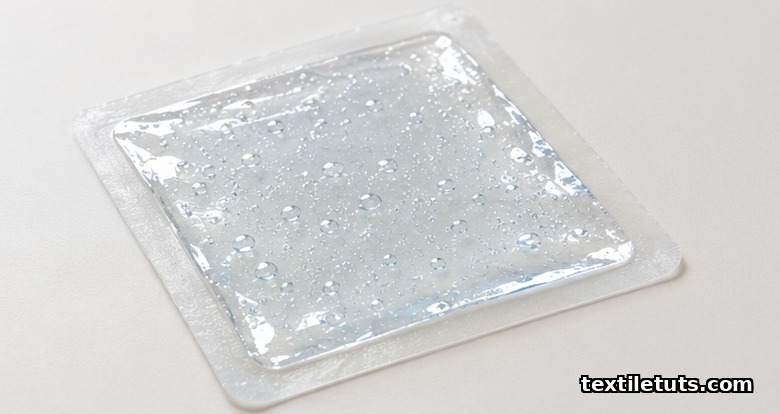
Hydrogel wound dressings are polymer-based medical textiles composed of 70-90% water held inside cross-linked polymer networks (most commonly polyacrylamide, polyethylene oxide, or polyvinylpyrrolidone) that maintain a moist wound interface at a surface pH of 4.0-6.5, lower wound-bed temperature by 2-5 °C during the first 4-6 hours after application, and donate moisture to support autolytic debridement of devitalized tissue.
For a textile engineer, hydrogel dressings sit at the intersection of polymer chemistry, nonwoven substrate engineering, and biomedical application: the cross-linked matrix must hold 70-90% water without dissolving, the backing or carrier layer must manage moisture vapor transmission, and the finished product must pass ISO 10993 biocompatibility testing for skin-contact medical devices.
This article covers the polymer science behind hydrogel wound dressings, the engineering parameters that govern their performance in the wound bed, the indications and contraindications that frame their clinical use, the application procedure and wear time, and how hydrogels compare against hydrocolloid, alginate, and foam dressings on the four parameters textile engineers usually care about (water content, exudate handling, autolytic debridement capacity, and pain or cooling effect).
What Is a Hydrogel Wound Dressing?
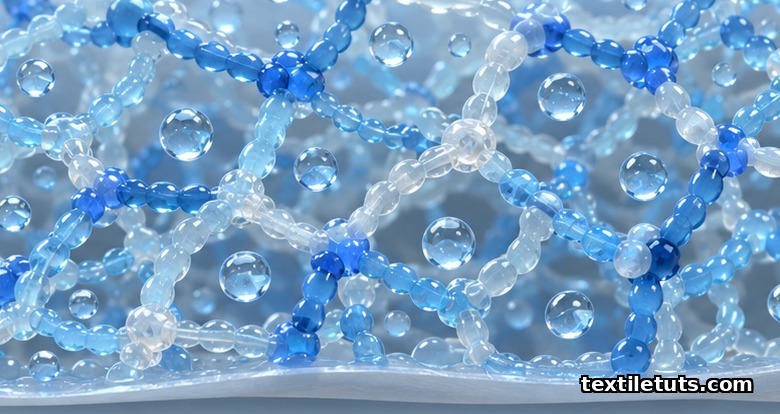
A hydrogel wound dressing is a medical textile composed of a three-dimensional network of hydrophilic polymer chains that absorb and retain a large fraction of water (typically 70-90% by weight) without dissolving, because chemical or physical cross-links between the chains hold the network together. The polymer matrixes most commonly used are polyacrylamide (PAM), polyethylene oxide (PEO), polyvinylpyrrolidone (PVP), and copolymers of these, sometimes blended with natural polymers such as carboxymethyl cellulose or sodium alginate to tune the moisture-release profile.
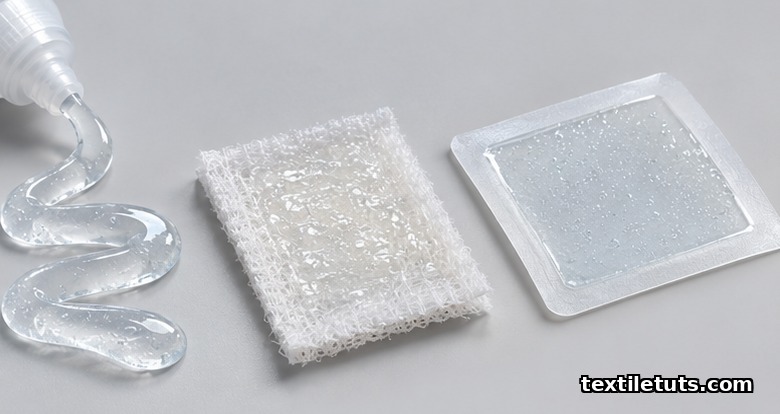
Hydrogel wound dressings are supplied in three product geometries. Amorphous gels are packaged in tubes, sachets, or spray bottles and used to fill cavity wounds. Impregnated gauzes are woven or nonwoven scrims pre-soaked with the gel, used as primary contact layers on shallow wounds. Sheet dressings are continuous gel films bonded to a thin carrier, usually a 25-50 µm polyurethane film or a polyester / polypropylene nonwoven web. All three geometries share the same physicochemical principle: a high water content held inside a polymer scaffold that releases water vapor slowly into the wound bed while remaining structurally stable at body temperature.
Polymer Chemistry and Composition
Cross-link density is the single most important textile-engineering parameter in a hydrogel dressing. Too few cross-links and the polymer dissolves into wound exudate, leaving residue in the wound bed; too many and the gel turns brittle, loses conformability, and fails to follow wound contours. ASTM F2311, the Standard Specification for Polymeric and Copolymeric Hydrogel for Use in Wound Management, sets the reference composition and mechanical-performance envelope for this material class.
The polymer matrix is paired with a backing or carrier that controls the moisture vapor transmission rate (MVTR) of the finished dressing. A typical sheet hydrogel uses a 25-50 µm polyurethane film with an MVTR of 800-1500 g/m²/24 h measured per ASTM E96 (gravimetric water-vapor cup method), enough to let excess water vapor escape while keeping the wound bed at near-saturation humidity. When the carrier is a polyester or polypropylene nonwoven, the MVTR is governed by the nonwoven’s basis weight, fiber diameter, and calender-bonding pattern. Typical nonwoven carriers run 30-80 g/m² in basis weight and deliver MVTR values in the 1000-2500 g/m²/24 h range.
Mechanical properties of the gel itself are tuned by adjusting three knobs: the cross-linker ratio (usually 0.1-2.0 mol% relative to monomer), the polymer concentration in the pre-gel solution (typically 10-30% w/w), and the plasticizer content (glycerol and sorbitol are common at 5-20% w/w). The resulting gel typically has an elastic modulus in the 5-50 kPa range, an equilibrium swelling ratio of 100-400%, and a water-vapor permeability that is roughly 3-5 times lower than the backing film alone.
Mechanism of Action: Moisture Donation, Cooling, and Autolysis
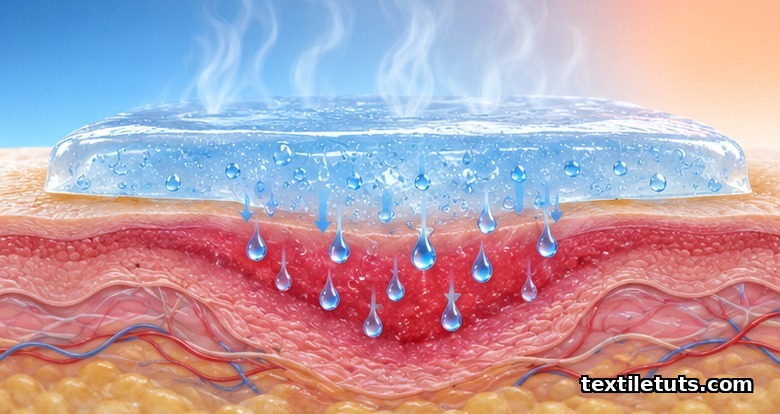
Hydrogel dressings act through three coupled mechanisms. First, they donate moisture to a dry or lightly exudating wound bed, raising the local relative humidity at the wound surface toward 100% and keeping dermal cells hydrated, which supports granulation tissue formation. Second, evaporation of water from the gel surface draws heat from the wound bed, lowering local temperature by 2-5 °C in the first 4-6 hours; this is the mechanism behind the rapid pain relief documented in partial-thickness burns and abrasion injuries. Third, the moist environment rehydrates hardened eschar and slough, allowing endogenous proteolytic enzymes (collagenase, elastase, and matrix metalloproteinases) to break down devitalized tissue. This autolytic debridement is selective to non-viable tissue and does not damage healing granulation tissue, which is why hydrogel is a first-line choice for debriding dry or sloughy wounds.
The 1962 paper by George Winter, “Formation of the scab and the rate of epithelization of superficial wounds in the skin of the young domestic pig,” published in Nature, established that re-epithelialization in occluded, moist wounds proceeds roughly twice as fast as in air-exposed wounds. Hydrogel dressings operationalize that finding: they create and sustain the moist interface Winter identified as the active variable. Since then, multiple systematic reviews, including Junker and colleagues in Wounds (2013), have corroborated the clinical benefit of moist-wound-healing modalities across partial-thickness burns, donor sites, and pressure ulcers.
Indications: Where Hydrogel Performs Best
Clinical guidelines recommend hydrogel for partial-thickness burns (first- and second-degree), donor sites after split-thickness skin grafting, pressure ulcers stage I-II, radiation dermatitis, dry or lightly exudating chronic wounds, and necrotic or sloughy wounds that need autolytic debridement. The cooling effect also makes hydrogel a common choice for abrasion injuries and superficial burns, where immediate pain relief is a clinical priority. NICE NG19 (Diabetic foot problems: prevention and management) places hydrogel as an option for dry or lightly exuding diabetic foot ulcers once infection has been excluded.
Hydrogel is contraindicated in three settings. Heavily exudating wounds overwhelm the polymer matrix and macerate the peri-wound skin, so alginate or foam dressings are preferred. Infected wounds are a relative contraindication; the FDA guidance on wound dressings and the Wounds UK best-practice statements flag that sealed moisture can support bacterial proliferation, so clinicians typically switch to an antimicrobial dressing (silver, honey, or PHMB-impregnated) until infection is controlled. Third-degree (full-thickness) burns require surgical debridement and skin grafting, not autolytic debridement, so hydrogel plays no role there. Known polymer sensitivity is a final, rare precaution listed in manufacturer IFUs and in ASTM F2311.
Application Procedure and Wear Time
Sheet hydrogels are cut to overlap the wound margin by 1-2 cm, applied to a clean debrided wound bed, and secured with a secondary dressing (gauze wrap, foam, or transparent film). Amorphous gels are squeezed into cavity wounds and covered with a secondary dressing. The standard wear time is 1-3 days for cavity or amorphous gels, and up to 5-7 days for sheet forms under a transparent film on lightly exudating wounds, with the upper bound set by the polymer’s hydration limit and by exudate load. Each dressing change includes wound assessment, gentle irrigation with normal saline, and re-application of the hydrogel on the clean wound bed.
Hydrogel vs. Hydrocolloid vs. Alginate vs. Foam
| Property | Hydrogel | Hydrocolloid | Alginate | Polyurethane foam |
|---|---|---|---|---|
| Water content of dressing | 70-90% | <60% (gel-forming on contact) | Variable (calcium-sodium) | <5% (dries if not sealed) |
| Best exudate level | None to low | Low to moderate | Moderate to heavy | Moderate to heavy |
| Autolytic debridement | Strong | Moderate | Limited | Limited |
| Pain / cooling effect | Yes (2-5 °C drop, 4-6 h) | No | No | No |
| Typical wear time | 1-7 days | 3-7 days | 1-3 days | 3-7 days |
Frequently Asked Questions
How often should a hydrogel dressing be changed?
Most hydrogel sheet dressings are changed every 1-3 days, with some products rated for wear times up to 7 days when used under a transparent secondary film on lightly exudating wounds (per manufacturer IFUs and the ASTM F2311 specification). The dressing should be replaced sooner if the gel dries out, leakage is visible at the margins, or the clinical assessment indicates a re-evaluation.
Can hydrogel dressings be used on infected wounds?
Hydrogel is generally avoided on clinically infected wounds because the sealed moist environment can support bacterial proliferation, which is consistent with FDA wound-dressing guidance and with the Wounds UK best-practice statements. When infection is suspected, a clinician typically switches to an antimicrobial dressing (silver, honey, or PHMB-impregnated) and re-evaluates the hydrogel choice after the infection is controlled.
Do hydrogel dressings actually cool a burn?
Yes. Evaporative water loss from the gel surface draws heat from the wound bed, lowering local temperature by 2-5 °C in the first 4-6 hours after application. This cooling is the primary mechanism behind the rapid pain relief reported in partial-thickness burns and abrasion injuries, and has been quantified using infrared thermography of the wound bed in several clinical studies.
What is the difference between hydrogel and hydrocolloid dressings?
Hydrogel dressings donate moisture (70-90% water held inside a cross-linked polymer network), while hydrocolloid dressings absorb exudate and form a gel in situ (they are composed of an elastomer adhesive plus gel-forming particles such as carboxymethyl cellulose). Hydrogel is preferred on dry wounds and where cooling is a clinical priority; hydrocolloid is preferred on low-to-moderately exudating wounds where a longer wear time and an occlusive seal are desired.
Are hydrogel wound dressings biodegradable?
Standard clinical hydrogels based on synthetic polymers such as polyacrylamide, polyethylene oxide, or polyvinylpyrrolidone are not biodegradable and must be removed at each dressing change. Bioactive hydrogel formulations built from gelatin, chitosan, alginate, or PEG-peptide copolymers are an active research area and can show partial or full enzymatic degradation, but they remain an experimental class for routine clinical use and are not the products covered by ASTM F2311.
References
- ASTM International. ASTM F2311-20: Standard Specification for Polymeric and Copolymeric Hydrogel for Use in Wound Management. ASTM International, West Conshohocken, PA. Reference specification for hydrogel composition, mechanical performance, and biocompatibility.
- Winter GD. Formation of the scab and the rate of epithelization of superficial wounds in the skin of the young domestic pig. Nature, 1962; 193: 293-294. Foundational paper establishing moist wound healing, which is the operating principle behind hydrogel dressings.
- Junker JPE, Kamel RA, Song J, et al. Clinical impact upon wound healing and inflammation in moist, dry, and wet environments: a systematic review. Wounds, 2013. Systematic review covering moist-wound-healing outcomes across partial-thickness burns and chronic wounds.
- National Institute for Health and Care Excellence (NICE). NICE NG19: Diabetic foot problems: prevention and management. NICE, London. Clinical guideline covering dressing selection, including the role of hydrogel on dry or lightly exuding diabetic foot ulcers.
- ISO 10993-1:2018. Biological evaluation of medical devices, Part 1: Evaluation and testing within a risk management process. International Organization for Standardization, Geneva. Biocompatibility framework applied to hydrogel wound dressings for skin contact.
- ASTM E96/E96M-22. Standard Test Methods for Gravimetric Determination of Water Vapor Transmission Rate of Materials. ASTM International, West Conshohocken, PA. Test method used to characterize the MVTR of hydrogel backing films and nonwoven carriers.
This article is the working reference for hydrogel wound dressings from a textile-engineering and polymer-science perspective. Editorial by Asad Ullah (Meem), TextileTuts. Sources: ASTM F2311, Winter (Nature 1962), Junker et al. (Wounds 2013), NICE NG19, ISO 10993-1, ASTM E96 as cited.


