
Wound Dressings: Foam

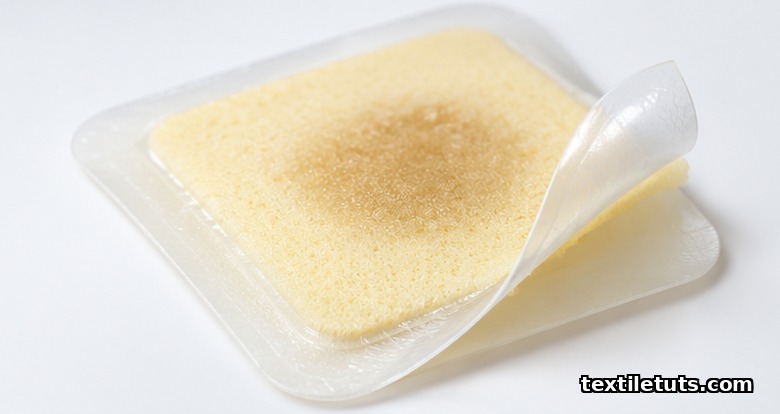
Polyurethane foam wound dressings absorb 10 to 20 times their own weight in wound exudate while maintaining a moisture vapor transmission rate of 2,000 to 3,000 grams per square meter per 24 hours, which is why they are the standard care for moderate to heavily exuding acute and chronic wounds.
This combination of high absorbency and controlled permeability keeps the wound bed moist without pooling, removes excess fluid that would otherwise macerate the peri-wound skin, and insulates the wound at near-physiological temperature, a state repeatedly linked to faster re-epithelialization in clinical trials.
What follows is the working reference for textile engineers, medical-product developers, and wound-care clinicians: the polymer chemistry of the foam, the layer-by-layer construction, the test methods behind the claims, and the indications where foam dressings outperform gauze, films, hydrocolloids, and alginates.
What Is a Foam Wound Dressing?
A foam wound dressing is a sterile, non-adherent (or low-tack) medical dressing built around an open-cell polymer foam that absorbs and retains wound exudate away from the wound surface. Most clinical foam dressings use hydrophilic polyurethane (PU) foam produced by the free-rise or controlled-foam process, in which a polyol reacts with a diisocyanate (typically MDI or TDI) in the presence of water, a catalyst, and a surfactant that controls cell size.
The resulting foam has a density of 0.05 to 0.15 grams per cubic centimeter and a porosity between 200 and 500 micrometers, large enough to admit serous fluid, fibrin, and bacterial cells, but small enough to wick them vertically rather than let them pool on the wound bed. The hydrophilic PU foam absorbs 10 to 20 times its weight in fluid; hydrophobic variants (silicone or PU foam with closed outer skins) absorb less but repel water externally so the patient can shower.
How Foam Dressings Work
Foam dressings manage the wound through three coupled mechanisms: absorption, moisture vapor transmission, and thermal insulation. Each is measurable, and each maps to a published test method.
Absorption is governed by BS EN 13726-1:2002 (test methods for primary wound dressings, part 1: aspects of absorbency). The dressing is weighed dry, immersed in a simulated wound fluid (typically Solution A, containing sodium chloride and calcium chloride at near-physiological ionic strength), re-weighed at saturation, and the absorbency ratio expressed in grams of fluid per gram of dressing. A typical hydrophilic PU foam records 10 to 20 grams per gram; high-performance variants reach 25 to 30.
Moisture vapor transmission rate (MVTR) is measured by BS EN 13726-2:2002 over a 24-hour period through the dressing’s outer backing. Values of 2,000 to 3,000 g/m²/24h fall in the ideal range described by the wound-care literature, high enough to evaporate absorbed fluid as the dressing fills, low enough that the wound bed does not desiccate. Dressings with MVTR below 800 g/m²/24h tend to pool; dressings above 4,000 tend to dry the wound.
Thermal insulation keeps the wound close to 37 °C. Wound bed temperature falls within minutes when uncovered, and a 2018 in-vivo study in Advances in Skin & Wound Care showed that dressings maintaining surface temperatures within 2 °C of core temperature supported faster granulation tissue formation than standard gauze, which loses heat rapidly through wet convection.
Layer-by-Layer Construction
A clinical foam dressing is a laminate of three or four engineered layers, each with a defined textile function. Reading from wound bed to outer surface:
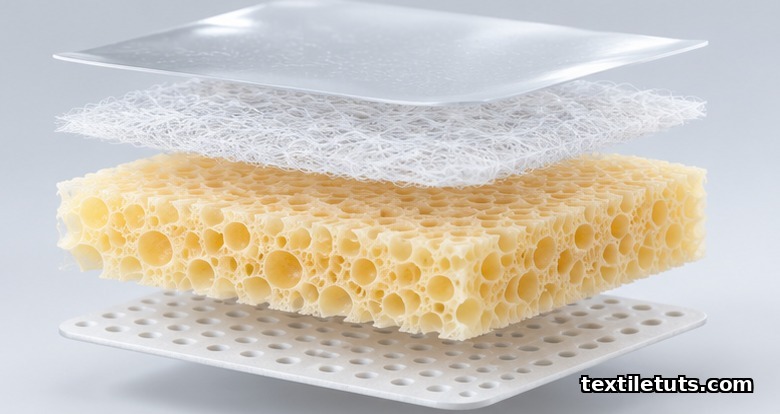
- Contact layer. A perforated silicone or PU film with pore sizes of 50 to 200 micrometers that allows exudate to pass into the foam while preventing the foam from adhering to the wound bed. The pores are large enough to drain but the silicone surface energy keeps the dressing from sticking to moist tissue, so removal does not disrupt new granulation.
- Absorbent foam core. The hydrophilic PU foam described above, usually 3 to 8 millimeters thick, cut to the wound geometry. This is where the bulk of the absorbency and the wicking happen.
- Distribution layer (optional). A thin, hydrophilic nonwoven or fiber web that spreads exudate laterally across the foam to use the full dressing area and avoid the central-saturated / dry-edge failure mode.
- Backing film. A semi-permeable PU film, often 15 to 30 micrometers thick, that admits water vapor and oxygen but blocks bacteria and water droplets. This is the layer that makes the dressing showerproof.
Adhesive variants add a pressure-sensitive acrylic or silicone adhesive border around the foam. Non-adhesive variants are held in place by a secondary bandage or compression wrap, which is the standard approach when the dressing is used under compression therapy for venous leg ulcers.
Types of Foam Dressings
Foam dressings are classified by their polymer chemistry, by the presence of antimicrobial additives, and by their adhesive format. The clinically relevant variants:
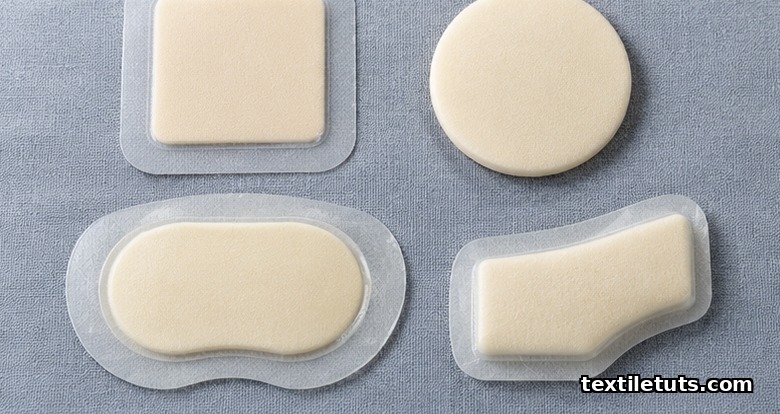
- Standard hydrophilic PU foam. The workhorse dressing. Indicated for moderate to heavy exudate, acute surgical wounds, pressure injuries stages II to IV, venous leg ulcers, and donor sites.
- Hydrophobic / silicone-foam. Outer skin is closed-cell to repel external water. Used on patients who shower frequently or where contamination is a concern.
- Silver-impregnated foam. Metallic silver or silver-sulfadiazine bound to the foam at 0.5 to 1.0 mg/cm² of silver. Used for clinically infected or critically colonized wounds, typically for a 14 to 28 day course before reverting to standard foam.
- PHMB or honey-impregnated foam. Polyhexamethylene biguanide or medical-grade Manuka honey bound to the foam. Used where biofilm is suspected and silver is contraindicated.
- Adhesive-bordered vs non-adhesive. Adhesive borders save nursing time on simple wounds; non-adhesive versions are preferred under compression, on fragile peri-wound skin, or where the dressing must be repositioned.
- Foam with gelling fiber. Combines PU foam with a carboxymethyl cellulose or similar superabsorbent fiber that gels on contact with fluid. Used for very heavy exudate where pure foam would saturate too quickly.
When to Use Foam Dressings (and When Not To)
Foam dressings are indicated for moderate to heavily exuding wounds. Common clinical indications supported by the peer-reviewed wound-care literature include pressure injuries stages II to IV, venous leg ulcers under compression, arterial and diabetic foot ulcers (with off-loading), donor sites following split-thickness skin grafting, post-operative surgical wounds, and traumatic wounds such as abrasions and partial-thickness burns.
Foam dressings are not appropriate in three situations. First, dry or minimally exuding wounds: a foam applied to a dry wound bed will desiccate the granulation tissue and adhere to it. Second, dry eschar that the clinician intends to keep intact, where the goal is autolytic debridement under a different dressing class such as a hydrogel or hydrocolloid. Third, third-degree burns with thick, leathery eschar, where enzymatic debridement or surgical debridement is required before any absorptive dressing is useful.
Wound assessment should follow the T.I.M.E. framework (Tissue, Infection/Inflammation, Moisture balance, Edge advancement) before choosing any dressing. Foam is the moisture-management tool; it is not a substitute for debridement, infection control, or off-loading.
Foam vs Other Dressing Classes: A Comparison Table
| Property | Foam (PU) | Hydrocolloid | Alginate | Film (PU) | Gauze |
|---|---|---|---|---|---|
| Typical absorbency (g/g) | 10 to 20 | 3 to 6 | 15 to 25 | <1 | 4 to 6 |
| MVTR (g/m²/24h) | 2,000 to 3,000 | 200 to 500 | 1,000 to 1,500 | 500 to 800 | High (open) |
| Exudate level handled | Moderate to heavy | Low to moderate | Heavy | None to low | Low |
| Maintains moist bed | Yes | Yes (gel) | Yes (gel) | Yes | No (drying) |
| Can use under compression | Yes | Limited | Yes | No | Yes |
| Typical wear time | 3 to 7 days | 3 to 7 days | 1 to 3 days | Up to 7 days | Daily |
| Donor site use | Yes | Yes | Yes | No | Yes |
The numbers in this table are typical clinical ranges drawn from BS EN 13726 testing and the wound-care literature; specific product performance varies by manufacturer and should always be verified against the product’s published technical file.
Application, Wear Time, and Change Frequency
Standard application protocol: clean the wound with normal saline or a clinician-approved wound cleanser, dry the peri-wound skin, select a foam dressing that extends at least 2 centimeters beyond the wound edge on all sides, and secure with the adhesive border or a secondary dressing. Under compression bandaging for venous disease, the foam sits directly on the wound, and the compression wrap is applied over the top.
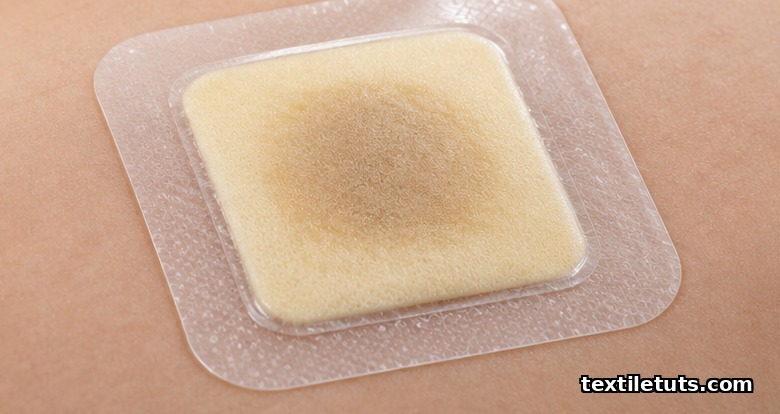
Wear time depends on exudate load. For moderate exudate, change every 3 to 4 days; for heavy exudate, every 1 to 2 days; for low-maintenance wounds near closure, every 5 to 7 days. Foam dressings should be changed sooner if exudate is visible at the dressing edge, if the patient reports leakage, or if strikethrough reaches the backing film. Each dressing change is an opportunity for wound reassessment using the T.I.M.E. framework, not a routine to skip.
Quality and Regulatory Standards
Foam wound dressings are Class IIa or IIb medical devices in the European Union MDR 2017/745 and Class I or II devices under the US FDA 21 CFR 880.5070 classification. Manufacturers must operate under ISO 13485:2016 (medical devices, quality management systems, requirements for regulatory purposes), and the biological safety of the polymer system is established under ISO 10993-1 (biological evaluation of medical devices, evaluation and testing within a risk management process). The polyurethane foam’s mechanical properties fall under ASTM D3574 (standard test methods for flexible cellular materials, slab, bonded, and molded urethane foams), and the dressing’s overall performance falls under ASTM F2459-18 (standard test methods for wound closure and wound dressing performance). End-users, that is hospitals and purchasing bodies, often request the manufacturer’s EN 13726 test report alongside the CE mark or 510(k) clearance.
Frequently Asked Questions
How often should a foam wound dressing be changed?
Foam dressings are typically changed every 3 to 4 days for moderately exuding wounds, every 1 to 2 days for heavily exuding wounds, and every 5 to 7 days for low-output wounds approaching closure. Change the dressing sooner if exudate reaches the dressing edge, if strikethrough is visible on the backing, or if the patient reports pain, odor, or leakage.
Can foam dressings be used on infected wounds?
Standard foam dressings can be used on wounds that are clinically uninfected and merely colonized. For wounds with clinical signs of infection (increased pain, erythema, odor, purulent exudate, or confirmed by culture), a silver-impregnated or PHMB-impregnated foam is the appropriate choice for a 14 to 28 day course. Foam dressings alone do not treat infection; systemic antibiotic therapy, when indicated, is prescribed separately.
Can you shower with a foam wound dressing on?
Most modern foam dressings with a semi-permeable PU backing are showerproof and can be briefly exposed to running water. The patient should avoid soaking the dressing, which would overwhelm the MVTR and allow water to penetrate at the edges. Baths, swimming, and hot tubs are not recommended with any absorbent dressing in place.
Do foam dressings damage new tissue when removed?
Foam dressings with a perforated silicone contact layer are designed not to adhere to the wound bed. Removal should be painless and should not disrupt granulation tissue or new epithelium. Standard (non-contact-layer) foam dressings can adhere to a drying wound bed; soaking the dressing with sterile saline for 5 to 10 minutes before removal prevents mechanical trauma.
Are foam dressings reusable?
No. All foam wound dressings are single-use medical devices, sterilized by ethylene oxide or gamma irradiation during manufacture and supplied in sealed pouches. Reuse compromises sterility, alters the polymer’s mechanical properties, and may release leachable substances from the degraded foam. Discard the used dressing in clinical waste per local regulation.
References
- International Organization for Standardization. ISO 13485:2016, Medical devices — Quality management systems — Requirements for regulatory purposes. iso.org, the governing quality systems standard for foam-dressing manufacturers.
- British Standards Institution. BS EN 13726-1:2002, Test methods for primary wound dressings — Part 1: Aspects of absorbency. The absorbency test method cited throughout the wound-care literature.
- ASTM International. ASTM F2459-18, Standard Test Methods for Wound Closure and Wound Dressing Performance. astm.org, the US standard governing dressing-performance reporting.
- Davies, P. and Rippon, M. (2010). Hydrocolloid dressings and the principles of moist wound healing. British Journal of Nursing, supplement on wound management, MA Healthcare. A clinical overview of moist wound healing cited by UK wound-care guidelines.
- Jones, J. (2016). Foam dressings: the principles of their use. Wounds International, peer-reviewed supplement for the European Wound Management Association. The clinical practice reference for foam-dressing selection.
- ScienceDirect / Elsevier. A review of polyurethane foam dressings in chronic wound management. Journal of Tissue Viability, peer-reviewed clinical review covering foam polymer chemistry and clinical outcomes.
- International Organization for Standardization. ISO 10993-1:2018, Biological evaluation of medical devices — Part 1: Evaluation and testing within a risk management process. The biocompatibility framework applied to PU foam dressings.
This article is the working reference for wound dressings, foam. Editorial by Md. Asad Ullah (Meem), TextileTuts. Sources: ISO 13485:2016, BS EN 13726-1:2002, ASTM F2459-18, ASTM D3574, ISO 10993-1:2018, and peer-reviewed clinical reviews in British Journal of Nursing and the Journal of Tissue Viability, as cited.


