
Wool Spinning: Worsted vs Woolen Systems

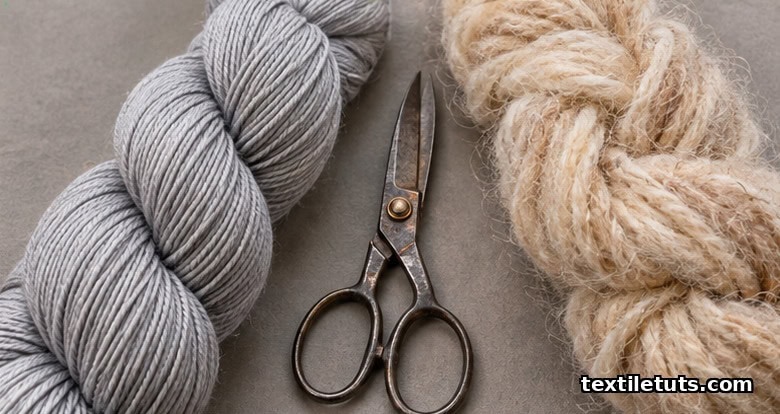
The worsted system processes long-staple wool fibers of 60 to 200 mm through scouring, carding, combing, drawing, and ring spinning to produce a smooth, parallel, dense yarn typically spun to 1/30 to 1/60 worsted count, while the woolen system processes short-staple fibers of 25 to 60 mm through only carding and mule or ring spinning to produce a loftier, hairy yarn sold on the woolen run count system.
The two systems diverge because worsted combing aligns fibers and removes noils, where woolen spinning deliberately preserves fiber disorder for bulk and warmth. This guide explains how fiber length dictates route selection, what each machine sequence actually does, how worsted count and woolen run count differ, and which fabrics each yarn ends up in.
By the end of this article, you will be able to read a yarn label and know whether it passed through a comber or a card, predict its hand-feel, and assign it to its correct end use.
Why Fiber Length Decides the System
Wool is graded before it reaches the spinning mill, and the single most important parameter is fiber length. The British Wool Marketing Board and The Woolmark Company classify fleece into Merino (under 30 µm, short and fine), crossbred (30 to 37 µm, medium), and carpet or strong wool (over 37 µm, long and coarse). Fiber length travels with these grades, and mill buyers price raw wool partly on the Hauteur or Barbey length measured by an Almeter, typically 60 to 200 mm for apparel wool and 25 to 60 mm for carpet wool.
Above 50 mm mean length, the fiber is long enough to survive the combing step without excessive breakage and noil waste, so it is routed to the worsted system. Below 50 mm, combing would pull out more than 25 percent of the fiber mass as noil, which is uneconomic; the fiber is routed to the woolen system where only carding is required. As a result, every worsted mill is also defined by an upper length limit, and every woolen mill is defined by a lower one.
Fineness interacts with length. A 19 µm Merino of 80 mm and a 35 µm Lincoln of 150 mm can both be worsted-spun, but the resulting yarn count, fabric weight, and end use will be very different.
The Worsted System: Combing to Ring Spinning
The worsted sequence is a long, capital-intensive chain. Scoured and blended wool first passes through a worsted card (a series of roller cards plus a tape condenser) that opens the locks and forms a 20 to 40 g/m sliver. The sliver is then pre-drafted on a gill box (intersecting gill) to align fibers before entering the comb.
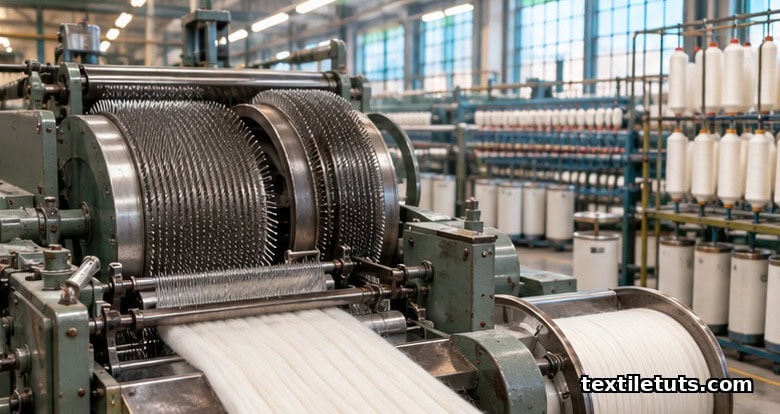
The comb is the defining machine of the system. A Noble, Heilmann, or Schlumberger comb removes short fibers (noil), vegetable matter, and any remaining contaminants, leaving a combed sliver of 100 percent long, parallel fibers. Noil extraction typically runs 4 to 12 percent by weight for fine Merino and can exceed 20 percent for crossbred lots with shorter mean length. The combed sliver then passes through two to three more gill boxes for further parallelization and doubling, then a roving frame that drafts to a thin roving of about 0.5 to 2.5 ktex, and finally a ring spinning frame that inserts twist at 9,000 to 18,000 rpm spindle speed to deliver a finished yarn.
Worsted yarn is smooth, strong, lustrous, and clearly defined in count. It is the yarn of worsted suiting, gabardine, tropical wool, and fine knitwear, where surface definition and drape matter more than bulk. The linear density is measured in worsted count (1 lb of yarn per 560 yards = 1 worsted count unit), standardized under ISO 2060 for linear density determination.
The Woolen System: Carding to Mule or Ring Spinning
The woolen sequence is shorter and cheaper to install. Scoured wool, often blended with recycled wool (shoddy), man-made fibers, or noils, is fed to a woolen card with a worker-and-stripper roller arrangement that breaks down the locks and randomizes fiber direction. The card delivers a condensed sliver or roving directly, typically 0.5 to 4 ktex, without any combing step.
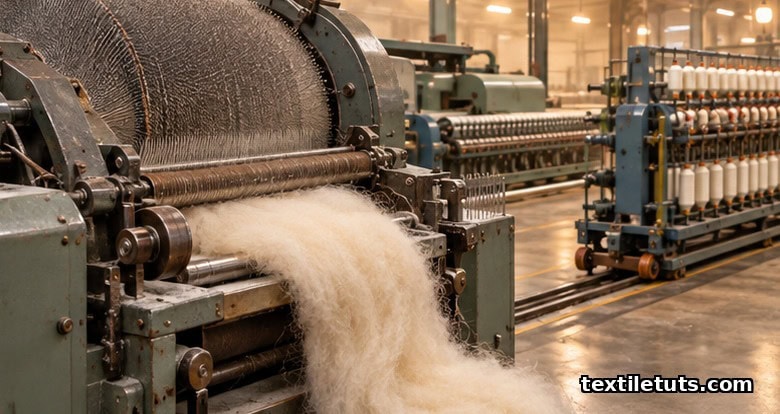
Because fibers are deliberately kept disordered, the roving is lofty and hairy. Twist is then inserted either on a mule spinning frame (an intermittent machine that drafts out 1 to 2 m of yarn per cycle, traditionally used for soft-weaving woolen yarn up to about 50 metric count) or on a modern ring spinning frame (continuous, faster, used for coarser carpet yarn and hand-knitting yarn).
Woolen yarn is fuzzy, soft, and bulky, with high hairiness that traps air and yields superior thermal insulation per unit weight. It is the yarn of tweed, blankets, woolen overcoating, carpets, and rug yarn. The linear density is reported on the woolen run count system (1 lb of yarn per 1,600 yards = 1 run), sometimes also on the Yorkshire skein (1 lb per 256 yards) for heavier carpet yarn, and is verified by ISO 2060 mass per unit length.
Worsted Count vs Woolen Run Count
Yarn count systems are independent of the spinning system, but worsted and woolen mills each favor one. Worsted count expresses length per pound: 1 worsted count = 560 yards per pound, so a 1/30 worsted yarn weighs 17.06 tex and a 1/60 worsted yarn weighs 8.53 tex. Woolen run count uses 1,600 yards per pound, so a 1/4 run yarn weighs 113.4 tex and a 1/8 run yarn weighs 56.7 tex.
The numeric systems look similar but represent very different linear densities. A 1/30 worsted is roughly twice as fine as a 1/4 woolen run. Both can be cross-converted through the tex value, the SI unit that the ISO 2060 standard normalizes regardless of which indirect count system the mill happens to use.
Twist direction and twist level also differ. Worsted yarn for weaving is usually Z-twist with a twist multiplier of about 3.0 to 3.5 (alpha), while woolen yarn for hand-knitting is often S-twist with a multiplier around 2.5 to 3.0 to keep the yarn soft and balanced. ISO 2061 governs the test method for twist determination.
End Uses: Suiting Versus Carpets
Worsted yarn goes where surface smoothness, drape, and crease recovery matter. Tailored suits, dress trousers, gabardine, serge, and high-twist crepe yarns all use worsted yarn of 1/30 to 1/60 worsted count, often woven at 200 to 400 g/m². Worsted yarn also dominates the machine-knitting sector for fine-gauge knitwear, where stitch definition depends on hairiness being minimized.
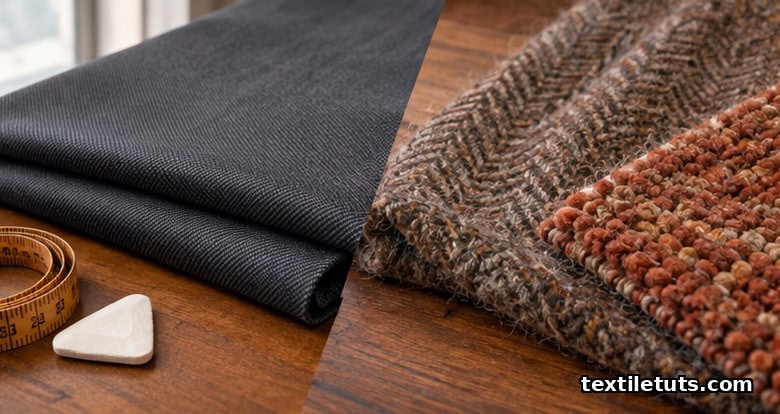
Woolen yarn goes where bulk, warmth, and softness matter more than surface clarity. Tweed, melton, duffle-coating fabric, blankets, hosiery, and hand-knitting yarns are typically woolen-spun, with carpet yarns sitting at the coarsest end of the spectrum at around 100 to 500 tex (roughly 0.5 to 3.5 runs). The same fiber can therefore finish in a 200 USD suit or a 10 USD rug, depending solely on the route it took through the mill.
Worsted vs Woolen: Direct Comparison
| Property | Worsted System | Woolen System |
|---|---|---|
| Fiber length range | 60 to 200 mm (long staple) | 25 to 60 mm (short staple) |
| Mean fiber fineness | 18 to 25 µm typical | 25 to 40 µm typical |
| Machine sequence | Card, gill, comb, gill, roving, ring | Card, mule or ring |
| Noil extracted | 4 to 20 percent by weight | None (no combing) |
| Yarn count system | Worsted count (1/30 to 1/60 typical) | Woolen run (1/1 to 1/8 typical) |
| Yarn surface | Smooth, parallel, lustrous | Hairy, lofty, soft |
| Twist multiplier | 3.0 to 3.5 (alpha) | 2.5 to 3.0 (alpha) |
| Typical end use | Suiting, gabardine, fine knitwear | Tweed, carpet, blanket, rug |
| Fabric weight range | 150 to 400 g/m² | 300 to 800 g/m² |
| Capital cost per spindle | Higher (more machines per kg of yarn) | Lower (shorter sequence) |
Frequently Asked Questions
Q1: What is the main difference between worsted and woolen spinning?
The worsted system combs the sliver to remove short fibers and align the remaining long fibers (60 to 200 mm) parallel, then ring-spins a smooth, dense yarn. The woolen system skips combing and spins a lofty, hairy yarn from short fibers (25 to 60 mm) directly off the card. The presence or absence of the comb is the defining step.
Q2: Can the same wool fiber be spun on either system?
Only if its mean length falls in the overlap zone around 50 to 60 mm, and even then the resulting yarn will differ. A 55 mm fiber combed worsted will lose a high noil percentage, while the same fiber carded woolen will give a coarse but serviceable carpet yarn. Below 50 mm, worsted combing is uneconomic. Above 200 mm, the woolen card cannot fully randomize the fiber and sliver quality suffers.
Q3: How does worsted count differ from woolen run count?
Worsted count uses 560 yards per pound as the unit, so a 1/30 worsted is 17.06 tex. Woolen run count uses 1,600 yards per pound, so a 1/4 run is 113.4 tex, more than six times coarser at the same numeric label. Both are converted to tex under ISO 2060 for unambiguous reporting.
Q4: Which system produces a warmer yarn?
The woolen system produces the warmer yarn per unit weight, because the disordered fiber arrangement traps more still air. A 400 g/m² woolen overcoating will keep you warmer than a 200 g/m² worsted suit of the same fiber. However, the worsted suit breathes better and is more comfortable indoors, so warmth per gram and comfort per gram are different metrics.
References
- International Organization for Standardization. ISO 2060:2015, Textiles — Yarn from packages — Determination of single-end linear density (mass per unit length) using gravimetric and vibroscope methods. https://www.iso.org/standard/63530.html — Defines the tex method used to verify both worsted count and woolen run count.
- International Organization for Standardization. ISO 2061:2015, Textiles — Determination of twist in yarns — Direct counting method. https://www.iso.org/standard/63531.html — Reference test method for the twist levels reported in both worsted and woolen yarns.
- The Woolmark Company. Wool Processing: From Fibre to Yarn. https://www.wool.com/ — Industry reference for woolen versus worsted routing decisions and end-use guidance.
- Ross, D. A., and Mahoney, D. Woollen and Worsted Yarn Manufacture. The Textile Institute, Manchester — Standard textbook reference for the machine sequences described in this article.
- Johnson, N. A. G., and Russell, I. M. (eds.). Advances in Wool Technology. Woodhead Publishing, Cambridge — Peer-reviewed coverage of combing performance and noil extraction rates.
- Tester, D., and McGregor, B. A. The Effect of Fibre Length on Yarn Quality in Worsted and Woolen Spinning. Journal of the Textile Institute, peer-reviewed paper on fiber-length thresholds for each route.
This article is the working reference for worsted versus woolen wool spinning. Editorial by Iftay Khairul Alam, TextileTuts. Sources: ISO 2060, ISO 2061, the Woolmark Company, Textile Institute publications, and peer-reviewed Journal of the Textile Institute literature as cited.


