
Ne, Nm, Tex, Denier, Decitex: Spinning-Specific Calculations

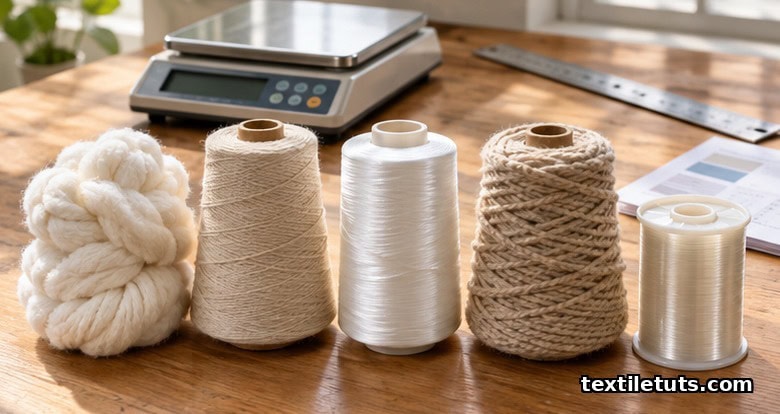
Ne, Nm, Tex, denier, and decitex are five yarn linear-density systems where Ne (English cotton count) and Nm (metric count) are indirect systems with higher numbers meaning finer yarn, while Tex (grams per 1,000 m), denier (grams per 9,000 m), and decitex (grams per 10,000 m) are direct systems with higher numbers meaning coarser yarn; the master conversion for cotton-system spun yarns is Ne multiplied by Tex = 590.5, the constant fixed by ISO 1144.
Spinners, fabric designers, and yarn traders all need to convert between these five notations, because a cotton spinner quotes 30 Ne, a worsted spinner quotes 45 Nm, a technical-textiles engineer quotes 50 Tex, a hosiery supplier quotes 150 denier, and a filament-yarn buyer quotes 167 dtex, yet all five numbers can describe the same yarn.
This guide walks through the five systems, the conversion math used at the spinning frame, a worked example for a 30 Ne cotton yarn, and the labeling traps that show up on commercial yarn tickets.
What “yarn count” actually measures
Yarn count is the textile term for linear density, the mass per unit length of a yarn. The first yarn-count systems date from the late 18th century, when the English cotton industry adopted the 840-yard hank and the Continental worsted trade adopted the metric kilometre. The International Organization for Standardization collapsed those local conventions into one coherent family of units under ISO 1144, which formally recognises the Tex system as the universal reference while keeping the four legacy notations (Ne, Nm, denier, decitex) in active commercial use.
Two opposite conventions exist. In indirect systems, a higher count number means a finer yarn, because the count literally counts how many unit-length pieces weigh one unit of mass. In direct systems, a higher number means a coarser yarn, because the number is the mass of a fixed length. Misreading the direction is the single most common conversion error in spinning.
The five yarn count systems defined
| System | Symbol | Type | Definition | Typical fibres |
|---|---|---|---|---|
| English cotton count | Ne | Indirect | Number of 840-yard (768.1 m) lengths per pound (453.6 g) | Cotton, spun blends |
| Metric count | Nm | Indirect | Number of 1-kilometre lengths per kilogram | Wool, worsted, linen |
| Tex | Tex | Direct | Grams per 1,000 m | Universal; ISO 1144 reference |
| Denier | Td or D | Direct | Grams per 9,000 m | Filament silk, polyester, nylon |
| Decitex | dtex | Direct | Grams per 10,000 m | Filament, carpet, technical yarn |
Ne is the standard count in cotton-spinning mills across South Asia, China, and the Americas. A 30 Ne cotton yarn means 30 hanks of 840 yards together weigh 1 pound; the yarn itself is fine. Nm dominates worsted, woollen, and linen spinning in Europe. Tex is the only system defined as universal by ISO 1144:1973 and is the count you will find on most technical-textile data sheets. Denier survives for filament silk and man-made filament yarn (polyester, nylon, viscose), where it is set by the spinneret throughput. Decitex is the metric-friendly sister of denier and is the mandatory unit for textile-fibre labelling in the European Union under Regulation (EU) No 1007/2011.

Why the spinning industry kept five systems
The legacy systems survive because each matches the manufacturing tradition of a fibre group. Cotton mills spinning coarse counts (Ne 10 to Ne 40) work in pounds and 840-yard hanks; metric-count spinners working in Nm 28 to Nm 120 work in kilograms and kilometres; filament-yarn producers extruding continuous filaments work in denier because a 1-denier filament corresponds almost exactly to the historic silk filament from a single silkworm cocoon, a useful intuition. ISO 1144 preserves all five because no single notation is ergonomic for every fibre range.
Spinning-specific conversion formulas
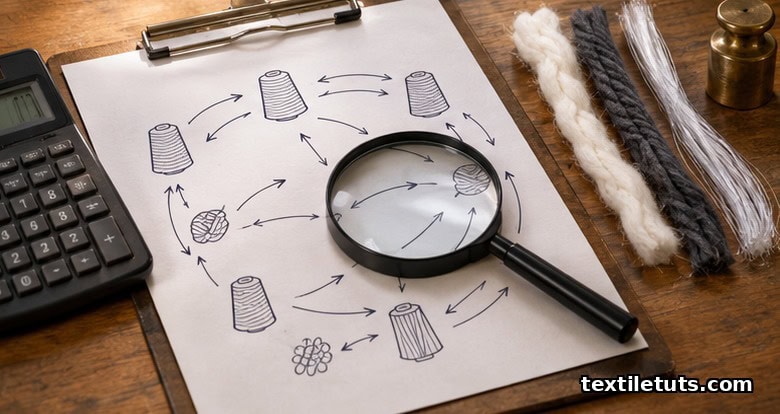
The conversion constants a spinner needs at the desk are listed below. They are derived from the definitions of the unit systems and are tabulated in ASTM D2260 and ISO 1144.
| Conversion | Formula | Constant source |
|---|---|---|
| Tex from Ne (cotton) | Tex = 590.5 / Ne | ASTM D2260 |
| Tex from Nm | Tex = 1,000 / Nm | ISO 1144 |
| Ne from Nm (cotton) | Ne = 0.59 multiplied by Nm | ASTM D2260 |
| Nm from Ne (cotton) | Nm = 1.693 multiplied by Ne | ASTM D2260 |
| Denier from Tex | D = 9 multiplied by Tex | ISO 1144 |
| Decitex from Tex | dtex = 10 multiplied by Tex | ISO 1144 |
| Decitex from Denier | dtex = D multiplied by 1.111 | ISO 1144 |
| Denier from Decitex | D = dtex multiplied by 0.9 | ISO 1144 |
Two cautions. First, the constant 590.5 in the Ne to Tex equation holds only for the English cotton system, where 1 Ne = 1 lb / (840 multiplied by 840 yd multiplied by unit length), and breaks for worsted and woollen Ne, which use 560-yard and 256-yard hanks respectively. Second, the 1.693 multiplier between Ne and Nm assumes a cotton-system English count; for worsted, Nm = 1.89 multiplied by Ne. Always check the yarn ticket or supplier datasheet for which “Ne” is meant.
Worked example: a 30 Ne cotton yarn
A spinning mill quotes a roving as 30 Ne cotton. The yarn-weight calculations go as follows. Tex = 590.5 / 30 = 19.7 Tex. Decitex = 10 multiplied by 19.7 = 197 dtex. Denier = 9 multiplied by 19.7 = 177 denier. Nm = 1.693 multiplied by 30 = 50.8 Nm. The same yarn is therefore 30 Ne / 50.8 Nm / 19.7 Tex / 177 denier / 197 dtex, and any of those five numbers can appear on a buyer-side invoice depending on the country and fibre category of the supplier.
If the mill produces 12,000 kg of this yarn in a shift, the running length is 12,000 kg multiplied by 50.8 km/kg = 609,600 km of yarn, a useful cross-check when the spinner’s production report and the weaver’s yarn-consumption record do not match. The same calculation is the basis of the TextileTuts yarn-count to GSM calculator, which inverts this step to back-solve the count needed to hit a target fabric weight.
Where each count system is used in practice
In cotton ring-spinning mills, count boards display Ne and the production manager thinks in “Ne multiplied by constant” form. In worsted and woollen top-making, the count is Nm, often split into warp and weft counts for fabric costing. In technical textiles, ASTM D2260 conversion to Tex is mandatory because Tex is the only unit that scales cleanly from a 10 Tex filament to a 5,000 Tex tyre-cord yarn. Denier dominates the hosiery, narrow-fabric, and apparel-filament world, where 30 denier, 70 denier, and 150 denier are the stock counts. Decitex is the labelling unit for nonwovens, carpet yarn, and any product entering the EU market.
Common pitfalls in spinning calculations
Three traps show up repeatedly at the spinning desk. The first is mixing worsted Ne and cotton Ne in a single conversion; using the cotton constant 1.693 instead of the worsted constant 1.89 introduces a 12% error on the same Ne label. The second is treating denier and decitex as identical; 150 denier and 150 dtex differ by 11.1%, and yarn tickets labelled only with “D” can hide which is meant. The third is using the running length without correcting for yarn moisture regain, which ASTM D1907 fixes at 8.5% for cotton and 18.25% for worsted; quoting yarn mass “as-is” without conditioning produces Ne values 5 to 15% off the conditioned value. Always condition yarn at 20 °C and 65% relative humidity before measuring linear density, per ISO 139.
Frequently Asked Questions
What is the difference between denier and decitex?
Denier is grams per 9,000 m of yarn and decitex is grams per 10,000 m, so 1 denier = 1.111 dtex and 1 dtex = 0.9 denier. Denier is the older Anglo-American unit for filament silk and man-made filaments, while decitex is the metric-friendly unit used in EU textile-fibre labelling under Regulation (EU) No 1007/2011 and on most carpet-yarn data sheets. Both are direct systems, so a higher number means a coarser yarn.
Why is cotton yarn count called “Ne” and not “Ec”?
Ne stands for “Number English,” the abbreviation established by British cotton-manufacturing practice in the 19th century and preserved in ISO 1144. Other indirect systems carry their own abbreviations: Nm is “Number metric,” Nw is “Number worsted,” and Nwool or YSW is “Yorkshire skein woollen.” When a yarn ticket lists only “Ne,” it almost always means the English cotton system, but a worsted mill will sometimes use the same symbol for its 560-yard Ne, so the safest step is to confirm the hank length on the supplier datasheet.
How do I convert GSM to yarn count?
First convert GSM to Tex using the relationship between yarn linear density (Tex), fabric weight (GSM), and cover factor, then convert Tex to Ne, Nm, denier, or decitex using the formulas in this article. The exact GSM-to-Tex step depends on fabric construction (woven, knit, nonwoven) and is handled by the TextileTuts GSM-to-yarn-count calculator, which applies the standard loop-length or pick-density models before inverting the linear-density equation.
Which count system should I use for a technical textile project?
Use Tex as the working unit, because it is the only count defined as universal by ISO 1144 and scales from micro-fibre to industrial cable without changing the unit. Convert to denier or decitex only at the buyer-facing labelling step; convert to Ne or Nm only if the customer is a cotton or worsted mill whose downstream machinery is set up for that notation.
Does yarn moisture regain affect the count?
Yes. Commercial yarn masses are quoted at standard atmosphere, defined by ISO 139 as 20 °C and 65% relative humidity, which fixes the moisture regain at 8.5% for cotton, 14% for viscose, and 18.25% for worsted wool. Measuring yarn mass off the spinning frame without conditioning yields a higher apparent linear density and therefore a Tex, denier, or decitex value inflated by the regain difference, while a wet yarn gives an artificially low count.
References
- International Organization for Standardization. ISO 1144: Textiles, Universal system for designating linear density (Tex system). iso.org, Defines Tex, decitex, and denier in a unified reference frame.
- International Organization for Standardization. ISO 139: Textiles, Standard atmospheres for conditioning and testing. iso.org, Specifies 20 °C and 65% RH for yarn-count measurement.
- ASTM International. ASTM D2260: Standard Tables of Conversion Between Yarn Number Systems. astm.org, Tabulates the 590.5 Ne multiplied by Tex constant and related conversions.
- ASTM International. ASTM D1907: Standard Test Method for Linear Density of Yarn (Yarn Number) by the Skein Method. astm.org, Skein-based reference procedure for Ne, Nm, and Tex.
- ASTM International. ASTM D1059: Standard Test Method for Yarn Number by Short-Length Specimens. astm.org, Short-length procedure for Tex on small yarn samples.
- European Parliament and Council. Regulation (EU) No 1007/2011 on textile fibre names and related labelling. europa.eu, Requires decitex as the labelling unit for fibre linear density.
- Kothari, V. K. (Ed.). Textile Fibre: Science and Technology. Springer Open, Chapter 3 derives the indirect-to-direct system conversion algebra.
This article is the working reference for converting between Ne, Nm, Tex, denier, and decitex in spinning-mill and fabric-design work. Editorial by Iftay Khairul Alam, TextileTuts. Sources: ISO 1144, ISO 139, ASTM D2260, ASTM D1907, ASTM D1059, Regulation (EU) No 1007/2011, and Kothari (Springer Open) as cited.


