
How Yarn Count Affects Spinning Production

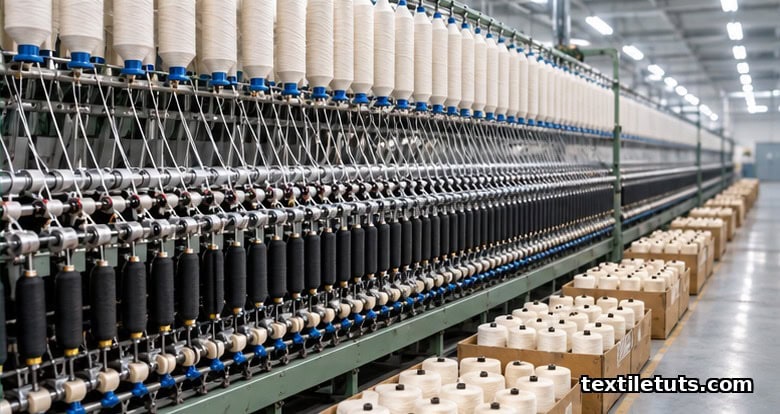
Yarn count directly controls spinning-mill output: shifting from Ne 24 to Ne 40 on a ring frame typically cuts spindle production by 30 to 50 percent, raises end-breakage rate from 8 to 30 breaks per 1,000 spindle-hours, and forces a finer-fiber mix (cotton staple length ≥28 mm, linear density ≤4.5 micronaire) to keep the sliver weavable.
Because every downstream metric, from rotor speed to twist multiplier to comber noil extraction, is set against the count the mill will deliver, the count decision drives raw-material cost, machine allocation, and quality rejection rates long before any yarn reaches the winding room.
This article walks through how yarn count governs each step of spinning production, from bale selection through roving and ring or rotor spinning, and closes with the practical levers mills use to recover productivity when a buyer demands a finer count.
Yarn Count Systems Used in Spinning Production
Yarn count is a way to express linear density, the mass per unit length, and it comes in two families. The direct system (Tex and its sub-units, millitex and decitex, plus denier) reports grams per 1,000 m or per 9,000 m: a 20 tex yarn weighs 20 g per kilometre. The indirect system reports length per unit mass: English cotton count (Ne) counts the number of 840-yard hanks in one pound, and metric count (Nm) counts kilometres per kilogram. A finer yarn reads as a higher number in the indirect system and a lower number in the direct system, which is the single most common source of confusion in buyer conversations.
ISO 1144:2016 standardises the universal Tex-based designation so mills and buyers anywhere can compare without conversion error. ASTM D2260 publishes the conversion tables between Ne, Nm, Tex, denier, and worsted count (Nec, New) that mills still use in everyday tickets. Because Tex and denier are direct and linear, they are the preferred system for technical textiles, while Ne remains the de-facto language of cotton spinning in Bangladesh, India, Pakistan, and China.
How Yarn Count Sets Spindle Speed and Spinning Tension
Spindle speed on a ring frame is governed by the balance between yarn tension (which rises with traveller mass) and the centrifugal force the traveller can survive without flying off. Spinning finer counts requires a lighter traveller, and lighter travellers limit how fast the spindle can run without losing stability. In practice, a modern ring frame turning Ne 24 carded cotton at 18,000 rpm drops to roughly 14,000 rpm when the same machine is re-set for Ne 40, and below 11,000 rpm for Ne 60 combed, all else equal.
This is why mill planners quote production in spindle-rotations per minute and then divide by the twist per inch (TPI) the yarn needs to survive weaving or knitting. Twist per inch, in turn, is calculated from the twist multiplier (TM), which for cotton weaving yarns sits between 3.5 and 4.5 (alpha = TM × √Ne). Finer counts demand more twist per inch to keep the yarn structure coherent, so the spindle has to insert more turns per metre, taking longer for the same delivery length.
End-Breakage Rate and Machine Efficiency
End-breakage rate is the single most sensitive indicator that a count is straining the machine’s drafting system. On a properly set ring frame, Ne 24 cotton runs at 6 to 10 breaks per 1,000 spindle-hours; at Ne 40 the same frame climbs to 18 to 30 breaks; and at Ne 60 combed the rate can exceed 50 per 1,000 spindle-hours if the roving is not perfectly prepared.
Each break costs the spinner 3 to 6 minutes of piecing time, drops a length of waste yarn, and pulls the doffer off-schedule. Mill-efficiency studies on ring spinning typically report 5 to 10 percent efficiency loss per 10-count increase in Ne, which is why commercial spinners separate counts into spinning groups (coarse Ne ≤20, medium Ne 21–34, fine Ne 35–50, superfine Ne ≥51) and dedicate specific machines to each band.
Fiber Selection as a Function of Target Count
Yarn count drives the choice of cotton or blend before a single bale is opened. The minimum staple length required to spin a given count reliably is governed by the fiber-to-yarn strength ratio: a 28 mm cotton can spin comfortably up to Ne 40, a 30 mm cotton reaches Ne 60, and anything finer than Ne 80 generally needs long-staple cotton (≥32 mm) or a polyester blend with a linear density ≤1.2 denier per filament.
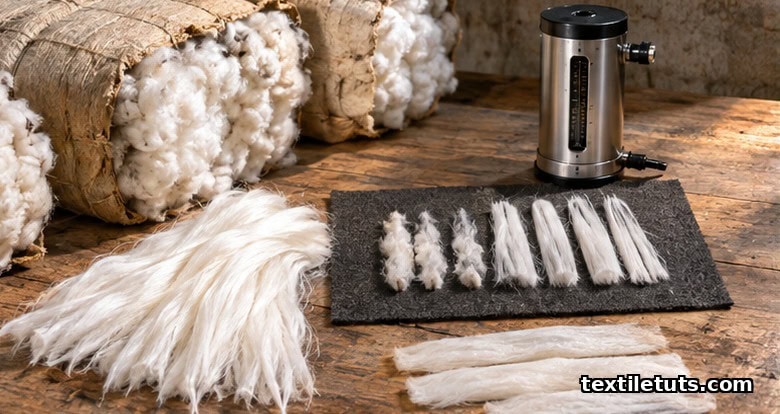
Micronaire (the airflow resistance of a fixed mass of fiber) is the second gate. Spinning finer than Ne 60 typically needs cotton in the 3.8 to 4.5 micronaire range. Coarser micronaire fibers, even if long, generate thick places in fine counts that show up as yarn faults after winding. Combing removes short fibers and neps, and the combed noil extraction rate rises with target count, from 8 percent at Ne 30 to 18 to 22 percent at Ne 60. That noil is sold back as a lower-grade yarn, so the effective fiber cost per kilogram of yarn climbs steeply as count rises.
Drafting, Roving, and Winding Adjustments
Spinning finer counts forces three changes on the drafting system. First, the main draft zone is widened and the break draft lowered to keep floating fibers under control, typically a break-draft ratio of 1.18 to 1.25 instead of 1.30 used for coarser counts. Second, the apron in the top drafting roller is replaced with a finer-grooved or non-apron cradle to reduce fiber bunching. Third, roving weight (hank roving) drops from 0.80 to 1.20 Ne at coarse counts to 0.40 to 0.60 Ne for fine counts, requiring the roving frame to operate at higher draft and lower delivery speed.
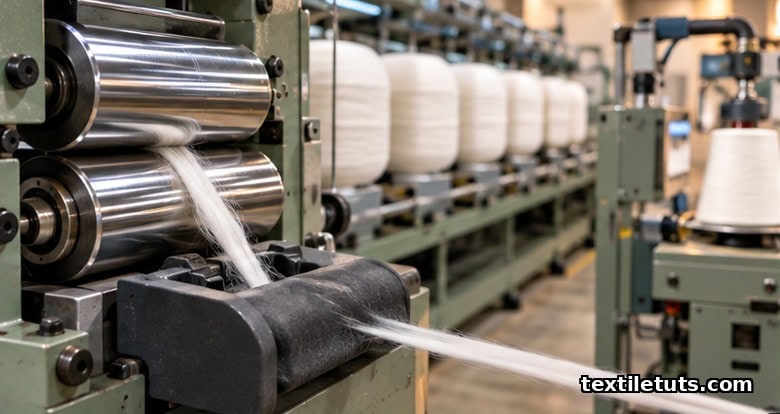
On the winding side, yarn clearing sensitivity must rise. Uster Classimat settings drop from a 50 percent threshold cut at Ne 24 to a 30 percent threshold at Ne 40, which lengthens the clearing cycle and reduces winder productivity by 10 to 15 percent. Splicer air pressure is also recalibrated, since finer yarns need less air to splice but fail more easily when the splice is over-pressed.
Ring, Rotor, and Air-Jet Spinning: Which Count Each System Spins Best
Spinning system choice is itself a function of yarn count. Ring spinning is universal but most productive at coarse and medium counts. Rotor spinning is fastest for coarse counts (Ne 6 to Ne 30) but loses economic advantage above Ne 36, because rotor opening rollers cannot separate fibers finely enough to keep yarn evenness (CV%) within commercial limits. Air-jet spinning fits the medium-fine band (Ne 30 to Ne 60) and delivers a yarn with lower hairiness but about 10 to 15 percent lower tenacity than ring yarn at the same count.
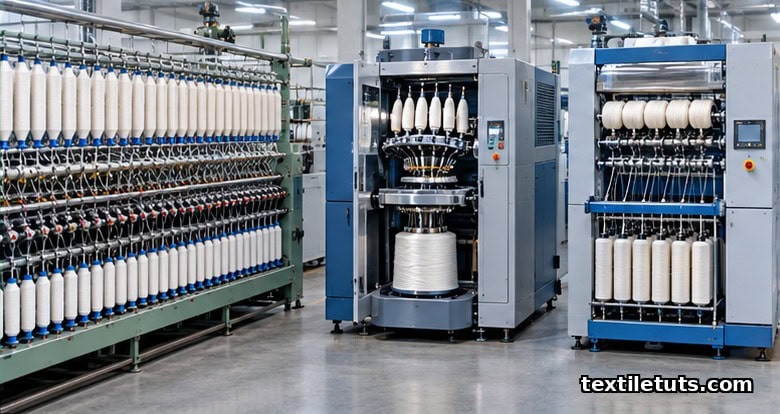
Vortex spinning (a Murata proprietary air-jet variant) extends the practical upper limit to roughly Ne 60 to Ne 80 in 100 percent cotton. Compact spinning, a modification of the ring frame that condenses the fiber strand before twist insertion, lifts ring yarn quality at any count and effectively lets the same fiber spin one count finer with acceptable hairiness and pilling resistance. Many mills therefore quote a “compact equivalent” count when they pitch to buyers.
Quality Metrics That Change with Count
Yarn evenness, measured as coefficient of variation of mass per unit length (CV%), typically worsens as count rises. Ne 24 carded yarn often tests at CV% 14 to 16, Ne 40 carded at 16 to 18, and Ne 60 combed compact at 13 to 14 (the combing and compacting offset the trend, but at higher cost). Hairiness (H-index) rises with count because finer yarns expose more fiber ends per unit surface area, which is one reason air-jet and compact yarns dominate the knit market.
Tenacity, expressed in cN/tex, follows a U-shape with respect to count for any given fiber: very coarse yarns have fewer fibers in the cross-section and rupture early, while very fine yarns also drop in tenacity because each fiber carries more of the load and breaks individually. The peak tenacity for a given cotton mix sits in the medium-fine band, typically Ne 40 to Ne 60 combed, which is why weaving yarn orders for high-count poplin and sheeting target that range.
Productivity Math Spinners Use in Planning
Spindle production in kg per spindle per shift is the standard planning metric. On a modern ring frame, an operator tends 600 to 800 spindles at Ne 24 but only 350 to 500 spindles at Ne 40, because of the lower spindle speed and higher end-breakage piecing. The output per spindle per hour drops from about 0.040 kg at Ne 24 to 0.020 kg at Ne 40 and 0.012 kg at Ne 60 combed, before counting comber loss.
This is why the price spread between, say, Ne 30 carded and Ne 60 combed cotton yarn on international markets is roughly 60 to 90 percent, not the 100 percent that the count number itself would suggest. The extra cost is the price of the extra spindle-hours, the extra comber noil, and the tighter quality window that drives the spinning mill to run the frame below its nominal speed.
Yarn Count and Spinning Production: Practical Levers Mills Use
When buyers ask a mill to spin finer than the existing set-up can comfortably handle, spinners typically reach for four levers in combination: blend in 30 to 50 percent polyester to keep yarn strength up while lowering cost, switch to compact or air-jet drafting, raise comber noil extraction to clean the sliver further, and slow the spindle by 15 to 25 percent to bring the breakage rate back inside the acceptable envelope. None of these levers is free, but together they buy 5 to 8 additional Ne counts without a complete machine rebuild.
If the order is genuinely long-term and fine-count heavy, the more durable fix is to dedicate frames: install finer-gauge drafting systems, lighter travellers, and larger diameter packages, then re-balance the speed and twist settings for the new count band. This is how mills in Bangladesh and Vietnam have built separate “fine-count” and “coarse-count” lines that run in parallel, each at its own efficiency optimum, rather than asking one frame to span the full range.
Frequently Asked Questions
What is the relationship between yarn count and production speed in ring spinning?
Spindle speed falls as count rises, typically from around 18,000 rpm at Ne 24 to 14,000 rpm at Ne 40 and below 11,000 rpm at Ne 60, because finer counts need lighter travellers and lower tension to keep end-breakage in check. Production in kg per spindle per hour therefore drops by roughly half between Ne 24 and Ne 40.
How does yarn count affect end-breakage rate in spinning?
End-breakage rate rises sharply with finer counts because the drafting zone holds fewer fibers in cross-section and the roving tension is harder to control. Typical rates are 8 to 10 breaks per 1,000 spindle-hours at Ne 24, 18 to 30 at Ne 40, and above 50 at Ne 60 combed, which is why mills plan operator tending and piecing time around the target count.
Which spinning system is best for fine yarn counts?
Ring spinning is the most versatile and handles the widest count range, but compact ring, air-jet, and vortex spinning are more efficient in the fine-count band (Ne 40 to Ne 80). Rotor spinning stays competitive only up to about Ne 30 to Ne 36 because opening-roller design limits how finely it can separate fibers.
How does yarn count influence fiber selection in spinning?
Finer counts require longer, finer, and more uniform fibers. Cotton of at least 28 mm staple length and 3.8 to 4.5 micronaire is the practical minimum for Ne 40, while Ne 60 and above needs 30 mm or longer staple, micronaire below 4.5, and typically combing to remove short fibers.
Why does spinning production cost rise with finer yarn counts?
Production cost rises because finer counts combine three penalties: lower spindle speed, higher end-breakage and piecing time, and higher comber noil extraction. Together these raise the effective cost per kilogram of yarn by 60 to 90 percent between Ne 30 and Ne 60 combed cotton, which is the price spread visible in international yarn markets.
References
- International Organization for Standardization. ISO 1144:2016 Textiles — Universal system for designating linear density (Tex System). iso.org. Foundation standard for naming yarn count.
- ASTM International. ASTM D2260-03(2013) Standard Tables for Conversion of Yarn Number and Universal Yarn Numbering System. astm.org. Conversion tables between Ne, Nm, Tex, and denier.
- International Organization for Standardization. ISO 2061:2015 Textiles — Determination of Twist in Yarns — Direct Counting Method. iso.org. Method for twist per inch used in TM-based setting.
- ASTM International. ASTM D1422 / D1423 Standard Test Methods for Twist in Single Spun Yarns. astm.org. Reference test methods for yarn twist verification.
- Lawrence, C.A. Advances in Yarn Spinning Technology. Woodhead Publishing (Elsevier), 2010. Research monograph on spinning systems and count-related productivity.
- Klein, W. A Practical Guide to Ring Spinning. The Textile Institute, Manchester. Manual on count-driven settings for ring frames.
- Ishtiaque, S.M., et al. Influence of yarn count on ring spinning performance parameters. ResearchGate / journal paper. Empirical breakage and productivity data across counts.
This article is the working reference for how yarn count governs spinning production. Editorial by Iftay Khairul Alam, TextileTuts. Sources: ISO 1144:2016, ASTM D2260-03(2013), ISO 2061:2015, ASTM D1422/D1423, Lawrence (Woodhead), Klein (Textile Institute), Ishtiaque et al. as cited.


