
Spinning Mill Workflow: From Bale to Cone

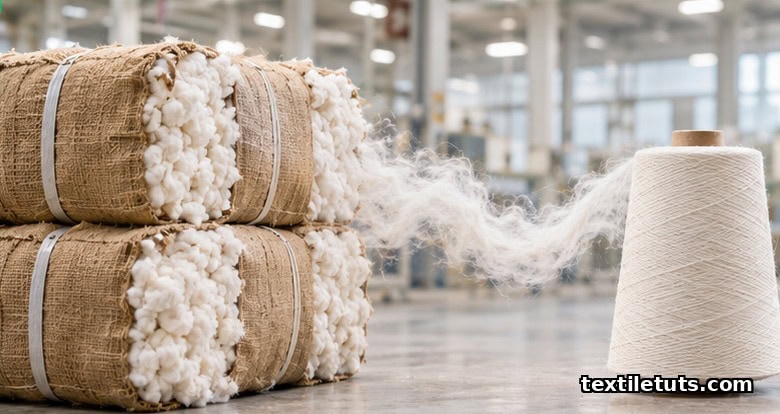
The cotton spinning mill workflow converts a 180 to 220 kg bale of compressed cotton fiber into a 1.5 to 2.5 kg cross-wound yarn cone through eight sequential stages (bale opening, blending, carding, breaker drawing, finisher drawing, roving, ring spinning, and winding/packaging), with a typical mass balance of 88 to 92 percent yarn yield, 4 to 7 percent blowroom and card waste, and 3 to 6 percent comber noil for combed counts, and a total conversion time of 12 to 18 hours from bale feed to cone delivery.
From bale to cone, the cotton fiber is opened, cleaned, individualized, drafted, blended, twisted, and wound across roughly thirty machines in a modern short-staple mill, with the ring frame inserting 800 to 1,200 turns per metre of twist at 25,000 rpm spindle speed and the autoconer clearing faults at 1,800 to 2,200 m/min before the cone enters the warping, knitting, or weaving creel.
This hub article walks the workflow stage by stage, gives the operating parameters a textile engineer sets at each step, and links to the detailed spoke articles in the TextileTuts Spinning cluster.
Stage 1: Bale Opening and Blending
Bale opening is the first quality gate. A spinning mill cannot feed a 180 to 220 kg compressed bale directly to the card; the tufts must be opened, cleaned, and blended into a uniform feed stock at the rate the card expects. Modern hard-pressed bale pluckers (Rieter B 60, Truetzschler Blendomat) remove 6 to 10 individual tufts per plucking cycle and deliver 600 to 1,200 kg/h per blowroom line to a sequence of opening and cleaning machines.
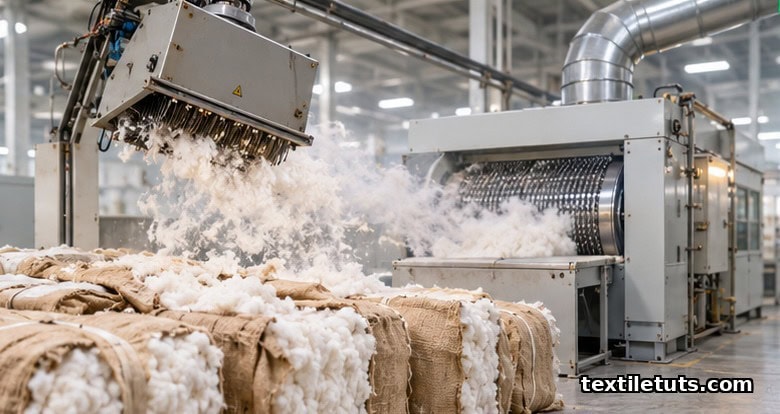
Blending at the bale lay-down is the single most important process decision a spinner makes on fiber quality, because two-thirds of the yarn’s evenness and tensile variability is fixed before the fiber reaches the card. A multi-mixer lay-down of 6 to 8 bales across the spinning mix brings blend variation on the draw-frame sliver below 2 percent CV; a single-stack lay-down of two or three bales in sequence typically produces 4 to 8 percent CV and the spinning manager sees that variability as long-wave count variation on the spectrogram.
Three opening-and-cleaning principles dominate the modern blowroom. First, the number of opening points in series: more opening machines open the tuft more completely, but every passage adds 2 to 4 percent fiber breakage, with immature cotton (micronaire below 3.8) showing the steepest nep increase above six passages. Second, cleaning-element aggressiveness: saw-tooth beaters (Kirschner, Uniflex) treat both trash and fiber as targets and achieve 60 to 75 percent trash removal at the blowroom, while porous drum cleaners and Axi-Flo type units remove 40 to 55 percent with much less fiber damage. Third, direct card feeding versus lap feeding: chute-fed cards (Truetzschler DirectFeed, Rieter DeltaFeed) eliminate lap winding and reduce card-room neps by 15 to 25 percent relative to lap-fed cards of equivalent production.
Output of the blowroom is a tuft stream at 50 to 90 percent opening efficiency (measured as the share of fibers separated from any tuft larger than 5 mg) feeding the card via chute or lap. Humidity is controlled at 55 to 65 percent RH throughout this stage; below 50 percent, static charge builds on synthetic staple and drafting becomes unstable in the downstream card.
Stage 2: Carding
The card is the only machine in the spinning workflow that performs true fiber individualization, and the ISO 16549 evenness tests that come at the end of the workflow are largely determined by the card’s trash removal, short-fiber extraction, and web uniformity. A modern flat-top card (Truetzschler TC 19, Rieter C 70, Lakshmi Galaxy) processes 80 to 220 kg/h of cotton at delivery speeds of 200 to 250 m/min for the can sliver, with trash removal of 90 to 95 percent and short-fiber removal (fibers below 12 mm) of 0.5 to 2.0 percent of feed weight depending on flat setting.
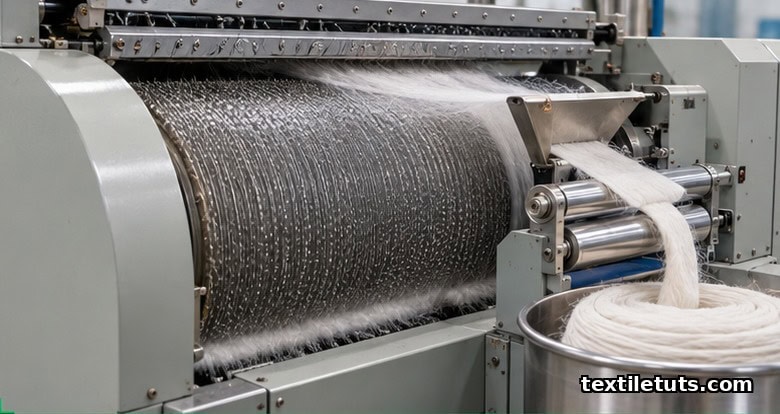
The card has five functional zones, each with a measurable engineering target. The feed table and licker-in tufter open compressed tufts and reject heavy trash through grid bars; the cylinder and flats (or revolving flat strip) individualize fibers against the clothing wire by opposing-direction surface speeds (typically 30 to 36 m/s on the cylinder); the doffer and web condenser strip the individualized web and condense it into a sliver; and the coiler and calender rolls deliver the sliver into a can at 3.5 to 6.0 ktex linear density. The flat count of 400 to 500 working flats per cylinder on a modern revolving-flat card, set at 0.20 to 0.30 mm flat-to-cylinder gap, removes more than 95 percent of trash larger than 500 µm before the web reaches the doffer.
Card sliver count variation (CV%) at delivery typically runs 3 to 5 percent, a number whose downstream consequences are visible at every later stage as periodic drafting waves 2.5 to 4 m in wavelength. The evenness target for a “5 percent Uster” yarn (a yarn whose CV sits in the top 5 percent of Uster Statistics 2024 global mills for the relevant count) is card sliver CV of 3.0 to 3.5 percent, achieved by proper grinding cycles (every 800 to 1,200 production hours), correct licker-in setting, and stable atmospheric conditions.
Waste from the card is segregated by quality. Flat strip waste is a high-grade recycle (typically re-introduced at the breaker draw frame through a waste opener) at 0.5 to 1.5 percent of feed. Licker-in and mote waste is contaminated with high trash and short-fiber content; it is sold for non-woven or yarn counts above Ne 10. The combined card waste fraction sits at 4 to 7 percent of feed weight for carded cotton and 6 to 10 percent for synthetic staple.
Stage 3: Drawing: Breaker and Finisher
Drawing is where blend quality is finalized and where the autoleveler closes the loop on long-wave count variation from the card. A modern cotton draw frame runs 6 to 8 ends up at 600 to 1,200 m/min delivery speed, with a short-term autoleveler that adjusts the break draft at every 8 to 12 mm of sliver travel to hold the cross-section within ±1.5 percent of the setpoint. ISO 16549 spectrograms of a properly leveled draw-frame sliver show no peak above 0.5 percent of the CV at the 2.5 to 4 m wavelength typical of card autoregulation.
Most cotton draw frames operate as a two-passage system. The breaker draw frame feeds 6 to 8 card slivers (each 3.5 to 6.0 ktex) through a 6x to 8x draft, delivering a leveled sliver at 3.5 to 5.5 ktex; the finisher draw frame takes 6 to 8 of those breaker slivers and drafts 6x to 8x again, delivering a finisher sliver at 3.0 to 4.5 ktex. Doubling alone reduces long-wave count variation by the square root of the number of doublings, so 6-end breaker feeding combined with 6-end finisher feeding reduces card sliver count variation by a factor of about 6, and that reduction is why two draw-frame passages are standard even on mills running compact or vortex yarn.
Drafting principles govern what the draw frame leaves behind. The break draft, typically 1.20 to 1.40, controls the back-zone fiber density and prevents drafting waves caused by floating short fibers. The main draft of 4x to 6x is distributed between the back and front roller nip; on a Rieter RSB-D 50 or Truetzschler TD 10, the apron drafting system (HP-type or SU-type) tolerates a 25 to 30 percent wider short-fiber window than roller-only drafting. Top-arm loading at 18 to 22 daN per centimeter of nip holds the floating-fiber fringe inside the front drafting zone without crushing the fibers, and modern suction-tube or compact strip systems (Rieter ComforSpin, Suessen EliTe) eliminate the spinning triangle at the next stage as well.
For combed yarn, the breaker draw frame feeds a lap winder that builds a 50 to 80 g/m lap of 6 to 8 ends; the lap is combed on a high-speed comber (Rieter E 90, Hara 800) at 350 to 500 nips/min with a noil percentage of 8 to 18 percent of feed weight, removing fibers shorter than 12.5 mm and residual neps. The combed sliver is then fed through a third draw frame passage (sometimes called the “preparator” or “finisher” stage) before the roving frame.
Stage 4: Roving (Ring Spinning Route Only)
The roving frame is unique to the ring spinning route. Its job is to insert just enough protective twist into a slightly drafted sliver so the strand can be wound onto a bobbin, transported to the ring frame, and unwound at high speed without breaking. Roving twist is intentionally low, 18 to 30 turns per metre for cotton at 0.4 to 0.8 ktex, just enough to give lateral cohesion for handling but not so much that the ring frame cannot draft it out.
Roving count and twist are coupled to the target yarn count through the roving draft. For a 20 tex (Ne 30) ring yarn drawn from a 0.55 ktex roving at a draft of around 28, the roving frame runs 1,200 to 1,800 rpm spindle speed with a 6x to 8x draft from the breaker draw-frame sliver. Modern roving frames (Rieter R 35, Zinser RoWeaving) use pressure-drafting or apron-drafting systems and a flyer that winds the roving onto a press-pac bobbin at a controlled tension of 10 to 18 cN per end. The bobbin weighs 0.8 to 1.5 kg and holds 8,000 to 15,000 m of roving.
Two practical numbers govern roving quality. Roving CV percent at delivery should sit below 4.0 percent on the Uster Tester for 0.5 ktex roving; above 5.0 percent, the ring frame drafting wave becomes visible in the yarn spectrogram. Singles-per-meter roving break strength should reach at least 70 to 80 percent of the parent yarn’s projected strength; below 65 percent, the roving breaks at the ring frame and the spinner sees an end-down rate that drives the machine efficiency below 90 percent.
Rotor, air-jet, and vortex routes skip this stage entirely. Their feed package is the finisher draw-frame sliver can delivered directly to the spinning machine, which is why these systems are called “short-process” routes. Eliminating the roving frame saves roughly 8 to 12 percent of spinning-mill energy, 6 to 10 percent of floor space, and one operator per 12 to 16 machines.
Stage 5: Ring Spinning
The ring frame is where drafted fiber stream meets twist and locks it into a yarn. The drafting system at the front of the ring frame takes the roving (or, on compact-spinning frames, a draw-frame sliver through a suction slot) and drafts it 25x to 50x to the final yarn count. Twist is inserted by dragging a C-shaped traveler around a stationary ring at spindle speeds up to 22,000 to 25,000 rpm on modern frames (Rieter G 38, Zinser 71, Toyota RX 240).
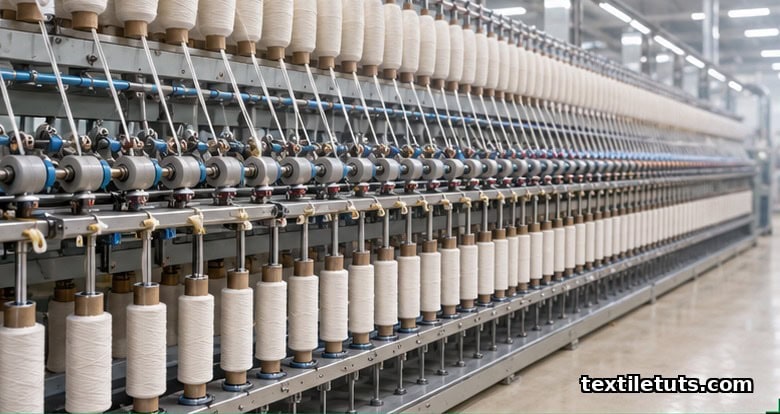
The spinning triangle is the critical fiber-control zone. Between the front roller nip and the twist point, a small unsupported fiber bundle of 15 to 25 mm is twisted. Compact-spinning systems (Suessen EliTe, Rieter ComforSpin, Zinser Air-Com) use a suction slot or perforated apron to condense this triangle and pre-align the fibers, producing a 10 to 20 percent strength gain and a 30 to 50 percent reduction in yarn hairiness. A modern compact-spun 20 tex (Ne 30) ring yarn runs at 23,000 rpm, with a twist multiplier of 3.8 to 4.2 (cotton TM, defined as turns per inch divided by the square root of the English count), and produces approximately 40 to 60 kg per delivery over an 8-hour shift.
Twist direction is conventionally “Z” for singles yarn in the cotton system. The twist multiplier determines yarn strength, hairiness, and end-down behavior: a TM below 3.6 at Ne 30 produces 5 to 10 percent lower single-end tenacity; a TM above 4.5 produces a stiff yarn that is hard to knit and causes slough-offs at the ring frame traveller. Uster Statistics 2024 benchmarks for single-end tenacity of combed cotton at Ne 30 place a “5 percent” yarn above 18.5 cN/tex and a “25 percent” yarn at 15.0 to 16.0 cN/tex.
The bobbin (or “cop”) leaving the ring frame weighs 60 to 120 g and holds 200 to 600 m of yarn, enough for a few minutes of knitting or weaving creel feed. The ring frame doffer removes full bobbins automatically every 90 to 180 minutes, depending on count, and replaces them with empty tubes; modern frame doffers handle 1,000 to 1,600 spindles per doffer cycle. The package-to-package efficiency of a modern ring frame sits at 92 to 96 percent (the share of shift time during which spindles are spinning), with the remainder split among doffing, end-down piecing, and creel changes.
Stage 6: Winding and Yarn Clearing
The winder takes every ring bobbin and rewinds it onto a cross-wound cone suitable for the next process. Modern autoconers (Schlafhorst Autoconer 7, Murata Mach Coner, Savio Eco Pulsar) run at 1,800 to 2,200 m/min per spindle, with 24 to 64 spindles per machine and a digital twin that integrates with the mill’s Uster quantum 3 clearer network. The conversion from bobbin to cone adds 3 to 5 percent to yarn production cost but removes 30 to 50 percent of customer-side claims by performing quality control that the ring frame cannot do in-line.
The yarn clearer is the quality gate. Mechanical clearers (slub catchers) use a fixed slot width and remove only the largest slubs; optical clearers (photocell) measure diameter in 0.05 mm steps; electronic clearers (capacitive or laser) measure mass per unit length in CV percent and cross-section bands. A typical capacitive clearer on 20 tex cotton cuts 8 to 20 faults per 100,000 m, with thresholds set at +50 percent (thick place), -30 to -40 percent (thin place), and 4 cm length (slub). The cleaner the cut, the higher the splice frequency downstream.
Splicing replaces the knot. Pneumatic splicers inject compressed air at 5 to 7 bar to open fibers and entangle two ends, producing a joint of 25 to 40 mm and 80 to 95 percent of parent yarn strength. A modern cotton knitting mill runs 95 to 100 percent splices; a weaving mill runs 60 to 90 percent splices depending on loom type, because air-jet and water-jet looms above 800 m/min pick weft at high speed and any knot can deflect the yarn and miss the insertion nozzle.
Package density is the second engineering variable. Weaving cones run at 0.45 to 0.55 g/cm³, which provides stable unwinding tension at high loom pick rates; dye packages run at 0.35 to 0.45 g/cm³ to allow dye liquor to penetrate; knitting cones run at 0.42 to 0.55 g/cm³. A field check is mass divided by volume measured with calipers; values outside 0.30 to 0.60 g/cm³ signal a winding recipe that needs adjustment.
Stage 7: Cone Packaging and Warehouse
The cone leaves the winder as a 1.5 to 2.5 kg package wound on a 3°30′ tapered paper tube (for weaving) or a straight perforated plastic tube (for dyeing). The packaging stage inspects each cone for visual faults, weighs it to confirm the target mass within ±2 percent, applies a lot identification barcode or RFID tag, and palletizes 60 to 120 cones onto a stretch-wrapped pallet for transport to the warping, knitting, or dyeing section.
Lot identification is the final thread of traceability from the original bale. A modern spinning mill links every cone to the bale lay-down position from which its fiber was plucked, the date and time of carding, the draw frame and ring frame shifts, and the winder spindle. A customer claim on a specific cone can be traced back to the originating bale in under 30 minutes if the lot traceability system is in place. This is a regulatory requirement for some technical-textile and medical-textile customers.
Final yarn testing verifies that the package meets the customer’s specification. The standard test battery includes ISO 2062 (single-end breaking force and elongation at break), ISO 2061 (twist per metre by direct counting), ISO 2060 (linear density by skein), and ISO 16549 (yarn evenness by capacitance). Uster Statistics 2024 provides the global benchmark yardstick for each count range; a “5 percent Uster” yarn sits in the top 5 percent of mills worldwide on evenness, a “25 percent Uster” yarn sits in the top 25 percent, and a “50 percent Uster” yarn is process-fair.
Comparison Table: Eight Spinning-Mill Stages and Their Key Parameters
| Stage | Input | Output | Key parameter 1 | Key parameter 2 | Typical waste |
|---|---|---|---|---|---|
| Bale opening & blending | 180 to 220 kg cotton bale | 600 to 1,200 kg/h tuft stream | 6 to 8 bale lay-down | 55 to 65% RH | 0.5 to 1.5% |
| Carding | Tuft stream / lap | 3.5 to 6.0 ktex sliver (200 to 250 m/min) | Flat count 400 to 500 | Licker-in setting 0.20 to 0.30 mm | 4 to 7% |
| Breaker draw frame | 6 to 8 card slivers | 3.5 to 5.5 ktex leveled sliver | 6 to 8 ends up | Break draft 1.20 to 1.40 | 0.2 to 0.5% |
| Finisher draw frame | 6 to 8 breaker slivers | 3.0 to 4.5 ktex sliver | Delivery speed 600 to 1,200 m/min | Main draft 4 to 6x | 0.1 to 0.3% |
| Roving (ring route only) | 3.0 to 4.5 ktex sliver | 0.3 to 1.2 ktex roving bobbin | Spindle speed 1,200 to 1,800 rpm | Roving TM 18 to 30 turns/m | 0.5 to 1.0% |
| Ring spinning | Roving bobbin | 60 to 120 g cop (200 to 600 m) | Spindle speed 22,000 to 25,000 rpm | Yarn TM 3.8 to 4.2 (cotton, Ne 30) | 0.3 to 0.8% |
| Winding | Ring cop | 1.5 to 2.5 kg cross-wound cone | Winding speed 1,800 to 2,200 m/min | Winding tension 12 to 18 cN (20 tex) | 0.8 to 1.5% |
| Cone packaging | 1.5 to 2.5 kg cone | Palletized lot for dispatch | Cone mass ±2% | RFID lot trace | 0.0 to 0.3% |
Frequently Asked Questions
Q1: How long does it take for cotton to go from bale to cone?
From bale feed to cone delivery, the spinning-mill workflow takes 12 to 18 hours for a typical short-staple cotton route running 24 to 30 machines in series. Roughly half of that time is inter-stage buffering (can transport between card and draw frame, bobbin queues between roving and ring frame, cone queues at the winder), and the other half is active processing time on the machines.
Q2: What is the typical yarn yield from one bale of cotton?
A 180 to 220 kg bale yields 158 to 200 kg of finished yarn (88 to 92 percent net yield) for a carded cotton route at Ne 30, after accounting for 4 to 7 percent card waste, 0.3 to 0.8 percent draw-frame waste, 0.5 to 1.5 percent roving and ring-frame waste, and 0.8 to 1.5 percent winder waste. Combed routes fall to 80 to 86 percent yield because the comber removes 8 to 18 percent noil.
Q3: Why is the card called the heart of the spinning mill?
The card is the only machine that performs true fiber individualization on a production scale, and every downstream machine inherits the card’s blend quality, evenness, and short-fiber content. A mis-set card produces drafting waves that no draw frame can remove; a clean, even card sets up every later stage to run within specification. Roughly 70 percent of yarn quality variability is attributable to the card and its preparation.
Q4: Why does the ring route still dominate when rotor and air-jet routes are faster?
Ring spinning produces 10 to 25 percent stronger yarn, finer count capability (down to 4 tex versus 10 tex for rotor), and a more uniform parallel fiber structure that warps and weaves cleanly. Rotor, air-jet, and vortex routes are 5x to 10x faster per delivery, but their yarn is more hairy and slightly weaker, so high-quality woven warp, fine-count knitting, and sewing-thread applications continue to route through ring spinning rather than the open-end systems.
Q5: What is the difference between a breaker draw frame and a finisher draw frame?
A breaker draw frame typically runs 6 to 8 card slivers through a 6x to 8x draft and delivers a leveled sliver, with the main purpose of preliminary blending and long-wave count correction. The finisher draw frame takes 6 to 8 breaker slivers through a similar draft and delivers the final roving-feed sliver at 3.0 to 4.5 ktex with tighter evenness specifications (CV below 2.0 percent). Mills running compact or vortex routes still use two draw-frame passages to bring card sliver count variation down by a factor of about 6 before the spinning frame.
References
- ISO 2061:2015. Textiles: Determination of Twist in Yarns: Direct Counting Method. International Organization for Standardization. URL: https://www.iso.org/standard/65208.html. Standard test method for twist per metre on single and plied yarns; applied at the roving and yarn stages.
- ISO 2062:2009. Textiles: Yarns from Packages: Determination of Single-End Breaking Force and Elongation at Break Using Constant Rate of Extension (CRE) Tester. International Organization for Standardization. URL: https://www.iso.org/standard/51017.html. Used to verify splice efficiency and ring-yarn package strength at the cone stage.
- ISO 2060:2008. Textiles: Yarn from Packages: Determination of Linear Density (Mass per Unit Length) by the Skein Method. International Organization for Standardization. URL: https://www.iso.org/standard/41485.html. Determines count on the finished cone prior to dispatch.
- ISO 16549:2004. Textiles: Yarn Evenness: Determination of Yarn Evenness and Approximation of Yarn Fineness by Capacitance Method. International Organization for Standardization. URL: https://www.iso.org/standard/34534.html. Anchors Uster Statistics CV% benchmarks at the draw frame, roving and yarn stages.
- Uster Technologies AG. Uster Statistics 2024: Quality Standards for the Global Spinning Industry. Uster, Switzerland: Uster Technologies, 2024. URL: https://www.uster.com/knowledge/uster-statistics/. Industry benchmark for CV%, IPI, hairiness, and clearer cut settings applied at every stage.
- Lawrence, C.A. Advances in Yarn Spinning and Winding. Cambridge, UK: Woodhead Publishing in association with the Textile Institute, 2019. ISBN 978-0-08-102738-5. Peer-reviewed treatment of blowroom, card, draw frame, roving, ring, and winding engineering.
- Rengasamy, R.S., and Bhattacharya, S. “Spinning: Principles, Practice and Quality Control.” In Textile Manufacturing Processes. Edited by Faheem Uddin. London: IntechOpen, 2022. doi:10.5772/intechopen.99743. URL: https://www.intechopen.com/chapters/79735. Open-access peer-reviewed chapter covering yarn formation mass balance and drafting mechanics.
- Klein, W. Handbook of Yarn Production: Technology, Science and Economics. Manchester, UK: The Textile Institute, 2019. ISBN 978-1-042-37250-7. Standard reference covering blowroom, card, draw frame, roving, ring, rotor, and winding engineering across the full mill workflow.
This article is the working hub reference for the spinning mill workflow from bale to cone. Editorial by Iftay Khairul Alam, TextileTuts. Sources: ISO 2061:2015, ISO 2062:2009, ISO 2060:2008, ISO 16549:2004, Uster Statistics 2024, Woodhead Publishing (2019), IntechOpen (2022), and Textile Institute Handbook (2019) as cited.


