
Jute Spinning Process

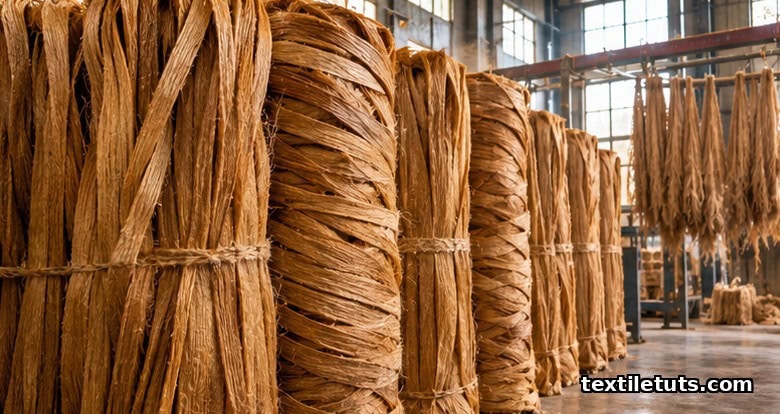
The jute spinning process converts retted and stripped 1.5 to 3 m Corchorus capsularis or Corchorus olitorius bast ribbons into twisted yarn through five sequential stages: batching with 5 to 7 percent jute batching oil, softening on fluted roller stacks, breaker and finisher carding, three-passage gill-box drawing, and spinning on flyer or sliver-spun ring frames, delivering commercial yarn counts between 170 and 415 tex at delivery speeds of 12 to 25 m/min on the frame.
Jute is the second most produced natural fiber on earth, and unlike cotton it never sees a blowroom or a flat-top card. The fiber arrives at the mill as long, stiff, lignin-rich ribbons that have already passed through retting, stripping, and drying, so the spinning chain starts with material that is fundamentally different from seed hairs and demands machines built specifically for bast fibers.
Why Jute Spinning Differs from Cotton Spinning
Jute is a bast fiber, harvested from the bark of Corchorus, and the filaments stay bundled in long ribbons. A single retted strip is 1.5 to 3 m long and 20 to 30 µm thick, while a cotton lint is 25 to 40 mm long and 12 to 22 µm thick. Bast ribbons carry 12 to 14 percent lignin and only 60 to 65 percent cellulose, against cotton’s 88 to 96 percent cellulose with negligible lignin. Lignin is the reason raw jute ribbon is brittle, the reason it cannot be carded to single fibers the way cotton can, and the reason jute mills apply a lubricating oil emulsion (jute batching oil, JBO) before softening to plasticize the fiber bundle. Jute’s moisture regain of 12.5 to 13.7 percent, versus cotton’s 8.5 percent, is why jute mills humidify heavily.
Jute Fiber Properties That Set the Spinning Parameters
Tensile strength of single jute filaments reaches 30 to 50 cN/tex dry and 35 to 55 cN/tex wet, making jute one of the strongest natural fibers in commercial use and a fiber that survives the aggression of the softening rollers. Specific fiber fineness runs 1.8 to 3.5 tex, but the ribbon as handled in the mill is closer to 60 to 100 ktex because the filaments stay bundled through batching, softening, and carding. Most jute yarns are constructed from ribbons broken into shorter overlapping fiber segments, with fibers aligned helically and locked together by twist in the flyer or ring stage. The yarn’s tensile properties therefore come from fiber bundle friction and twist, not from a fully parallel fiber core.
Stage 1: Batching
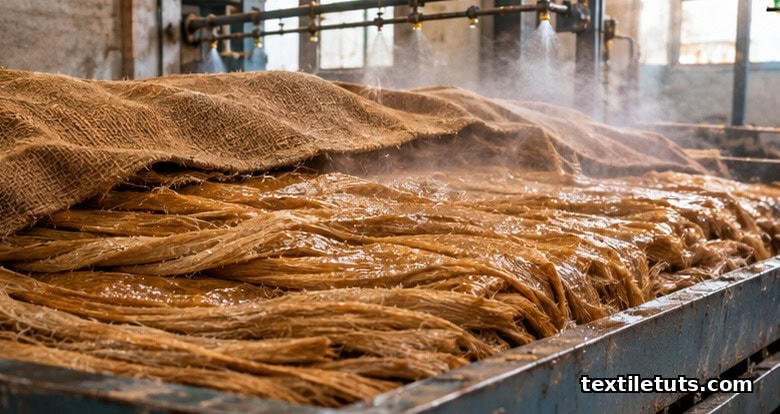
Batching is the first mill-floor operation. Re-dried jute ribbons from the press are arranged in 8 to 12 tonne batches by grade and sprayed with a mineral-oil-and-water emulsion called jute batching oil (JBO) at 5 to 7 percent of fiber mass, plus a trace of surfactant. The ribbons rest under a covering of jute cloth for 12 to 24 hours. The oil diffuses into the fiber bundle, softens the lignin-rich middle lamella, and adds the surface lubricity the next machine needs. Under-batched jute cracks in the softening rollers; over-batched jute slips out of the card and shows excessive fly waste. Batching also lifts the moisture from the press’s 9 to 11 percent back into the 13 to 15 percent band, where jute is flexible enough for mechanical action without producing static in the card.
Stage 2: Softening (Crushing)
The softener (also called a stacking or crushing machine) consists of pairs of spiral-fluted cast-iron rollers turning against each other at slightly different surface speeds. A typical machine has 6 to 12 pairs, each 150 to 200 mm in diameter, set in vertical or horizontal configuration. The spiral flutes break the stiff jute ribbon into shorter, more flexible fiber bundles while the pressure load (1.5 to 3 tonne on the nip) plasticizes the lignin. Two to three passages are standard. Output is a tangled mass of crushed ribbon with 30 to 50 percent of the original broken into segments 200 to 500 mm long, which is the length range the card feed can accept. Throughput runs 400 to 800 kg/h per passage on a single line.
Stage 3: Carding
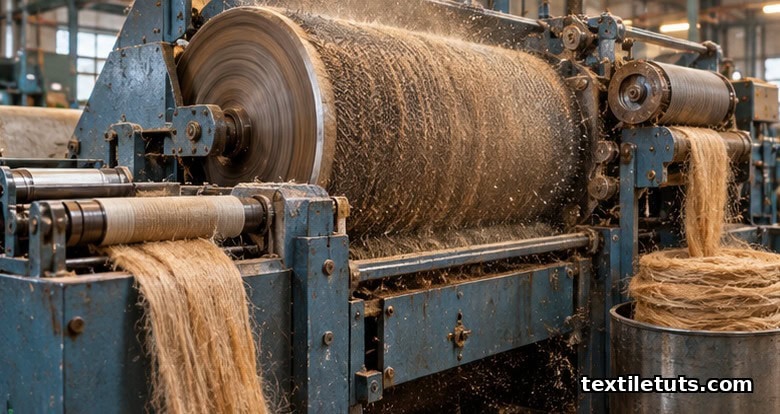
Jute carding is fundamentally different from cotton carding. Cotton cards individualize fibers to the single-fiber state; jute cards deliver ribbons and ribbon segments in an aligned tape, removing shives (woody core particles) and dust rather than opening every filament. Jute mills always run cards in pairs, which is why the machines are taller and heavier than their cotton counterparts. The breaker card has a main cylinder at 150 to 180 rpm, worker and stripper rollers, a feed roller, and a doffer that condenses the fiber stream into a sliver of 60 to 100 ktex, with trash removal of 60 to 75 percent. The finisher card repeats the process with finer settings, producing a sliver at 25 to 40 ktex with less than 2 percent shive content by mass. Total card delivery rate sits at 150 to 250 kg/h per line on a well-tuned modern card.
Stage 4: Drawing (Gill-Box)
A jute drawing frame is a gill box, a chain of faller bars that carries rows of pins through the sliver as it is drafted between the back roller and the front roller. Because the sliver entering has not been individualized, pin drafting is adequate and far cheaper than per-fiber control. Three passages are standard: breaker, intermediate, and finisher drawing. Doublings of 4 to 6 ends up at each passage reduce count variation by the square root of the number of doublings, while drafts of 4 to 8 reduce linear density progressively. Sliver linear density falls from 25 to 40 ktex at the finisher card to 12 to 25 ktex at the finisher drawing passage. The dominant fault at the draw frame is draughty sliver, regular thick-and-thin places produced by mis-set pins or damaged faller bars.
Stage 5: Spinning (Flyer and Ring Frames)
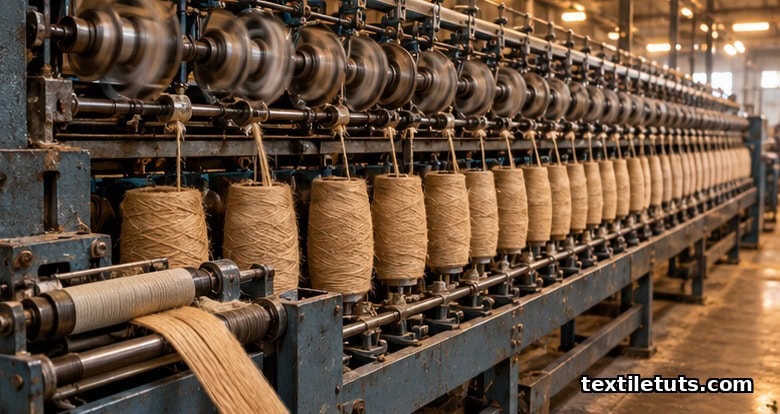
Jute spinning is dominated by two systems: flyer spinning (Hessian spinning or sliver spinning, developed in Dundee) and ring-frame spinning (the sliver-spun system for finer jute counts). Both feed finisher draw-frame sliver directly into the draft zone; there is no roving stage. Flyer spinning is the classical jute route: the sliver passes through a draft zone of 8 to 14x draft between back, middle, and front rollers, and twist is inserted by a flyer rotating at 1,200 to 2,500 rpm while the bobbin is held in the lift, producing a tapered cop suitable for creel feeding. Flyer-spun jute yarn is typically 250 to 415 tex and dominates the hessian sacking market. Ring-frame jute spinning (Janata-type frames, JF frames internationally) replaces the flyer with a ring and traveler running at 6,000 to 9,000 rpm and produces a finer, more even yarn at 170 to 330 tex with stronger single-end tenacity. Twist multipliers run 1.6 to 2.4 turns per meter per √tex for coarse jute counts. Delivery speeds are 8 to 18 m/min on flyer frames and 12 to 25 m/min on JF ring frames, with output per spindle per shift of 8 to 14 kg on flyer frames and 12 to 18 kg on ring frames for 250 tex yarn.
Comparison Table: Jute Spinning vs Cotton Spinning
| Process Property | Jute Spinning | Cotton Spinning |
|---|---|---|
| Staple length entering mill | 1.5 to 3 m ribbons | 25 to 40 mm lint |
| Fiber type | Bast (bark) fiber | Seed hair fiber |
| Cellulose content | 60 to 65 percent | 88 to 96 percent |
| Lignin content | 12 to 14 percent | Negligible |
| Pre-spinning lubrication | Jute batching oil emulsion, 5 to 7 percent | Antistat spin finish, 0.2 to 0.5 percent |
| Cleaning approach | Retting + breaker and finisher card | Blowroom + flat-top card |
| Card output, fiber state | Ribbon segments, 60 to 500 mm | Individualized single fibers |
| Drawing passages | 3 (breaker, intermediate, finisher) | 1 to 2 (post-carding) |
| Drafting technology | Gill-box pin drafting | Roller apron drafting |
| Spinning frame | Flyer or sliver-spun ring | Ring, rotor, air-jet, or vortex |
| Delivery speed (m/min) | 8 to 25 | 25 to 500 |
| Practical tex range | 170 to 415 | 4 to 60 |
| Tenacity (cN/tex) | 30 to 50 | 20 to 35 |
| Dominant end use | Hessian, sacking, geotextiles, composites | Apparel, home textile, technical |
Frequently Asked Questions
Why does jute spinning start with oil and moisture?
Jute ribbon is brittle at the press because it is rich in lignin (12 to 14 percent) and dry (under 11 percent moisture). A mineral-oil-and-water emulsion called jute batching oil (JBO) is sprayed at 5 to 7 percent of fiber mass, and the batch rests for 12 to 24 hours before softening. The oil softens the middle lamella between fibers and adds the surface lubricity the fluted softening rollers need; the water lifts moisture back into the 13 to 15 percent band, where jute is flexible. Without JBO, the ribbon shatters under the rollers.
What is a jute drawing frame, and how does it differ from a cotton draw frame?
A jute drawing frame is a gill box, a chain of faller bars carrying pins through the sliver as it is drafted between back and front rollers. A cotton draw frame uses a roller-and-apron draft system that controls fibers individually. Because jute sliver contains ribbon segments 60 to 500 mm long rather than single fibers, pin drafting is adequate. Three passages are standard in jute (breaker, intermediate, finisher), against one or two in cotton post-carding.
Why is jute yarn spun on flyer frames rather than ring frames?
Flyer spinning handles the heavy sliver and coarse yarn counts that jute typically requires (250 to 415 tex) with low tension and a long twist zone, which protects the heavier yarn from the high-spindle-speed tension that a ring and traveler would impose. Ring-spun jute, on JF or Janata frames, is used for finer counts (170 to 330 tex), finer yarn evenness, and stronger single-end tenacity. Both systems coexist in the modern jute mill: flyer for coarse hessian, ring for finer yarn that may be bleached or finished for technical textile use.
How is jute yarn count measured, and what counts are common?
Jute yarn is counted in the tex system (grams per 1,000 m) or, in older Indian, Pakistani, and Bangladeshi mills, in English count (lb per spindle). Common commercial counts run 170 to 415 tex, with 280 tex a typical hessian count and 415 tex a heavy sacking yarn. The tex value is verified on a wrap reel and laboratory balance using the skein method, and a typical hessian yarn breaks at 14 to 18 cN/tex per ISO 2061 single-end tenacity references.
Is jute spinning still relevant with synthetic packaging alternatives available?
Yes. Jute is biodegradable and carbon-sequestering, unlike woven polypropylene, and it has the highest tensile strength per unit weight among commercial natural fibers, which is why jute geotextiles and jute-reinforced composites continue to grow. The jute spinning chain also employs several million workers in Bangladesh and West Bengal. Modern high-speed JF frames and quality-monitoring systems have lifted productivity by 30 to 50 percent since 2000.
References
- Kozlowski, R.M. (Ed.). Handbook of Natural Fibres: Volume 2, Processing and Applications. Woodhead Publishing (Elsevier), Cambridge, UK, 2012.
- Kozlowski, R.M. (Ed.). Handbook of Natural Fibres: Volume 1, Types, Production and Chemistry. Woodhead Publishing (Elsevier), Cambridge, UK, 2012.
- Mather, R.R. and Wardman, R.H. The Chemistry of Textile Fibres. Royal Society of Chemistry (RSC), Cambridge, UK, 2015.
- Mohanty, A.K., Misra, M., Drzal, L.T. (Eds.). Natural Fibers, Biopolymers, and Biocomposites. CRC Press (Taylor & Francis), Boca Raton, FL, 2005.
- Mwaikambo, L.Y. and Ansell, M.P. “Chemical modification of hemp, sisal, jute, and kapok fibers by alkalization.” Journal of Applied Polymer Science, Vol. 84, No. 12, 2002, pp. 2222 to 2234.
- Rowell, R.M. and Stout, H.P. “Jute and Kenaf.” In Lewin, M. (Ed.), Handbook of Fiber Chemistry, 3rd ed., CRC Press (Taylor & Francis), Boca Raton, FL, 2007.
- Encyclopaedia Britannica. “Jute: Plant Fibre.” Encyclopedic reference for fiber origin, retting, and major jute-producing countries.
This article is the working reference for the jute spinning process. Editorial by Iftay Khairul Alam, TextileTuts. Sources: Kozlowski (Woodhead/Elsevier), Mather and Wardman (RSC), Mohanty et al. (CRC/Taylor & Francis), Mwaikambo and Ansell (Wiley), Rowell and Stout (Taylor & Francis), and Encyclopaedia Britannica, as cited.


