
Wire Weaving: Metal Mesh

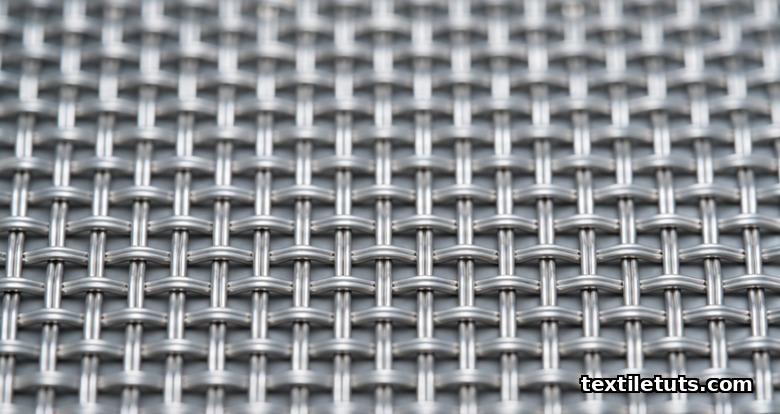
Wire weaving produces metal mesh with aperture openings from 0.025 mm to 12.7 mm, mesh counts from 2 to 400 openings per linear inch, and tensile strengths between 400 and 2,000 MPa depending on the wire alloy and weave pattern.
Metal mesh is a woven textile formed by interlacing metallic wires on looms that operate on the same warp-and-weft principle as a conventional fabric loom, only with steel, stainless steel, copper, brass, bronze, or nickel-alloy wire in place of cotton, polyester, or fiberglass yarn. The end product is a textile structure that behaves like a fabric in flexibility, but like a metal sheet in mechanical strength, heat tolerance, and chemical resistance.
This article walks through how wire weaving works, the four weave geometries that define mesh behavior, the wire alloys that set its performance envelope, the standards that govern mesh specification, and the test methods used to verify what a weaver has actually made.
What Wire Weaving Actually Is
A wire mesh fabric is built on the same structural logic as any other woven cloth. A set of straight warp wires runs lengthwise under tension on the loom. A second set of weft wires is inserted crosswise, usually one pick at a time, by a shuttle, a rapier, or a needle. The warp and weft cross at right angles and lock together by friction at every intersection. When the wires are stainless steel, brass, or copper, the resulting textile behaves physically like a sheet of metal with regular, repeatable holes.
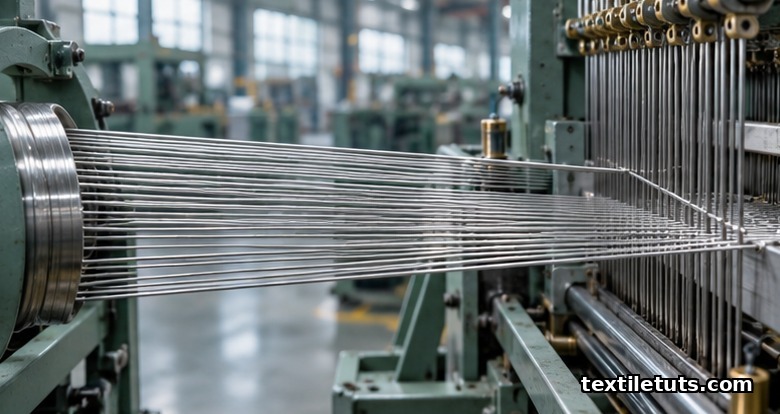
The mechanical difference from a polymer-fibre weave is the wire diameter and the spring-back. A 0.10 mm stainless-steel wire is roughly 8 to 10 times stiffer in bending than a 0.10 mm cotton yarn, and it returns to its original position once deflected. That spring-back is what gives metal mesh its characteristic snap when handled and its dimensional stability under load.
Wire mesh differs from perforated sheet, expanded metal, and welded wire mesh in one important way. Wire cloth is woven, so the openings are precisely regular and the wires cross over and under each other rather than being fused at the joints. This gives woven mesh a higher open area percentage than welded mesh of the same nominal aperture, and finer apertures than expanded metal of the same sheet thickness.
The Four Weave Geometries That Define Mesh
Wire cloth specification is dominated by four weave types. Each geometry produces a different balance of flow rate, mechanical strength, and particle-retention capability.
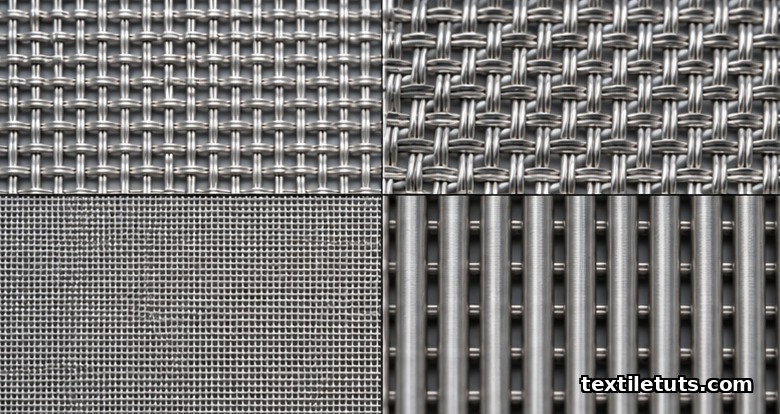
Plain weave is the most common. Each weft wire passes over one warp wire and under the next, alternating on every pick. The mesh count (number of openings per linear inch) and the wire diameter together determine the aperture. Plain-weave mesh is mechanically balanced in both directions and is used for general screening, sifting, and filtration where the aperture is wider than about 0.10 mm.
Twill weave allows each weft wire to pass over two warp wires and under the next two. This offset pattern lets a twill mesh carry a heavier wire for the same mesh count, which translates to greater mechanical strength and longer service life under abrasive loading. Twill is the geometry of choice for mining screens, vibrating sieves, and filter cloth in mineral processing.
Dutch weave uses a small warp wire diameter and a heavier weft wire. The warp wires sit close together and the weft wires are packed densely over them, producing a mesh with very small effective aperture but high overall open area. Dutch weave is the standard filter medium for fine particulate retention, hydraulic fluid filtration, and pharmaceutical processing. Typical retention ratings run from 5 µm to 200 µm.
Reverse dutch weave inverts that geometry. The warp wires are heavy, the weft wires are light, and the heavy warp wires are packed closely. The mechanical strength sits in the warp direction, making reverse-dutch mesh suitable for high-pressure filter tubes, candle filters, and strainers where the differential pressure across the mesh is high.
Wire Alloys and What Each Brings
Mesh performance is set by the wire material as much as by the weave geometry. The four most common alloys cover about 95 percent of industrial wire cloth production.
Stainless steel (304 and 316) is the workhorse alloy. Type 304 stainless (18 percent chromium, 8 percent nickel) offers tensile strength around 620 MPa and good corrosion resistance in oxidizing environments. Type 316 adds 2 to 3 percent molybdenum, which raises pitting-corrosion resistance in chloride-rich environments and pushes tensile strength to around 700 MPa. Both are specified under ASTM A580 for stainless-steel wire.
Brass (typically 70 percent copper, 30 percent zinc) is used where electrical conductivity, EMI shielding, and decorative appearance matter more than mechanical strength. Brass wire mesh has a tensile strength around 400 MPa and is a common architectural mesh for interior partitions and facades.
Copper mesh is softer (around 220 MPa tensile) but offers the highest electrical and thermal conductivity of the common mesh alloys. It is used for RF shielding enclosures, Faraday cages, and certain pharmaceutical filtration applications where copper’s bacteriostatic behaviour is useful.
Nickel and nickel alloys (Monel, Inconel, Hastelloy) cover extreme service. Inconel 600 wire mesh retains useful tensile strength above 600 °C and resists oxidizing atmospheres at those temperatures. Monel 400 mesh resists hydrofluoric acid and seawater corrosion. These alloys push tensile strength above 1,000 MPa and are specified in aerospace, chemical processing, and oil-and-gas filtration.
How Mesh Count, Wire Diameter, and Aperture Relate
Mesh count is the number of openings per linear inch. Aperture is the clear distance between adjacent wires. Wire diameter is the thickness of each wire. The three are linked by a geometric identity that defines every woven-wire specification:
Aperture (mm) = 25.4 / mesh count - wire diameter (mm)
A 100-mesh cloth with a 0.10 mm wire diameter has an aperture of 25.4 / 100 – 0.10 = 0.154 mm. A 200-mesh cloth with the same wire diameter has an aperture of 0.027 mm. Push the mesh count higher and the aperture shrinks, but the wire diameter must also shrink to keep the cloth physically weaveable. Practical manufacturing limits sit near 400 mesh for plain weave and around 500 mesh for dutch weave, with wire diameters of 0.025 mm or smaller.
The open area percentage of the cloth (the proportion of total area that is empty aperture rather than wire) follows a separate relationship:
Open area (%) = (aperture / (aperture + wire diameter))² × 100
A 100-mesh × 0.10 mm cloth with a 0.154 mm aperture has an open area of about 36 percent. A 60-mesh × 0.20 mm cloth with a 0.223 mm aperture has an open area of about 27 percent. Higher mesh counts do not automatically give higher open area. The trade-off between fineness and flow rate is set by wire diameter as much as by mesh count.
Standards That Govern Wire Cloth Specification
Wire cloth is one of the most heavily standardized industrial textiles. Three families of standard are used globally:
ISO 9044 specifies requirements for industrial woven wire cloth made of round wire, including tolerances on mesh count, wire diameter, aperture, and width. It is the global reference standard for plain and twill weave mesh in carbon steel, stainless steel, and non-ferrous alloys.
ISO 4783-1 to 4783-3 covers wire cloth combinations, preferred sizes, and tolerances for industrial applications including filtration and screening.
ASTM E2016 is the U.S. standard specification for industrial woven wire cloth, with detailed tolerance classes for mesh count, wire diameter, and aperture. ASTM E454 covers industrial perforated plate and sheet (a related but distinct product).
ASTM A580 covers stainless-steel wire as a raw material, including mechanical property requirements for tensile strength, elongation, and hardness.
For sieve analysis, ISO 3310-1 and ASTM E11 define the wire cloth used in test sieves, with standardized aperture sizes from 125 mm down to 20 µm.
How Wire Cloth Is Tested
The two load-bearing tests for woven-wire cloth are tensile testing of the wires (the raw-material strength) and aperture verification (the finished-product geometry).
Tensile testing follows ISO 6892-1 for metallic wire at ambient temperature. Specimens are pulled to failure and the ultimate tensile strength, yield strength, and elongation at break are recorded. For 316 stainless steel wire used in mesh production, ultimate tensile strength typically falls between 620 and 800 MPa depending on the wire’s cold-work history.
Aperture verification uses optical measurement under ISO 9044 and ASTM E2016 tolerance tables. A sample of mesh is illuminated from below and the apertures are measured by calibrated microscope or by automated vision system. For fine mesh below 100 µm aperture, scanning electron microscopy is used to resolve apertures that optical methods cannot.
For woven-wire cloth used in filtration, ISO 16889 defines the multi-pass test for hydraulic filter elements, which exercises the mesh against a controlled contaminant load and measures the beta ratio (the ratio of upstream to downstream particle counts above a given size). A beta-1000 rating at 25 µm means that for every 1,000 particles of 25 µm or larger upstream, fewer than 1 pass downstream.
Wire Mesh Compared to Welded Mesh and Perforated Sheet
| Property | Woven wire cloth | Welded wire mesh | Perforated metal sheet |
|---|---|---|---|
| Junction type | Wires cross over/under, no fusion | Wires resistance-welded at every intersection | Solid sheet with punched holes |
| Smallest aperture | ~25 µm (400 mesh) | ~1 mm typical, ~0.5 mm achievable | ~0.5 mm typical |
| Maximum open area | ~50 percent at most mesh counts | ~80 percent in heavy grid | ~50 percent (hexagonal pattern) |
| Mechanical strength direction | Balanced (plain) or directional (dutch) | Strong at welds, weaker between | Anisotropic (depends on hole pattern) |
| Common materials | Stainless, brass, copper, nickel alloys | Galvanized steel, stainless | Steel, stainless, aluminium |
| Typical applications | Filtration, sieving, EMI shielding | Fencing, concrete reinforcement, cages | Screening, decorative panels, guards |
Welded mesh wins on raw mechanical strength and open area for a given wire diameter, but it loses at fine apertures because the welding process cannot reliably join sub-millimetre wires without fusing them together. Perforated sheet wins on stiffness and impact resistance, but the apertures are limited by punch tooling and the open area is constrained by the punch pattern geometry. Woven cloth wins on aperture precision, fine-mesh capability, and bidirectional flexibility.
Where Wire Mesh Is Used
Filtration is the largest single application. Dutch-weave cloth filters hydraulic fluid, fuel, pharmaceutical liquids, and process water. Stainless steel dutch mesh with a 10 µm retention rating is a standard hydraulic filter element in aerospace and heavy-equipment hydraulics.
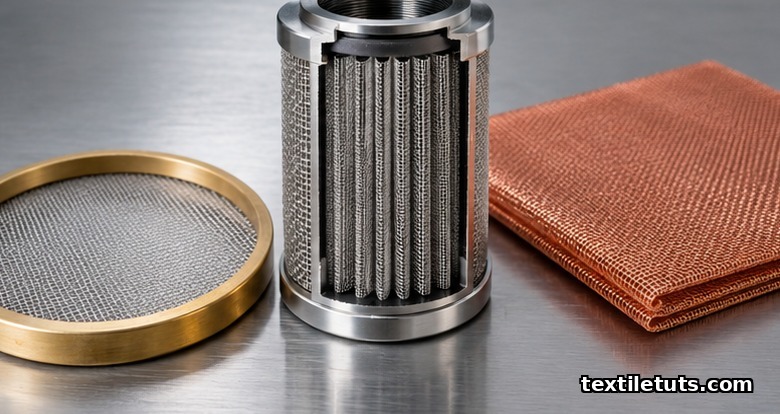
Screening and sifting covers mining, aggregate processing, food and grain grading, and pharmaceutical powder classification. A typical mineral-processing plant uses vibrating screens lined with twill-weave stainless mesh in the 0.5 mm to 2 mm aperture range.
EMI and RF shielding uses copper, brass, and tin-plated steel mesh in gasket and enclosure form to block electromagnetic interference. A double layer of 100-mesh copper cloth provides 60 to 80 dB of shielding effectiveness across the 1 MHz to 1 GHz range.
Architectural applications include woven-wire facades, interior partitions, ceiling panels, and decorative screens. Brass and bronze mesh are common for these uses because of their colour and resistance to indoor corrosion.
Reinforcement applications include composite layup (woven wire cloth embedded in resin), filtration candles, and industrial battery plates.
Frequently Asked Questions
What is the smallest aperture available in woven wire mesh?
The finest commercially available woven wire cloth is dutch weave at around 5 µm (0.005 mm) effective aperture, with mesh counts up to about 500 per inch. The physical limit is set by the wire diameter needed to keep the cloth weaveable, which for 500-mesh cloth is roughly 0.020 mm. Below this, the wires break during weaving and the cloth cannot hold its geometry.
Does wire mesh rust?
Carbon steel wire mesh rusts quickly when exposed to moisture, and is usually galvanized or coated for protection. Stainless steel grades 304 and 316 resist rust in oxidizing and mildly chloride-rich environments respectively. For marine or chemical service, 316 stainless, Monel, or Hastelloy mesh is specified because 304 stainless can pit in chloride concentrations above about 200 ppm.
Can wire mesh be cut to size?
Yes. Plain and twill weave mesh can be cut with tin snips for light wire diameters, with heavy-duty shears for heavier gauges, or with abrasive-wheel cutters for stainless mesh above 1 mm wire. Dutch weave mesh is best cut with a fine-toothed band saw or a laser cutter to avoid distorting the dense warp-weft packing at the cut edge.
What is the difference between mesh count and aperture?
Mesh count is the number of openings per linear inch. Aperture is the clear distance between adjacent wires in millimetres. They are linked by the formula aperture (mm) = 25.4 / mesh count – wire diameter (mm). A 100-mesh cloth with 0.10 mm wire has 0.154 mm aperture; the same 100-mesh count with 0.20 mm wire has only 0.054 mm aperture.
How do you clean wire mesh without damaging it?
For stainless steel mesh, ultrasonic cleaning with a neutral detergent, back-flushing with clean water, or soaking in a 5 percent nitric acid pickle passivation bath removes particulate and restores the chromium-oxide layer. Avoid hydrochloric acid on stainless mesh because chloride ions cause pitting. For brass and copper mesh, mild detergent and warm water are sufficient; avoid ammonia-based cleaners on copper because they tarnish the surface.
References
- International Organization for Standardization. ISO 9044:1999 — Industrial woven wire cloth — Technical requirements and tests. iso.org — base specification for plain and twill weave wire cloth tolerances.
- International Organization for Standardization. ISO 3310-1:2016 — Test sieves — Technical requirements and testing — Part 1: Test sieves of metal wire cloth. iso.org — aperture tolerances for sieving-grade wire cloth.
- International Organization for Standardization. ISO 6892-1:2019 — Metallic materials — Tensile testing — Part 1: Method of test at room temperature. iso.org — method for tensile testing of wire used in mesh production.
- ASTM International. ASTM E2016 — Standard Specification for Industrial Woven Wire Cloth. astm.org — U.S. specification for wire cloth tolerances and acceptance criteria.
- ASTM International. ASTM A580/A580M — Standard Specification for Stainless Steel Wire. astm.org — raw-material specification covering tensile and elongation requirements.
- International Organization for Standardization. ISO 16889:2008 — Hydraulic fluid power — Filters — Multi-pass method for evaluating filtration performance of a filter element. iso.org — multi-pass test method for filter cloth performance.
- ResearchGate. Characterization of woven wire mesh filters for hydraulic applications. researchgate.net — peer-reviewed study on filter-cloth pressure drop and retention behaviour.
- MDPI. Electromagnetic shielding effectiveness of woven copper and brass mesh. mdpi.com — peer-reviewed paper on shielding performance of 80 to 200 mesh copper and brass cloth.
This article is the working reference for wire weaving and metal mesh textiles. Editorial by Mohammad Yousuf (Anik), TextileTuts. Sources: ISO 9044, ISO 3310-1, ISO 6892-1, ISO 16889, ASTM E2016, ASTM A580, ResearchGate, MDPI as cited.


