
Carbon Fiber Weaving

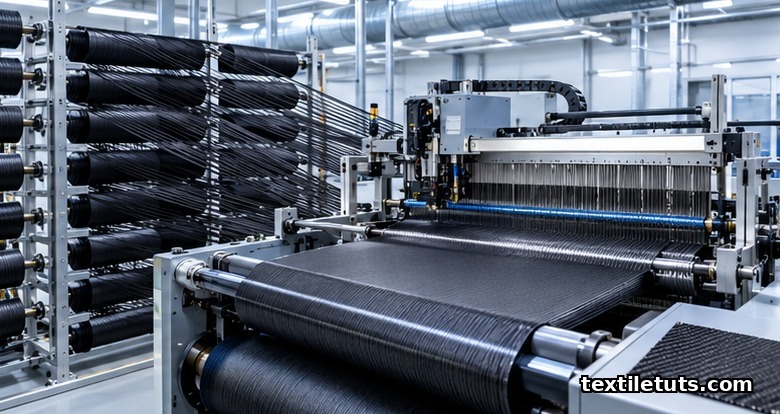
Carbon fiber weaving produces fabrics with tensile strengths of 3,000 to 7,000 MPa and tensile modulus of 230 to 700 GPa by interlacing continuous carbon tows (typically 1K to 24K filaments per bundle) on rapier or air-jet looms under tow tensions of 5 to 15 cN per end.
This is the highest-performance fabric form a weaving loom can deliver, and its properties depend directly on tow count, weave pattern, and loom settings. The article covers what carbon fiber weaving is, how to read tow specifications, common weave patterns, loom setup parameters, defects to control for, and the applications where woven carbon fabric sits in the supply chain.
What Carbon Fiber Weaving Is and Why It Matters
Carbon fiber weaving is the interlacing of continuous carbon fiber tows (untwisted bundles of parallel filaments, usually polyacrylonitrile (PAN)-based) into a planar fabric using a loom. The woven fabric is a dry, preform-stage reinforcement that is later combined with a polymer resin (epoxy is the most common matrix) to make a structural composite. The fabric itself carries no load by itself: the resin system transfers load between tows and provides compressive strength, but the woven geometry determines how stiff and strong the cured laminate will be.
Two facts make carbon fiber weaving a distinct discipline from textile weaving of cotton, wool, or aramid. First, carbon tows are abrasive and brittle, which puts hard wear on loom parts. Second, carbon tows have almost zero elongation before failure (1.5 to 2.0% for standard modulus fiber per ASTM D4018-17), so any localized tension spike or sharp radius during weaving translates directly into filament breakage and lost tensile properties in the cured laminate.
For a textile engineer, the practical interest is that carbon weaving borrows standard loom hardware (rapier, air-jet, projectile) but applies textile mechanics to a fiber whose stress-strain curve looks nothing like a natural fiber’s. Tow tension control, selvage formation, and weft insertion become the variables that decide whether the fabric is suitable for an autoclave-cured aerospace preform or only a non-structural panel.
Carbon Fiber Tow Specifications and Properties
A carbon tow is designated by the number of filaments it contains: 1K (1,000 filaments), 3K (3,000), 6K (6,000), 12K (12,000), and 24K (24,000) are the standard textile counts per ISO 13002:2014. Smaller tow counts (1K and 3K) are used where fabric drape and surface smoothness matter (cosmetic panels, complex contours), while 12K and 24K tows are used where cost and layup speed dominate (wind turbine blades, automotive).
Standard modulus PAN-based carbon fiber has a density of 1.75 to 1.80 g/cm³ per ISO 10119:2020, a tensile strength of 3,000 to 7,000 MPa, and a tensile modulus of 230 to 250 GPa. Intermediate modulus grades reach 300 to 350 GPa; high modulus grades reach 500 to 700 GPa with lower strength (2,000 to 4,000 MPa). The trade-off is structural: higher modulus means stiffer composite, lower elongation means more brittle behavior and tougher weaving.
Common fabric areal weights for woven carbon are 90 to 600 g/m². A 3K plain weave at 200 g/m² is a typical reference fabric for hand layup and small composite parts. A 12K twill at 400 to 600 g/m² is a common reference for autoclave-cured aerospace structures.
Common Weave Patterns for Carbon Fabric
Four weave patterns dominate the carbon fabric catalog:
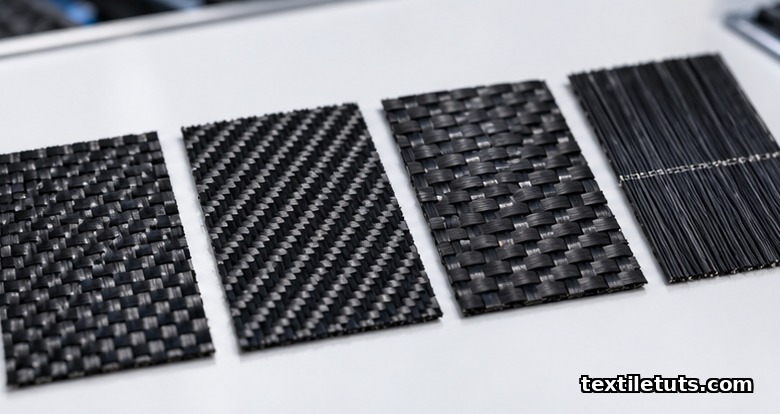
- Plain weave (1/1): Each warp tow passes over one weft tow and under the next. Maximum interlacing gives the highest dimensional stability and the lowest in-plane drapability. Used where flat, stable fabric matters more than conformability.
- Twill weave (2/2 or 4/4): Each warp tow passes over two (or four) weft tows before going under. Better drape than plain weave with a small penalty in stability. 2/2 twill is the most common pattern for aerospace preforms.
- Satin weave (4-harness, 5-harness, 8-harness): Long floats with single interlacing points. Maximum drape and minimum crimp, which translates to higher effective fiber strength in the cured laminate. Used where mechanical performance matters more than handling stability.
- Unidirectional (UD) fabric: Warp tows with only light weft (usually thin polyester or glass) to hold the fabric together. Used where maximum fiber volume fraction is required in one direction.
Crimp is the key property to watch across these patterns. Crimp is the undulation a tow develops as it passes over and under perpendicular tows. Higher crimp means more out-of-plane waviness in the cured laminate, which lowers compressive strength. Satin weaves show 1 to 3% crimp; plain weaves show 5 to 10% crimp; this is why satin is preferred for primary structure where compressive strength is critical.
Loom Setup and Weaving Process Parameters
Carbon weaving uses standard textile looms with material-specific adjustments. Rapier looms dominate because weft insertion is gentle and tow damage is low. Air-jet looms are used for narrow carbon fabrics where speed matters and tow count is low (1K to 3K); the air jet does introduce more filament breakage than a rapier. Projectile looms are used for very wide carbon fabrics.
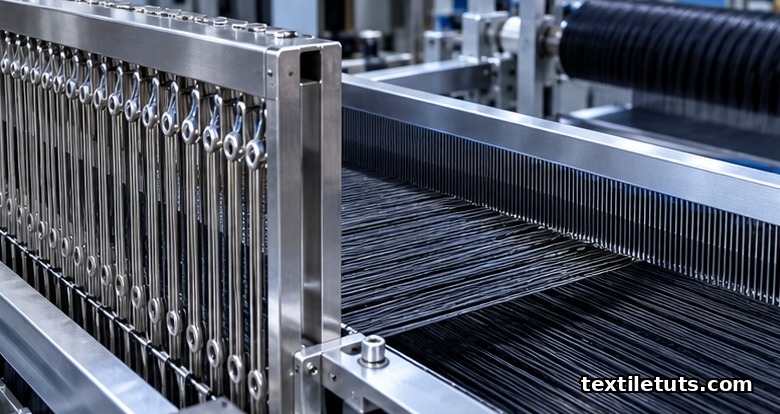
Critical process parameters for a carbon weave:
- Warp tension: 5 to 15 cN per tow, depending on tow count and weave pattern. Higher tension lowers crimp but risks filament breakage, especially with 1K tows.
- Weft insertion rate: typically 200 to 600 picks per minute on rapier looms for 3K to 12K fabrics. Higher rates increase weft-way tow damage.
- Heddle and reed: Stainless steel or ceramic-coated heddles, because bare steel abrades carbon filaments. Reed dent spacing matches tow width (typically 5 to 10 dents per inch for 3K tows).
- Humidity control: 50 to 65% relative humidity in the weave room. Dry carbon tows generate static, which causes shedding and lapping defects; too much moisture causes tow swelling and tension variation.
- Selvage: woven selvage using the same carbon tow or a sacrificial polyester tow, with locked edges to prevent fraying during subsequent handling and preforming.
The fiber volume fraction of the cured laminate is bounded by the woven fabric’s geometry. A typical 2/2 twill at 200 g/m² produces a cured laminate with 50 to 55% fiber volume fraction when impregnated with epoxy at standard resin content (35 to 45% by weight). Higher fiber volume fractions require satin weaves or UD fabrics, both of which pack more fiber per unit area.
Common Defects in Carbon Fiber Weaving
Defects in carbon weaving fall into a smaller set than in natural fiber weaving, but each is more consequential because carbon fabric is load-bearing:
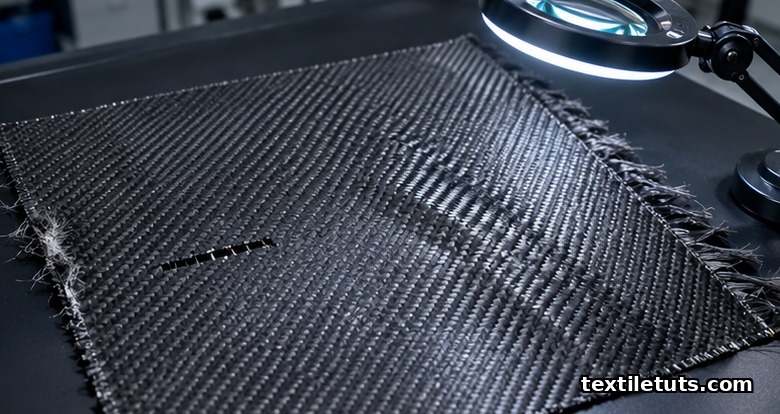
- Broken filaments: individual filaments fractured during weaving, visible as fuzz on the tow surface. Caused by excessive tension, abrasion on heddles, or sharp reed dents. ASTM D4018-17 is used to verify that the as-woven tow retains its specified tensile strength.
- Missing picks or missing ends: gaps in the weave from weft or warp insertion failure. Caused by static, incorrect tension, or mis-aligned harnesses.
- Crimp imbalance: warp and weft tows showing different crimp percentages, which causes anisotropic behavior in the cured laminate.
- Selvage fraying: loose tows at the fabric edge, caused by incorrect selvage settings or low edge tension.
- Contamination: oil, silicone, or dust on the tow, which prevents proper resin wet-out in the cured laminate. Weaving rooms handling carbon typically run cleaner than apparel weaving rooms.
Each defect is checked during weaving by visual inspection under polarized light and by periodic tensile testing of the as-woven tow per ASTM D4018-17. Aerospace-grade carbon fabric is typically 100% inspected, while industrial-grade fabric is sampled.
Carbon Fabric Applications
Woven carbon fabric is a structural reinforcement, not a final product. The end-use parts made from it:
- Aerospace primary and secondary structure: aircraft floor beams, wing skins, fuselage frames. 2/2 twill at 200 to 300 g/m², autoclave-cured epoxy prepreg.
- Wind turbine blades: spar caps and root sections, often UD or heavy twill at 600 to 800 g/m², vacuum-infused epoxy.
- Automotive: body panels, chassis components, driveshafts. Mix of 2/2 twill and UD, resin transfer molding (RTM) or wet compression molding.
- Sports equipment: bicycle frames, tennis rackets, racing shells. 2/2 twill or plain weave at 200 to 400 g/m², autoclave or oven-cured epoxy.
- Pressure vessels: Type IV CNG and hydrogen tanks. Wrap-wound carbon over a polymer liner, with the wrap pattern derived from filament winding rather than weaving.
The woven fabric’s role across these uses is consistent: it provides the in-plane stiffness and strength that the part needs, while the resin system (chosen separately) provides compressive strength, out-of-plane toughness, and environmental resistance.
Frequently Asked Questions
What is the difference between carbon fiber and carbon fiber fabric?
Carbon fiber is the filament itself, a polyacrylonitrile (PAN) or pitch precursor that has been oxidized, carbonized, and graphitized into a continuous filament about 5 to 7 micrometers in diameter. Carbon fiber fabric is the textile form, made by weaving thousands of these filaments into a tow and then interlacing tows on a loom. The fiber is the raw material; the fabric is the reinforcement form a composite part is built from.
Why is carbon fiber woven and not just used as a unidirectional sheet?
Unidirectional (UD) sheets have higher fiber volume fraction and higher strength along the fiber direction, but they are unstable in handling and have almost no strength perpendicular to the fibers. Woven fabric trades a small amount of in-plane strength (because of crimp) for balanced strength in two directions and far better handling and draping. For most aerospace, automotive, and sporting-goods parts, that trade-off is worth it.
Can carbon fiber be woven on a standard textile loom?
The loom mechanism (rapier, air-jet, projectile) can be standard, but the contact parts touching the carbon tow (heddles, reed dents, yarn guides) must be stainless steel, ceramic-coated, or polymer to prevent abrasive filament breakage. The warp and weft tension settings, humidity control, and cleanliness standards are also more demanding than for natural fibers. A loom set up for cotton or polyester can be reconfigured for carbon, but not without material changes.
Does carbon fiber lose strength during weaving?
Yes. Standard modulus carbon tow starts at 3,000 to 7,000 MPa tensile strength as measured on the unsized, untensioned tow. After weaving, the same tow typically retains 90 to 95% of that strength when properly processed, dropping to 80 to 85% with poor tension control or abrasive guides. ASTM D4018-17 is the standard test method used to confirm retained tensile strength after weaving.
What is the typical price of woven carbon fabric?
Industrial-grade 3K twill at 200 g/m² trades at roughly USD 25 to 60 per square meter as of 2026, while aerospace-grade autoclave-cure prepreg (resin-pre-impregnated woven fabric) trades at USD 80 to 250 per square meter. The variation reflects tow count, weave pattern, inspection standards, and resin system. Heavy 12K fabrics at 600 g/m² fall in similar ranges, with pricing dominated by raw fiber cost.
References
- International Organization for Standardization. ISO 10119:2020 — Carbon fibre — Determination of density. iso.org — Specifies the gas pycnometer and column density methods for carbon fiber density.
- International Organization for Standardization. ISO 13002:2014 — Carbon fibre — Designation system for filament yarns. iso.org — Defines the K (1,000 filament) designation system for carbon tows.
- ASTM International. ASTM D4018-17 — Standard Test Methods for Properties of Continuous Filament Carbon and Graphite Fiber Tows. astm.org — Tensile strength, modulus, and elongation testing for as-produced and as-woven tows.
- ASTM International. ASTM D3039/D3039M-17 — Standard Test Method for Tensile Properties of Polymer Matrix Composite Materials. astm.org — Tensile testing of the cured composite laminate built from woven carbon fabric.
- Hexcel Corporation. HexPly 8552 Product Data. hexcel.com — Reference data sheet for one of the most widely used epoxy resins paired with woven carbon prepreg in aerospace.
- Toray Industries. Torayca T800S and T1100 Technical Data Sheet. toray.com — Manufacturer-published tensile properties for standard and intermediate modulus carbon fiber used in 3K to 24K tow weaving.
This article is the working reference for carbon fiber weaving. Editorial by Mohammad Yousuf (Anik), TextileTuts. Sources: ISO 10119:2020, ISO 13002:2014, ASTM D4018-17, ASTM D3039/D3039M-17, Hexcel HexPly 8552, Toray Torayca T800S/T1100 as cited.


