
Sectional Warping in Weaving

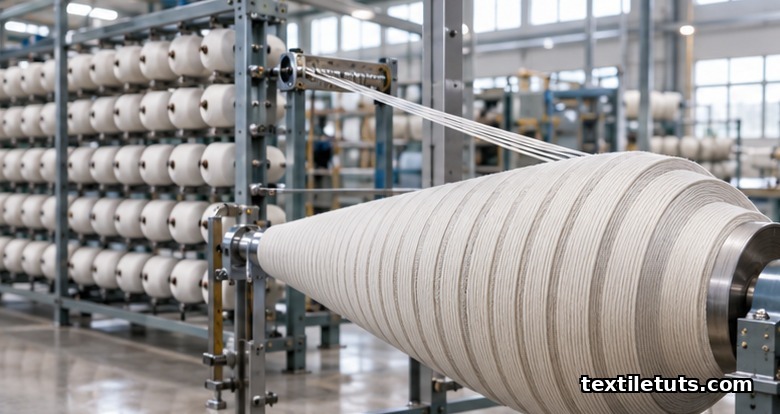
Sectional warping (also called drum warping or pattern warping) winds warp ends in narrow bands of 25 to 50 mm onto a conical drum at production speeds of 200 to 800 m/min, producing a weaver’s beam of 50 to 500 m compared with the 1,000 to 3,000 m beams made by beam (high-speed) warping for bulk production runs.
It is the warp-preparation method textile mills reach for when run length is short, yarn count is fine, or the fabric specification calls for a colored or patterned warp that must be rebuilt often, the same conditions that make a 1,500 m beam warp uneconomical.
This guide walks through how a sectional warping machine works, where it earns its place next to beam warping, the process parameters that govern yarn quality, and the quality-control checks that separate a usable beam from a costly re-do.
What Sectional Warping Is and When Mills Use It
Sectional warping is a two-stage warp-preparation process. In the first stage, a creel feeds a small group of ends (typically 20 to 60 at a time, called a “section”) onto the surface of a tapered drum. Each section is wound as a tight, parallel band that covers the full width of the eventual weaver’s beam. Once every section is on the drum, the operator transfers the full warp from the drum onto the weaver’s beam in a single pull.
The defining feature is the drum itself. Modern sectional warping machines use a cone-shaped drum whose diameter increases by 2 to 4 mm per band of wound yarn. The taper compensates for the layers of yarn already on the drum, so each new section sits in a fresh, sharply defined zone rather than spreading into the previous one. Band width is set by a traversing yarn guide and is typically 25 to 50 mm on cotton and 15 to 30 mm on filament synthetics.
Three conditions point a mill toward sectional warping rather than beam (high-speed) warping:
- Short run length. Sample warps, fashion orders, and short production runs rarely justify the creel setup and yarn waste of a full beam warp. Sectional warping can produce a usable beam from as little as 50 m of warp.
- Patterned or colored warps. Yarn-dyed stripes, checks, and color-and-weave effects need a precise end-by-end color pattern. Sectional warping builds that pattern one section at a time, so a 1,200-end stripe can be reconstructed from a written draft instead of a memory test.
- Fancy or filament yarns. Fancy yarns (slub, boucle, chenille) and fine filament yarns are prone to tension variation and abrasion on a high-speed creel. The slower traverse and lower tension window of a sectional machine preserve yarn quality.
How a Sectional Warping Machine Works
A modern sectional warping machine has three working zones: the creel, the guide-and-tension zone, and the conical drum. Each one governs a different variable in the final beam quality.
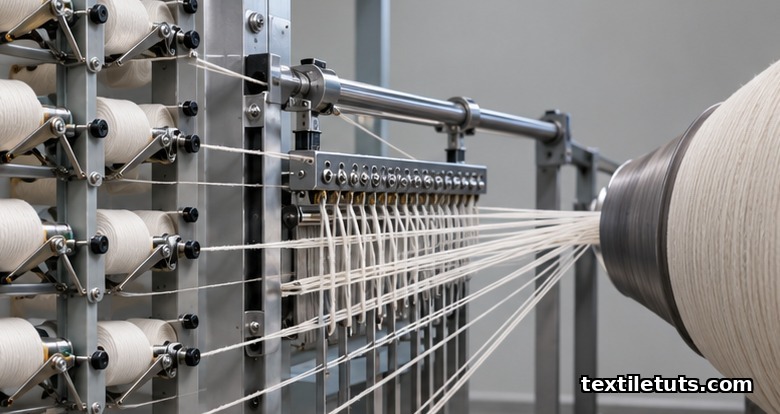
The creel holds the supply packages and feeds yarn to the guide system. Creel capacity on production machines ranges from 400 to 1,200 packages, with V-shaped and magazine (V-stack) configurations common in suiting mills. Each package sits in a tensioner, usually a gate or disc type, set to deliver yarn at 6 to 14 cN depending on yarn count. Even tension across all packages is the single biggest determinant of beam quality.
The guide system gathers the ends from the creel rows into a flat ribbon and lays that ribbon on the drum in overlapping bands. The traverse guide moves horizontally across the drum face at a rate matched to the winding speed, so each new turn of yarn sits just beside the previous turn. The number of ends in a section times the turns required determines the band length on the drum.
The drum itself is a truncated cone mounted on a vertical or horizontal axis. Its taper, expressed in millimeters of radius growth per band, must match the warp density planned for the fabric. A typical cotton warp at 24 ends/cm might be set with a 2.5 to 3.5 mm radial taper per band; a denser 40 ends/cm polyester warp needs a tighter 1.5 to 2.5 mm taper to keep bands level.
Process Parameters That Govern Warp Quality
Five parameters decide whether the beam that comes off the drum will weave cleanly: winding speed, warp tension, band width, drum taper, and beaming-off tension. Each has a working range, and most mills tune them empirically against a sample.
Winding speed is the most obvious. Production sectional warpers run at 200 to 500 m/min for cotton and 400 to 800 m/min for filament synthetics. Running above the recommended speed raises yarn tension peaks and increases the risk of end breaks, especially with weaker rotor or air-jet yarns. Below 150 m/min, the package balloon and balloon control become erratic.
Warp tension must be uniform across every end in the section. ISO 2061 specifies yarn tension testing procedures that mills apply during creel setup: each end is measured at the package and adjusted until the reading falls within a tolerance band of typically plus or minus 10% of the target value. For a 30 tex cotton warp, the target is usually 8 to 12 cN per end.
Band width depends on the planned warp density. As a working rule, band width in millimeters multiplied by ends per centimeter equals the number of ends in that band. So a 40 mm band on a 24 ends/cm warp carries 96 ends, while the same 40 mm band on a 40 ends/cm warp carries 160 ends. The drum must rotate enough turns during each band to lay all those ends side by side without gaps or overlap.
Drum taper must keep the drum surface speed constant as each new band builds up. If the taper is too steep, later bands ride higher and the finished beam will show a stepped profile. If the taper is too shallow, later bands compress the earlier ones, distorting the cross-section.
Sectional Warping vs. Beam Warping: When to Choose Which
Both methods produce the same output, a weaver’s beam ready for sizing or direct weaving, but they fit different jobs. The choice is mainly about run length, warp pattern complexity, and yarn type.
| Property | Sectional warping | Beam (high-speed) warping |
|---|---|---|
| Typical run length | 50 to 500 m | 1,000 to 6,000 m |
| Production speed | 200 to 800 m/min | 600 to 1,200 m/min |
| Creel capacity | 400 to 1,200 packages | 600 to 1,800 packages |
| Setup / changeover time | 1 to 3 hours | 3 to 6 hours |
| Best for short sample warps | Yes | No |
| Best for colored/patterned warp | Yes (band-by-band control) | Limited (full-creel run) |
| End break rate | 0.3 to 1.0 per 10,000 m | 0.5 to 1.5 per 10,000 m |
| Yarn waste on changeover | 1.5 to 3.0% | 0.8 to 1.5% |
The rule of thumb used by most mills: when the warp length falls below roughly 600 m, when the color pattern changes every 100 ends or less, or when the yarn count is finer than 20 tex, sectional warping usually wins on total cost. Above 1,000 m of a single-color, single-count warp, beam warping pulls ahead on speed and labor.
Quality Control on the Beam
Four checks separate a clean beam from one that breaks out at the loom. Mills that run a consistent QC pass on every warp see measurable drops in weaving stops.
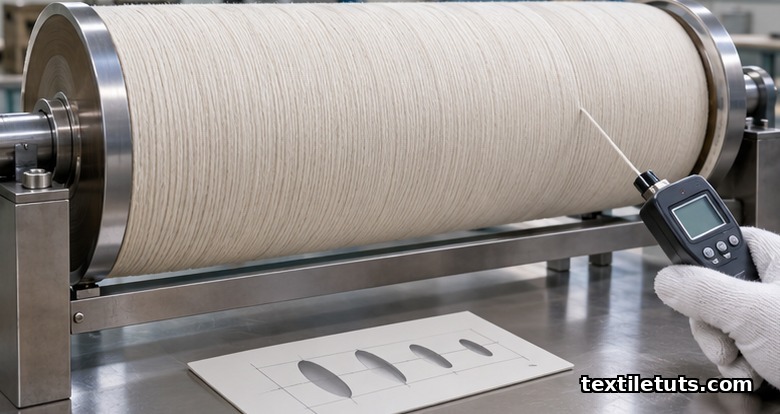
First, end-to-end tension uniformity. Sample 10% of the ends with a handheld tension meter at the creel after doffing the first 50 m. ISO 2062 provides a standard method for tensile testing individual yarn, which complements the tension-meter checks during production. A spread greater than plus or minus 15% of target calls for tensioner adjustment.
Second, band integrity. Lift the traverse guide and inspect the drum face for gaps, overlaps, or soft spots. Gaps mean the drum is rotating too slowly or the traverse rate is too high; overlaps mean the opposite. Either one shows up in the woven fabric as a visible thick or thin band running across the full warp width.
Third, cross-section profile. After beaming-off, measure the beam flange-to-flange profile at five points. A clean beam shows a flat or slightly convex profile; a concave profile means the inner bands are over-compressed and the beam will unwind unevenly.
Fourth, end count verification. ASTM D1059 provides a standard method for yarn number by short-length specimens, which mills cross-check against the warp plan to confirm that no end has been lost or doubled during creel setup. A 1,200-end warp with one missing end shows up in the fabric as a single thin streak 1.0 to 1.5 cm wide that runs the entire warp length.
Common Defects and Their Causes
Most sectional warping defects trace back to creel tension or drum mechanics. Recognizing them quickly saves a beam from being scrapped.
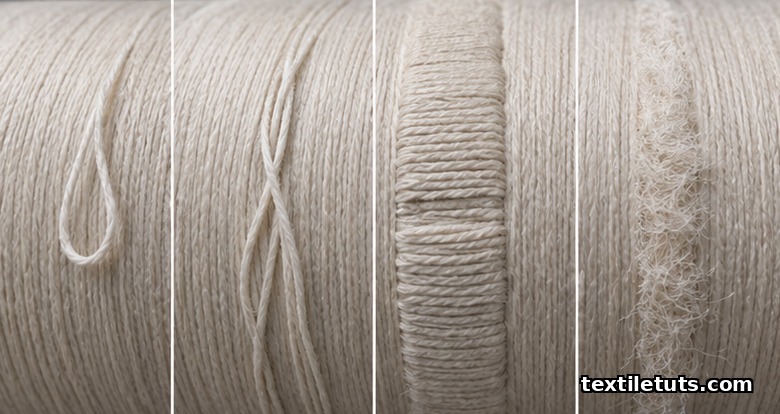
- Slack ends: single ends running visibly looser than their neighbors. Caused by a worn tensioner disc or a depleted package on the creel.
- Crossed ends: two ends swapping positions in the band. Caused by a broken lease string or a missed threading at the guide.
- Hard bands: localized density spikes on the drum. Caused by an excessive drum taper or a slow traverse rate.
- Soft edges: end bands that feather at the edges of the drum. Caused by traverse over-travel or a misaligned guide eyelet.
Each defect has a known fix, but the cheapest fix is prevention: a 10-minute creel walk-through before each section catches roughly 80% of the breaks a beam warp would otherwise carry into weaving.
Frequently Asked Questions
Q1: What is the main difference between sectional warping and beam warping?
Sectional warping winds a small group of ends (20 to 60) onto a tapered drum in narrow bands of 25 to 50 mm, then transfers the full warp onto the weaver’s beam in one pull. Beam warping winds the full warp width onto a beam directly from the creel at 600 to 1,200 m/min, in a single continuous run. Sectional warping fits short runs and patterned warps; beam warping fits long runs of a single yarn and color.
Q2: What is the maximum warp length a sectional warping machine can produce?
Most production sectional warpers build beams up to 500 m on cotton and up to 800 m on filament synthetics. The practical limit is the drum circumference, which is 2.0 to 3.5 m on common machines, multiplied by the number of turns each section can hold without compressing earlier bands. Mills needing longer warps move to beam warping or split the run across two beams.
Q3: Which fabrics use sectional warping most often?
Yarn-dyed shirtings and suitings, sample warps for development, and short-run fashion orders are the three largest users. Cotton/poly blend suiting at 20 to 30 tex, filament polyester at 5 to 15 tex, and worsted wool for tailored garments all run on sectional warping machines in mills worldwide.
Q4: How is yarn tension controlled on a sectional warping machine?
Each creel position has a gate or disc tensioner set to a target value (8 to 12 cN for a 30 tex cotton warp, for example). The operator measures 10% of the ends with a handheld tension meter after doffing the first 50 m and adjusts tensioners that fall outside the plus or minus 10% tolerance. ISO 2061 and ISO 2062 are the reference methods mills use to calibrate their tension targets.
Q5: Can sectional warping replace sizing before weaving?
No, sizing is a separate step that applies a protective film to the warp surface to reduce abrasion in the loom. Sectional warping only assembles the warp onto the weaver’s beam; sizing (or a direct-loom sizing substitute) still comes between warping and weaving for cotton and cotton-blend warps above roughly 30 tex.
References
- International Organization for Standardization. ISO 2061:2015 Textiles — Determination of twist in yarns: Direct counting method. iso.org — Method for verifying yarn parameters used in warp preparation.
- International Organization for Standardization. ISO 2062:2009 Textiles — Yarns from packages: Determination of single-end breaking force and elongation at break using constant rate of extension (CRE) tester. iso.org — Reference for single-end tensile testing of warp yarn.
- ASTM International. ASTM D1059-17 Standard Test Method for Yarn Number by Short-Length Specimens. astm.org — Method used to verify end counts and yarn number on the finished warp.
- Adanur, S. (2001). Handbook of Weaving. CRC Press, Boca Raton. — Textbook chapter on warp preparation including sectional warping mechanics and drum taper design.
- Talukdar, M.K., Sriramulu, P.K., & Ajgaonkar, D.B. (1998). Weaving: Machines, Mechanisms, Management. Mahajan Publishers, Ahmedabad. — Reference work on sectional warping machines used in Indian suiting mills.
- Behera, B.K., & Hari, P.K. (2010). Woven Textile Structure: Theory and Applications. Woodhead Publishing, Cambridge. — Peer-reviewed treatment of warp density, band geometry, and weaving preparation parameters.
- AATCC. AATCC Test Method 81-2006 pH of the Wetted Water Extract of Textile Fabrics. aatcc.org — Auxiliary standard applied during warp conditioning checks before weaving.
This article is the working reference for sectional warping in weaving. Editorial by Mohammad Yousuf (Anik), TextileTuts. Sources: ISO 2061, ISO 2062, ASTM D1059, the Adanur weaving handbook, and the Behera woven-textile-structure textbook as cited.


