
Winding and Cone Winding in Spinning

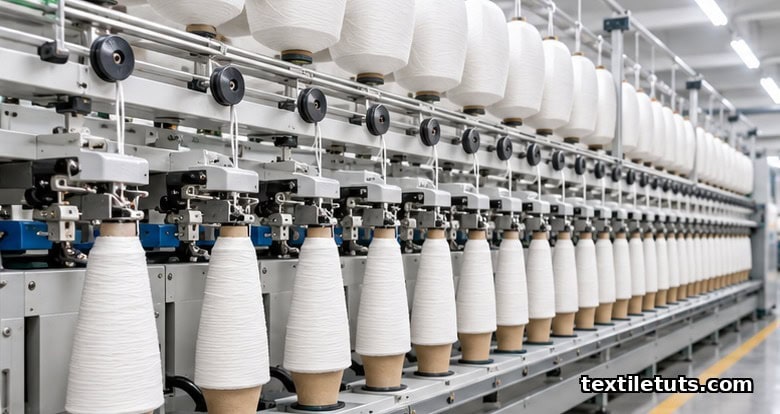
Winding is the final step of the spinning process in which yarn from ring, rotor, or air-jet frames is transferred onto cross-wound packages at delivery speeds of 1,200 to 2,200 m/min, package mass of 1.5 to 5 kg, and controlled winding tension of 8 to 25 cN per single yarn, while electronic clearers cut out thick and thin faults whose cross-section deviates more than ±50% from the running mean.
For ring-spun cotton yarn of 20 tex, the cone winder runs at roughly 1,800 m/min, builds a 1.8 kg package with a winding angle of 5.5 to 9.5 degrees, and the clearer cuts approximately 8 to 20 splices per 100,000 m of yarn.
This article covers the purpose of winding, the three principal package shapes, the mechanics of winding tension, the three clearer generations, package density control, and the automation layer that has defined the modern autoconer.
What Winding Does in a Spinning Mill
Winding takes the yarn that leaves the last spinning station and rewinds it onto a larger, denser, fault-cleaned package that downstream processes can handle efficiently. The bobbin from a ring frame weighs 60 to 120 g and holds only a few hundred meters of yarn; one cone can hold 40,000 to 120,000 m, depending on yarn count, which removes the constant doffing pressure from weaving, knitting, or dyeing preparation.
Winding also performs three quality functions that the ring, rotor, and air-jet frames cannot perform economically in-line:
- Yarn clearing through mechanical, optical, or electronic sensors that remove thick places, thin places, slubs, and foreign fibers.
- Yarn joining through knotters or splicers that produce joints of 70 to 95% of the parent yarn strength.
- Yarn classification by count, twist, and evenness so that the mill can ship lots of known quality and the customer can pay for measured performance.
A typical cone winder in a cotton system has 12 to 60 spindles, each winding one yarn end independently. An autoconer 5 has 24 to 60 winding heads per machine, and autoconer 7 reaches 64 heads. The conversion from bobbin to cone adds roughly 3 to 5% to yarn production cost, recovered by the 30 to 50% reduction in customer-side claims.
Cone, Cheese, and Cross-Wound Packages
The winder builds three principal package geometries. Each geometry solves a different downstream problem.
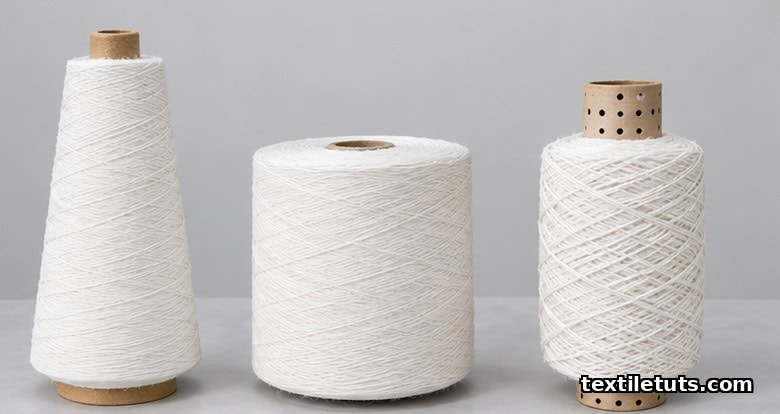
| Property | Cone (tapered) | Cheese (cylindrical) | Cross-wound on dye tube |
|---|---|---|---|
| Tube taper angle | 3°30′ or 4°20′ (standard) | 0° (straight) | 0° (straight, perforated) |
| Package mass | 1.0 to 2.5 kg | 0.5 to 2.0 kg | 0.8 to 2.5 kg |
| Yarn angle on package | 5.5 to 9.5° | 9 to 14° | 10 to 16° |
| Typical end use | Weaving (shuttle and shuttleless) | Warping, two-for-one twisting | Package dyeing, beam warping |
| Creel requirement | Single-end creel | Single-end creel | Single-end creel |
| Dye liquor flow | Poor (closed taper traps liquor) | Limited | Excellent (perforations allow axial flow) |
| Unwinding speed (weaving) | Up to 1,400 m/min (water-jet loom) | Rare | Rare |
The cone angle of 3°30′ (9 minutes of arc from the axis) or 4°20′ is the international default for weaving because the tapered package unwinds with constant yarn tension across the full diameter. As the package unwinds, the effective unwinding diameter shrinks; the taper compensates for that shrinkage by keeping the unwind tension within ±10% of its setpoint, an essential condition for water-jet and air-jet looms running above 1,000 m/min.
Cheeses are straight-walled cylindrical packages used as creel feed for two-for-one twisters and warping creels. They are not used directly in weaving because their unwinding tension rises sharply as the diameter shrinks. Cross-wound packages on perforated dye tubes are the standard form for package dyeing machines because the perforations allow dye liquor to flow axially through the package, producing a level dyeing in 6 to 12 hours.
Winding Tension, Cops Build, and Density
Winding tension is the single most important mechanical variable on a cone winder. Too little tension produces a soft package that collapses in transport; too much tension stretches the yarn, raises hairiness by 10 to 20%, and increases end breaks at the next process.
The conventional range for cotton ring-spun yarn is 8 to 25 cN per single yarn, scaling with yarn count. For 20 tex cotton, 12 to 18 cN is typical; for 60 tex coarse yarn, 20 to 25 cN; for 7 tex fine yarn, 6 to 10 cN. The tension is set by a yarn tension gate (a disc or horseshoe brake) just above the package, and is read on the machine’s HMI as a real-time cN value per spindle.
Package density is the second key variable and is controlled by three adjustable parameters:
- Winding angle (5.5 to 9.5°): higher angles give softer packages but better unwinding tension stability.
- Winding speed (m/min): slower winding allows more time for the yarn to relax and gives a denser package.
- Traverse stroke length (100 to 250 mm): longer strokes give more layers per unit, but with the risk of pattern bands.
Target package density for weaving cones is 0.45 to 0.55 g/cm³. For dye packages, 0.35 to 0.45 g/cm³ is preferred so that dye liquor can penetrate. A simple field test for density is package mass divided by package volume measured with calipers; values outside the 0.30 to 0.60 g/cm³ range signal a winding recipe that needs adjustment.
Yarn Clearers: Mechanical, Optical, and Electronic
The yarn clearer is the quality gate of the winding machine. It scans every meter of yarn that passes through the winding head and cuts the yarn when it detects a fault that exceeds the operator’s threshold.
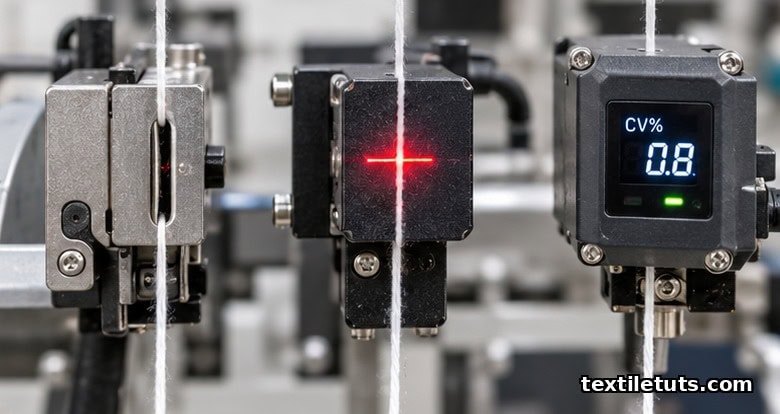
The three generations of clearer differ in what they can detect and how precisely they can be set.
- Mechanical clearers (slub catchers) use a fixed slot width and remove only the largest slubs. They cut approximately 1 fault per 1,000 m on coarse yarn. They cannot detect thin places and cannot be adjusted by count or twist.
- Optical clearers (photocells) measure the diameter of the yarn by light transmission. They can be set by diameter (in 0.05 mm steps) and remove both thick and thin faults. A typical optical clearer on 20 tex cotton cuts 12 to 25 faults per 100,000 m.
- Electronic clearers (capacitive or laser) measure the yarn’s mass per unit length, which is the property that actually affects downstream fabric quality. Capacitive clearers (such as Loepfe YarnMaster, Uster Quantum 3, and Premier Qualipath) set thresholds in CV% and cross-section bands; laser clearers set thresholds in micrometers. Electronic clearers typically cut 8 to 20 faults per 100,000 m with more accurate grading.
The mass-based threshold is normally expressed as a percentage of the running mean cross-section. Common cut settings for cotton knitting yarn are +50% (thick), -30% (thin), and 4 cm or longer (slub length). For weaving yarn, the thick-fault setting is tightened to +35% to reduce visible neps in the fabric, while the thin-fault setting stays at -30% to prevent end breaks.
Knots vs Splices and the Move to Knotless Yarn
Every yarn break at the winder must be rejoined. The two joining technologies are the knotters and the splicers. Knotters produce a small lump that is roughly 1.5 to 2.5 times the yarn diameter at the knot; splicers overlap the two yarn ends and use air-jet or mechanical intermingling to blend the two ends into a joint of similar diameter and 80 to 95% of the parent yarn strength.
The proportion of splices to knots has become the leading indicator of winding quality. In 1985, virtually all joints were knots. By 2024, a modern cotton knitting mill runs 95 to 100% splices, while a weaving mill runs 60 to 90% splices depending on loom type. Air-jet looms running above 800 m/min require a minimum of 95% splices because even a small knot can deflect the weft yarn and miss the insertion nozzle.
Splicers themselves are of two types. Pneumatic splicers use compressed air at 5 to 7 bar to open the fibers and entangle the two ends; they produce a splice of 25 to 40 mm length. Mechanical (twist-back) splicers re-twist the two ends together without air; they produce a shorter, slightly harder splice of 15 to 25 mm. Pneumatic splicers are dominant for cotton and blends, mechanical splicers for filament and coarse counts.
Automation: From Autoconer to Autoconer 7 and Beyond
The Schlafhorst Autoconer, introduced in 1958, defined the automated winding machine and is still the benchmark. Each generation has added a layer of automation.
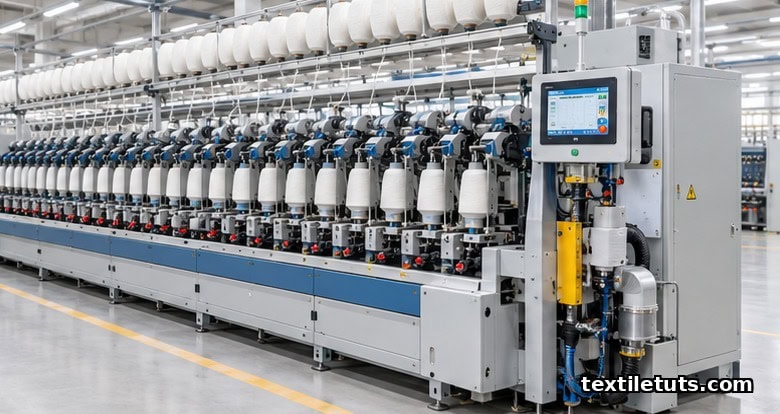
- Autoconer 138 (1975): electronic clearer, automatic doffing, automatic knotter.
- Autoconer 238 (1985): splicer instead of knotter as default, electronic package density control.
- Autoconer 338 (1998): 24-head independent drives, on-machine clearer calibration.
- Autoconer 5 (2008): 24 to 60 heads, 2,000 m/min winding speed, integrated pre-cleaner.
- Autoconer 7 (2021): 64 heads, 2,200 m/min, digital twin integration, predictive clearer maintenance.
The competitive alternative is Murata’s Mach Coner and Savio’s Eco Pulsar, both of which have their own automation stacks. The headline metric across all modern winders is the package-to-package efficiency, defined as the percentage of machine time that is winding yarn rather than doffing, splicing, or clearing. Modern autoconers run at 92 to 96% efficiency; machines older than 1990 run at 75 to 85%.
Frequently Asked Questions
Q1: What is the difference between cone winding and cheese winding?
Cone winding uses a tapered tube (3°30′ or 4°20′) that produces a package whose unwinding tension stays constant as the package unwinds; this is the standard form for weaving creels. Cheese winding uses a straight-walled cylindrical tube and produces a package whose unwinding tension rises as the diameter shrinks; it is used as creel feed for two-for-one twisters and warping.
Q2: What winding tension should be used for 20 tex cotton yarn?
For 20 tex ring-spun cotton yarn, the standard winding tension at the package is 12 to 18 cN per single yarn. Weaving cones run at the upper end of this range (15 to 18 cN) for package stability; knitting cones run at the lower end (10 to 14 cN) for softer yarn with lower hairiness.
Q3: Why do modern winders use electronic clearers instead of mechanical ones?
Mechanical clearers (slub catchers) only remove the largest faults and cannot detect thin places. Electronic clearers measure the yarn’s actual cross-section or mass per unit length, set thresholds in CV% or micrometers, and remove thick, thin, and slub faults with a single device. This reduces customer claims by 30 to 50% and increases yarn classification accuracy.
Q4: What package density is correct for a weaving cone?
For a weaving cone, target density is 0.45 to 0.55 g/cm³. Lower than 0.40 g/cm³ gives a soft package that collapses in transport; higher than 0.60 g/cm³ gives a hard package with high unwinding tension and an increased break rate on air-jet and water-jet looms.
Q5: What is the typical winding speed on a modern autoconer?
An Autoconer 5 winds at 1,800 to 2,000 m/min on 20 to 30 tex cotton; the Autoconer 7 reaches 2,200 m/min on the same count. Rotor-spun yarn can be wound at 2,200 to 2,400 m/min because it has higher hairiness tolerance; fine-count combed cotton is normally wound at 1,400 to 1,700 m/min to control clearer efficiency.
References
- ISO 2061:2015. Textiles — Determination of twist in yarns — Direct counting method. International Organization for Standardization. URL: https://www.iso.org/standard/65208.html — Defines the direct counting method for twist per metre in single and plied yarns.
- ISO 2062:2009. Textiles — Yarns from packages — Determination of single-end breaking force and elongation at break using constant rate of extension (CRE) tester. International Organization for Standardization. URL: https://www.iso.org/standard/51017.html — Standard test for single-end yarn strength used to verify splice and knot efficiency.
- Uster Technologies AG. Uster Statistics 2024: Quality Standards for the Global Spinning Industry. Uster, Switzerland: Uster Technologies, 2024. URL: https://www.uster.com/knowledge/uster-statistics/ — Industry benchmark for CV%, IPI, hairiness, and clearer cut settings.
- Lawrence, C.A. Advances in Yarn Winding and Winding Machines. Cambridge, UK: Woodhead Publishing in association with the Textile Institute, 2019. ISBN 978-0-08-102738-5. — Peer-reviewed treatment of winding mechanics, clearer technology, and package dynamics.
- Rengasamy, R.S., Patnaik, A., and Bhattacharya, S. “Yarn Winding: Principles, Practice and Quality Control.” In Textile Manufacturing Processes. Edited by Faheem Uddin. London: IntechOpen, 2022. doi:10.5772/intechopen.99743. URL: https://www.intechopen.com/chapters/79735 — Open-access peer-reviewed chapter on winding tension, package density, and clearer settings.
- Klein, W. “Winding.” In Handbook of Yarn Production: Technology, Science and Economics. Manchester, UK: The Textile Institute, 2019. ISBN 978-1-042-37250-7. — Standard reference covering autoconer mechanics and yarn package engineering.
This article is the working reference for winding and cone winding in spinning mills. Editorial by Iftay Khairul Alam, TextileTuts. Sources: ISO 2061:2015, ISO 2062:2009, Uster Statistics 2024, Woodhead Publishing (2019), IntechOpen (2022), and Textile Institute Handbook (2019) as cited.


