
Common Spinning Defects: Slubs, Neps, Thick and Thin Places


Slubs, neps, thick places, and thin places account for 70 to 80 percent of all imperfections counted by Uster evenness testers, and a single thick place above +50 percent of nominal yarn cross-section drops fabric appearance grade by one to two points on the 4-point IPI (Imperfections per Inspection meter) reference scale used by Uster Statistics 2018. Each defect class has its own length window, cross-section deviation, and root cause profile, so a spinner who can place a defect on the right class before opening the machine card saves hours of trial and error downstream.
This guide defines the six defect classes reported by Uster instruments, walks through fiber, machine, and process causes, and lays out a prevention checklist used in cotton and cotton-blend ring spinning.
How Uster Classifies Yarn Defects
The Uster Evenness Tester (and its successors Uster Tester 6, Uster Quantum 4) reports every fault by length and by cross-section deviation from a moving average taken over an 8-metre window. A defect is logged whenever the deviation crosses one of the four cross-section thresholds (+100 percent, +50 percent, +200 percent, -50 percent) and falls inside a defined length window (Uster Statistics 2018). Six classes cover the practical space a textile engineer meets at the inspection table:
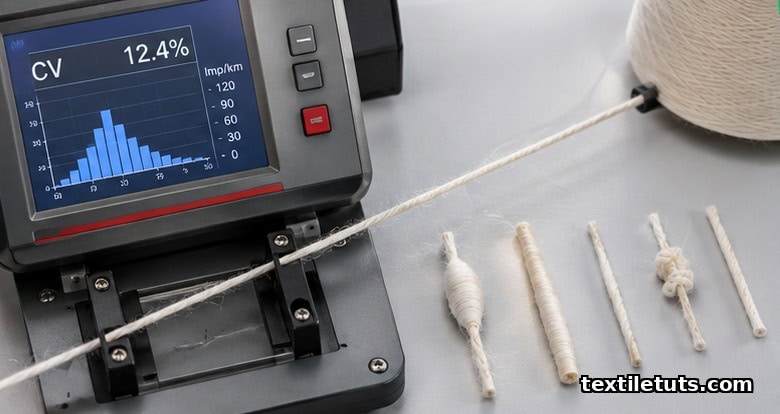
- Slub: +100 to +400 percent cross-section, length 4 to 20 mm, visible to the naked eye as a soft pulse in the running yarn.
- Nep: +200 percent or more, length below 4 mm; reported separately because the visual impact on fabric is disproportionately high for its size.
- Thick place: +50 percent, length up to 4 cm (count-dependent), milder than a slub.
- Thin place: -50 percent, length up to 4 cm; the critical defect for weaving because it is the first place the yarn breaks on the loom.
- Long thick place: +50 percent, length above 4 cm (8 cm for finer counts). Long thicks usually come from drafting disturbances lasting several spindle rotations.
- Long thin place: -50 percent, length above 4 cm; typically a partial end break the drafting system has re-pieced.
The cross-section thresholds (+50 percent, -50 percent, +200 percent) and the count-dependent length cutoffs are anchored in ISO 16549 (textiles, determination of yarn evenness and approximation of yarn fineness by capacitance method), with ISO 2061 (determination of twist in yarns by the untwist-retwist method) paired in routine auditing because twist multiplier interacts with defect generation.
Causes: Fiber, Machine, and Process Factors
Most defects have a layered cause. A nep may originate in raw cotton, be amplified by the blowroom and card, and only become a fabric fault because the ring frame drafting system fails to break it up. The useful diagnostic frame keeps three layers separate so the corrective action matches the right machine.
Fiber-layer causes
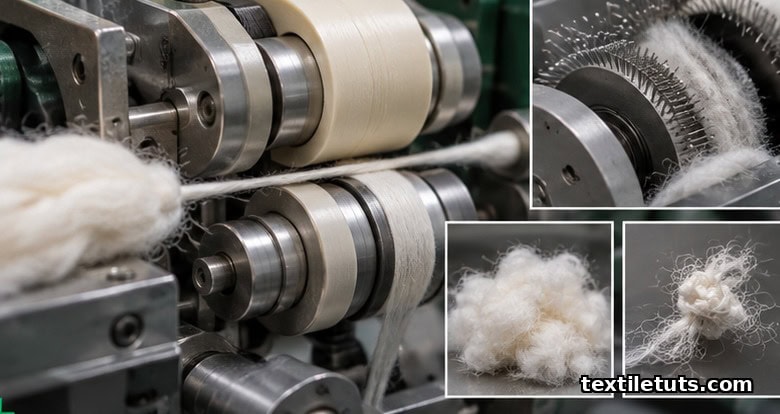
Short fiber content (SFC, the share of fibers shorter than 12.7 mm in cotton by weight) is the single largest predictor of neps and slubs in ring spinning. Uster Statistics 2018 indicates every 1 percent rise in SFC adds roughly 10 to 15 neps per km at Ne 30 carded, with a steeper gradient in combed yarn. Immature fibers (micronaire below 3.8) collapse in the card licker-in region, wrap around neighbouring fibers, and reappear as card-room neps. Excessive trash and high HVI (High Volume Instrument) nep count in the raw stock transfer card-room neps at a near 1:1 ratio in the card sliver.
Blending cotton across a wide micronaire range produces periodic thick and thin places because the drafting system averages only across a short floating-fiber window. Synthetic staple (polyester, viscose) brings its own list: low-crimp or over-crimped fibers produce slubs, and overfinished fibers reduce interfiber friction under peak draft and produce thin places.
Machine-layer causes
On the ring frame, the dominant defect generator is the drafting system. Worn top rollers, glazed aprons, incorrect top-arm weighting, and mis-set spacer widths each leave a characteristic signature: glazed aprons cause long thicks, uneven weighting causes periodic thick-thins every spindle pitch, and excessive spacer width lifts the break draft and produces slubs. The SU-type drafting element (Suessen EliTe, Rieter ComforSpin) tolerates more of these faults than the older HP-type because of its floating cradle, but still requires the maker’s scheduled roller and apron condition.
On the card, the leading cause of neps is the licker-in, flat, doffer, and transfer region. Under-setting the licker-in to the cylinder, cylinder speeds above 36 m/s surface, blunt or hooked-wire clothing, and high short-fiber-content raw stock all push nep counts up. The same machine out of condition produces thin places in the card sliver that reappear as long thins after drafting.
Process-layer causes
Parameters that are usually blamed correctly include excess back-roller draft (floating short fibers on the drafting apron), insufficient draft distribution between back and middle zones, too-low total draft for the fiber length, twist multiplier (TM, the ratio of turns per inch to the square root of the English count) below 3.8 for Ne 30 cotton, and humidity below 55 percent RH, which lets fibers lose static charge and behave erratically.
Speed-tension interactions also matter: spindle speeds above 18,000 rpm with too coarse a traveler lift yarn tension and amplify thin places, while running too slow at high TM can starve the winding tension and cause slough-offs that look like long thicks in the package.
How the Defects Show Up on the Uster Tester
The Uster Tester 6 output report (run under ISO 16549) yields CV% (coefficient of variation of mass per unit length), the three-class imperfection count per km (thins at -50 percent, thicks at +50 percent, neps at +200 percent), and an IPI value (Imperfections per Inspection meter) that links to the 4-point fabric grade scale. For Ne 30 carded cotton ring yarn, Uster Statistics 2018 records medians of about 12.5 percent CVm, 25 thins/km, 65 thicks/km, and 110 neps/km, with 25 percent of mills running below 15 thins, 50 thicks, and 70 neps/km (the “25-percent line” benchmark).
Length and cross-section matter because they translate directly into fabric faults. A 4 mm slub at +200 percent cross-section is one conspicuous thick bar per metre in a woven cloth. A 4 cm long thin at -50 percent is roughly the length that decides whether the warp breaks during weaving or just looks lighter after dyeing, a distinction the buyer sees at the inspection table.
Effect on Fabric Quality and Downstream Processing
Three fabric-level costs are easy to quantify. Weaving efficiency drops by 0.5 to 2 percentage points for every doubling of thin-place count, because thin places concentrate end-breaks at the shed crossing and weft-insertion points. Knitting efficiency is hit harder by thick places and slubs: a single slub wedges into the needle hook on circular knitting and stops the machine. Dyeing uniformity is hit by periodic thick-thin variation along the warp: the same nominal count absorbs dye unevenly when the local mass varies, producing the barred or moiré appearance flagged at top inspection.
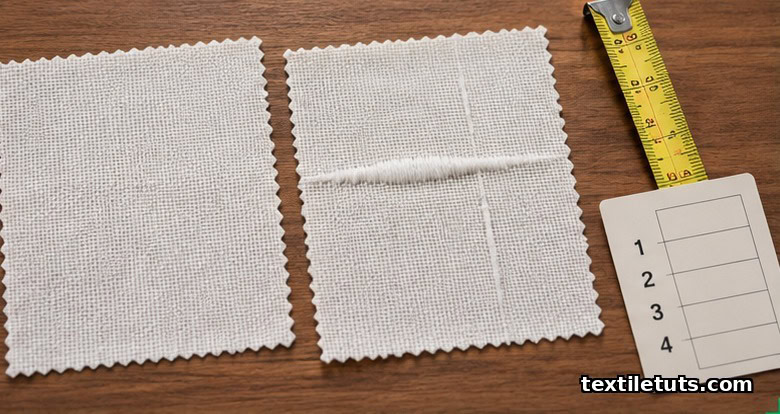
Yarn hairiness (validated per ISO 7211-5 using the Zweigle Hairiness Meter or equivalent) interacts with slubs and thick places: a yarn full of small slubs carries more surface hairs and pills faster, reducing the visible-grade and service life of knit and single-jersey garments.
Prevention and Process Control
A working prevention routine has four layers, matched to the four places where defects enter the process.
- Raw-material control: specify SFC below 8 percent and micronaire 4.0 to 4.8 for Ne 30 carded cotton; verify on HVI bales and reject lots with HVI nep count above 200 to 250 neps/g.
- Carding control: trend card-room neps/g against licker-in speed and doffer speed over 30-day laps, and replace the licker-in before the maker’s 600-hour limit on cotton.
- Draw-frame control: target sliver CV% below 4 percent on autoleveller draw frames and verify doubling accuracy monthly; most draw-frame long thicks trace to autoleveller faults the operator rarely sees without a periodic check.
- Ring-frame control: keep drafting-roller eccentricity below 0.02 mm, check apron condition weekly, run top-arm pressure at the maker’s nominal value, hold humidity at 55 to 65 percent RH, and set the Uster Quantum 4 or Loepfe YarnMaster clearer at the buyer-specified defect cut.
A typical 30,000-spindle improvement programme moves from the 50-percent Uster line to the 25-percent line over six to nine months, with IPI dropping by 30 to 50 percent and weaving efficiency rising by 1 to 3 percentage points on the same loom line.
Defect Types, Causes, and Prevention: A Comparison Table
| Defect class | Cross-section | Length window | Main fiber cause | Main machine / process cause | Primary prevention |
|---|---|---|---|---|---|
| Thin place | -50 percent or more | Up to 4 cm | Short fiber, low humidity | Worn aprons, low draft | Apron check; RH 55 to 65 percent |
| Thick place | +50 percent or more | Up to 4 cm | Float fibers, blending variation | Roller eccentricity, uneven apron | Roller geometry check every 6 months |
| Nep | +200 percent or more | Below 4 mm | Immature fiber, high trash | Card licker-in / cylinder settings | Card clothing cycle; licker-in speed |
| Slub | +100 to +400 percent | 4 to 20 mm | Long float, foreign fiber | Excess break draft, low TM | TM above 3.8 at Ne 30 |
| Long thick | +50 percent or more | Above 4 cm | Drafting disturbance | Autoleveller fault, sliver irregularity | Draw-frame sliver CV under 4 percent |
| Long thin | -50 percent or more | Above 4 cm | Partial end break, re-piecing | Wrong top-arm pressure | Creel tension and stop-motion check |
Frequently Asked Questions
What is the difference between a slub and a thick place?
A slub is a sudden, severe increase in yarn diameter, +100 to +400 percent over the local mean, with a length between 4 mm and 20 mm, while a thick place is a milder, +50 percent deviation of length up to 4 cm. Slubs are reported as a separate class on the Uster Tester because they are the eye-visible faults on woven and knitted fabric, and a roll of cloth with a few slubs per hundred metres can lose an entire appearance grade at inspection.
How are neps different from slubs in yarn?
A nep is a small fiber tangle, +200 percent cross-section or more, with a length shorter than about 4 mm, while a slub runs 4 mm to 20 mm and has a more oriented fiber body. Neps originate mostly in raw cotton and carding, slubs mostly in drafting and twisting. The Uster Tester uses the same +200 percent cross-section threshold for both but separates them by length, which is why Uster Statistics treats neps/km as a separate category with its own benchmark.
Why do thin places cause more end-breaks in weaving than thick places?
A thin place has the smallest cross-section in the yarn, so it is where the cyclic shed tension crosses the yarn breaking load first. A thick place is over-built, so it survives the shed but shows up later as a visible bar in the woven cloth. Uster Statistics 2018 records thin-place count as the leading predictor of loom efficiency, with weaving efficiency dropping roughly 1 percentage point for every doubling of thin-place count on cotton warp yarn.
Can spinning defects be removed after the yarn is made?
Minor thick places and slubs can be cut by electronic yarn clearers on winding machines, set to splice or drop at a buyer-specified cross-section and length threshold, but the clearers remove the affected yarn length and reduce yield by 1 to 3 percent per kg. Thin places, neps, and most long variants cannot be repaired downstream; removing the fault means removing a metre of yarn at the winder, which is why prevention at the ring frame is cheaper than re-cutting at the winder for almost every defect class.
What Uster Statistics line should a ring-spun cotton mill target?
For Ne 30 carded cotton ring yarn, Uster Statistics 2018 places the 25-percent line at about 9 to 15 thins/km, 35 to 50 thicks/km, and 60 to 80 neps/km, with CVm around 11 to 12 percent. Most export-grade woven mills run at or below the 25-percent line, and combed mills target the 5-percent line on the same chart. The right benchmark depends on end use: knit apparel accepts the 50-percent line for neps, while combed warp yarn for shirting should sit on the 25-percent line for every defect class.
References
- International Organization for Standardization. ISO 16549:2004, Textiles, Determination of yarn evenness and approximation of yarn fineness by capacitance method. iso.org (defines the cross-section and length thresholds used by Uster testers for thin places, thick places, and neps).
- International Organization for Standardization. ISO 2061:2015, Textiles, Determination of twist in yarns, Untwist-retwist method. iso.org (referenced for the twist-multiplier calculations that prevent slubs).
- Uster Technologies. Uster Statistics 2018: The World’s Leading Benchmark for Yarn Quality. Uster.com (CVm and imperfection medians; the 25-percent and 50-percent benchmark lines for short-staple yarn counts).
- International Organization for Standardization. ISO 7211-5:2020, Textiles, Methods for analysis of woven fabric construction, Part 5: Determination of linear density of yarns removed from fabric. iso.org (used alongside yarn-evenness testing to verify hairiness and count deviation after weaving).
- Klein, W. Short-Staple Spinning, Volume 1 (Manual of Textile Technology). Woodhead Publishing (Cambridge) (drafting-system causes of slubs, thick places, and thin places in ring spinning).
- Lawrence, C.A. (ed.). Advances in Yarn Spinning Technology (Woodhead Publishing Series in Textiles, Number 138). Elsevier / Woodhead Publishing (peer-reviewed engineering volume on card-room and ring-frame process parameters).
This article is the working reference for the classification, causes, and prevention of slubs, neps, thick places, and thin places in ring spinning. Editorial by Iftay Khairul Alam, TextileTuts. Sources: ISO 16549, ISO 2061, ISO 7211-5, Uster Statistics 2018, and peer-reviewed spinning literature as cited.


