
Roving Frame in Spinning: Function and Specifications

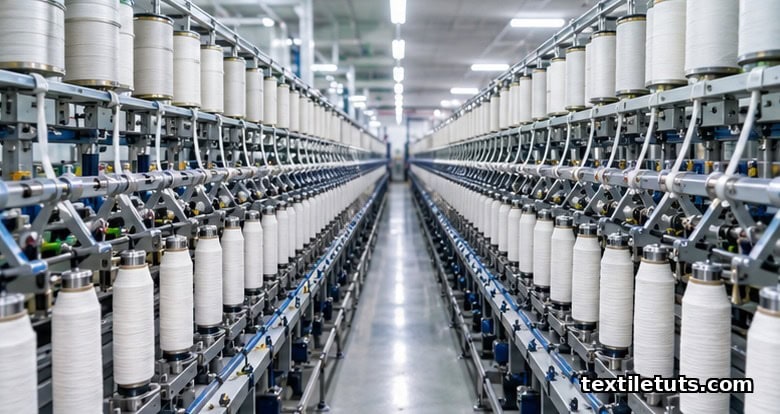
A roving frame (also called a speed frame) inserts 1.0 to 2.5 turns per inch of low protective twist into a drawn sliver at a total draft of 6 to 10 times, producing cotton roving of 0.5 to 1.5 Ne (0.59 to 1.18 ktex) wound on 230 mm bobbins at flyer speeds of 1200 to 1800 rpm. The roving frame sits between the drawing frame and the ring frame in the conventional cotton spinning sequence, and its job is to give the fiber strand just enough cohesion to be unwound, drafted further, and twisted in the next step without breaking.
This article walks through how a roving frame works, the specifications that define its output, the quality numbers mills track day to day, and the practical differences between a roving frame, a speed frame, and the roving-less routes used in rotor and air-jet spinning.
Where the Roving Frame Sits in the Spinning Sequence
Carded or combed sliver from the draw frame arrives at the roving frame at a linear density of roughly 3.0 to 4.5 ktex (Ne 0.22 to 0.33). It is too thin and too untwisted to be fed straight into a ring frame: drafting it further at ring-frame speeds would cause uncontrolled fiber slippage, lapping on the front drafting rollers, and unacceptable end breakage rates.
The roving frame solves this by drafting the sliver to a coarser count, inserting a controlled small amount of twist, and winding the result onto a roving bobbin. The output is called roving (also called slubbing in older literature and in some regions). It is a slightly twisted strand, weak enough to be drafted further downstream but coherent enough to be unwound at high speed from a package.
For a typical Ne 30 cotton yarn, the roving frame produces roughly Ne 0.7 to 1.0 (0.59 to 0.85 ktex) roving with a twist multiplier of about 1.0 to 1.4 in the cotton count system. The exact target depends on fiber length, blend, and the number of doublings the mill wants to carry into the ring frame.
Working Principle: Draft, Twist, and Wind
Three operations happen simultaneously on a modern roving frame, each governed by its own gear set or inverter drive:
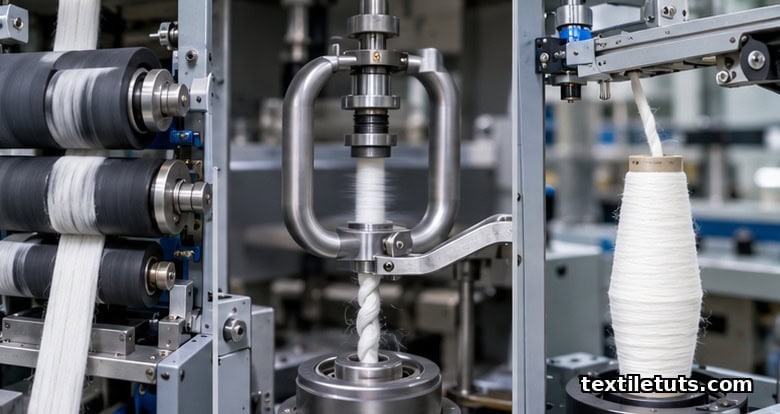
- Drafting. Sliver is pulled from 60 to 120 cans on the creel at the back of the machine, fed through a 4-over-4 or 3-over-3 drafting system with double aprons, and drafted to 6 to 10 times its incoming linear density. Total draft is split between a break draft of 1.2 to 1.5 times and a main draft of 5 to 8 times.
- Twisting. The drafted strand passes through a flyer rotating at 1200 to 1800 rpm (up to 2000 rpm on high-speed frames). The flyer inserts twist as the strand descends into the bobbin tube. Inserted twist equals the differential between flyer speed and delivery speed.
- Winding. The roving is built into a tapered or cylindrical package on the bobbin by a traversing mechanism that lays the strand along the bobbin axis in a controlled pattern.
The flyer is the defining component of a cotton roving frame. It is a U-shaped or leg-shaped metal blade mounted on a vertical spindle, with a presser arm carrying the roving into the bobbin. Flyer leg speed is the single most important productivity parameter: doubling flyer speed roughly doubles frame output, all else being equal.
Key Specifications of a Modern Roving Frame
The table below lists typical operating ranges for a contemporary cotton roving frame. Numbers vary by fiber (cotton, synthetics, wool), by count range, and by machine builder (Rieter, Toyota, Marzoli, Truetzschler, and Zinser are common suppliers).
| Parameter | Typical Range | Notes |
|---|---|---|
| Creel capacity | 60 to 120 sliver cans | Higher on link-coner roving frames |
| Total draft | 6 to 10 times | Break draft 1.2 to 1.5 times, main 5 to 8 times |
| Flyer speed | 1200 to 1800 rpm | Up to 2000+ rpm on high-speed frames |
| Inserted twist (TPI) | 1.0 to 2.5 | Cotton: TM 1.0 to 1.4 in cotton count |
| Roving count output | 0.5 to 1.5 Ne (cotton) | Equivalent to 0.4 to 1.2 ktex |
| Bobbin dimensions | 230 x 330 mm (cotton) | Diameter by height |
| Package weight | 1.5 to 3.0 kg | Higher with link winding, up to 5 kg |
| Spindle gauge | 220 mm or 254 mm | Center-to-center spacing between flyers |
| Number of spindles | 60 to 180 | Depends on frame length and gauge |
| Power consumption | 0.05 to 0.10 kWh per kg roving | Approximate, varies with build year |
| Drafting system | 3-over-3 or 4-over-4 with aprons | Suction at front zone on newer builds |
For polyester-cotton blends, twist values run slightly higher (TM 1.3 to 1.6) to control the slick synthetic fibers. For combed cotton, twist values run slightly lower because the sliver is already well-aligned and lapping risk is lower. Wool roving frames use a different drafting geometry entirely, with longer fiber paths and gentler drafts of 4 to 6 times.
Roving Frame vs Speed Frame: Is There a Difference?
In modern usage, the terms “roving frame” and “speed frame” refer to the same machine. “Speed frame” became the preferred term in mid-20th century textile literature because the new machines operated at flyer speeds far higher than the older roving frames they directly replaced. Today, both names appear interchangeably in technical documents, supplier catalogs, and mill-floor conversation.
What should not be confused with either: a “roving machine” in the woolen system is a different mechanism, with a condenser tube and rubbing leather instead of a flyer, used for producing condensed yarns destined for woolen ring spinning or woolen mule spinning. The cotton roving frame and the woolen condenser are related concepts but use very different mechanical actions.
Quality Parameters and What Mills Measure
Roving quality is judged on three main families of metrics, all of which carry forward into the ring frame and ultimately into yarn quality:
- Count CV (coefficient of variation of linear density). The typical acceptable range for cotton roving is 3.0 to 5.0 percent. Above this, the ring frame will produce uneven yarn and excessive end breaks. Mills targeting premium counts run count CV below 3.5 percent.
- Twist CV. Should be below 5 percent for cotton. Variation in twist causes soft spots that snap during ring spinning, raising end-break rates.
- Uster evenness (U percent). Modern roving frames target U percent values in the 4.5 to 7.0 range at 25 m/min test speed on a Uster Tester 5 or equivalent.
Mills also track imperfection counts (thick places, thin places, neps), but most imperfections in the roving originate upstream in carding or drawing and are not corrected at the roving frame, which acts as a passive attenuator rather than a cleaning machine.
Common Defects and Their Root Causes
Five defects account for the majority of roving-frame stoppages and downstream yarn complaints:
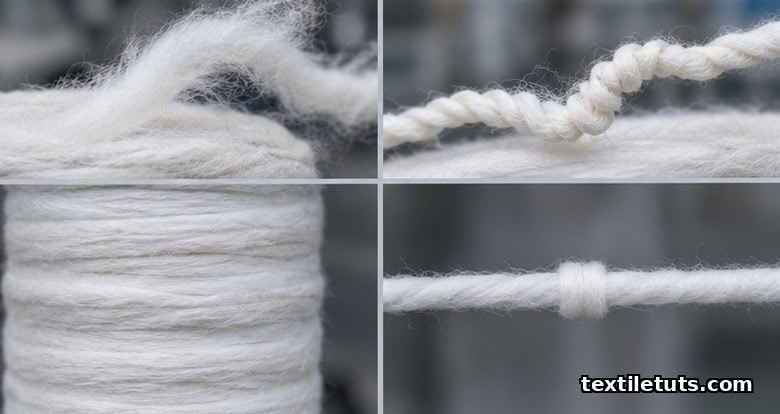
- Soft roving (insufficient twist). Caused by worn aprons, low flyer speed, or excessive draft. Leads to lap-ups at the ring frame front rollers and elevated end breakage.
- Hard roving (excessive twist). Caused by flyer speed too high for the set delivery speed, or by an incorrect gear change after a count reset. Reduces draftability downstream and produces harsher yarn.
- Count variation. Caused by uneven sliver feed, gear slippage, or incorrect draft gear settings. Surfaces as periodic thick-and-thin bands.
- Flyer barring. Periodic thick-and-thin bands with a wavelength equal to one flyer revolution. Caused by flyer imbalance. Requires flyer balancing or replacement.
- Streakiness. Long-period unevenness of 5 m or more. Caused by drafting roller eccentricity, worn top roller coverings, or uneven pressure settings.
A standard quality SOP is to test roving count and strength on a Uster Tester at least once per shift, and to audit flyer bearings, top roller cots, and apron condition on a preventive maintenance schedule (typically weekly on continuous-running mills).
Modern Developments: Link Winding and Suction
Two technologies have substantially changed roving frame design over the past two decades:
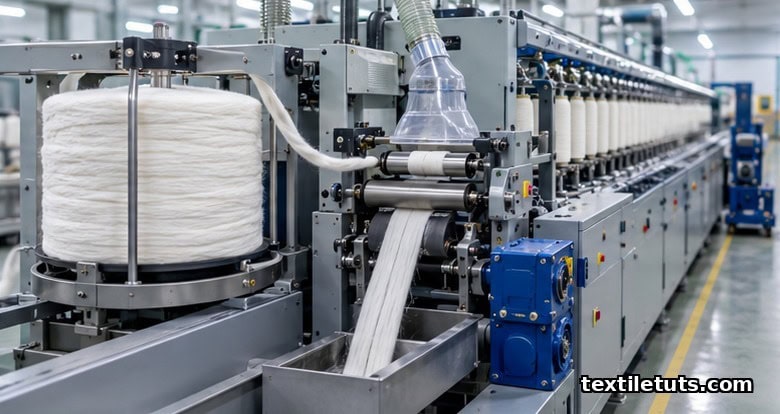
- Link winding (link coner). Replaces the bobbin with a continuous supply package wound directly to a ring-frame-friendly format, eliminating the bobbin transport step and reducing handling waste. Link-wound packages can run to 5 kg or more, cutting doff frequency on the ring frame.
- Suction at the drafting zone. Pneumatic suction at the front drafting rollers removes stray fibers and short fly, improving cleanliness and reducing operator cleaning frequency. Uster Imperfection A3 (neps) reductions of 20 to 40 percent are typical.
Higher-end frames now also include auto-doffing, auto-levelling at the back zone (compensating for incoming sliver count variation), and full servo drives replacing mechanical gear trains. The combined effect is faster startups, lower count CV, lower imperfection counts, and lower labor per kilogram of roving.
The Roving Frame in Modern Spinning Mills
Despite its age as a machine class, the roving frame remains the standard preparation step for ring spinning in 2026. Compact spinning, rotor spinning (Open End), and air-jet spinning all use different preparation paths (drawn sliver directly, no roving), but conventional ring frames still depend on roving packages, and ring spinning still accounts for the majority of fine-count cotton yarn worldwide. Mills spinning Ne 60 and finer counts, very fine synthetics, or premium blends almost always keep a roving frame as a mandatory step in the sequence.
For newer mills installing compact ring frames, the roving frame is typically paired with a high-speed auto-doffing unit, a closed-loop count control system using a Uster or equivalent roving tester, and direct link-wound supply packages. The combination keeps roving count CV below 3.5 percent and lets the ring frame run at its maximum delivery speed without being limited by roving package quality.
Frequently Asked Questions
What is the difference between a roving frame and a speed frame?
There is no functional difference. Both names refer to the same machine in cotton spinning. “Speed frame” became the more popular term in the mid-20th century because the new machines operated at higher flyer speeds than the older roving frames they replaced. Today the two terms are used interchangeably in textbooks, supplier catalogs, and on the mill floor.
What twist multiplier is used for cotton roving?
Cotton roving is usually produced with a twist multiplier (TM) of 1.0 to 1.4 in the cotton count system. At a roving count of Ne 0.85 (1.18 ktex), a TM of 1.2 gives approximately 1.4 turns per inch. Polyester-cotton blends use a slightly higher TM (1.3 to 1.6) to control the slick synthetic fibers, while combed cotton uses the lower end of the range.
How many spindles does a modern roving frame have?
Modern cotton roving frames typically carry 60 to 180 spindles, arranged in one or two sides. The number is set by the frame length, spindle gauge (220 mm or 254 mm), and mill layout. High-speed auto-doffing frames tend toward the lower end of this range to keep doff cycle time manageable. Some specialty frames go as low as 36 spindles for very fine counts where each spindle requires more space.
What is the standard roving count for cotton ring spinning?
For a Ne 30 cotton yarn, the typical roving count is Ne 0.7 to 1.0 (0.59 to 0.85 ktex). For a finer Ne 60 yarn, mills drop the roving count to Ne 0.4 to 0.6 to keep total draft within the ring frame’s practical range. Coarser yarns (Ne 10 to 20) use heavier roving up to Ne 1.5. The exact target is set by ring frame draft capability, fiber length, and the count CV the mill is willing to accept.
Why are some mills replacing roving frames with roving-less spinning?
Rotor spinning (Open End), compact air-jet, and vortex spinning all feed drawn sliver directly, eliminating the roving frame step. Mills adopt these routes for higher throughput (rotor and vortex run at 150 to 250 m/min delivery versus 20 to 30 m/min on a ring frame), lower labor, and smaller footprint. Ring spinning still produces finer, stronger, and smoother yarn, so the roving frame remains the standard for premium cotton, fine synthetics, and worsted counts.
References
- ISO 2:1973. Textiles — Designation of yarns (Tex system). International Organization for Standardization. https://www.iso.org/standard/4539.html — Reference system for the Tex linear-density unit used in roving count specifications.
- ASTM D1578-93(2021). Standard Test Method for Breaking Strength of Yarn by the Skein Method. ASTM International. https://www.astm.org/d1578-93r21.html — Method referenced in roving and yarn quality protocols.
- ASTM D1425-14. Standard Test Method for Evenness of Textile Strands Using Capacitance Testing. ASTM International. https://www.astm.org/d1425-14.html — Underlying test method for the Uster evenness values reported on roving.
- AATCC. Manual of International Test Methods and Procedures. American Association of Textile Chemists and Colorists. https://www.aatcc.org/ — Reference framework for mill quality systems covering the roving and yarn stages.
- Lawrence, C. A. (2010). Advances in Yarn Spinning Technology. Woodhead Publishing (Elsevier). https://www.sciencedirect.com/book/9781845694449 — Authoritative academic reference on roving frame design, drafting systems, and modern automation.
- Klein, W. (1987). A Practical Guide to Ring Spinning. The Textile Institute, Manchester. https://www.textileinstitute.org/ — Standard textile-engineering text covering roving preparation parameters and their downstream effect on ring yarn quality.
This article is the working reference for the roving frame in the cotton spinning sequence. Editorial by Iftay Khairul Alam, TextileTuts. Sources: ISO 2:1973, ASTM D1578-93, ASTM D1425, AATCC Manual, Lawrence (2010), and Klein (1987) as cited.


