
Industrial Yarn Spinning: Tire Cord, Conveyor Belt

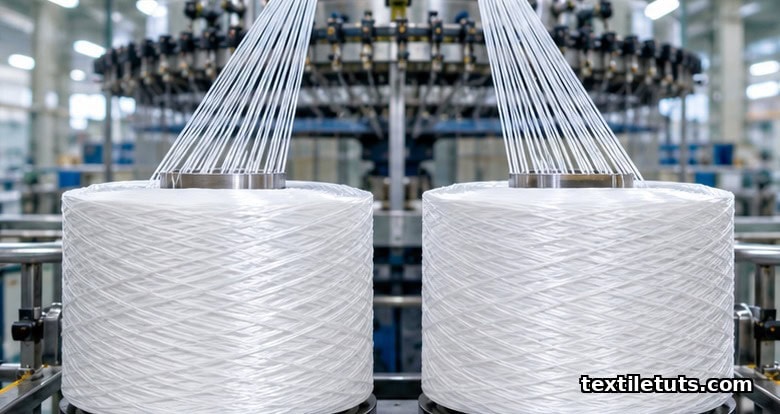
Industrial yarns for tire cord and conveyor belt reinforcement are produced as twisted plied constructions of high-tenacity polyester (PET), nylon 6, or nylon 6,6 with linear densities of 940 to 2,100 dtex, breaking tenacity of 7.5 to 9.5 g/denier, breaking elongation of 10 to 18 percent, and twist multipliers between 4.0 and 5.5; tire-cord fabrics are woven at 30 to 80 ends per 10 cm, while conveyor-belt carcasses use 80 to 160 ends per 10 cm at higher pick densities.
The two application families share raw-material chemistry, the same draw-twisting equipment, and almost the entire upstream process chain, yet they diverge sharply in cord geometry, fatigue target, adhesive chemistry, and the international standards that qualify the finished fabric.
This article walks through the yarn specifications, twisting systems, dipping chemistry, weaving geometry, and quality-control methods that separate a tire-cord yarn from a conveyor-belt fabric yarn, with side-by-side numbers and the ISO and ASTM test methods each application calls out.
Why the Yarn Stage Decides the Whole Composite
A radial tire and a multi-ply conveyor belt are both rubber-textile composites, and both depend on the same upstream decision: the filament yarn itself. Twist level, tenacity, and gauge uniformity at the spinning stand dictate every downstream property, from the cord’s resistance to compressive fatigue in a tire sidewall to the belt’s splice retention under a 30 kN/m edge load. Process engineers treat the yarn stage as a thermal-mechanical contract: the tensile modulus and breaking elongation measured at the creel set the ceiling for what dipping, weaving, and calendering can later achieve.
For textile engineers moving from apparel yarn into technical yarn, the first adjustment is mental. An apparel cotton or polyester yarn with a breaking tenacity of 3.5 to 5.0 g/denier is acceptable for knitted jersey. A tire-cord yarn must clear 7.5 g/denier as a release threshold, and most specifications push for 8.5 g/denier and above. The same constraint applies on the conveyor-belt side, where carcass yarns for steel-cord-reinforced mining belts are often replaced by heavy polyester or aramid plied yarns in lighter-duty industrial applications.
Yarn Construction: Filament, Ply, and Cord
Industrial yarn for both end uses starts as a continuous filament, not a spun staple. High-tenacity PET filament is produced at 5.0 to 7.0 g/denier off the spin draw line, then drawn at draw ratios between 5.5:1 and 6.2:1 with a hot plate at 200 to 240 degrees Celsius to lock in crystallinity above 50 percent. Nylon 6 and 6,6 follow the same draw pattern but at a slightly higher hot plate temperature of 220 to 260 degrees Celsius because of their higher melting point and higher moisture regain, which affects hot relaxation behavior.
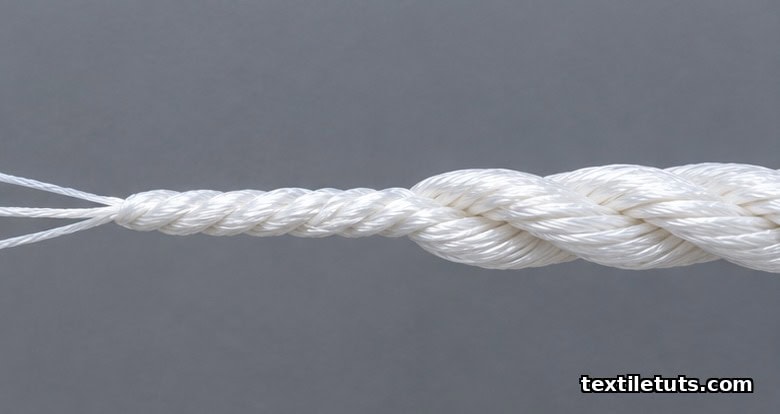
Single-end yarn is rarely used in either application. The standard unit is a plied yarn: two or three single ends twisted together on a two-for-one twister, then two plied ends twisted in the opposite direction to form a cabled cord. Tire-cord constructions are usually expressed as 840/2, 1,100/2, 1,670/2, or 2,100/2 (dtex/ply count), and the final cabled cord typically has 470 to 600 turns per meter of cable twist after the plying operation.
Conveyor-belt carcass yarns use a similar construction but at heavier linear densities. A typical belt carcass fabric uses 1,100/2, 1,670/3, or 2,200/2 PET plied yarn, sometimes with nylon 6 weft for impact absorption on mining belts. The twist direction is set opposite to the eventual belt load direction so that the cord tries to untwist under tension, locking the rubber matrix around it.
Twist and the Twist Multiplier
Twist is the cheapest way an industrial yarn mill controls cord performance. Twist multiplier (TM) is calculated as turns per meter divided by the square root of the tex count; a TM of 4.0 to 4.5 gives a soft cord with high fatigue life and lower tensile strength, while a TM of 5.0 to 5.5 pushes breaking tenacity higher at the cost of fatigue endurance.
Tire-cord plied yarn for passenger radial tires is twisted at a TM of 4.0 to 4.5 on the singles, then cabled at a TM of 4.5 to 5.0. Truck and off-the-road (OTR) tire cords move higher, to a singles TM of 4.5 to 5.0 and a cable TM of 5.0 to 5.5, because the heavier load requires more lateral stability at the cost of heat buildup in the cord plies. Conveyor-belt carcass yarn, in contrast, sits at a lower singles TM of 3.5 to 4.2 because the cord operates under more uniform tension rather than the cyclic flexing seen in a tire sidewall.
The twist direction convention is fixed across both applications: Z-twist singles, S-twist plied yarn. Reversing this convention causes yarn liveliness, splice slippage, and severe lamination defects at the calender.
Dipping: RFL and the Adhesive Interface
Greige industrial yarn has no chemical affinity for rubber. The cord is passed through a two-stage dip tank: a first epoxy or isocyanate-based pre-dip that bonds to the fiber surface, followed by a resorcinol-formaldehyde-latex (RFL) dip that bonds to the rubber compound. Dwell times are 1.0 to 3.0 seconds in the pre-dip at 30 to 60 degrees Celsius and 3.0 to 6.0 seconds in the RFL dip at 200 to 240 degrees Celsius, with subsequent drying and hot-stretching at 220 to 250 degrees Celsius under 1.0 to 4.0 percent overfeed to lock in cord twist.
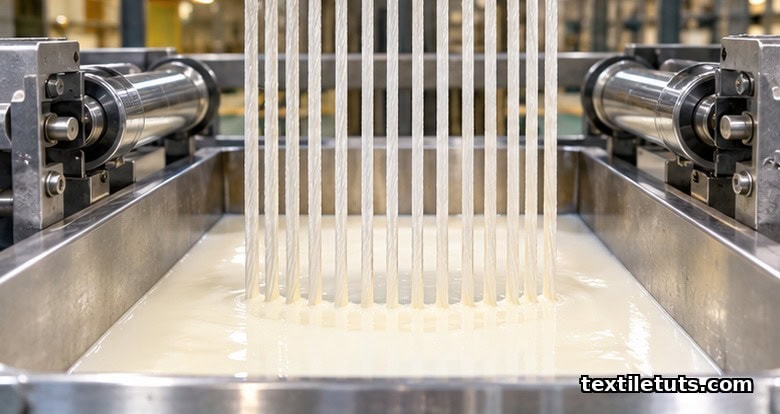
Tire-cord RFL formulations use a styrene-butadiene-vinyl pyridine (SBVP) latex at 30 to 40 percent solids for polyester, and a styrene-butadiene (SBR) latex for nylon. Conveyor-belt carcass dipping adds an anti-static additive and, for mining-grade belts, a chloroform-extractible wax emulsion to reduce ply friction during service. The dried pick-up of RFL on the cord is held at 4.0 to 6.0 percent by weight; falling outside this window is a release defect.
Weaving Geometry for Cord Fabric
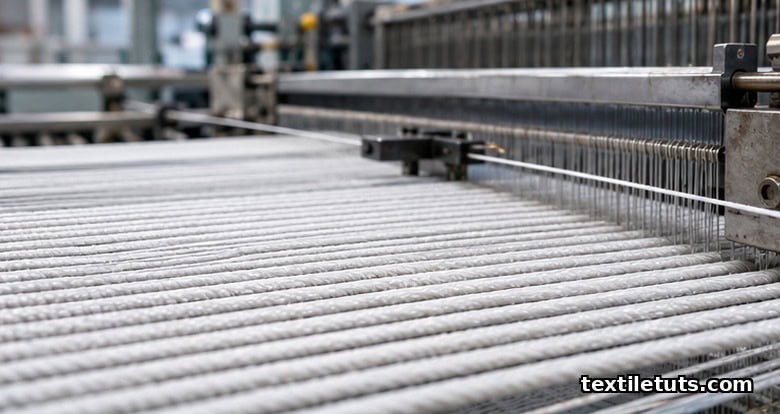
Cord fabric is woven, not knit. A typical tire-cord loom runs 30 to 80 ends per 10 cm in the warp with weft (nylon 6, typically 470 dtex at 10 to 15 picks per 10 cm) inserted only to hold the warp cords in place during dipping and calendering. The weft is later discarded or burnt off during tire building, so its tensile contribution is negligible.
Conveyor-belt carcass fabric uses 80 to 160 ends per 10 cm in the warp and 20 to 40 picks per 10 cm in the weft. The weft is retained in the belt because it carries transverse load and resists impact damage. Multi-ply belts stack 2 to 6 plies, with inter-ply rubber skim compounds at 0.8 to 2.0 mm per skim.
Property Comparison: Tire Cord vs Conveyor Belt Yarn
| Property | Tire Cord (PET) | Conveyor Belt Carcass (PET) |
|---|---|---|
| Linear density (dtex) | 940 to 2,100 | 1,100 to 2,400 |
| Breaking tenacity (g/denier) | 7.5 to 9.0 | 7.0 to 8.5 |
| Breaking elongation (%) | 10 to 14 | 12 to 18 |
| Hot air shrinkage at 177 °C (%) | 3.0 to 6.0 | 4.0 to 8.0 |
| Twist multiplier (plies) | 4.5 to 5.5 | 3.5 to 4.2 |
| Cord construction | Plied, sometimes cabled | Plied, occasionally cabled |
| Ends per 10 cm (warp) | 30 to 80 | 80 to 160 |
| Dip system | Epoxy pre-dip + RFL (SBVP latex) | RFL (SBR latex), sometimes single-stage |
| Primary test standards | ASTM D885, ASTM D2970, ISO 4639 | ISO 252-1, ISO 252-2, ISO 3684, ISO 703 |
The table summarizes a typical mid-range specification. Mining-grade conveyor belts shift toward heavier 2,200/3 constructions with aramid weft reinforcement, while high-performance passenger tire cords sometimes drop to 470/2 for ultra-light applications.
Quality Control and Test Standards
Two standards frameworks dominate the release testing for these products. The tire-cord framework centers on ASTM D885, which covers breaking strength, breaking elongation, modulus at 1 percent and 5 percent extension, hot-air shrinkage at 177 degrees Celsius, and dip pick-up; ASTM D2970 covers tire-cord adhesion to rubber using a strip pull-out method on a vulcanized block.
The conveyor-belt framework relies on ISO 252-1 and ISO 252-2 for ply adhesion, ISO 3684 for minimum pulley diameter, ISO 703 for transverse flexibility, and ISO 9856 for elastic and permanent elongation under load. ISO 7622 covers steel-cord-reinforced belts, while ISO 14890 covers textile carcass belts specifically. The choice between frameworks reflects the application: a tire is a closed-cell pressure vessel that fails by fatigue, while a belt fails by ply separation or edge cut growth.
Process control at the spinning stand follows standard textile test methods even for these heavy products. Linear density is measured on a wrap reel at 50 m per wrap; tenacity is measured on a constant-rate-of-extension (CRE) tensile tester at a gauge length of 500 mm and a crosshead speed of 300 mm/min; twist is measured by the untwist-retwist method on a hand-driven or motor-driven twist counter. Hot-air shrinkage is measured after 2 minutes at 177 degrees Celsius in a forced-convection oven with the cord under a 0.05 g/denier pre-tension.
Common Failure Modes and Their Root Causes
Tire-cord failures in service fall into three buckets: cord-to-rubber adhesion loss (RFL breakdown), tensile fatigue (cord breakage after cyclic flexing), and thermal degradation (loss of tenacity after prolonged high-temperature service). Each can be traced back to the yarn stage. Insufficient twist gives high initial tenacity but poor fatigue life. Excessive twist lowers tenacity and raises hysteresis heat in service. Inconsistent dip pick-up creates adhesion hot spots that propagate under load.
Conveyor-belt carcass failures are different. The most common mode is ply separation at the belt edge, caused by undersized weft density that lets the rubber skim extrude between warp cords. The second is splice failure, where the belt step joint delaminates because the splice angle does not match the carcass cord angle. A third mode, specific to mining belts, is cut and gouge growth from falling lump ore; this is mitigated by adding a transverse fabric or steel-breaker layer, but the underlying carcass yarn still carries the impact load.
Frequently Asked Questions
What twist multiplier should I use for a polyester tire cord?
For passenger radial tires, a singles twist multiplier of 4.0 to 4.5 and a cable twist multiplier of 4.5 to 5.0 gives the best balance of tensile strength and fatigue endurance. Truck and OTR tires shift the singles TM up to 4.5 to 5.0 and the cable TM to 5.0 to 5.5 to handle higher static loads.
Why is nylon 6,6 preferred over nylon 6 for some tire cords?
Nylon 6,6 has a higher melting point (255 °C vs 220 °C for nylon 6) and a higher tensile modulus after hot stretching, which gives better dimensional stability at high tire operating temperatures. Nylon 6 still dominates the bias-ply and motorcycle-tire segment because of its lower cost and easier processing window.
Can I use the same dipped cord fabric for a tire and a conveyor belt?
No. The dip chemistry is similar but not identical, and the weaving geometry is fundamentally different. Tire-cord fabric uses 30 to 80 ends per 10 cm with thin nylon weft that is discarded during tire building, while conveyor-belt fabric uses 80 to 160 ends per 10 cm with a heavier weft that stays in the finished belt. Substituting one for the other leads to splice slippage on belts and sidewall failure on tires.
How is hot air shrinkage at 177 °C measured, and why is it critical?
The test is run on a conditioned cord specimen under a 0.05 g/denier pre-tension in a forced-convection oven set to 177 °C for 2 minutes; the change in length, expressed as a percentage of the original gauge length, is the shrinkage value. Tyre cord polyester is normally specified at 3.0 to 6.0 percent shrinkage at 177 °C. High shrinkage leads to cord pull-back during tire curing and uneven mold fill; low shrinkage leads to slack cords that fatigue early.
What is the difference between ASTM D885 and ISO 4639?
ASTM D885 covers the mechanical properties of the greige and dipped yarn itself (tenacity, elongation, modulus, shrinkage, dip pick-up). ISO 4639 covers the adhesion strength between the dipped cord and a vulcanized rubber compound using a strip pull-out method. Both are usually required: D885 to qualify the yarn, ISO 4639 to qualify the cord-rubber interface.
References
- ASTM International. ASTM D885 / D885M, Standard Test Methods for Tire Cords, Tire Cord Fabrics, and Industrial Filament Yarns Made from Manufactured Organic-Base Fibers. ASTM: breaking strength, elongation, modulus, shrinkage, and dip pick-up methods for tire-cord yarn.
- ASTM International. ASTM D2970 / D2970M, Standard Test Method for Filament Yarn from Tire Cords by Means of a Strip Pull-Out Test. ASTM: cord-to-rubber adhesion strength on a vulcanized block.
- ISO. ISO 252-1:2014, Conveyor belts, Adhesion between constitutive elements, Part 1: Methods of testing. ISO: ply adhesion test methods for textile carcass and steel-cord belts.
- ISO. ISO 3684:1990, Conveyor belts, Determination of minimum pulley diameter for textile carcass belts. ISO: minimum pulley diameter as a function of belt construction and carcass yarn.
- ISO. ISO 4639:2015, Rubber, vulcanized or thermoplastic, Determination of adhesion to textile fabrics. ISO: strip pull-out adhesion between rubber and textile reinforcement.
- Sprengel, R., and co-authors. Materials, Design and Modeling of Tire Cords. Springer Open, Materials Science forum, a peer-reviewed review of high-tenacity PET, nylon 6, and nylon 6,6 cord yarn behavior.
- Topbas, S., and contributors. Conveyor Belt Technology, Textile Carcass Reinforcement. ResearchGate publication archive, a peer-reviewed overview of carcass fabric construction and ply adhesion for mining and industrial belts.
This article is the working reference for industrial yarn spinning in tire cord and conveyor belt reinforcement. Editorial by Iftay Khairul Alam, TextileTuts. Sources: ASTM D885, ASTM D2970, ISO 252-1, ISO 3684, ISO 4639, Springer Open, ResearchGate as cited.


