
Whiskering and Handsanding on Denim

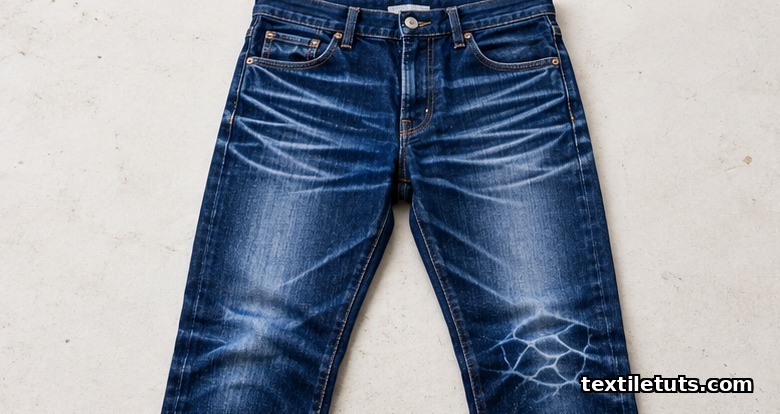
Whiskering and handsanding are dry mechanical abrasion finishes applied to indigo-dyed denim, in which P320 to P800 abrasive blocks are used to manually remove the surface layer of ring-dyed indigo dye so the white yarn core shows through and reproduces the creases that form at the hips, thighs, and knees after four to six months of regular wear.
Both finishes sit between desizing and the final rinse on a denim production line, and both are typically paired with a potassium permanganate (PP) spray at 30 to 60 g/L to sharpen the contrast between the abraded and untouched zones, which is why they appear together on almost every distressed-jean specification sheet.
This article covers the fiber chemistry that makes indigo respond to abrasion the way it does, the tools, grit grades, and spray distances used in industrial production, the effect on tensile strength and colorfastness measured against ISO and ASTM standards, and the operator-safety controls that keep KMnO4 and airborne dust within workplace exposure limits.
What Whiskering and Handsanding Actually Mean
Whiskering and handsanding are two related but distinct mechanical finishes used to age indigo denim artificially. Whiskering refers to the high-contrast, often vertical or honeycomb-patterned fade lines drawn across the front thigh, back yoke, and behind-the-knee areas using a stiff abrasive pad or pencil grinder. Handsanding refers to the broader, softer abrasion applied over flat surfaces like the seat, knees, and thighs, usually with a flexible sanding block or a paddle sander running at low RPM.
Both rely on the same underlying fiber property: indigo is a ring-dye, meaning the dye molecules sit on the outer surface of the cotton fiber instead of penetrating the core. A controlled amount of abrasion therefore removes dye without removing much fiber, which is what creates the white contrast that ordinary wear produces.
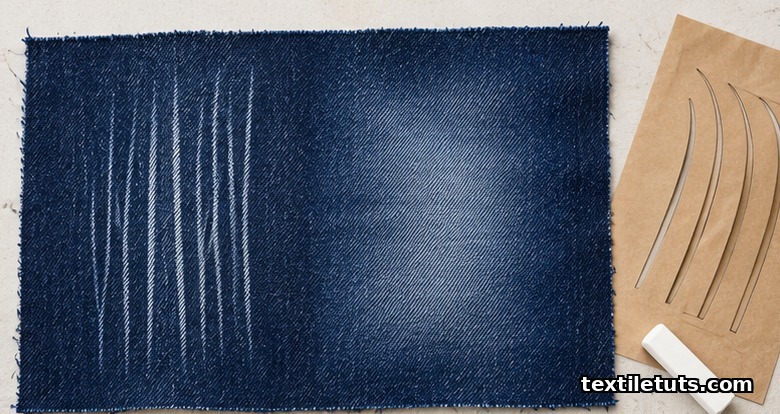
The two finishes differ mainly in coverage and intensity. Whiskering is selective, with a clearly defined pattern that follows body-crease geometry, often traced onto the garment using a printed template, a chalk pattern, or a kraft-paper stencil. Handsanding is wider and more diffuse, fading entire zones rather than drawing individual lines. On a single pair of jeans, handsanding usually happens first to set the base tone, then whiskering is layered on top to add the sharper accents the eye reads as “wear marks”.
The Indigo Chemistry That Makes Abrasion Work
Indigo (C16H10N2O2) is a vat dye applied to cotton through a reduction-oxidation cycle. In the dye bath, indigo is reduced to its soluble leuco form, which has only a weak affinity for cellulose. As a result, only the outermost layers of each cotton fiber pick up the dye, leaving the core nearly white. This ring-dyeing effect is the chemical reason mechanical abrasion produces a sharp white fade instead of a uniform color shift.
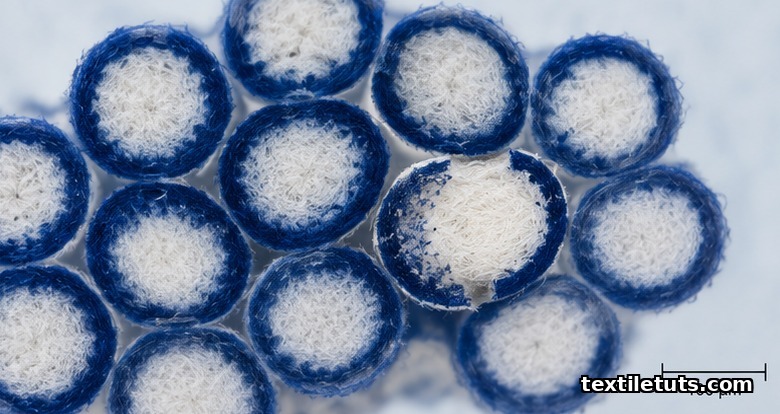
The depth of dye penetration in a typical indigo-dyed warp yarn is on the order of 0.5 to 1.5 micrometers of the fiber radius, with the remaining 8 to 12 micrometers of cotton remaining essentially undyed. A P400 abrasive removes on the order of 10 to 30 micrometers of fiber surface per pass under industrial pressure, so a single light sanding pass strips dye without noticeably damaging the underlying fiber, while heavy passes begin to break surface fibers and weaken the yarn.
To deepen the contrast beyond what abrasion alone can achieve, manufacturers apply a localized potassium permanganate spray. KMnO4 is a strong oxidizer that destroys indigo chromophores on contact, leaving a much paler zone. The spray is normally applied at 30 to 60 g/L from a distance of 10 to 15 cm, with garment moisture held below 70 percent to prevent the permanganate from migrating outside the target zone.
How Whiskering Is Applied on a Production Line
Industrial whiskering is done by a skilled operator holding a pencil-shaped abrasive tool, either a hand-held sanding stick or a small reciprocating grinder fitted with a 10 to 25 mm diameter abrasive tip. The operator works from a printed pattern that maps the location, length, and intensity of every whisker line. A standard five-pocket jean carries 60 to 120 individual whisker marks.
Common abrasive grades used for whiskering sit between P320 and P600. P320 leaves a coarse, high-contrast line reserved for raw or heavy-weight denim. P500 to P600 produces the softer lines seen on mid-weight stretch denim. Above P800 the abrasion is so fine that KMnO4 is usually needed for any visible contrast.
Modern high-volume factories have started using six-axis robotic arms fitted with force-feedback sanding heads to reproduce the same whiskering patterns. Robotic whiskering delivers consistent results across thousands of identical pairs and reduces operator exposure to KMnO4 mist and cotton dust, but the capital cost is roughly five to ten times that of a manual station.
Handsanding Tools, Pressure, and Quality Targets
Handsanding on flat panels uses either manual sanding blocks (backed by the operator’s palm pressure) or pneumatic paddle sanders running at 2,000 to 4,000 RPM. The abrasive media is usually aluminum-oxide or silicon-carbide paper on a foam backing; foam-backed discs conform to curved seams and produce softer fades than rigid blocks.
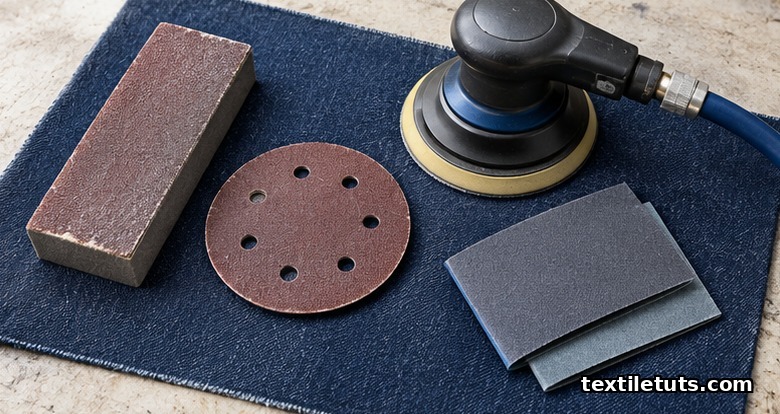
Operator-applied pressure on a manual block is typically in the 5 to 20 Newton range (roughly 0.5 to 2 kg of downward force). Higher pressure deepens the fade but also accelerates fiber damage and dust generation. Production specifications usually define the fade in terms of color change measured against a control swatch, rather than by counting strokes, because hand pressure varies between operators.
The reference standard for color measurement on denim is the CIE Lab Delta-E value measured against an unwashed control panel. A light handsanding pass typically produces a Delta-E of 8 to 15 against the original indigo, while a heavy whisker-plus-PP-spray zone can reach Delta-E values above 30. Buyers typically specify a target Delta-E band of 18 to 25 for the thigh zone of commercial stretch denim.
Strength Loss, Crocking, and the Standards That Bound the Process
Mechanical abrasion always reduces tensile strength in the treated zone, and production specs have to leave a margin for this. ASTM D5034 (Standard Test Method for Breaking Strength and Elongation of Textile Fabrics, Grab Method) is the most common test used to confirm that a finished garment still clears the retailer’s minimum strength threshold, typically 200 to 300 N warp-wise for a 12 oz denim after finishing.
Real-world data from production audits places the strength loss in a handsanded zone at 8 to 15 percent relative to an unsanded control, and in a heavy whisker-plus-PP zone at 15 to 25 percent. These ranges line up with values published in academic studies on denim finishing and explain why heavy-distressed jeans in a given weight tend to fail premature seam-tear tests more often than their clean-finish counterparts.
Colorfastness is the second quality gate. AATCC TM 8 (Colorfastness to Crocking) is used to check whether the abraded indigo will transfer onto adjacent fabrics, especially in lighter pocket linings. Properly rinsed and neutralized garments typically score 3 to 4 on the AATCC gray scale for dry crocking and 2 to 3 for wet crocking. ISO 105-C09, the standard for colorfastness to domestic and commercial laundering, is used to confirm that the fade does not bleed into wash water over repeated cycles. ISO 105-B02 controls the artificial-light fastness test that confirms the indigo will not shift toward red as it ages on a retail shelf under fluorescent lighting.
Environmental, Health, and Operator-Safety Controls
Both finishes generate fine cotton and synthetic-fiber dust that has to be captured at source. Manual sanding stations are normally paired with downdraft tables exhausting at 0.5 to 1.0 m/s face velocity. KMnO4 spray stations require local exhaust ventilation capable of clearing airborne manganese below the occupational exposure limit of 0.5 mg/m3 set as the inhalable fraction in most jurisdictions aligned with ACGIH recommendations.
Operator PPE for spray stations typically includes an N95 or better respirator, splash goggles, nitrile gloves, and an apron, because concentrated KMnO4 will stain skin and can cause chemical burns above 5 percent concentration. Sodium bisulfite or hydrogen peroxide is kept on hand as the neutralizer for accidental skin contact, since reducing the permanganate stops the oxidation reaction.
Effluent from the rinse that follows handsanding carries manganese ions and indigo wash-off. Most production-scale factories route this stream through a manganese-removal step, often precipitation as manganese hydroxide at pH 9 to 10, before discharge. Without that step, a single 10,000-pair-per-day facility can exceed local discharge limits for total manganese within a single production shift.
Whiskering and Handsanding Compared at a Glance
| Parameter | Whiskering | Handsanding |
|---|---|---|
| Coverage area | Narrow lines, 2 to 10 mm wide | Broad zones, 5 to 30 cm |
| Common abrasive grade | P320 to P600 | P400 to P800 |
| Typical tool | Pencil grinder or sanding stick | Foam-backed sanding block or paddle sander |
| PP spray needed | Usually yes, 30 to 60 g/L | Often optional, lower 20 to 40 g/L if used |
| Typical Delta-E vs. control | 20 to 35 | 8 to 18 |
| Tensile-strength loss (ASTM D5034) | 15 to 25 percent | 8 to 15 percent |
| Operator skill required | High (pattern tracing) | Moderate (uniform pressure) |
| Robotic automation | Common at >5,000 pcs/day | Emerging, less common |
Frequently Asked Questions
What is the difference between whiskering and handsanding?
Whiskering draws narrow, high-contrast fade lines along body-crease geometry using a pencil grinder or sanding stick, typically at P320 to P600 grit. Handsanding applies a wider, softer abrasion across flat surfaces such as the seat, knees, and thighs, usually with P400 to P800 foam-backed blocks. Most distressed jeans have both, with handsanding set first and whiskering layered on top.
Do whiskering and handsanding damage the denim fabric?
Both finishes remove a measurable amount of surface fiber along with the indigo dye. Handsanded zones typically lose 8 to 15 percent of their original warp tensile strength, while heavy whisker-plus-PP-spray zones can lose 15 to 25 percent when tested under ASTM D5034. Production specifications keep the loss within retailer strength limits, typically 200 to 300 N warp-wise on a 12 oz denim, by capping the number of passes and the abrasive grade used.
How is potassium permanganate used in denim whiskering?
Potassium permanganate is sprayed onto the denim as a localized oxidizing bleach at 30 to 60 g/L from a spray distance of 10 to 15 cm. The KMnO4 destroys the indigo chromophore on contact, deepening the whiteness left by the abrasive step. After the spray, the garment is neutralized with hydrogen peroxide or sodium bisulfite to stop the oxidation reaction before the final rinse.
Can whiskering and handsanding be done without chemicals?
Yes, and laser whiskering is the most common chemical-free alternative. A CO2 or fiber laser ablates dye and surface fiber along a digital pattern, producing a comparable fade without abrasive dust or permanganate spray. The result is more consistent across a production batch, but laser-only fades tend to look flatter than mechanical-plus-PP fades because they lack the random fiber damage that gives mechanical whiskering its depth.
Why does indigo denim turn white when rubbed but regular cotton does not?
Indigo is a ring-dye: the dye molecules sit on the outer one to two micrometers of each cotton fiber instead of penetrating the core. When the surface is abraded, the dye layer is removed before any significant fiber mass is lost, and the inner, undyed fiber shows through. Ordinary reactive-dyed cotton is dyed through the fiber cross-section, so abrasion removes dyed and undyed material together and only produces a dull gray, not a bright white.
How do factories test whether a whiskering or handsanding finish is consistent?
The two main tests are color measurement and strength retention. Color is read with a spectrophotometer against an unwashed control panel and reported as a CIE Lab Delta-E value, with production tolerance usually set at a Delta-E of plus or minus 2 across a batch. Strength retention is checked using ASTM D5034, with the rejection threshold set by the buyer, typically a 15 to 25 percent tensile-strength drop relative to the unsanded control.
References
- ASTM International. ASTM D5034-09: Standard Test Method for Breaking Strength and Elongation of Textile Fabrics (Grab Method). https://www.astm.org/d5034-09.html
- AATCC. AATCC Test Method 8-2016: Colorfastness to Crocking: AATCC Crockmeter Method. https://www.aatcc.org/
- International Organization for Standardization. ISO 105-C09:2001 — Textiles: Tests for colour fastness, Part C09: Colour fastness to domestic and commercial laundering. https://www.iso.org/standard/31279.html
- International Organization for Standardization. ISO 105-B02: Textiles: Tests for colour fastness, Part B02: Colour fastness to artificial light: Xenon arc fading lamp test. https://www.iso.org/standard/44832.html
- Paul, R. (Ed.). Denim: Manufacturing, Finishing and Applications. Woodhead Publishing (Elsevier). https://www.elsevier.com/books/denim/paul/978-0-85709-843-7
- ResearchGate. Effect of Mechanical Finishing on the Physical Properties of Denim Fabric. Open-access textile engineering literature on denim abrasion. https://www.researchgate.net/
This article is the working reference for denim whiskering and handsanding. Editorial by Shahrukh Islam, TextileTuts. Sources: ASTM D5034, AATCC TM 8, ISO 105-C09, ISO 105-B02, and the cited Woodhead Publishing and ResearchGate entries as cited.


