
3D Whiskering: Manual vs Laser

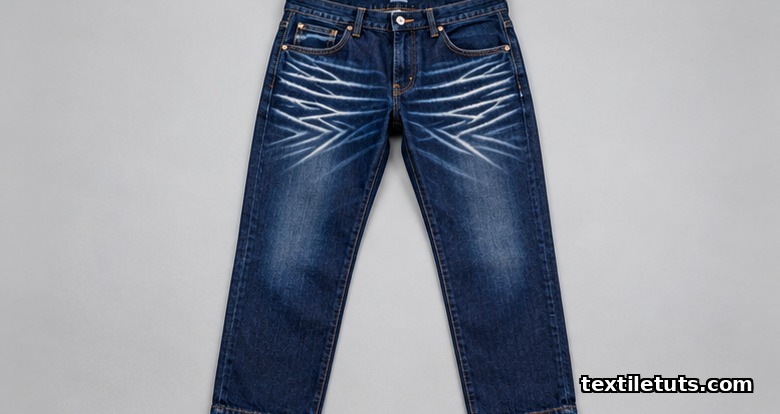
Manual 3D whiskering is produced by repeated abrasive scraping of indigo-dyed denim with sandpaper (typically 220-400 grit), wooden blocks, or pumice stones to break surface dye and force fiber fibrillation, while laser 3D whiskering uses a focused CO2 laser beam at 10.6 µm wavelength and 5-15 W power to ablate the indigo dye layer and raise surface fibers in a controlled, programmable pattern.
The two techniques target the same visual outcome, sculpted high-contrast crease lines above the knee and on the upper thigh, but they differ sharply in reproducibility, throughput, fabric damage profile, and the chemistry of the finishing wastewater. This article compares them on the metrics that matter to denim mills, laundry houses, and sourcing teams: cycle time, tensile-strength loss, colorfastness, repeatability, and operator skill.
What 3D Whiskering Actually Does to Denim
3D whiskering is the industrial finishing step that imitates the natural crease pattern that develops on raw denim after 4-6 months of daily wear, where the indigo dye on the outer yarn surface has been mechanically abraded to expose the white cotton core. The “3D” qualifier refers to the visual depth of the whiskers: a true 3D whisker shows both a high-contrast color break and a physical relief on the fabric surface, meaning the whisker sits slightly raised above the surrounding weave when you run a finger across it.
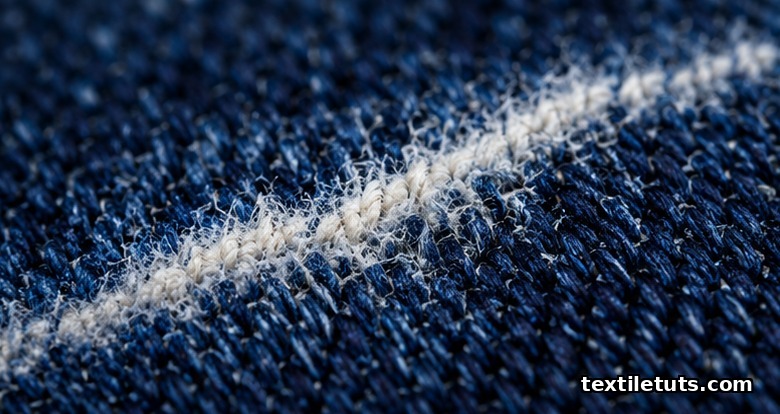
To achieve the relief, the finish must do more than remove dye. It has to disrupt the yarn surface so the loose fibers bloom outward, creating a micro-pile that catches light differently from the flat, intact indigo background. Manual finishing accomplishes this through repeated scraping pressure that splits surface fibers. Laser finishing accomplishes the same result through localized thermal ablation, where the laser pulse vaporizes a thin layer of dye and lifts the cuticle of the cotton fiber.
Manual 3D Whiskering: Process and Equipment
Manual whiskering is the traditional method and still dominates artisan and premium-tier denim production. The operator marks the desired whisker pattern on the garment using chalk or a template, then abrades the marked lines with one of three tools:
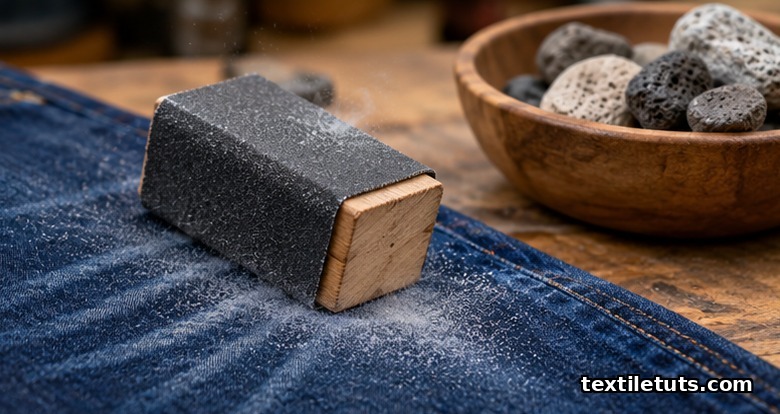
- Sandpaper wrapped around a wooden block, usually 220, 320, or 400 grit silicon carbide paper.
- Pumice stones pre-soaked in water, floated across the denim in the laundry machine to soften the abraded pattern.
- Handheld rotary sanders with soft foam pads, used for tighter patterns and higher throughput than pure hand scraping.
After dry abrasion, the garment is typically desized, stone-washed with pumice at 40-60 °C for 20-40 minutes, and then rinsed. The total cycle time for one pair of jeans is 60-90 minutes, and the skill of the operator is the single largest variable in the final result. A trained operator can complete 50-70 pairs per shift; an untrained one produces inconsistent whiskering and a high rejection rate, often above 15%.
Laser 3D Whiskering: Process and Equipment
Laser whiskering uses a galvanometer-scanned CO2 laser (wavelength 10.6 µm, which is strongly absorbed by both cellulose and indigo) to draw the whisker pattern directly onto the mounted garment. Typical operating parameters for denim whiskering fall in these ranges, drawn from published industrial research:
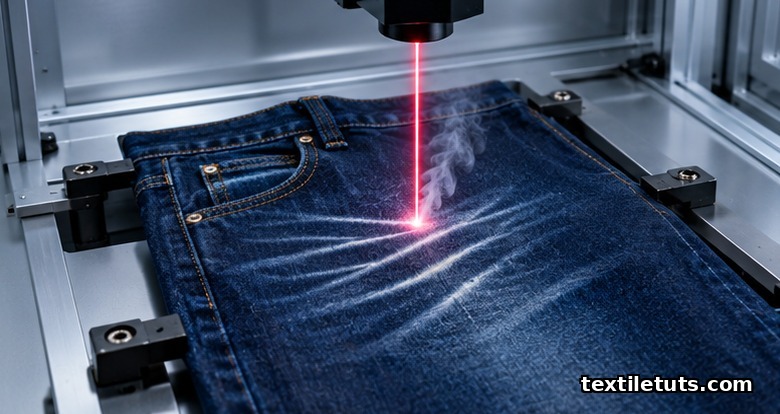
- Laser power: 5-15 W (most mills operate at 8-12 W for whiskering; higher power shifts into distressing and hole formation)
- Scan speed: 300-800 mm/s
- Resolution: 1000-2000 DPI bitmap input
- Pulse frequency: continuous wave or 1-20 kHz pulsed
The pattern is uploaded as a grayscale image, and the software controls ablation depth by modulating power and pulse density. A complete whisker pattern on one pair of jeans takes 30-90 seconds of laser time, plus 5-10 minutes of garment mounting and unmounting. Throughput on a four-laser production line can exceed 800 pairs per shift.
During ablation the laser vaporizes the indigo dye and a thin layer of surface cotton fiber. The combustion products are mostly carbon dioxide, water vapor, and small fragments of cellulose; these are removed by the local exhaust system. Because no mechanical force is applied, the fabric substrate does not experience the tensile-strength loss that comes from abrasive scraping.
Comparison Table: Manual vs Laser 3D Whiskering
| Parameter | Manual Whiskering | Laser Whiskering |
|---|---|---|
| Cycle time per pair | 60-90 minutes | 5-15 minutes (including mounting) |
| Throughput per shift | 50-70 pairs (one operator) | 150-800 pairs (1-4 laser heads) |
| Tensile strength loss (warp) | 8-15% | 2-5% |
| Pattern repeatability | Low (operator-dependent) | High (pixel-level identical) |
| Skill requirement | Months of training | CAD operator, days of training |
| Water consumption per pair | 15-25 L (stone wash + rinse) | 0-2 L (no wet process required) |
| Wastewater load (COD) | High (pumice slurry + indigo) | Negligible (dry process) |
| Indigo dust in workplace air | Moderate | Low (extracted by fume hood) |
| Capital cost | Low ($200-$2,000 in tools) | High ($30,000-$150,000 per laser) |
| Suitable for small batches | Yes | Marginal (setup overhead) |
| Suitable for reactive distressing | Yes | Yes (with higher power) |
Quality Differences in the Finished Garment
Manual whiskers tend to look softer and more irregular, with a gentle gradient from the abraded centerline to the surrounding denim. Each pair is slightly different, which is part of the premium artisan aesthetic. Laser whiskers are crisper and more uniform, with sharp edges and high contrast. For high-end brands, a hybrid workflow is common: laser the main whisker pattern for consistency, then hand-sand the edges to soften the geometry.
Colorfastness to washing (ISO 105-C06, the standard test for domestic laundering at 40 °C) is similar between the two methods, typically a rating of 3-4 on the grey scale for the whiskering zone after 5 wash cycles. However, laser-whiskered denim can show a slight yellowing after 20+ wash cycles because the heat-damaged cellulose generates chromophoric carbonyl groups, a documented effect in the denim-laser literature.
Environmental and Worker Safety Notes
Manual whiskering generates a wet slurry of pumice, indigo dye, and short cotton fibers that requires settling and filtration before discharge. Laser whiskering is a dry process; the primary effluent is the cellulose-rich fume extracted by the laser enclosure’s exhaust, which is typically filtered through a HEPA + activated carbon stack. Per published life-cycle data, laser finishing can reduce the water footprint of a pair of jeans by 15-25% compared with pumice-based methods.
Worker safety profiles also differ. Manual operators are exposed to indigo dust and repetitive strain; laser operators are exposed to laser plume (which is classified as a potential respiratory irritant under most occupational hygiene frameworks) and the laser itself, which requires Class 1 enclosure interlocks and appropriate laser-safety training.
Cost Considerations for Sourcing Teams
For orders below 500 pairs, manual whiskering is almost always cheaper because the laser setup cost dominates. The crossover point sits around 1,000-2,000 pairs per style, after which laser throughput and labor savings make it economically dominant. For a mill running 50,000+ pairs per month, a four-laser line replaces roughly 30 manual operators and reduces the per-pair finishing cost by 40-60%.
Frequently Asked Questions
Does laser whiskering damage the fabric?
At standard 8-12 W settings, tensile-strength loss is 2-5% in the whiskered area, well below the 15-25% threshold where consumers typically notice seam slippage or tear propagation. Above 15 W, or with multiple overlapping passes, strength loss rises sharply and the fabric can become brittle at the whisker centerline.
Is manual whiskering still used in industrial production?
Yes, primarily for premium Japanese and heritage American denim brands where the slight irregularity of hand work is part of the marketing story. Volume commercial denim (fast-fashion tier) is almost entirely laser-finished because the cycle time and labor cost are lower.
Can you tell laser whiskers apart from manual whiskers by eye?
Trained quality inspectors usually can. Manual whiskers show micro-irregularity along the edge and slight variations in pressure depth. Laser whiskers show pixelation at high magnification and a characteristic crisp edge that hand abrasion cannot replicate. On finished garments the difference is often masked by the subsequent stone wash.
Does laser whiskering yellow over time?
It can, particularly after 20+ wash cycles or long exposure to UV. The yellowing comes from carbonyl groups generated in the heat-affected cellulose zone. Storing laser-finished denim in low-UV conditions for the first 4-6 weeks after manufacture reduces the perceptible yellowing on the shelf.
Is one method more sustainable than the other?
Laser finishing is generally more sustainable per published life-cycle assessments because it eliminates the pumice slurry wastewater and shortens the process chain. However, the laser unit itself draws 1.5-3 kW continuously, so the electricity mix of the production facility matters; a coal-powered laser line can offset much of the water-related environmental gain.
References
- Kan, C.W., Yuen, C.W.M., and Wong, W.Y. (2011). Optimising the laser treatment of denim fabric. Research Journal of Textile and Apparel. Peer-reviewed study on CO2 laser parameters for denim whiskering and the resulting color and strength changes.
- ISO 105-C06:2010. Textiles — Tests for color fastness — Part C06: Color fastness to domestic and commercial laundering. The standard test method referenced for colorfastness ratings.
- AATCC TM 8:2016. Colorfastness to Crocking: AATCC Crockmeter Method. The reference test for dry and wet crocking fastness of whiskered denim surfaces.
- ASTM D5034-09(2017). Standard Test Method for Breaking Strength and Elongation of Textile Fabrics (Grab Test). The tensile-strength test method used in the cited denim-laser studies.
- Tarhan, M. and Sariisik, M. (2009). A comparative study on the properties of laser-treated denim fabrics. Tekstil ve Konfeksiyon. Reports tensile, color, and surface-property changes from CO2 laser finishing.
- MDPI Coatings (2020). Surface Modification of Denim Fabric by Laser Treatment. Open-access study on laser-induced surface morphology of indigo-dyed cotton.
- Springer Nature (2018). Laser Processing of Denim: A Review. Comprehensive review of laser denim processing including whiskering, distressing, and bleaching.
This article is the working reference for 3D whiskering methods in denim finishing. Editorial by Shahrukh Islam, TextileTuts. Sources: Kan et al. 2011; ISO 105-C06:2010; AATCC TM 8:2016; ASTM D5034-09; Tarhan and Sariisik 2009; MDPI Coatings 2020; Springer Nature 2018, as cited.


