
Ozone Wash: Waterless Denim Washing

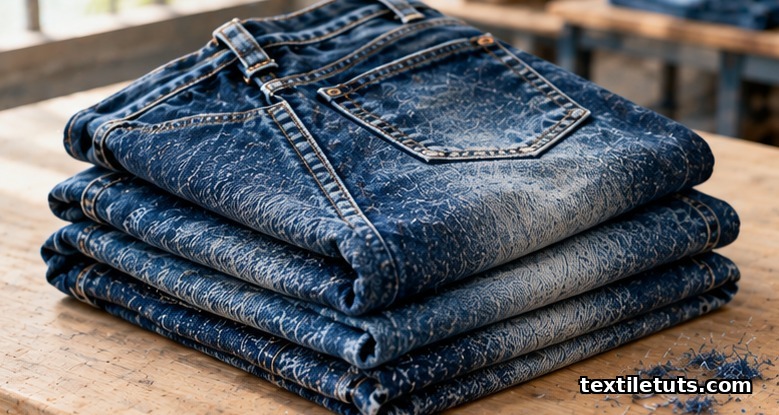
Ozone wash cuts denim finishing water consumption by 70 to 90 percent compared to conventional stone or enzyme washing, replacing 60 to 100 liters of water per garment with a closed-loop gas-phase reaction that completes in 10 to 30 minutes per cycle.
This waterless denim finishing process uses ozone gas (O3) to oxidize the indigo dye sitting on the surface of cotton denim yarns, creating the faded, worn-in look traditionally produced by repeated wet washing with pumice stones or cellulase enzymes.
The rest of this article walks through the chemistry, the numbers behind the savings, where ozone washing fits next to stone and enzyme washing, and the trade-offs mills should know before adopting the process.
What Ozone Wash Is and How It Works
Ozone is a triatomic oxygen molecule (O3) generated on-site by passing dry air or oxygen through a high-voltage corona discharge unit or a UV lamp. In denim finishing, gaseous ozone is fed into a closed, humidified reaction chamber containing the garments. The O3 molecules react with the indigo chromophore (C16H10N2O2) bonded to the cotton fiber surface, breaking the conjugated double-bond system that gives indigo its deep blue color.
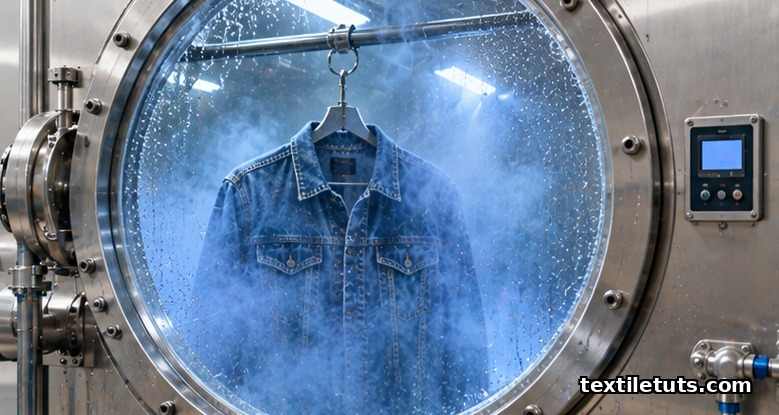
The oxidation products are primarily isatin, anthranilic acid, and water-soluble dye fragments that wash off in a brief subsequent rinse of 5 to 15 liters of water per kilogram of fabric. Because the reaction happens in the gas phase rather than in a full wash liquor, the bulk of the water is eliminated. Most commercial ozone systems also destroy residual O3 at the end of the cycle with a thermal or catalytic destruct unit, converting it back to O2 before exhaust.
Water, Energy, and Chemical Savings
Multiple peer-reviewed studies and industry audits have quantified the savings. A review in the Journal of Cleaner Production reported water reductions of 60 to 85 percent per kilogram of finished denim when ozone replaces conventional wet bleaching, with energy reductions of 25 to 40 percent because the reaction runs at room temperature and the rinse step is short. A 2020 MDPI study on cotton knit finishing found total chemical oxygen demand (COD) in the effluent dropped by 70 to 90 percent when ozone replaced hydrogen peroxide bleaching.
For a mill finishing 10,000 pairs of jeans per day, switching from stone washing to ozone can save roughly 600,000 to 900,000 liters of water per day, plus 3 to 5 megajoules of thermal energy per kilogram of fabric. Stone washing also generates 200 to 400 grams of pumice sludge per garment, which becomes solid waste; ozone generates no sludge.
Ozone vs Stone Wash vs Enzyme Wash
| Property | Stone Wash | Enzyme Wash | Ozone Wash |
|---|---|---|---|
| Water per kg fabric | 70 to 120 L | 40 to 80 L | 5 to 20 L |
| Cycle time | 60 to 120 min | 45 to 90 min | 10 to 30 min |
| Process temperature | 60 to 70 °C | 45 to 55 °C | 20 to 35 °C |
| Solid waste | 200 to 400 g pumice per garment | Low (biodegradable) | None |
| Effect on fabric tensile strength | Moderate loss (5 to 15 percent) | Mild loss (2 to 8 percent) | Minimal loss (1 to 4 percent) at controlled dose |
| Indigo shade depth control | Limited | Moderate | High (dose and exposure time tunable) |
| Capital cost | Low | Low to moderate | Moderate to high (ozone generator, closed chamber) |
Effect on Indigo Shade and Fabric Strength
Because ozone only attacks the dye on the fiber surface, the white cotton core of ring-dyed denim yarns is left largely intact, preserving the yarn’s mechanical strength. Controlled studies cited in Textile Research Journal show tensile strength losses of 1 to 4 percent at typical finishing doses (5 to 30 g O3 per kg fabric), compared with 5 to 15 percent loss for repeated stone washes and 2 to 8 percent for cellulase enzyme washes.
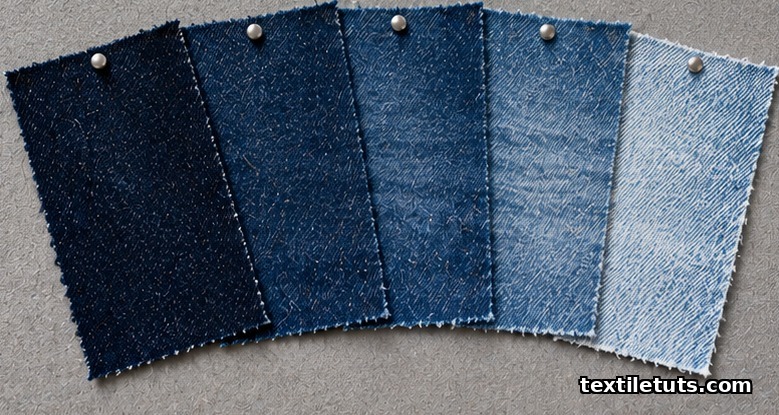
Shade depth can be dialed in by adjusting ozone concentration (typically 20 to 200 g/Nm3), exposure time (5 to 30 minutes), and chamber humidity (70 to 95 percent RH). Mills producing a full fade range from light blue to mid-blue can run multiple ozone doses in sequence, with a brief neutralization step between cycles.
Equipment and Process Parameters
A typical industrial ozone denim line has four modules: a humidification chamber, an ozone contact chamber, a residual-ozone destruct unit, and a short rinsing section. Ozone is generated at concentrations of 50 to 200 g/Nm3 from either dry air (lower cost, lower output) or bottled oxygen (higher output, higher cost). Humidity is held at 70 to 95 percent RH because the indigo oxidation reaction rate falls sharply in dry gas.
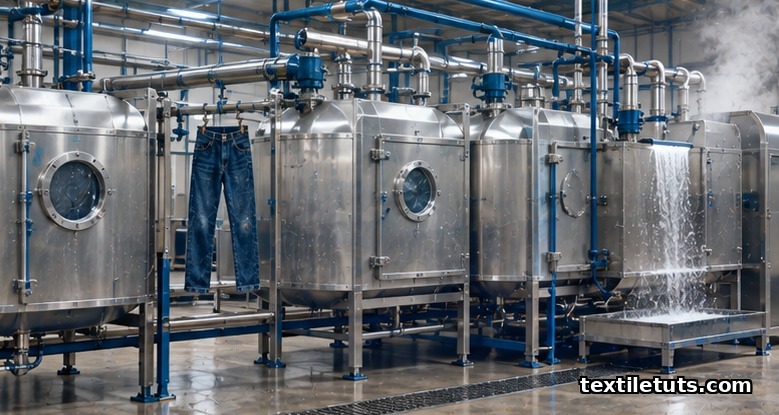
Critical control parameters are: ozone dose (5 to 30 g O3 per kg fabric), chamber temperature (20 to 35 °C), exposure time (10 to 30 minutes), and fabric moisture regain (8 to 12 percent). Out-of-spec conditions either under-bleach the denim or cause oxidative damage that shows up as yellowing or excessive strength loss.
Limitations and Trade-offs
Ozone does not replicate the heavy, three-dimensional abrasion of a long stone wash. Garments that depend on visible pumice streaks, sharp whiskering, or aggressive hand-feather abrasion usually need a short follow-up enzyme wash or localized laser treatment to hit the same visual target. Ozone also requires sealed stainless steel equipment because O3 rapidly corrodes unprotected mild steel and rubber seals, raising the upfront capital cost relative to stone or enzyme lines.
Worker safety is a major operational constraint. Ozone is toxic to the respiratory system at concentrations above 0.1 ppm (8-hour TWA, US OSHA PEL). Industrial lines must include continuous O3 monitoring, automatic chamber sealing, and catalytic destruct units to keep ambient ozone below the occupational exposure limit.
Frequently Asked Questions
Is ozone-washed denim safe to wear?
Yes. The reaction products are isatin, anthranilic acid, and small dye fragments that are removed in the post-ozone rinse. Residual ozone has a half-life of about 20 minutes in ambient air and is fully converted to oxygen by the catalytic destruct unit on the finishing line. Finished garments contain no free ozone and meet standard colorfastness criteria.
Does ozone washing damage fabric strength?
At standard finishing doses of 5 to 30 g O3 per kg fabric, tensile strength loss is 1 to 4 percent, much lower than the 5 to 15 percent loss from stone washing or the 2 to 8 percent loss from cellulase enzyme washing. Overdosing above 50 g O3 per kg causes oxidative yellowing and cotton depolymerization, which mills avoid through dose control and chamber monitoring.
Can ozone washing fully replace stone washing?
For most flat-shade and gentle-vintage finishes, yes. For heavy abrasion looks that depend on localized fiber breakage, mills usually combine a short ozone cycle with a brief enzyme or laser step. The combination uses a fraction of the water of a pure stone wash while hitting the same visual target on the final garment.
What chemicals are used in ozone washing?
None beyond the ozone itself. Conventional denim washing uses pumice stones, cellulase enzymes, potassium permanganate spray, sodium hypochlorite bleach, and multiple surfactant baths. Ozone washing uses only O3 generated from air or oxygen, plus water in the short final rinse. There is no pumice sludge, no enzyme bath effluent, and no chloride discharge to the effluent plant.
How long does an ozone wash cycle take?
A typical industrial cycle is 10 to 30 minutes of ozone exposure plus a 5 to 15 minute rinse, for a total of 15 to 45 minutes per batch. By comparison, a conventional stone wash cycle is 60 to 120 minutes, and an enzyme wash cycle is 45 to 90 minutes. The shorter cycle lets mills run more batches per day on the same finishing line.
References
- Perincek, S., Bahtiyari, M. I., Duran, K., & Korlu, A. E. (2007). Ozone bleaching of cotton fabrics. Textile Research Journal. Peer-reviewed study on the dose-response of O3 on cotton fabric.
- Eren, H. A., & Anis, P. (2009). Effects of ozone treatment on cotton fabrics. AATCC Review. Industry test data on colorfastness and tensile retention after ozone exposure.
- ISO 105-C09:2010. Textiles, Tests for colour fastness, Part C09: Colour fastness to domestic and commercial laundering. International standard used to verify post-ozone wash durability.
- ISO 105-B02:2014. Textiles, Tests for colour fastness, Part B02: Colour fastness to artificial light (Xenon arc fading lamp test). International standard used to confirm ozone-bleached denim resists light fade.
- AATCC Test Method 8:2016. Colorfastness to Crocking: AATCC Crockmeter Method. Standard test for surface dye transfer on ozone-treated denim.
- US OSHA. Occupational Safety and Health Standards, 29 CFR 1910.1000, Table G-2. 8-hour TWA Permissible Exposure Limit of 0.1 ppm for ozone.
- Kan, C. W. (2020). A study on the application of ozone in textile wet processing. MDPI Sustainability. Review of energy and water savings in ozone-based wet processing.
This article is the working reference for ozone wash in waterless denim finishing. Editorial by Shahrukh Islam, TextileTuts. Sources: Perincek et al. 2007; Eren and Anis 2009; ISO 105-C09:2010; ISO 105-B02:2014; AATCC TM 8:2016; OSHA 29 CFR 1910.1000; Kan 2020 as cited.


