
Wet-Laid Nonwoven

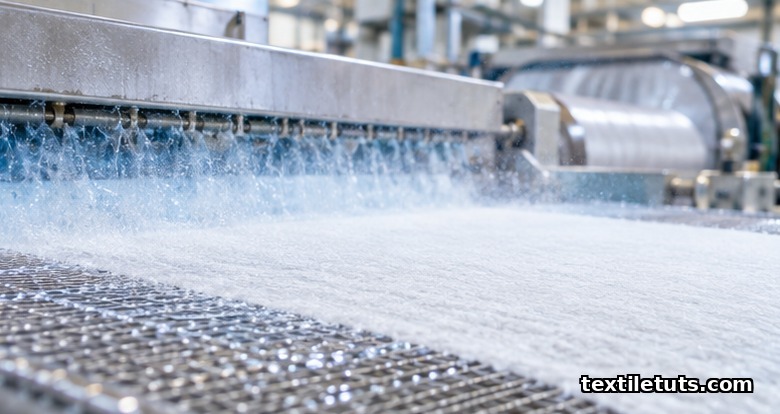
Wet-laid nonwovens are flat, paper-like fabrics formed by dispersing fibers 1 to 25 millimeters long in water at 0.005 to 0.1 percent consistency, draining the slurry over a moving wire screen at line speeds up to 2,000 meters per minute, and bonding the resulting web with binders, heat, or hydrogen bonds between cellulosic fibers.
Because the process mirrors paper-making on Fourdrinier, inclined-wire, or cylinder machines, wet-laid lines run faster than most dry-laid lines and accept extremely short fibers that competing routes reject. The result is an isotropic web with basis weights typically between 10 and 500 grams per square meter, used in glass-mat reinforcement, battery separators, coffee-filter stock, medical drapes, HVAC filtration, and bituminous roofing.
This guide covers how wet-laid nonwovens are made, which fibers and binders go into them, the mechanical properties that separate them from dry-laid and spunmelt fabrics, the standards that govern them, and where wet-laid technology outperforms competing nonwoven processes.
How Wet-Laid Nonwoven Manufacturing Works
The wet-laid process treats a fiber slurry the way a paper mill treats pulp. Continuous filaments or staple fibers are opened and blended in a pulper, then diluted with water to a headbox consistency between 0.005 and 0.1 percent by mass. At that concentration, individual fibers can move freely without forming flocs, which is the precondition for a uniform web. The dilute suspension is metered through a headbox onto a moving wire mesh, where gravity and vacuum remove the water and leave a randomly oriented web behind.
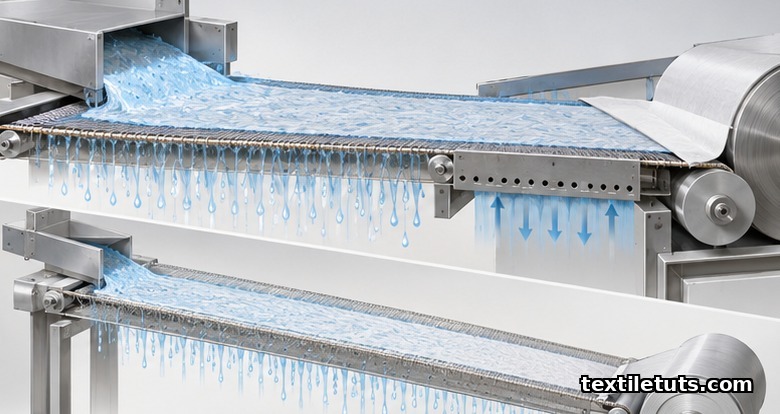
Three machine formats dominate wet-laid nonwoven production. Fourdrinier machines use a flat, horizontal wire and work well for heavier webs. Inclined-wire (or “Invers”) machines angle the forming section upward and let water drain through a shorter contact zone, which improves fines retention. Cylinder (or rotoformer) machines use a rotating cylindrical wire partially immersed in the slurry and are favored for short, fine fibers such as glass microfiber. Line speeds reach 2,000 meters per minute on modern assets, well above the 100 to 800 meters per minute typical of carded dry-laid lines and competitive with spunmelt throughput.
After forming, the wet web passes through pressing and drying sections. Bonding happens at this stage and may use any of the routes described in the bonding section below.
Fibers Used in Wet-Laid Nonwovens
Wet-laid lines accept a wider fiber-length window than any other nonwoven process. The viable range stretches from below 1 millimeter for fibrillated cellulose and glass microfiber in HEPA filtration media up to 25 millimeters for reinforcement applications. By contrast, dry-laid carding needs fibers longer than about 30 millimeters, and spunmelt processes work best with continuous filaments.
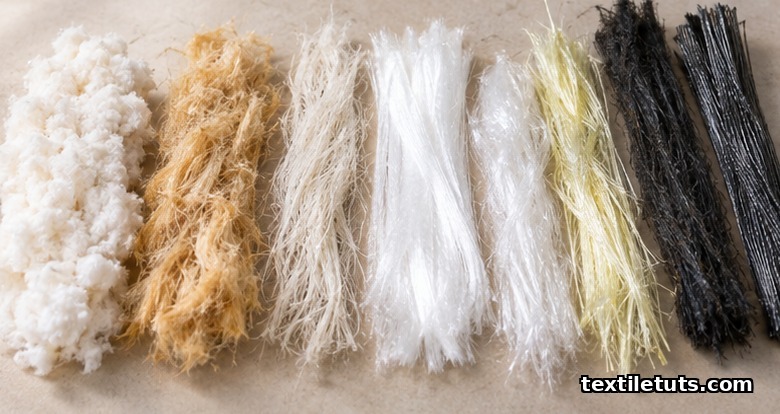
Cellulosic fibers dominate by tonnage. Wood pulp, cotton linters, rayon, lyocell, and abaca are common in wipes, tea-bag paper, and medical drapes where absorbency and skin contact matter. Polyester and polypropylene staple fibers are added where wet strength and chemical resistance are required. Glass microfiber, ceramic fiber, carbon fiber, aramid, and PTFE are processed on cylinder machines for technical filtration, battery separators, and high-temperature insulation. Specialty bicomponent fibers with a low-melt sheath (110 to 200 degrees Celsius) and a higher-melt core act as thermal binders when the dried web passes through a calendar or through-air oven.
Bonding Methods: From Hydrogen Bonds to Latex Binders
Bonding converts the loose wet-laid web into a usable fabric. Four bonding routes are in commercial use.
Hydrogen bonding is the cheapest route. Cellulosic fibers carry surface hydroxyl groups (-OH) that form hydrogen bonds as water leaves the web in the dryer section. Pure hydrogen-bonded wet-laid fabrics, sometimes called “nonwoven paper,” appear in tea bags, coffee filters, and facemask inner layers. Tensile strength is adequate when dry but drops sharply when wet unless a wet-strength resin such as polyamide-epichlorohydrin (PAE) is added at 0.5 to 2 percent add-on.
Thermal bonding uses heat to fuse thermoplastic fibers, either homofilaments with a low melting point or bicomponent fibers. Calendaring between heated rolls or through-air ovens at 110 to 200 degrees Celsius activates the bond. Thermal-bonded wet-laids are common in wipes, hygiene components, and battery separators.
Chemical bonding applies a latex binder such as acrylate, styrene-butadiene (SB), ethylene-vinyl acetate (EVA), or polyvinyl acetate (PVAc) by saturation, foam, or print. The web is then dried and cured at 140 to 170 degrees Celsius. Binder loading ranges from 5 to 40 percent of the finished fabric weight and drives tensile strength, stiffness, abrasion resistance, and hydrophilicity or hydrophobicity depending on the chemistry.
Mechanical bonding (needling, hydroentanglement, or stitch-bonding) is applied when a binder-free fabric is required for absorbency or purity. Hydroentanglement, which uses fine water jets at 50 to 400 bar to entangle the fibers, produces soft, textile-like wet-laid webs used in wet wipes, facial masks, and medical dressings.
Properties: Isotropy, Smoothness, and Basis Weight Range
Wet-laid webs are isotropic, meaning tensile strength in the machine direction differs from the cross direction by less than 20 percent in most grades. Dry-laid carded webs typically show a 2:1 to 4:1 machine-to-cross ratio, and spunbond fabrics are strongly anisotropic. Isotropy matters for filtration and coating applications where uneven stress distribution would otherwise distort the laminate.
Surface smoothness is another advantage. The water-borne forming step lays fibers flat against the wire, and calendering after bonding can push roughness below 200 micrometers Ra on glass-mat grades. Smoothness supports uniform coatings in battery separators and uniform impregnation in roofing membranes.
Basis weight spans 10 grams per square meter for light filtration media to 500 grams per square meter for glass-mat and roofing substrates. Thickness ranges from 0.05 millimeters in tissue-grade wet-laid to more than 2 millimeters in heavy industrial mats. Air permeability can be tuned over four orders of magnitude (about 0.5 to 5,000 cubic centimeters per square centimeter per second) by adjusting fiber diameter, basis weight, and binder content, which is why wet-laid technology serves both HEPA filtration and breathable backsheet applications from the same basic asset.
Comparison: Wet-Laid vs Dry-Laid vs Spunmelt
| Property | Wet-Laid | Dry-Laid (Carded / Airlaid) | Spunmelt (Spunbond / Meltblown) |
|---|---|---|---|
| Typical line speed | Up to 2,000 m/min | 100 to 800 m/min | 200 to 800 m/min |
| Fiber length accepted | Below 1 mm to 25 mm | Above ~30 mm staple | Continuous filaments |
| Basis weight range | 10 to 500 g/m2 | 15 to 1,000 g/m2 | 5 to 300 g/m2 |
| Web isotropy (MD:CD ratio) | Near 1:1 (under 1.2:1) | 2:1 to 4:1 | Strongly anisotropic |
| Surface smoothness | Excellent (down to 200 µm Ra) | Moderate | Good (spunbond), variable (meltblown) |
| Binder-free options | Yes (hydrogen bond, hydroentangling) | Yes (needling, hydroentangling) | No (calender or thermal only) |
| Capital cost (relative) | High (paper-mill base) | Medium | High (polymer extrusion) |
Applications Across Industries
Wet-laid nonwovens are a staple of the filtration industry. Glass-microfiber wet-laid media, formed on cylinder machines from fibers below 5 micrometers in diameter, capture 99.97 percent of particles at 0.3 micrometers (the HEPA H13 threshold per EN 1822) and form the heart of HVAC, cleanroom, and respirator cartridges. Wet-laid cellulosic webs appear in tea bags, coffee pods, and the absorbent core of personal-care wipes.
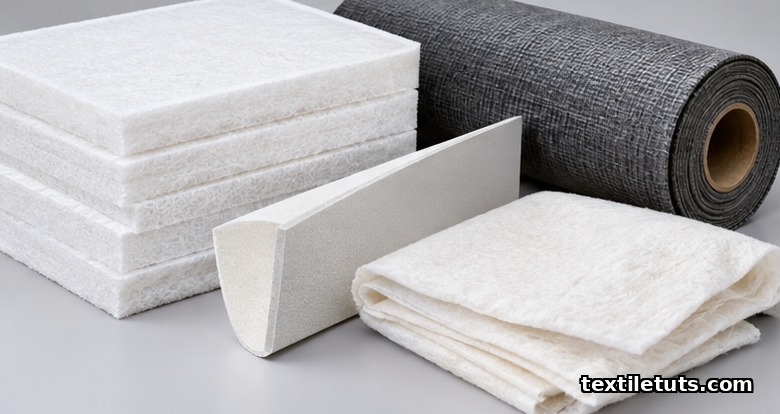
In the built environment, glass-mat wet-laids reinforce bituminous roofing shingles and gypsum wallboard, replacing organic felts with a thinner, stronger, fire-resistant substrate. Battery separators in flooded lead-acid and alkaline cells are wet-laid from polyester, polyolefin, or glass microfiber blends, where the smooth surface and uniform pore structure support even ion flow and help prevent internal short circuits.
Medical and hygiene products rely on wet-laid technology for face-mask inner layers, surgical drapes, and absorbent wound dressings. The combination of low lint, biocompatibility, and binder flexibility is hard to match with dry-laid routes. In specialty papers, wet-laid nonwovens carry coatings for labels, capacitors, and cable wrap, where isotropy and dimensional stability are non-negotiable.
Test Methods and Quality Standards
The ISO 9073 series, maintained by the International Organization for Standardization, defines the test methods that govern nonwoven fabrics across most markets. ISO 9073-1 sets the procedure for mass per unit area; ISO 9073-3 covers tensile strength and elongation; ISO 9073-6 covers absorption; ISO 9073-15 covers air permeability; and ISO 9073-18 covers bursting strength. Compliance with these methods is the default specification in most technical datasheets.
ASTM D1117 provides a complementary guide for evaluating nonwoven fabrics in North America and aligns the relevant D-series methods for tensile, tear, bursting, and absorbency testing. ASTM D3776 covers mass per unit area on small swatches and is widely cited in glass-mat specifications. INDA and EDANA, the two main nonwoven trade associations, jointly publish the Nonwovens Standard Procedures (NWSP) that reconcile ISO and ASTM methodologies for global buyers.
Filtration grades follow additional standards. ISO 16890 (which replaced EN 779 in 2018) grades air filtration media by PM10, PM2.5, and PM1 efficiency, while EN 1822 and ISO 29463 set the H10 to U17 classes for HEPA and ULPA filters. Battery separator grades typically cite IEC 62133 for safety performance and the relevant ASTM or TAPPI method for wicking, porosity, and electrical resistance.
Frequently Asked Questions
What is the difference between wet-laid and dry-laid nonwovens?
Wet-laid nonwovens form webs by draining a water-fiber slurry through a wire mesh, while dry-laid nonwovens form webs from air-borne fibers on a card or airlaid machine. Wet-laid lines accept shorter fibers (down to below 1 millimeter for glass microfiber and fibrillated cellulose) and produce more isotropic webs, with machine-to-cross tensile ratios typically under 1.2:1. Dry-laid lines need fibers longer than about 30 millimeters and produce webs with a 2:1 to 4:1 machine-to-cross strength ratio.
Why are wet-laid nonwovens used in battery separators?
Wet-laid webs offer uniform pore structure, smooth surfaces (under 200 micrometers Ra after calendering), and chemical purity at basis weights between 80 and 200 grams per square meter. These characteristics support even ion flow, suppress dendrite growth, and resist internal short circuits, which is why most flooded lead-acid and many alkaline cells still use wet-laid separators rather than extruded films.
Can wet-laid nonwovens be made without chemical binders?
Yes. Binder-free wet-laid fabrics rely on hydrogen bonding between cellulosic fibers or on hydroentanglement using high-pressure water jets at 50 to 400 bar. Hydrogen-bonded fabrics lose most of their strength when wet unless a wet-strength resin such as polyamide-epichlorohydrin is added at 0.5 to 2 percent add-on. Hydroentangled fabrics retain their strength in both dry and wet states and dominate the premium wipes and facial mask markets.
What fibers are commonly used in wet-laid nonwovens?
Wood pulp, cotton linters, rayon, and lyocell account for most tonnage. Polyester, polypropylene, glass microfiber, ceramic fiber, carbon fiber, aramid, and PTFE cover technical applications. Fiber lengths typically run from below 1 millimeter (glass microfiber, fibrillated cellulose) to 25 millimeters (specialty reinforcements), with diameters from sub-micrometer fibrils to over 20 micrometers (standard synthetic staple).
How sustainable are wet-laid nonwovens?
Sustainability depends on fiber choice. Wood-pulp, cotton, and lyocell wet-laids are renewable and biodegradable under industrial composting conditions (lyocell typically disintegrates within 21 to 28 days under EN 13432 conditions). Polyester and polypropylene wet-laids are recyclable in dedicated streams but persist in landfills if discarded. Closed-loop white-water systems, where 95 to 99 percent of process water is reused, keep fresh-water demand below 10 cubic meters per ton of fabric and have become standard on modern European lines.
References
- International Organization for Standardization. ISO 9073-1:2022, Nonwovens, Part 1: Test methods for determination of mass per unit area. iso.org — covers the gravimetric procedure for basis weight that anchors every wet-laid datasheet.
- ASTM International. ASTM D1117-23, Standard Guide for Evaluating Nonwoven Fabrics. astm.org — lists the ASTM D-series methods used in nonwoven quality control.
- INDA and EDANA. Nonwovens Standard Procedures (NWSP). edana.org — harmonized ISO/ASTM methods for the global nonwovens industry.
- Batra, S. K., and Pourdeyhimi, B. Introduction to Nonwovens Technology. DEStech Publications, 2012. Via researchgate.net — textbook chapter on wet-forming of staple fibers and comparison with dry-laid routes.
- Russell, S. J., ed. Handbook of Nonwovens. Woodhead Publishing (Elsevier), 2007. Via sciencedirect.com — peer-reviewed chapters on wet-laid forming, bonding, and filtration media.
- International Organization for Standardization. ISO 16890:2016, Air filters for general ventilation. iso.org — the current standard that grades wet-laid filtration media by PM10, PM2.5, and PM1 efficiency.
This article is the working reference for wet-laid nonwoven manufacturing, fibers, bonding, properties, applications, and test methods. Editorial by Md. Asad Ullah (Meem), TextileTuts. Sources: ISO 9073-1:2022, ASTM D1117-23, INDA/EDANA NWSP, Batra and Pourdeyhimi (DEStech, 2012), Russell (Woodhead, 2007), and ISO 16890:2016 as cited.


