
Air-Laid Nonwoven

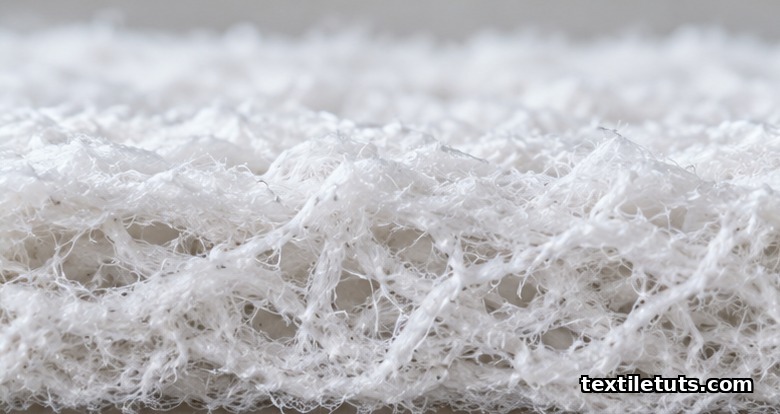
Air-laid nonwoven fabric is a dry-laid nonwoven produced by suspending short cellulose or synthetic fibers (typically 6 to 40 mm in length) in an air stream and depositing them onto a moving forming screen with vacuum-assisted airflow, producing webs with basis weights of 20 to 1,000 gsm and thicknesses from 0.5 mm to over 10 mm.
Air laying is the only nonwoven process that can use wood pulp directly without first converting the pulp into a continuous yarn, which is why air-laid webs dominate the absorbent cores of baby diapers, feminine hygiene products, and adult incontinence pads.
This article explains how the air-laid process works, which fibers and bonding systems are used, the physical properties that make air-laid webs suitable for absorbency, and the standards and applications that govern the final product.
What Is Air-Laid Nonwoven?
Air-laid nonwoven is a fibrous web formed entirely by aerodynamic means, without the water used in wet-laid processes and without the carding rolls used in carded dry-laid processes. The defining feature is that individual fibers, or fiber flocks, are introduced into a turbulent air stream that carries them to a perforated forming drum or screen, where they are laid down in a random three-dimensional arrangement and held in place by suction until bonding occurs.
The web is then consolidated by one of four bonding methods: hydrogen bonding from cellulose fiber-fibril activation, thermal bonding using bicomponent synthetic fibers, latex or chemical bonding, or multi-bonded combinations that layer pulp with thermoplastic binder fibers. The output is a bulky, porous structure with high void volume, low density (typically 0.02 to 0.15 g/cm³), and rapid capillary uptake of liquids.
By contrast, wet-laid nonwovens are produced by suspending fibers in water and draining them on a wire, while carded dry-laid webs are produced by carding machines that align fibers in the machine direction. Air-laid webs have a more isotropic fiber distribution than carded webs and a higher thickness-to-mass ratio than wet-laid webs, which is why air-laid is the preferred process when bulk and absorbency matter more than surface smoothness.
The Air-Laid Process: Step by Step
The process begins with fiber preparation. Pulp sheets are defibrated in a hammermill or disk refiner into individual fibers and small fiber flocks. Synthetic fibers, when used, are opened on a bale-opening line and cut to the desired length (commonly 6 to 40 mm) before being blended with the pulp. The fibers are then fed into a forming head through a metered dosing system that controls the basis weight of the deposited layer.
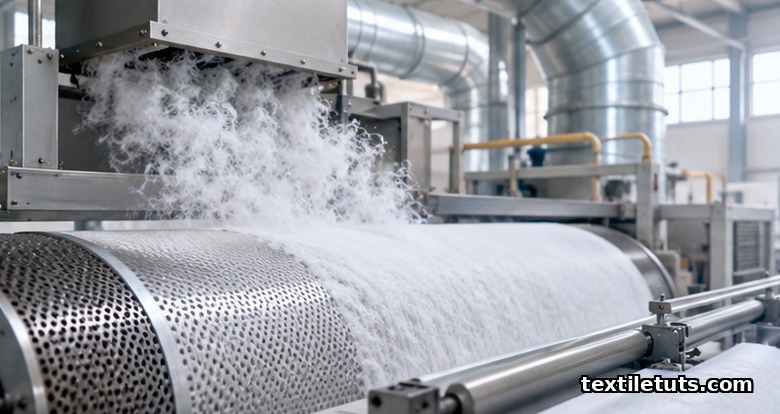
The most common forming head is a rotating drum covered with a perforated screen, housed inside a vacuum box. Air carries the fibers through a forming duct and onto the rotating drum, where the vacuum pulls air through the screen and leaves the fibers deposited on the surface in a randomly oriented web.
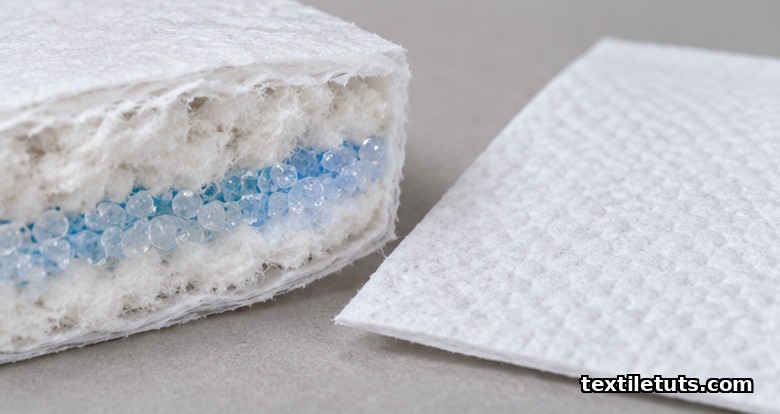
Multiple forming heads can be arranged in series to build up basis weight without reducing line speed. A typical hygiene-core line has three to four forming heads, each depositing a layer of 30 to 100 gsm, allowing the final web to reach 100 to 400 gsm with controlled composition gradients (for example, a higher pulp fraction at the top of the web for liquid acquisition and a higher superabsorbent polymer fraction at the bottom for storage).
After the web is formed, it passes through a bonding station. For 100 percent cellulose webs, bonding is achieved by hydrogen bonding, where controlled moisture and pressure activate the cellulose fibrils so that adjacent fibers bond through hydrogen bridges. For synthetic or blend webs, bonding is achieved by passing the web through a heated calendar or oven where the binder fibers melt and fuse at the crossover points between fibers.
Fibers Used in Air-Laid Nonwovens
The most important raw material is fluff pulp, a wood pulp with high cellulose content and fiber lengths of 1 to 5 mm, supplied in roll or bale form. Fluff pulp provides the bulk, absorbency, and hydrogen-bonding capacity that defines air-laid performance. Softwood pulps give higher tensile strength, while hardwood pulps give higher absorption capacity.
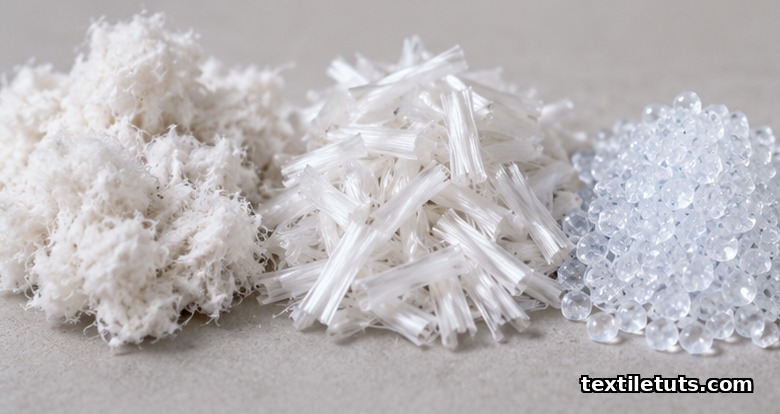
Bicomponent synthetic fibers, usually a polyethylene sheath around a polypropylene or polyester core, are added to give the web mechanical strength, elastic recovery, and the ability to bond without chemical adhesives. The sheath melts at 110 to 130 °C and fuses adjacent fibers, while the core retains structural integrity. Typical bicomponent-fiber content in a blended air-laid web is 5 to 20 percent by mass.
Other fibers used include single-component polyester (PET) and polypropylene (PP), cotton linters and reclaimed cotton, viscose (rayon), and specialty fibers such as polylactic acid (PLA) for biodegradable products. Superabsorbent polymer (SAP) particles can be incorporated into the web during forming to boost liquid storage capacity for hygiene applications.
Bonding Methods
Hydrogen bonding is the lowest-cost and most environmentally compatible bonding method, but it requires precise control of moisture (typically 8 to 12 percent water content during bonding) and produces a web with lower wet strength than thermally or latex-bonded equivalents.
Thermal bonding uses heat and pressure to fuse binder fibers. Calendar bonding passes the web through heated rolls at 130 to 180 °C, producing a thin, smooth, paper-like web with high tensile strength. Through-air thermal bonding passes heated air through the web, producing a bulky, soft web with high loft, more suitable for wipes and absorbent cores.
Latex bonding, now in decline because of the move toward binder-fiber systems, sprays a water-based acrylic or styrene-butadiene latex onto the web and dries it in an oven. The dried latex film bonds the fibers and adds elasticity, wet strength, and abrasion resistance.
Multi-bonded webs combine thermal bonding with hydrogen bonding or with latex bonding to balance softness, strength, and cost. Modern absorbent-core air-laid webs are typically multi-bonded, with a bicomponent-fiber outer layer and a hydrogen-bonded cellulose inner layer.
Properties and Performance Characteristics
Air-laid webs are characterized by high bulk (thickness per unit mass), high porosity, and rapid liquid uptake. Typical properties for a hygiene-grade air-laid web at 250 gsm include:
- Basis weight: 20 to 1,000 gsm (web-dependent)
- Thickness: 0.5 to 15 mm
- Density: 0.02 to 0.15 g/cm³
- Tensile strength (machine direction): 5 to 200 N/5 cm depending on bonding
- Water absorption capacity: 8 to 20 times web mass for pure cellulose webs
- Air permeability: 1,000 to 10,000 mm/s
Compared with carded thermal-bonded nonwovens of similar basis weight, air-laid webs have 2 to 4 times higher thickness and 1.5 to 3 times higher absorption capacity, because of the more random fiber orientation and the larger void volume.
Applications
By volume, the largest application is absorbent hygiene: the cores of baby diapers, feminine sanitary pads, and adult incontinence products. Air-laid webs in this segment typically contain 60 to 90 percent fluff pulp, 10 to 40 percent superabsorbent polymer, and 5 to 15 percent bicomponent binder fiber, with a basis weight of 200 to 500 gsm.
The second-largest application is wipes, including baby wipes, household cleaning wipes, and industrial wipes. Wipe-grade air-laid webs typically have basis weights of 40 to 80 gsm and are often through-air thermal bonded for softness and wet strength.
Other applications include food pads (absorbent pads for meat, fish, and produce packaging), tabletop and napkin products, oil and chemical absorbent pads, filtration media, acoustic insulation, and agricultural mulches. Specialty applications include cosmetic facial masks, where air-laid webs of pure cellulose or of cellulose-synthetic blends provide a substrate for active ingredients.
Standards and Test Methods
The ISO 9073 series, maintained by the International Organization for Standardization, defines test methods for nonwovens, including mass per unit area (ISO 9073-1), thickness (ISO 9073-2), tensile strength and elongation (ISO 9073-3), tear resistance (ISO 9073-4), and absorption capacity (ISO 9073-6). These standards apply directly to air-laid webs.
ASTM D5732 covers stiffness of nonwoven fabrics by the cantilever method, while ASTM D5035 and ASTM D5034 cover tensile properties of textiles and nonwovens, respectively. The AATCC TM97 test method covers absorbency of nonwovens, and AATCC TM130 covers soil release for wipe applications.
Industry associations including EDANA (Europe) and INDA (North America) publish voluntary test methods and guidelines for specific end-use applications. The joint INDA/EDANA Flushability Guidelines (GD4 for drainline, GD5 for municipal systems) set industry benchmarks for dispersibility of nonwoven wipes.
Frequently Asked Questions
What is the difference between air-laid and wet-laid nonwovens?
Air-laid nonwovens use an air stream to suspend and deposit fibers onto a forming screen, while wet-laid nonwovens suspend fibers in water and drain them onto a wire. Air-laid webs are bulkier, more porous, and more absorbent than wet-laid webs of the same basis weight, and they are the standard choice for absorbent hygiene cores, while wet-laid webs are more often used in tea-bag and filter paper applications.
What fibers can be used in air-laid nonwovens?
The most common fiber is wood pulp (fluff pulp) in lengths of 1 to 5 mm. Bicomponent synthetic fibers (PE/PP or PE/PET) in lengths of 6 to 40 mm are added for thermal bonding and wet strength. Other fibers include single-component polyester, polypropylene, viscose, cotton linters, and PLA for biodegradable applications. Superabsorbent polymer particles can be incorporated as a powder during web forming.
Why are air-laid nonwovens used in diaper absorbent cores?
Air-laid webs combine high cellulose content with high void volume, so they wick liquid rapidly away from the surface and distribute it across the core, where superabsorbent polymer particles lock it in. A typical diaper core is an air-laid web with 60 to 90 percent fluff pulp and 10 to 40 percent SAP, with a basis weight of 200 to 500 gsm, achieving a rewet value (liquid returned under pressure) below 0.5 g.
Can air-laid nonwovens be recycled or are they biodegradable?
Pure cellulose air-laid webs are biodegradable and compostable under industrial composting conditions (EN 13432). Webs containing synthetic binder fibers are not fully biodegradable but can be incinerated for energy recovery. Recycling of post-consumer air-laid hygiene products is technically challenging because of the SAP content and the difficulty of separating cellulose from synthetics, but research on cellulose-dissolution recycling is in progress.
Are there microplastic concerns with air-laid nonwoven wipes?
Wet wipes made from air-laid cellulose webs are often marketed as biodegradable and flushable, but real-world wastewater studies show that they persist in sewer systems and contribute to blockages. Cellulose-only wipes are an improvement over polyester wipes, but consumers should still avoid flushing any nonwoven wipes unless the product is explicitly certified as dispersible under the INDA/EDANA GD4 or GD5 flushability guidelines.
References
- ISO. ISO 9073 (series), Textiles — Test methods for nonwovens (Parts 1–6). International Organization for Standardization. URL: https://www.iso.org/standard/83610.html — Defines mass per unit area, thickness, tensile, tear, and absorption test methods for nonwovens.
- ASTM International. ASTM D5732, Standard Test Method for Stiffness of Nonwoven Fabrics Using the Cantilever Test. URL: https://www.astm.org/d5732-22.html — Cantilever stiffness method applicable to air-laid webs.
- AATCC. AATCC Test Method 97 (Absorbency of Nonwovens) and AATCC TM130 (Soil Release). American Association of Textile Chemists and Colorists. URL: https://www.aatcc.org/testing/test-methods/ — Standard absorbency and soil-release methods for nonwovens.
- Russell, S.J. (Ed.). Handbook of Nonwovens. Woodhead Publishing / Elsevier. URL: https://www.sciencedirect.com/book/9780128183784/handbook-of-nonwovens — Peer-reviewed textbook covering the air-laid process, fiber selection, and bonding chemistry.
- INDA and EDANA. Flushability Guidelines (GD4 / GD5). INDA, Association of the Nonwoven Fabrics Industry / EDANA, International Association for the Nonwovens and Related Industries. URL: https://www.inda.org/ — Voluntary flushability guidelines for nonwoven wipes and dispersibility testing.
This article is the working reference for air-laid nonwoven fabric structure, process, and applications. Editorial by Md. Asad Ullah (Meem), TextileTuts. Sources: ISO 9073 series, ASTM D5732, AATCC TM97 and TM130, Russell (Handbook of Nonwovens), INDA/EDANA Flushability Guidelines as cited.


