
SMMS Nonwoven

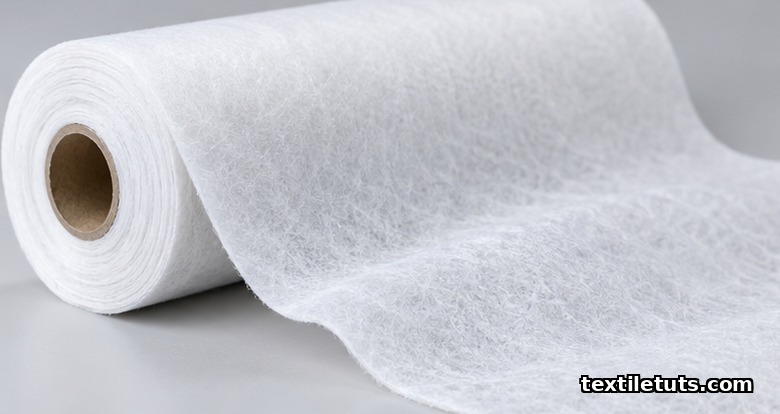
SMMS (Spunbond-Meltblown-Meltblown-Spunbond) nonwoven is a four-layer polypropylene composite fabric, produced at basis weights of 10–80 gsm, that delivers bacterial filtration efficiency above 99% against a 3.0 µm particle challenge while maintaining hydrohead resistance of at least 50 cm H₂O.
This article explains what SMMS fabric is, how the four-layer composite is manufactured, the specifications that matter for buyers and product developers, and how SMMS compares with SMS and SSMMS variants used in medical, hygiene, and filtration applications.
The nonwoven category covers every fabric that is bonded by mechanical, thermal, or chemical means rather than by weaving or knitting, and within that category SMMS is one of the workhorse structures for high-barrier disposables.
What SMMS Nonwoven Means
SMMS stands for Spunbond-Meltblown-Meltblown-Spunbond, and the acronym describes the layer order inside one continuous fabric sheet. The two outer layers are spunbond (S), made from continuous filaments of average diameter 15–35 µm that give the fabric tensile strength and abrasion resistance. The two inner layers are meltblown (M), made from microfibers of average diameter 1–5 µm that create a tortuous path for liquids and particles. The two meltblown layers together do most of the filtration work; the two spunbond layers act as the load-bearing carcass.
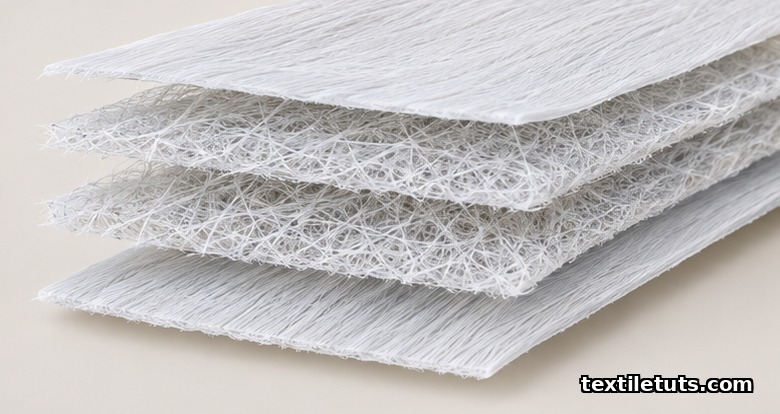
Most SMMS grades use polypropylene (PP) as the only polymer because polypropylene melts at 160–170 °C and can be processed on a single Reicofil or similar spunbond/meltblown line. The four layers are laid down in one pass and thermally bonded by calender rolls, so the result is one fabric, not four laminated sheets. That single-pass construction is what keeps the price competitive against laminated alternatives.
How SMMS Is Manufactured
SMMS production runs on a combination line that houses two spunbond beams and two meltblown beams in series. The polymer, almost always polypropylene with a melt flow rate of 25–40 g/10 min, is extruded through spinnerets in the spunbond stations, attenuated by high-velocity air, and deposited on a moving forming belt as a random web of continuous filaments. In the meltblown stations the same polypropylene is extruded through much finer die holes and blown by hot air at velocities high enough to fracture the polymer stream into sub-5 µm fibers before they land on the belt.
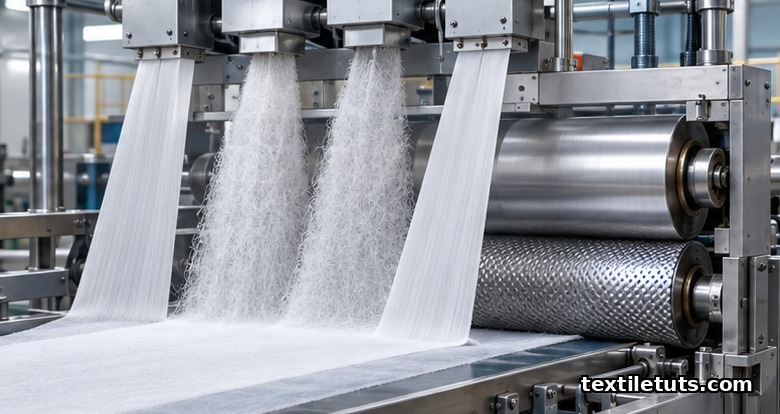
After deposition, the four webs pass through a calender where a heated steel roll and a patterned roll apply pressure and temperature (typically 140–160 °C) to fuse the filaments at their contact points. The bond area, controlled by the engraving on the patterned roll, typically covers 12–25% of the surface; the rest of the area stays open, which is what allows the meltblown layer to breathe and filter.
The basis weight of each layer is independently adjustable through the polymer throughput at each beam, so an SMMS at 25 gsm might split as 7/5.5/5.5/7 gsm or 8/4.5/4.5/8 gsm depending on the converter’s design intent. More weight in the meltblown layers improves filtration; more weight in the spunbond layers improves tensile and tear strength.
Key Properties and Specifications
SMMS fabrics are specified by a small set of measurable properties. The four that drive most purchasing decisions are basis weight, tensile strength, hydrohead resistance, and bacterial filtration efficiency (BFE).
- Basis weight (gsm): 10–80 gsm is the commercial range; 15–25 gsm covers surgical drape and face mask applications; 35–60 gsm covers gown and protective apparel; 60–80 gsm covers industrial absorbent and filtration media.
- Tensile strength: MD ≥40 N/5 cm and CD ≥30 N/5 cm at 25 gsm is typical for a medical-grade SMMS, measured per ISO 9073-3.
- Hydrohead resistance: ≥50 cm H₂O at 25 gsm measured per AATCC 127, with medical grades often specified at ≥80 cm H₂O.
- Bacterial filtration efficiency: ≥99% at a 3.0 µm challenge per ASTM F2101, with some grades certified at ≥99.9%.
- Air permeability: 100–250 cm³/cm²/s at 125 Pa per ISO 9237, a range that keeps the fabric breathable while remaining liquid-resistant.
- Elongation at break: 40–80% MD, 50–90% CD per ISO 9073-3.
All of these values can shift ±10% lot to lot because nonwovens are statistically random webs, so converter datasheets typically report a tolerance band, not a single number.
SMMS vs SMS vs SSMMS: How the Variants Differ
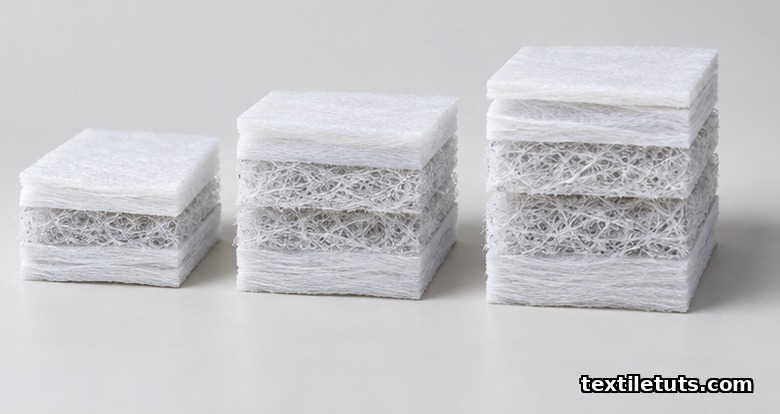
SMS (three layers) was the original workhorse. SMMS adds a second meltblown layer for higher barrier at the same basis weight. SSMMS adds a second spunbond layer on the face side for a smoother, lower-lint surface. The trade-off is straightforward: more layers raise barrier and strength, but also raise basis weight and cost.
| Property | SMS (25 gsm) | SMMS (25 gsm) | SSMMS (25 gsm) |
|---|---|---|---|
| Layer count | 3 | 4 | 5 |
| BFE (ASTM F2101, 3.0 µm) | ≥95% | ≥99% | ≥99% |
| Hydrohead (AATCC 127) | ≥40 cm H₂O | ≥50 cm H₂O | ≥50 cm H₂O |
| MD tensile (ISO 9073-3) | ≥35 N/5 cm | ≥40 N/5 cm | ≥45 N/5 cm |
| Lint (ISO 9073-10) | Moderate | Moderate | Low (smoother face) |
| Typical cost index | 1.00× | 1.05–1.10× | 1.10–1.15× |
For most medical and hygiene end-uses, SMMS has effectively replaced SMS because the extra meltblown layer buys a measurable step-up in barrier at a marginal cost increase, while SSMMS remains a specialty grade for surgical drapes and cleanroom apparel where lint control matters more than cost.
Where SMMS Is Used
SMMS shows up wherever a disposable needs both barrier performance and mechanical strength. Medical applications include surgical gowns, drapes, sterilization wraps, and face mask inner/outer layers (with the meltblown often provided by a third N95-grade layer). Hygiene applications include baby diaper top sheets, sanitary napkin covers, and adult incontinence product outer layers. Filtration applications include HVAC pre-filters, liquid filter media supports, and oil-absorption pads.
Outside the medical and hygiene sectors, SMMS appears in agricultural crop covers (where the spunbond layers resist UV tearing) and in industrial wipe substrates where the meltblown layer holds sorbents and the spunbond layers provide scrubbing strength.
Testing Standards Buyers Should Know
SMMS is qualified by an overlapping stack of ISO, ASTM, and AATCC methods, and most buyer specifications cite at least one from each body.
- ISO 9073-3: tensile strength and elongation (replaced older EN 29073-3).
- ISO 9073-10: dry particulate matter (lint) generation.
- ISO 9237: air permeability at 100–200 Pa.
- ISO 11843: detection of chemical residues (relevant for medical-grade cleanliness).
- ASTM F2101: bacterial filtration efficiency (BFE) at 3.0 µm Staphylococcus aureus aerosol.
- ASTM F1670/F1671: penetration by synthetic blood and viral phage (for Level 2–4 gowns per AAMI PB70).
- AATCC 42: impact penetration (water spray).
- AATCC 127: hydrostatic head resistance.
A medical-grade SMMS typically passes ASTM F1671 at the Level 4 gown threshold, while a hygiene-grade SMMS may only be required to meet AATCC 42 and a relaxed BFE specification.
Frequently Asked Questions
Is SMMS the same as N95 mask fabric?
No. N95 respirators require a meltblown layer certified at ≥95% filtration of a 0.1–0.3 µm NaCl aerosol per NIOSH 42 CFR Part 84, which is a far tighter test than ASTM F2101 at 3.0 µm. SMMS is used as the outer and inner layers of many N95 masks, but the actual electrostatic meltblown that does the filtering is a separate, specially charged grade inserted between the SMMS layers.
Can SMMS be sterilized by autoclave, EtO, or gamma?
Yes to all three. Polypropylene resists the 121 °C steam cycle, the EtO gas cycle, and 25–50 kGy gamma doses without measurable strength loss, which is why SMMS is the standard substrate for sterile-pack drapes and gowns. Gamma doses above 50 kGy start to embrittle the polymer and are not recommended.
What is the shelf life of SMMS medical fabric?
Stored dry below 30 °C and away from direct UV, SMMS retains its physical properties for at least 5 years per ASTM D4169 accelerated aging protocols. The bottleneck is not the polymer but the electrostatic charge on the meltblown layer, which decays faster if the rolls are stored in high humidity.
Does SMMS contain any recycled polypropylene?
Medical-grade SMMS is virtually all virgin resin because FDA-cleared applications require a documented resin grade and lot traceability. Non-medical grades (agricultural covers, some wipes) can use 30–50% post-consumer recycled PP, though this typically reduces tensile strength by 10–15% and slightly raises lint.
How does SMMS differ from standard spunbond polypropylene (SS)?
SS has only two spunbond layers and zero meltblown, so it lacks the fine-fiber barrier that gives SMMS its liquid and particle resistance. SS is used where strength and economics matter more than barrier (furniture backing, agricultural ground cover), while SMMS is reserved for end-uses where some level of fluid or microbial barrier is required.
References
- International Organization for Standardization. ISO 9073-3:2023 — Nonwovens — Determination of tensile strength and elongation. https://www.iso.org/standard/83610.html — defines the tensile test method used for SMMS datasheets.
- ASTM International. ASTM F2101-19 — Standard Test Method for Evaluating the Bacterial Filtration Efficiency (BFE) of Medical Face Mask Materials. https://www.astm.org/f2101-19.html — the BFE test at 3.0 µm cited above.
- ASTM International. ASTM F1671 / F1671M-22 — Standard Test Method for Resistance of Materials Used in Protective Clothing to Penetration by Blood-Borne Pathogens. https://www.astm.org/f1671_f1671m-22.html — the viral penetration test used for medical SMMS.
- AATCC. AATCC Test Method 127-2017 — Water Resistance: Hydrostatic Pressure Test. https://www.aatcc.org/testing/methods/ — the hydrohead method cited above.
- Bhardwaj, N. and Kundu, S.C. Electrospinning: A fascinating fiber fabrication technique. Biotechnology Advances, 28(3), 325–347. https://www.sciencedirect.com/science/article/pii/S0734975010000360 — peer-reviewed review of meltblown and nanofiber filtration media (background on barrier mechanisms).
- INDA (Association of the Nonwoven Fabrics Industry). Nonwovens Glossary and Reference Guide. https://www.inda.org — industry reference for SMMS terminology and applications.
- EDANA (European Disposables and Nonwovens Association). Nonwovens Training Course Manual. https://www.edana.org — defines SMS, SMMS, SSMMS layer nomenclature used in this article.
This article is the working reference for SMMS nonwoven structure, properties, and applications. Editorial by Md. Asad Ullah (Meem), TextileTuts. Sources: ISO 9073-3, ASTM F2101, ASTM F1671, AATCC 127, ScienceDirect (Bhardwaj & Kundu 2010), INDA, EDANA as cited.


