
Weaving Quality Control

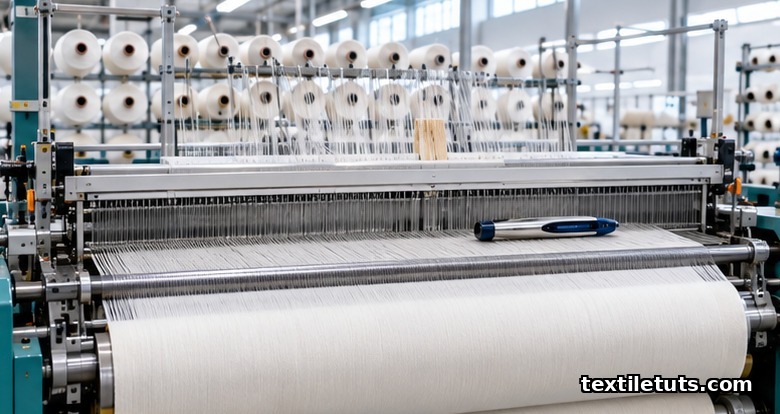
First-pass fabric inspection rejects 8 to 15 percent of woven output on average in developing-mill studies, and weaving quality control is the gate-by-gate set of physical, dimensional, and visual checks that holds that rejection rate down by catching broken picks, miscounts, and off-spec grams per square meter (GSM) before the fabric reaches the cutter.
The cost of a missed defect multiplies downstream: a missed slub that costs $0.02 to fix on the loom can cost $4.00 to remove during garment sewing, or trigger a full shipment rejection at the buyer’s final audit. This article walks through the parameters weaving mills actually test, the defects they actually look for, and the international standards that frame the whole workflow.
What Weaving Quality Control Covers
Weaving quality control (QC) is the systematic process of verifying that woven fabric meets a buyer-specified set of physical, dimensional, and visual criteria before it is shipped. It is not a single test, but a sequence of checks that starts the moment the first meter comes off the loom and ends only after the final audit. The four pillars of any weaving QC program are construction verification, physical-property testing, visual inspection, and process control of the loom itself.
Construction verification confirms that the fabric’s warp count, weft count, weave type, and fabric weight match the original specification (often called the “tech pack” in apparel). Physical-property testing measures strength, shrinkage, and color fastness on samples pulled from the lot. Visual inspection assigns point penalties to defects such as broken picks, oil stains, or uneven selvage. Process control, finally, keeps yarn tension, loom temperature, and pick density within the machine’s stable operating window so the upstream causes of defects are caught at the source rather than the fabric roll.
Critical Quality Parameters Tested in Woven Fabrics
Every woven fabric order is governed by a parameter sheet agreed between mill and buyer. The parameters below are the ones that appear on virtually every sheet, with the standard method used to measure each.
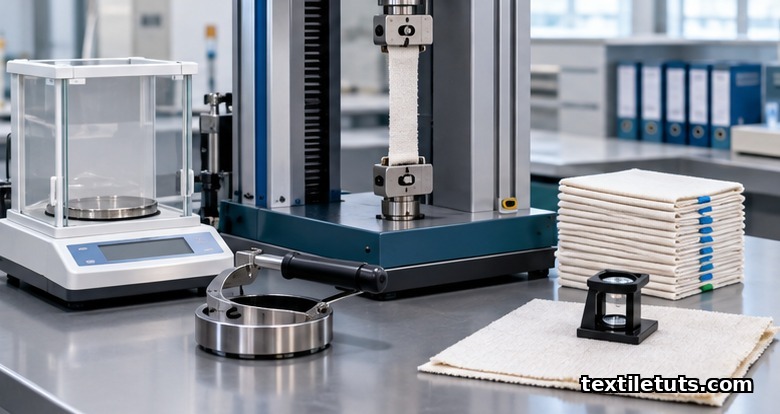
Fabric weight (GSM or oz/yd²). Weight per unit area is the most quoted number on a tech pack and the easiest one to fail. A 180 GSM spec is meaningless unless the tolerance is also stated, and the industry default tolerance is plus or minus 5 percent for bottom-weight fabrics and plus or minus 3 percent for shirting. ASTM D3774 (“Standard Test Method for Mass Per Unit Area of Woven Fabric”) is the most common method. The lab cuts five 100 cm² specimens with a circular cutter, conditions them at 20 °C and 65 percent relative humidity per ISO 139, weighs them on an analytical balance, and averages.
Thread density (ends and picks per inch or per cm). Ends per inch (EPI) and picks per inch (PPI) determine hand, drape, cover factor, and ultimately weight. A 60 x 60 construction at 180 GSM behaves nothing like a 60 x 40 at the same weight, because the weft is coarser or the fabric is more open. ASTM D3775 (“Standard Test Method for Warp (End) and Filling (Pick) Count of Woven Fabric”) describes the count procedure. Tolerances are typically plus or minus 2 per inch on each direction; wider deviation is a weaving fault, not a measurement error.
Breaking strength and tear strength. These are the numbers that decide whether a fabric can survive normal garment sewing and end use. ASTM D5034 (grab test) or D5035 (strip test) measure breaking strength, while ASTM D1424 (Elmendorf pendulum) measures tear strength. A typical 180 GSM cotton poplin should hit at least 30 kgf warp and 20 kgf weft on a strip test; bottom-weight denim will run 80 to 120 kgf warp.
Dimensional stability after wash. AATCC Test Method 135 (“Dimensional Changes of Fabrics After Home Laundering”) simulates five wash cycles at a defined temperature and reports warp and weft shrinkage as a percentage. Commercial launderers use AATCC TM96 instead. Buyers typically allow minus 3 percent warp and minus 3 percent weft on woven cotton; anything outside that band triggers a finishing or preshrinking fix before shipment.
Construction analysis for fiber blend and weave type. ISO 7211-1 (“Textiles: Woven Fabrics, Construction, Methods of Analysis”) defines how to desize, dissect, and identify the weave pattern under low magnification. For fiber blends, AATCC TM20A covers qualitative identification and TM20A or quantitative chemical dissolution under ISO 1833 gives the actual blend ratio.
Common Weaving Defects and How to Identify Them
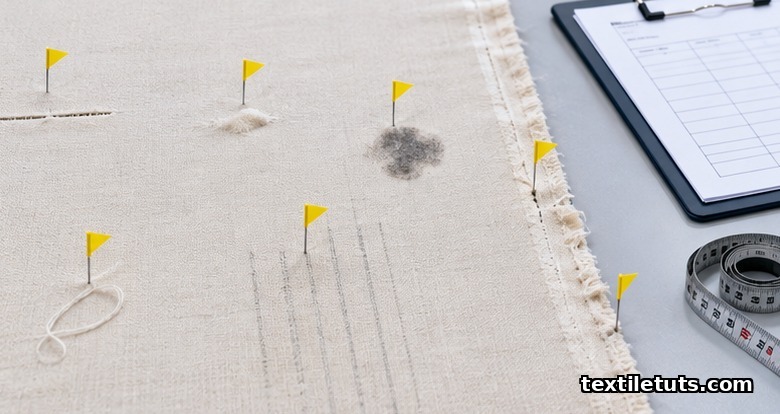
Most woven defects fall into one of three classes: yarn-related (the yarn itself was bad), loom-related (the machine introduced the fault), or weave-structure (the design was mis-executed). The table below lists the defects most mills encounter, with the typical point penalty under the 4-point system described in the next section.
| Defect | What it looks like | Likely cause |
|---|---|---|
| Broken pick | A single weft thread missing across part or all of the fabric width | Weft yarn exhaustion, cop slip, or shuttle/trap failure |
| Broken end | A single warp thread missing across a length of fabric | Yarn tension spike, knot slip, or healds mis-set |
| Float | A yarn passing over yarns it should interlace with, producing a loose loop | Heddle miss-set, dobby/Jacquard card error, or weft insertion failure |
| Slub | A thickened, uneven section in an otherwise uniform yarn | Spinning drafting fault or foreign fiber blend-in |
| Reed mark | Visible vertical streaks from improper reed wire spacing | Wrong reed for the yarn count, or reed damage |
| Oil stain | Discolored patch from machine oil or grease | Loom lubrication leak; often near selvage |
| Uneven selvage | Selvage tighter, looser, or pulled in relative to the body | Selvage tension imbalance or temple mis-set |
| Barre | Horizontal bands of different appearance across fabric width | Yarn lot mixing with different dye affinity or count |
| Mispick | One or more picks placed in the wrong shed | Dobby timing, weft-feeder error, or operator mistake |
| Hole | A complete break in the fabric | Severe yarn break, shuttle trapped, or reeds broken |
The visual distinction matters because the same defect can be a 1-point penalty or a 4-point penalty depending on severity and visibility. A 5 mm float inside the body of a dark fabric might be invisible to the buyer, while the same float on a white shirt front panel will be flagged as a major.
Inspection Systems: 4-Point, 10-Point, and AQL
Visual inspection is not just “look at the fabric.” It is a scoring exercise against a published rulebook, so the same roll of cloth gets the same score from any trained inspector anywhere in the world. Two scoring systems dominate the woven apparel trade.
The 4-point system (also called the “American Apparel” system) assigns 1, 2, 3, or 4 penalty points per defect based on size and severity. Defects up to 3 inches (76 mm) score 1 point; 3 to 6 inches score 2; 6 to 9 inches score 3; anything over 9 inches, plus holes and open seams, score 4 points. The total points per 100 linear yards of fabric is the “points per hundred yards” (pph), and most buyers set the acceptable limit at 28 to 40 pph depending on end use. A mill with a stable 25 pph is in excellent shape; one running 60 pph will see rejections spike.
The 10-point system (also called the “British” or “Decathlon” system) is simpler: each defect costs 10 points regardless of size, but only defects up to a defined length are counted, and there is a fixed cap on points per linear yard. It is faster to apply in a high-volume mill and is preferred where many small defects are expected, for instance on coarse-yarn denims or linen.
Acceptance Quality Limit (AQL) is a sampling layer on top of either system. Rather than inspect every yard, inspectors pull a random sample according to a published sampling plan (commonly ISO 2859-1) and decide lot acceptance based on how many defects fall inside that sample. A buyer specifying “AQL 2.5, general inspection level II” is telling the mill that the sample may contain up to 2.5 percent defective units at the chosen sample size before the lot is rejected.
International Standards Governing Weaving QC
Standards do not decide whether a fabric is “good”; they decide how everyone agrees to measure it. Weaving QC programs in export-oriented mills are typically built around the following core references.
- ISO 9001 sets the quality-management-system framework: documented procedures, internal audits, corrective action, and management review. Most multi-buyer mills run ISO 9001 as the platform for everything else.
- ISO 139 defines standard atmospheres for conditioning textiles (20 °C, 65 percent relative humidity). Every weight, strength, and dimensional test is meaningless without conditioning per this standard first.
- ISO 7211-1 through -6 define methods of woven-fabric analysis (weave, thread density, mass, crimp). Used for construction verification and for settling disputes over EPI/PPI claims.
- ASTM D3774 / D3775 / D5034 / D5035 / D1424 cover mass, thread count, breaking strength (grab and strip), and tear strength, the workhorse test methods for woven apparel.
- AATCC TM135, TM96, TM20, TM20A cover dimensional change after home laundering, dimensional change after commercial laundering, fiber identification (qualitative), and fiber blend (quantitative).
- ISO 2859-1 is the attribute sampling plan referenced by nearly every “AQL” line on a tech pack.
Buyers from the European Union and North America typically cite ASTM and AATCC; buyers from Asia more often cite ISO. Mils that export globally usually run both, which is why the test report on a finished roll will frequently list results in both unit systems and reference both standards.
A Real-World Weaving QC Workflow
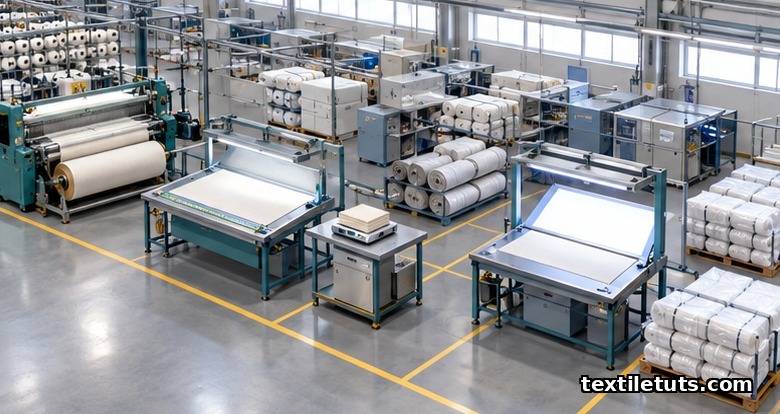
The exact sequence varies by mill, but a typical export-oriented woven line runs through six gates between loom and shipment.
Gate 1: Loom-side checks. The weaver checks EPI, PPI, and visual quality on the first 5 m off every loom every two hours. Anything out of tolerance is recorded, the loom is stopped, and the issue (often a broken end, mispick, or oil mark) is fixed before further weaving.
Gate 2: In-process greige inspection. Greige (undyed, unfinished) fabric is inspected as it is batched. This catches weaving defects that are harder to see after finishing, such as reed marks or shading across the roll.
Gate 3: Pre-finishing audit. Before singeing, desizing, bleaching, or dyeing, the fabric is measured, weighed, and inspected once more. Any major defect that survives this gate will become much harder to fix after finishing, so the decision is often to downgrade the lot to a lower-grade sale.
Gate 4: Post-finishing audit. After dyeing and finishing, finished width, finished GSM, EPI/PPI, and shrinkage (per AATCC TM135) are tested on samples cut from the head, middle, and tail of each lot. Color fastness, pilling, and spirality are added for many end uses.
Gate 5: Final inspection (4-point or 10-point). A trained inspector walks each roll on a frame under standard lighting (typically D65 or TL84 depending on buyer), records every defect against the scoring system, and computes the points per hundred yards. Rolls above the buyer’s pph threshold are sent for mending or rejected.
Gate 6: Pre-shipment audit. Often a third-party inspector verifies Gate 5 by re-inspecting a sample of rolls against AQL 2.5. The audit certificate is what the buyer’s merchandiser relies on to release payment.
Frequently Asked Questions
What are the most common defects in woven fabric?
The four defects that show up most often in woven-fabric QC reports are broken picks, broken ends, floats, and oil stains. Together they typically account for 60 to 70 percent of all flagged defects in cotton and polyester-cotton mills. Most are loom-side faults: a single mis-timed shed, a snapped weft, or a leaking lubrication point can each create one of these defects within a few centimeters of fabric.
How is GSM measured for woven fabric?
GSM (grams per square meter) is measured by cutting a known area of fabric with a circular cutter, typically 100 cm², conditioning the specimen at 20 °C and 65 percent relative humidity per ISO 139 for at least four hours, weighing it on an analytical balance, and multiplying by 100. Five specimens are usually cut and averaged. The method is standardized as ASTM D3774 for woven fabric. Buyers typically accept a tolerance of plus or minus 3 to 5 percent depending on end use.
What is the difference between 4-point and 10-point fabric inspection?
The 4-point system scores each defect at 1, 2, 3, or 4 points based on size, with the total points per 100 linear yards (pph) compared to a buyer-set limit, usually 28 to 40 pph. The 10-point system assigns a flat 10 points per defect with a length cap, and is faster to apply on coarse-yarn fabrics. Most woven apparel orders specify one or the other in the tech pack, but never both.
How is fabric strength tested on a woven sample?
Two methods dominate. ASTM D5034 (grab test) clamps only the center portion of the specimen, simulating stress at a stitch line. ASTM D5035 (strip test) clamps the full width, simulating uniform tension. Both use a constant-rate-of-extension (CRE) tensile machine and report breaking strength in kilogram-force or newtons, plus elongation at break. For woven apparel, breaking strength and tear strength (ASTM D1424, Elmendorf) are usually reported together.
What is AQL and why does it matter in weaving QC?
AQL, or Acceptance Quality Limit, is the maximum percentage of defective units a buyer will accept in a sampled lot. In woven fabric QC it is usually paired with a sampling plan from ISO 2859-1, which dictates how many rolls to inspect and how many defects can be inside that sample before the lot is rejected. A commonly specified AQL of 2.5 means that up to 2.5 percent defective units in the sample will pass, anything more will fail. AQL does not measure quality itself; it sets the threshold above which the buyer will refuse the lot.
References
- ASTM International. ASTM D3774-18: Standard Test Method for Mass Per Unit Area of Woven Fabric. ASTM Standards. Primary method for GSM measurement of woven fabric.
- ASTM International. ASTM D3775-17: Standard Test Method for Warp (End) and Filling (Pick) Count of Woven Fabric. ASTM Standards. Reference method for EPI and PPI measurement.
- ASTM International. ASTM D5034-21: Standard Test Method for Breaking Strength and Elongation of Woven Fabrics (Grab Test). ASTM Standards. Grab tensile-strength method for woven fabric.
- American Association of Textile Chemists and Colorists. AATCC Test Method 135-2018: Dimensional Changes of Fabrics After Home Laundering. AATCC Technical Manual. Standard wash-shrinkage method.
- International Organization for Standardization. ISO 7211-1:1984: Textiles — Woven Fabrics — Construction — Methods of Analysis, Part 1. ISO Standards. Defines weave, thread-density, and mass analysis.
- International Organization for Standardization. ISO 139:2005: Textiles — Standard Atmospheres for Conditioning and Testing. ISO Standards. Conditioning atmosphere (20 °C, 65 percent RH) cited by every other textile test method.
- International Organization for Standardization. ISO 2859-1:1999: Sampling Procedures for Inspection by Attributes. ISO Standards. The sampling backbone for fabric AQL inspection.
This article is the working reference for weaving quality control, covering the parameters tested, the defects flagged, and the international standards applied across export-oriented mills. Editorial by Sabbir Ahmed, TextileTuts. Sources: ASTM D3774, ASTM D3775, ASTM D5034, AATCC TM135, ISO 7211-1, ISO 139, and ISO 2859-1 as cited.


