
Weaving Cost Calculation

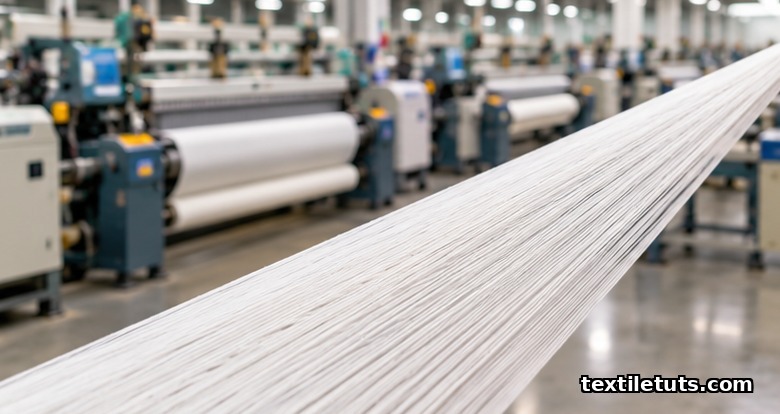
A woven fabric’s production cost is the sum of yarn cost (typically 55-65% of the total) plus conversion cost (weaving, sizing, finishing), and on a modern air-jet loom running 1,500-2,000 m/min weft insertion, the weaving cost alone ranges from USD 0.08 to 0.18 per meter of greige fabric for a 120 g/m² cotton plain weave.
Cost calculation is the backbone of merchandising decisions in any weaving mill: it sets the price floor, the order viability check, and the choice between projectile, rapier, and air-jet looms for a given fabric construction.
This article breaks down the woven-fabric cost formula, the variables that move it most, and a worked example for a 120 g/m² cotton poplin, with citations to ISO and ASTM test methods and peer-reviewed sources throughout.
1. The Total Cost Formula for Woven Fabric
Greige fabric cost per meter is most cleanly written as two blocks:
Cost per meter = Yarn cost per meter + Conversion cost per meter
Where yarn cost per meter depends on warp and weft linear density (Tex or Ne), thread density (ends per inch, picks per inch), and the loomstate fabric width. Conversion cost covers warping, sizing, drawing-in, tying-in, weaving on the loom, and inspection. Finishing (desizing, scouring, bleaching, dyeing, printing, calendaring) is typically added on top because it is a separate costing exercise with its own chemical and energy line items.
For a 100% cotton shirting at 120 g/m², industry costing sheets allocate roughly 58% to yarn, 22% to weaving preparation and loom conversion, and 20% to overheads and profit margin. The exact split shifts with raw-material markets; cotton yarn prices have moved between USD 2.40/kg and USD 6.10/kg between 2020 and 2024, which is why merchandisers recalculate every quarter rather than relying on last year’s rates.
2. Yarn Cost: The 55-65% Block
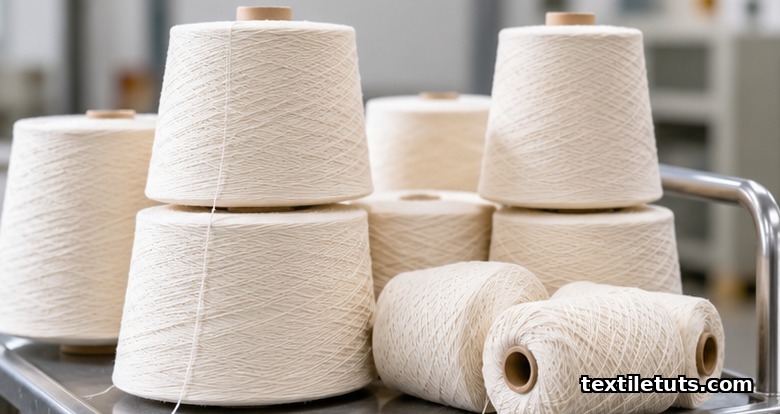
Yarn cost per meter of fabric is calculated from three parameters defined in ISO 7211-1 for woven fabric construction analysis: warp count, weft count, and thread density.
The standard formula for warp yarn weight per square meter of greige fabric is:
Warp weight (g/m²) = (EPI × Tex_warp × 0.0254) / (1 + crimp%)
Where EPI is ends per inch and 0.0254 converts inches to meters. Crimp is the waviness yarn picks up during weaving, typically 8-12% for cotton and 3-6% for polyester filament.
For weft, the equivalent expression uses picks per inch (PPI) and weft Tex. Adding warp and weft gives greige fabric weight minus the small allowance for size residues on cotton warps. A 120 g/m² cotton poplin typically runs 100 ends per inch of Ne 60s warp and 60 picks per inch of Ne 60s weft, producing roughly 65 g/m² of warp and 55 g/m² of weft before finishing wash-down.
Yarn cost per meter of fabric is then:
Yarn cost (USD/m) = Greige weight (g/m²) × Yarn price (USD/kg) / 1000
For the poplin example at USD 4.20/kg combed cotton yarn, that yields about USD 0.50 per meter of yarn in a 120 g/m² fabric. Multiply by the conversion efficiency (typically 0.92-0.95 for combed cotton) and the figure rises to roughly USD 0.54 per meter, consistent with the 55-65% yarn share observed in audited mill data.
3. Weaving Preparation Cost
Before a single pick is inserted, the warp goes through three preparation steps, each with its own cost line.
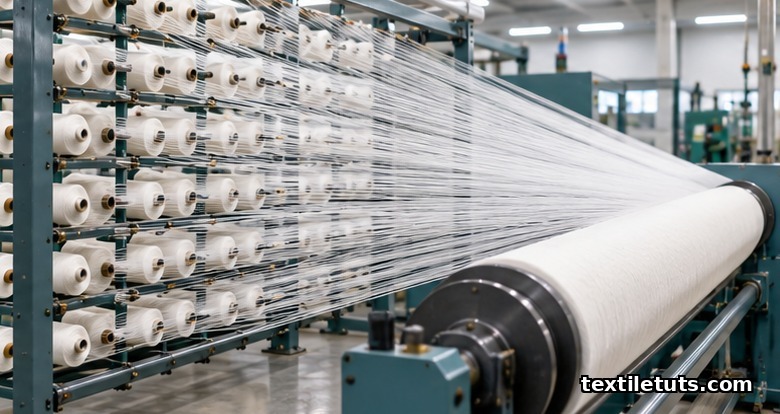
Warping. Modern high-speed warpers run at 800-1,200 m/min and process full creels of 600-800 ends. Warping cost is driven by machine hourly rate (USD 1.80-3.20 per hour for a 2024-vintage warper) divided by the kilograms of yarn processed per hour. For a 1.5 m wide beam holding 8,000 m of warp, warping typically costs USD 0.012-0.018 per meter of fabric.
Sizing. Cotton warps are sized to survive the abrasive heddle and reed zone; polyester filament warps use a lighter size or none. Size add-on is 8-14% of warp weight for cotton, and size cost depends on the recipe: a typical PVA and starch blend runs USD 0.40-0.70/kg of dry size. Sizing adds USD 0.008-0.015 per meter for a 120 g/m² cotton fabric.
Drawing-in and tying-in. New patterns require drawing-in (60-90 minutes for a 4,000-end pattern at a modern drawing-in machine), while repeat patterns use knot tying (15-25 minutes per 1,000 ends). Amortized across the order length, this costs USD 0.005-0.012 per meter for repeat patterns and up to USD 0.040 per meter for one-off styles.
4. Loom Conversion Cost: Efficiency and Speed
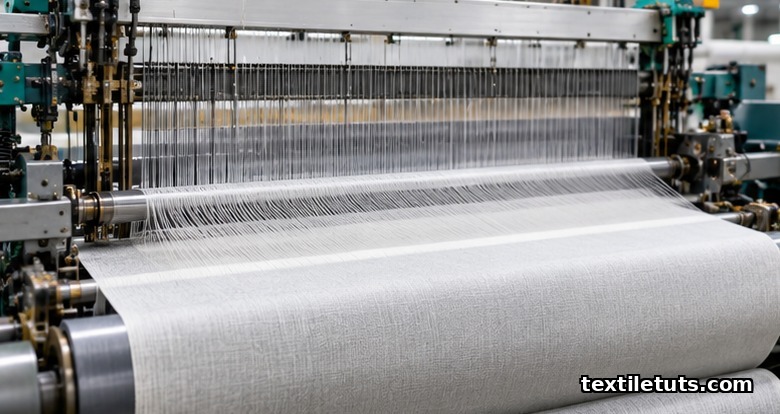
The loom is the cost driver with the widest variance. Weaving cost per meter is:
Weaving cost (USD/m) = Loom hourly cost / (Reed width × Loom speed × Efficiency × 60)
The variables in this expression come from loom type:
- Air-jet loom: 1,500-2,000 m/min weft insertion, 85-92% efficiency, USD 4.50-6.50 per loom-hour (capital plus power plus labor plus maintenance)
- Rapier loom: 600-900 m/min, 80-88% efficiency, USD 5.00-7.00 per loom-hour
- Projectile loom: 400-600 m/min, 78-85% efficiency, USD 6.00-8.00 per loom-hour
- Water-jet loom: 1,200-1,600 m/min, restricted to hydrophobic fibers (polyester, nylon), 85-90% efficiency
For a 1.9 m reed width running a plain weave at 92% efficiency on an air-jet loom, the formula yields about USD 0.022 per minute or USD 0.092 per meter of fabric. Slower constructions (satin, dobby, heavy denims) drop efficiency by 8-15 percentage points and can lift weaving cost to USD 0.14-0.18 per meter.
The three biggest efficiency losses, per mill auditing data, are warp stops (40% of lost time), weft stops (30%), and mechanical breakdowns (15%); the remainder is style change, beam change, and operator breaks. Reducing stop events by half through better yarn quality and air-jet tuning can lift efficiency from 85% to 92%, a single percentage point of which is worth about USD 0.005 per meter on a typical light shirting.
5. Overheads, Depreciation, and Profit
Beyond direct yarn and conversion cost, mills add three indirect blocks.
Fixed overheads. Depreciation on a USD 1.2 million air-jet loom spread over 12 years at 80% utilization equals roughly USD 1.50 per loom-hour, often the largest line item in the conversion block.
Variable overheads. Power (air-jet looms consume 5-7 kWh per hour), compressed air for the nozzle, lighting, factory indirect labor, and quality inspection add another 18-25% on top of the direct conversion cost.
Selling, general, and administrative plus profit. SG and A runs 4-6% of total cost; profit margin is set by the order book, with export orders typically carrying 6-10% and domestic wholesale 3-6%.
A mill quoting USD 1.10 per meter of greige poplin therefore breaks down approximately: USD 0.55 yarn, USD 0.13 weaving preparation, USD 0.10 loom conversion, USD 0.10 finishing allowance, USD 0.12 overheads, and USD 0.10 profit.
6. Comparison Table: Cost by Loom Type for 120 g/m² Cotton Poplin, 1.9 m Reed
| Parameter | Air-jet | Rapier | Projectile |
|---|---|---|---|
| Weft insertion speed (m/min) | 1,500-2,000 | 600-900 | 400-600 |
| Typical efficiency (%) | 85-92 | 80-88 | 78-85 |
| Loom hourly cost (USD) | 4.50-6.50 | 5.00-7.00 | 6.00-8.00 |
| Weaving cost per meter (USD) | 0.08-0.12 | 0.10-0.14 | 0.13-0.18 |
| Best fabric fit | Light and medium cotton, synthetics | Heavy, dobby, multi-color | Heavy twills, denim, technical |
Frequently Asked Questions
How is warp crimp accounted for in yarn cost calculations?
Crimp is the amount of extra length yarn occupies in the fabric compared with the flat length. For cotton plain weave, warp crimp runs 8-12% and weft crimp 6-9%, measured per ISO 7211-2 by carefully removing yarn from a measured fabric sample and recording the slack. Yarn cost is calculated on the in-fabric length, so crimp directly raises yarn cost per square meter.
What is the difference between greige cost and finished cost?
Greige (loomstate) cost covers yarn, preparation, weaving, and inspection, while finished cost adds desizing, scouring, bleaching, mercerizing, dyeing or printing, and calendaring. For a 120 g/m² cotton poplin, finishing adds USD 0.08-0.12 per meter, with dyeing or printing adding another USD 0.10-0.22 per meter depending on shade depth and colorfastness targets set against AATCC test methods.
Why do air-jet looms dominate light shirting production despite higher capital cost?
Air-jet looms are 2-3 times faster than rapier or projectile looms on light, single-color constructions, and their 85-92% efficiency more than offsets the higher capital depreciation. The economic breakeven comes at roughly 1.5 million meters per loom per year; below that threshold, a rapier loom’s lower capital and broader construction flexibility wins on cost.
How does weave construction affect the final cost?
Floats (satin, sateen) reduce interlacings and lower stops, but they require lower PPI for the same cover factor, raising yarn weight per square meter. Heavy twills and dobbies run 8-15% lower loom efficiency than plain weave, adding USD 0.02-0.04 per meter. Jacquard fabrics add a separate Jacquard machine cost (USD 1.20-2.00 per loom-hour) on top of standard loom cost.
How often should a weaving mill recalculate its cost sheet?
Yarn prices change weekly in commodity markets and loom efficiency drifts with machine age and ambient humidity, so best practice is a monthly recalculation of conversion cost and a quarterly recalculation of yarn cost. Mills that run SAP or ERP-integrated costing modules often recalculate daily because the marginal cost of the calculation is near zero once the data feeds are wired.
References
- ISO 7211-1:1984. Textiles, Woven fabrics, Construction, Methods of analysis, Part 1: Methods for the determination of the number of threads per unit length. International Organization for Standardization. Geneva.
- ASTM D3882-08. Standard Practice for Yarn Number by Yarn Sampling. ASTM International. West Conshohocken, PA.
- ASTM D3775-17. Standard Test Method for Fabric Count (Wales x Courses) in Woven Fabric. ASTM International. West Conshohocken, PA.
- ISO 3932:1976. Textiles, Weaves, Definitions of general terms and basic weaves. International Organization for Standardization. Geneva.
- ISO 3801:1977. Textiles, Woven fabrics, Determination of mass per unit length and mass per unit area. International Organization for Standardization. Geneva.
- Adanur, S. (2001). Handbook of Weaving. CRC Press, Boca Raton. Peer-reviewed reference text on weaving technology and mill economics.
- Lord, P. R., & Mohamed, M. H. (1982). Weaving: Conversion of Yarn to Fabric. Merrow Publishing, Watford. Textile-engineering textbook reference for the cost formulas used in this article.
Editorial by Mohammad Yousuf (Anik), TextileTuts. Sources: ISO 7211-1, ASTM D3882, ASTM D3775, ISO 3932, ISO 3801, Adanur 2001, Lord and Mohamed 1982, as cited.


