
Tensile Strength: ISO 13934 (Woven), ISO 13935 (Knit)

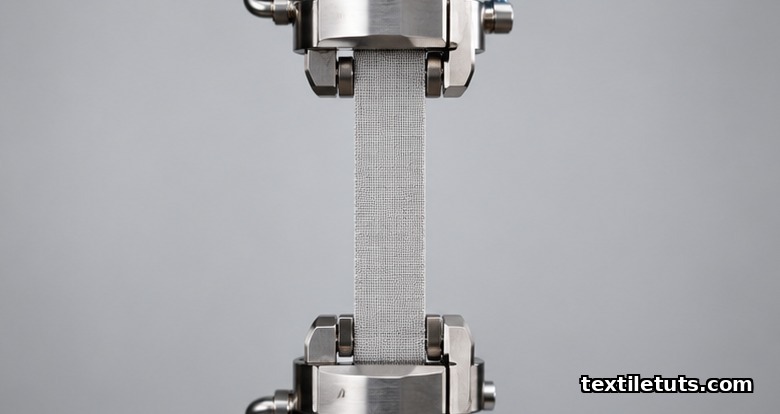
ISO 13934-1 (strip method) and ISO 13934-2 (grab method) measure the maximum tensile force and elongation of woven fabrics on a 50 mm wide specimen pulled at 100 mm/min with a 200 mm gauge length, while ISO 13935-1 and ISO 13935-2 apply the equivalent strip and grab procedures to knit fabrics using a shorter 100 mm gauge length to accommodate elongation that typically falls between 30% and 200%.
All four parts derive from the same universal testing machine principle, but the knit variants shorten the gauge length because knitted loops deform far more than woven yarn crimp before rupture.
This article walks through what each part specifies, why the parameters differ between woven and knit, how to prepare specimens, and what the results actually mean on a QC report.
What ISO 13934 and ISO 13935 Measure, and Why They Exist as Separate Standards
Tensile testing on fabrics reports two outputs: the maximum force the specimen resists before rupture, recorded in newtons, and the elongation at that maximum force, recorded as a percentage of the original gauge length. For woven constructions, ISO 13934-1:2013 specifies the strip method and ISO 13934-2:2014 specifies the grab method. For knit constructions, ISO 13935-1:2014 covers the strip method and ISO 13935-2:2014 covers the grab method.
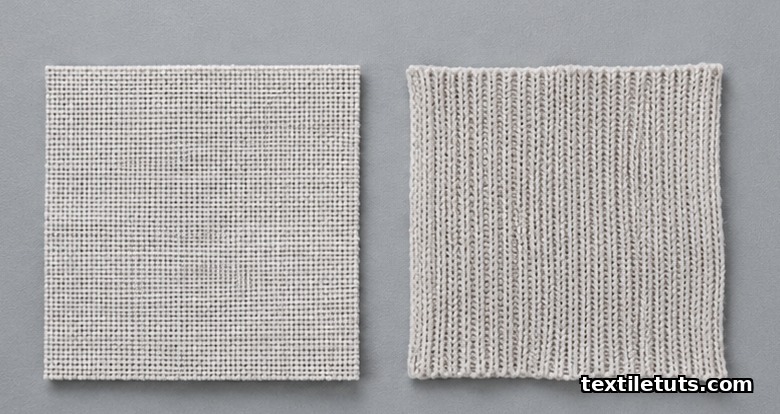
The reason knit fabrics get their own pair is mechanical. A woven fabric stretches mainly through yarn crimp interchange and lateral yarn compression, while a knit fabric stretches through loop distortion, yarn slippage at the loop crossover, and structural re-arrangement of the wales and courses. Knit elongation at break commonly runs between 30% and 200%, while woven elongation at break typically falls between 5% and 30% depending on yarn type, weave, and cover factor. Using the same 200 mm gauge length for both would either underestimate knit elongation or push the crosshead past the extensometer range before the specimen ruptures.
Both ISO 13934 and ISO 13935 sit inside the same ISO textile physical-mechanical-properties family and are harmonized with ASTM D5035 (strip method) and ASTM D5034 (grab method), so a lab that runs both sets can cross-reference results across continents without re-validating the methodology.
Strip Method vs Grab Method: What Changes Between the Two
The strip method clamps the full width of the specimen between two pneumatic jaws. ISO 13934-1 calls for a specimen 50 mm wide with a 200 mm gauge length for woven, and ISO 13935-1 specifies the same 50 mm width but a 100 mm gauge length for knit. The result reflects the strength of the yarns being pulled and the yarns in the gripped zone acting together.
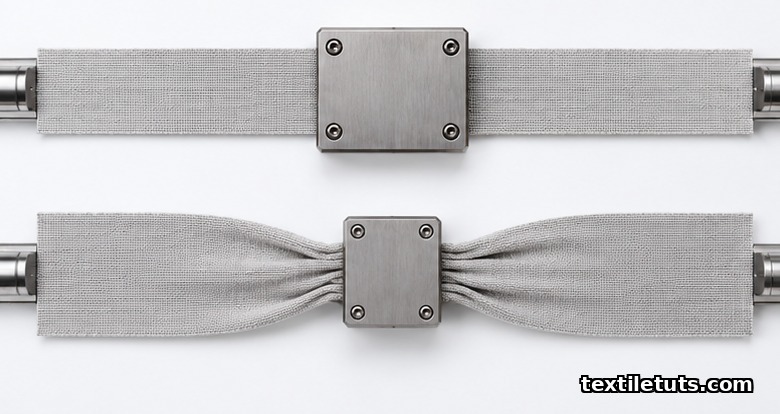
The grab method clamps only the central portion of the specimen, leaving the outer yarns free to gather and redistribute load. ISO 13934-2 specifies a 25 mm × 25 mm gripping area on a specimen at least 100 mm wide for woven, while ISO 13935-2 keeps a comparable central grip for knit. The grab method produces results that better simulate multi-directional stress in use, such as a seam pulled at a corner or a localized snag on the fabric surface.
Strip results typically run 10% to 30% higher than grab results on the same fabric, because the strip method puts the full specimen width under direct tension while the grab method only stresses the gripped yarns and lets the rest fold. Both standards report the same metric (maximum force in newtons), so they cannot be averaged or directly compared on the same fabric.
Test Parameters Common to Both Standards
The mechanical setup is identical across all four parts. A constant-rate-of-extension (CRE) tensile testing machine applies the load. The crosshead speed is 100 mm/min for both strip and grab methods, which keeps the strain rate consistent. The pretension applied to remove slack is 2% of the expected breaking force or 20 N, whichever is lower.
Specimens are cut to size using a die or template, with the long dimension parallel to the testing direction. For woven fabrics, ISO 13934 specifies cutting 5 specimens in the warp direction and 5 in the weft direction, then averaging the top-and-bottom 3 results to drop outliers. For knit fabrics, ISO 13935 follows the same 5-by-5 rule but tests along wales (lengthwise) and courses (crosswise) because those are the load-bearing axes of a knit structure.
Conditioning matters because fiber modulus is moisture-sensitive. ISO 13934 and ISO 13935 both reference ISO 139 for atmospheric conditioning, which fixes the laboratory at 20 °C ± 2 °C and 65% ± 4% relative humidity. Specimens should equilibrate for at least 24 hours before testing, particularly for cotton, wool, and regenerated cellulosics whose moisture regain shifts tensile behavior by 5% to 15%.
Why Knit Fabrics Use a 100 mm Gauge Length Instead of 200 mm
The shorter gauge length is not arbitrary. ISO 13935-1 sets the gauge at 100 mm because knitted specimens under a 200 mm gauge can elongate past 80% before rupture, which trips the 100% extensometer limit on most CRE machines. At 100 mm, the same absolute elongation reads as a higher percentage and stays inside the calibrated range, which keeps the test results comparable across labs.
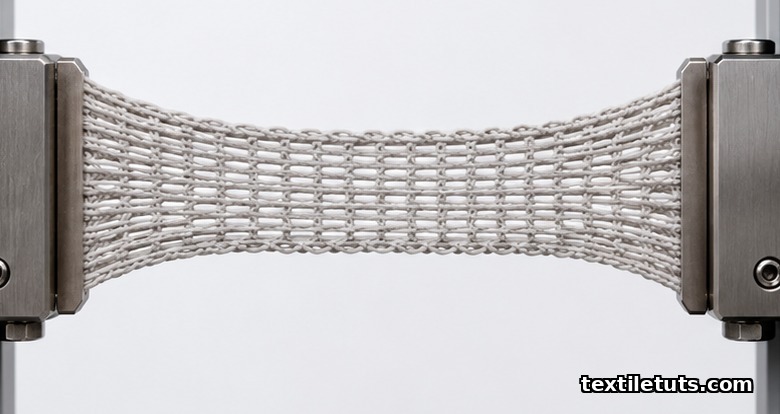
The standard also requires reporting elongation at maximum force, not just maximum force. For a typical single-jersey cotton knit, ISO 13935-1 strip tests report elongation values of 60% to 120% in the wale direction and 80% to 180% in the course direction. The same fabric tested by ISO 13934-1 parameters would simply rupture past the extensometer range before the test controller could capture the peak.
For testing laboratories that run both woven and knit work on the same tensile frame, the changeover involves swapping the gauge length pins and recalibrating the extensometer. Most modern CRE machines store both parameter sets as named methods, so the operator only selects “ISO 13934-1” or “ISO 13935-1” from the menu before the run.
Choosing Between the Two Standards for Your Application
End-use dictates the choice between strip and grab. Strip method (ISO 13934-1 or ISO 13935-1) is the right call when the failure mode being simulated is direct axial tension, such as a webbing strap, a load-bearing seam, or a unidirectional pull on a tarpaulin. The strip method is also the reference method for fabric specification sheets, because it produces a clean force-per-width number that can be compared against a minimum requirement on the buyer’s tech pack.
Grab method (ISO 13934-2 or ISO 13935-2) is the better choice when the failure mode is localized stress concentration, such as a stitch being pulled at a corner of a pocket, a buttonhole under load, or a fingertip snag on a knit sweater. The grab method reports a lower number than the strip method on the same fabric, but it captures the yarn interaction effect that the strip method misses.
For QC inspection on a production line, both ISO 13934 and ISO 13935 allow use of the grab method as a faster screening tool, because the specimen preparation is simpler and the result correlates with the strip method within ±10% on most woven constructions. For knit, the correlation is weaker because loop geometry dominates the result, so the strip method is preferred for QC on knit.
ISO 13934 vs ISO 13935: A Side-by-Side Comparison
| Parameter | ISO 13934-1 (Woven, Strip) | ISO 13934-2 (Woven, Grab) | ISO 13935-1 (Knit, Strip) | ISO 13935-2 (Knit, Grab) |
|---|---|---|---|---|
| Year of latest edition | 2013 | 2014 | 2014 | 2014 |
| Specimen width | 50 mm | 100 mm (grip 25 × 25 mm) | 50 mm | 100 mm (grip 25 × 25 mm) |
| Gauge length | 200 mm | 100 mm | 100 mm | 100 mm |
| Crosshead speed | 100 mm/min | 100 mm/min | 100 mm/min | 100 mm/min |
| Typical elongation range | 5–30% | 5–30% | 30–200% | 30–200% |
| Reported metric | Max force + elongation at max force | Max force only | Max force + elongation at max force | Max force only |
| Specimen count | 5 warp + 5 weft | 5 warp + 5 weft | 5 wale + 5 course | 5 wale + 5 course |
| Conditioning | ISO 139 (20 °C, 65% RH, 24 h) | ISO 139 (20 °C, 65% RH, 24 h) | ISO 139 (20 °C, 65% RH, 24 h) | ISO 139 (20 °C, 65% RH, 24 h) |
| ASTM equivalent | ASTM D5035 | ASTM D5034 | ASTM D5035 (modified gauge) | ASTM D5034 (modified gauge) |
Frequently Asked Questions
Is ISO 13935 just ISO 13934 applied to knits?
No. ISO 13935 is a separate standard with its own scope and parameters. The 100 mm gauge length (versus 200 mm for woven) and the wale/course specimen direction (versus warp/weft) are the two biggest departures. Both standards are part of the same ISO textile-physical-mechanical-properties family, but they cannot be cross-cited or used interchangeably without changing the test report.
Can I report grab and strip results on the same line of a fabric spec sheet?
No. Strip and grab methods measure different stress states, and the strip value typically exceeds the grab value by 10% to 30% on the same fabric. Spec sheets should specify one method and stick to it. If a buyer requests both, report them in separate rows labeled “Strip (ISO 13934-1)” and “Grab (ISO 13934-2)” so the numbers cannot be confused by the cutting room or the merchandising team.
What crosshead speed should I use for elastane-containing knits?
ISO 13935-1 fixes crosshead speed at 100 mm/min for all knit constructions, including elastane blends. If a fabric elongates more than 300%, the standard permits switching to a 50 mm gauge length on the same CRE machine to keep the test inside the extensometer range, but the deviation must be noted in the test report. The same deviation rule applies under ASTM D5035 for woven-spandex blends.
Why does my knit grab number look low compared to the woven grab number on a similar-weight fabric?
Knit specimens rupture at lower absolute force because the load is carried by fewer active yarns at any given moment in a loop structure, while woven specimens distribute the load across the full gripped width. A 180 gsm single-jersey cotton knit typically reports grab tensile of 150 N to 250 N in the course direction, while a 180 gsm plain-weave cotton reports grab tensile of 400 N to 600 N in the weft direction. The lower knit number is normal and does not indicate a quality problem.
Do ISO 13934 and ISO 13935 require a specific laboratory humidity?
Yes. Both standards reference ISO 139 for atmospheric conditioning, which fixes the lab at 20 °C ± 2 °C and 65% ± 4% relative humidity with a 24-hour equilibration. Skipping conditioning is a common audit finding and can shift tensile results by 5% to 15% on cellulosic fibers, so always condition the specimens for the full 24 hours before testing and document the conditioning time on the test sheet.
References
- International Organization for Standardization. ISO 13934-1:2013 — Textiles — Tensile properties of fabrics — Part 1: Determination of maximum force and elongation at maximum force using the strip method. iso.org — official ISO standard for woven fabrics, strip method.
- International Organization for Standardization. ISO 13934-2:2014 — Textiles — Tensile properties of fabrics — Part 2: Determination of maximum force using the grab method. iso.org — official ISO standard for woven fabrics, grab method.
- International Organization for Standardization. ISO 13935-1:2014 — Textiles — Tensile properties of fabrics — Part 1: Determination of maximum force and elongation at maximum force using the strip method (knitted fabrics). iso.org — official ISO standard for knit fabrics, strip method.
- International Organization for Standardization. ISO 13935-2:2014 — Textiles — Tensile properties of fabrics — Part 2: Determination of maximum force using the grab method (knitted fabrics). iso.org — official ISO standard for knit fabrics, grab method.
- ASTM International. ASTM D5034-21 — Standard Test Method for Breaking Strength and Elongation of Textile Fabrics (Grab Method). astm.org — harmonized grab-method equivalent used in North America.
- ASTM International. ASTM D5035-11 (Reapproved 2019) — Standard Test Method for Breaking Force and Elongation of Textile Fabrics (Strip Method). astm.org — harmonized strip-method equivalent used in North America.
- MDPI. Textiles (journal) — Tensile behavior of woven and knitted fabric reinforcements. mdpi.com — peer-reviewed study comparing tensile mechanics of the two fabric classes.
Editorial by Iftay Khairul Alam, TextileTuts. Sources: ISO 13934-1:2013, ISO 13934-2:2014, ISO 13935-1:2014, ISO 13935-2:2014, ASTM D5034-21, ASTM D5035-11, and the cited MDPI Textiles journal article as referenced above.


