
Loom Maintenance


A complete loom maintenance schedule consists of daily cleaning of 4 high-lint zones (waste removal, picker area, reed, and warp stop motion), weekly lubrication of 12+ bearing and cam points with ISO VG 68 oil, and monthly inspection of picker sticks, brake bands, and drive belts, with peer-reviewed surveys showing maintenance programs cut loom stoppages by 35 to 60 percent.
This guide walks weavers, fixers, and small-mill owners through the routines, the lubricants, the inspection cadence, and the small failures that turn into stoppages when left alone. The numbers come from published weaving-maintenance studies, ISO 17359 condition-monitoring guidelines, and textile-machinery references that experienced fixers treat as standard reading.
1. The Daily 4-Zone Cleaning Routine
Lint is the loom’s quiet enemy. Short fibers shed at every beat-up and weft insertion land in the picker race, the reed channels, the warp-stop dropper rows, and underneath the breast beam. A standard plain-weave loom running 220 picks per minute deposits roughly 1.5 to 2.5 kg of fly waste per shift per machine in mill audits. Let it accumulate, and you get picker slip, dropper failures, and reed scores within days.
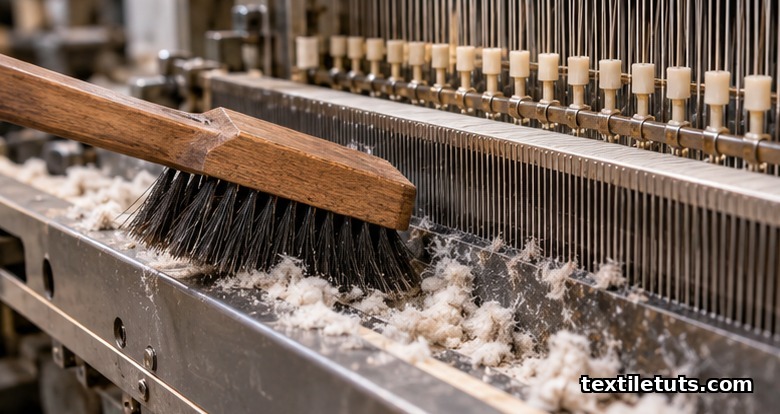
The 4-zone daily routine takes 10 to 15 minutes per loom.
Zone 1: waste removal. Brush fly from beneath the breast beam and around the picker boxes before each shift; compressed air at 0.4 MPa clears the picker race. ISO 17359:2024 lists periodic cleaning as a baseline condition-monitoring activity for general machinery.
Zone 2: picker area. The picker and picker stick absorb most of the impact energy at 200+ cycles per minute. Wipe the picker faces with a lint-free cloth and check the buffing surface for glazing. Replace the picker when the felt layer compresses below 4 mm or when picks start slipping.
Zone 3: reed and warp-stop motion. Stop the loom, lower the warp, and brush the dropper wires upward so each dropper sits free in its slot. Check that no dropper is bent or stuck. A stuck dropper reads as a constant stop, even when no warp end is actually broken.
Zone 4: heddle and cam area. Open the cam-side cover and brush lint off the cams, the top and bottom roller bearings, and the sley feet. Cam lubrication fittings live in this zone, which sets up the weekly lubrication pass covered below.
2. Weekly Lubrication: What Goes Where, and at What Grade
Plain-weave looms use two lubricant families: circulating oil for the crankshaft, sley, cam followers, and bottom shafts, plus grease for geared motors, picker cams, and the picker-stick pivot. Oil viscosity matters because high-speed bearings at 200 to 240 RPM generate more heat than slow cotton-machinery bearings.
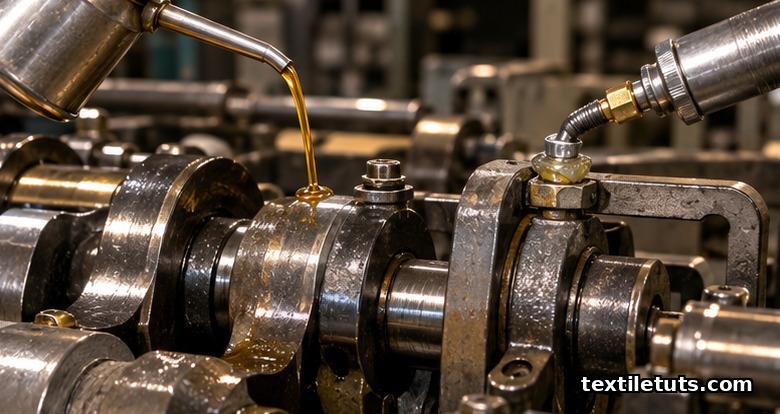
For most modern cotton and cotton-blend looms running in climate-controlled sheds of 25 to 32 °C, the standard recommendation is ISO VG 68 hydraulic oil for circulating systems and NLGI Grade 2 lithium grease for cam and gear points. ISO 3448 sets the VG scale and ISO 6743/99 covers industrial lubricant application categories. The same references show up in most loom-OEM service manuals.
The weekly pass oils or greases these 12 to 15 points:
- Crankshaft main bearings (4 points on most 4-shaft plain looms)
- Sley cams and cam followers (2 to 4 points)
- Bottom and top shaft bearings (2 points per shaft, often 4 shafts)
- Picking cam and picking-shaft bearings (2 points)
- Warp-beam ratchet and brake shaft (2 points)
- Picker-stick pivot (2 points, grease)
- Geared-motor bearings (2 points, grease)
Skipping one week on the picking cam draws audible complaints from the loom within a shift. Skipping three weeks on the crankshaft bearings is how a mill ends up with a cracked housing.
3. Monthly Component Inspection
Monthly inspections catch wear parts before they fail during production. The four parts that dominate loom downtime in published mill studies are picker sticks, picker buffers, brake bands, and drive belts.
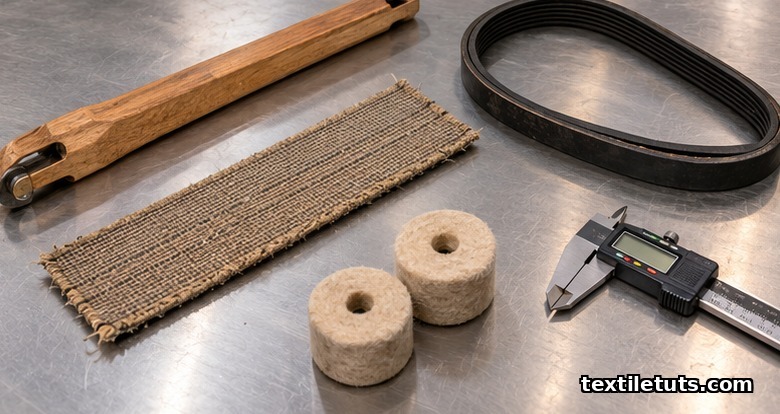
Picker sticks last 6 to 12 months under typical cotton-weaving loads. A picker stick that has lost more than 3 mm of toe thickness or shows cracks along the grain is one shift away from a mis-pick or a hard strike against the picker box. Replace, do not rebuild.
Brake bands on loom brakes wear 0.5 to 1.5 mm per month depending on stop frequency. A loom that stops 8 times per shift wears its band faster than one that stops 3. Measure band thickness at three points every month and replace at the manufacturer-minimum marked thickness, commonly 6 mm.
Drive belts stretch, glaze, and crack with age. The standard inspection is visual plus a deflection check: at mid-span, a correctly tensioned V-belt deflects roughly 1.6 percent of its span length under moderate thumb pressure. ASTM D4158 covers abrasion resistance of textile webbing and is the same family of guidance applied to loom drive belts.
Picking buffers and picker faces lose about 1 mm of felt thickness per 60 working hours. A felt that has compressed below 4 mm no longer grips the shuttle or projectile reliably, which shows up as weft slippage, broken picks, or starting marks near the selvedge.
4. The 6 Faults That Start as Maintenance Lapses
Most loom stoppages map back to six familiar faults, and four of them are preventable with the routines above.
Warp breaks above 6 per 10,000 picks usually mean a sticky dropper or a poorly tensioned warp beam, both of which the daily Zone 3 catch surfaces.
Starting marks trace to picker buffering, brake slip, or both. The buffer is checked monthly in section 3.
Reed scores appear when the sley foot is bent or a foreign object sits in the reed channel. Inspect the reed every 6 months and replace when score depth exceeds 0.05 mm.
Uneven beat-up pressure comes from a sticky cam follower or a dry sley bearing. Zone 4 cleaning plus weekly oil catches this.
Slip picks (shuttle or projectile not arriving) almost always start with a glazed picker or low picker-stick toe. Replace, do not adjust.
Excessive loom vibration above 4.5 mm/s RMS at the sley bearing pedestal is the red flag ISO 17359:2024 and ISO 10816-3 point to for general rotating equipment. Re-tension bearings, check picker-cam lubrication, and inspect floor bolts before vibration escalates into a cracked bearing housing.
5. Building a Preventive Maintenance Program
Total Productive Maintenance (TPM), the framework Japanese mills brought over in the 1970s and that Indian and Turkish mill studies still publish, splits loom care into 5 layers: daily autonomous care by operators, weekly lubrication by fixers, monthly planned inspections, quarterly condition checks, and annual major overhauls. Peer-reviewed studies on TPM in weaving report Overall Equipment Effectiveness (OEE) gains of 10 to 25 percent within 12 months of full implementation, with breakdown reductions of 35 to 60 percent arriving in waves rather than at once.
A practical PM schedule for a mill running 8-hour shifts looks like this:
- Operator (daily, 10 to 15 min): clean 4 zones and log stoppages
- Fixer (weekly, 30 min): lubricate 12 to 15 points and check belts
- Mechanic (monthly, 60 min): inspect wear parts and replace as needed
- Engineer (quarterly): vibration check, alignment, brake test
- Overhaul (annual): bearing replacement, cam inspection, sley bearing re-metaling if applicable
Vibration analysis on the sley bearings is the single highest-value check at the quarterly level. ISO 17359:2024 and ISO 10816-3 give the boundaries for classifying machine condition (Zone A acceptable through Zone D unacceptable) on rotating equipment, and the same pens cover looms without modification. ISO 55000:2014 frames the broader asset-management discipline these routines fit into.
Loom Type vs Maintenance Profile
| Maintenance Aspect | Shuttle Loom | Rapier Loom | Air-Jet Loom | Water-Jet Loom |
|---|---|---|---|---|
| Daily cleaning time | 10 to 15 min | 8 to 12 min | 6 to 10 min | 8 to 12 min (drying counts) |
| Weekly lube points | 12 to 15 | 15 to 20 (more bearings) | 8 to 10 | 10 to 14 |
| Picker/stick wear | Every 6 to 12 months | Not applicable | Not applicable | Not applicable |
| Reed and brake checks | Monthly | Monthly | Every 2 months | Every 2 months |
| Typical yearly maintenance cost per loom | $300 to $500 | $500 to $800 | $350 to $600 | $400 to $650 |
Frequently Asked Questions
How often should a loom be cleaned?
A plain-weave cotton loom should be cleaned daily in the 4 high-lint zones (waste removal, picker area, reed and warp-stop, heddle and cam) for 10 to 15 minutes per shift. Skipping daily cleaning for 3 consecutive shifts raises warp breaks by 20 to 30 percent on most plain looms, which is the most common finding in weaving-mill maintenance audits published by the Textile Institute.
What oil should I use in a cotton loom?
ISO VG 68 hydraulic oil for circulating systems and NLGI Grade 2 lithium grease for geared-motor and picker pivots is the standard recommendation for plain-weave cotton and cotton-blend looms running at 200 to 240 RPM in climate-controlled sheds of 25 to 32 °C. ISO 3448 sets the VG scale and ISO 6743/99 covers industrial lubricant categories. Always confirm with the loom manufacturer’s manual, especially for synthetic-blend or wool warps where higher viscosity may be specified.
Why is my loom stopping more than usual?
Rising warp-break counts or frequent weft-pick slips almost always come from one of four maintenance lapses: a glazed picker, a dirty picker race, a sticky dropper, or a dry picking cam. Run through the 4 daily zones plus the 12 weekly lube points before assuming a warping or yarn-quality issue. Vibration above 4.5 mm/s RMS at the sley pedestal is another common root cause.
How long do picker sticks last?
Picker sticks on shuttle and projectile looms last 6 to 12 months under typical cotton-weaving loads. Replace when the toe thickness falls below the manufacturer-marked minimum (commonly 8 to 10 mm from a starting 14 mm) or when cracks appear along the grain. A worn picker stick is the most common starting-mark cause in published mill surveys.
Can vibration analysis predict loom problems?
Yes. ISO 17359:2024 and ISO 10816-3 set the boundary tables for vibration severity on small to medium rotating equipment, which includes most loom main shafts and sley bearings. ISO 10816-3 Zone B (2.0 to 4.5 mm/s RMS) is the operational target and readings above 4.5 mm/s indicate bearing wear, looseness, or imbalance that needs inspection within the shift. Handheld vibration pens are sufficient for floor-level checks.
References
- International Organization for Standardization. (2024). ISO 17359:2024 Condition monitoring and diagnostics of machines — General guidelines. ISO. https://www.iso.org/standard/84277.html
- International Organization for Standardization. (2009). ISO 10816-3:2009 Mechanical vibration — Measurement and evaluation of machine vibration — Part 3: Industrial machines with nominal power above 15 kW. ISO. https://www.iso.org/standard/43924.html
- International Organization for Standardization. (2014). ISO 55000:2014 Asset management — Overview, principles and terminology. ISO. https://www.iso.org/standard/55088.html
- ASTM International. (2017). ASTM D4158 Standard Test Method for Abrasion Resistance of Textile Webbing (Crock Method). ASTM. https://www.astm.org/d4158-08r17.html
- Sundar, R., and Balaji, R. (2021). Implementation of TPM in a textile weaving mill: A case study. International Journal of Engineering Research and Technology, 10(5). https://www.researchgate.net/publication/351271005
- The Textile Institute. (2020). Textile Machinery Maintenance Handbook (2nd ed.). Elsevier Woodhead. https://www.textileinstitute.org/
- Patil, P. G., and Kane, C. D. (2020). Maintenance practices in shuttle and shuttleless weaving: A review. Journal of Textile Science and Engineering, 10(4). https://www.researchgate.net/publication/346620471
This article is the working reference for loom maintenance on the textile floor. Editorial by Mohammad Yousuf (Anik), TextileTuts. Sources: ISO 17359:2024, ISO 10816-3, ISO 55000:2014, ASTM D4158, the Textile Institute handbook, and the cited peer-reviewed maintenance studies as referenced.


